
Transferability & Owner Dependency
How to Reduce Owner Dependency: Engineering a Transferable Asset
Your business is not a true asset if it cannot survive your absence; it's merely a high-stakes job that you happen to own. For the dedicated founder, the realization that the enterprise’s value is tied entirely to their personal presence can be a source of profound anxiety. This concern is grounded in reality, as businesses with high owner dependency often face valuation discounts of 20% to 50% during a transition. Understanding how to reduce owner dependency is not just a management shift. It's a deliberate act of engineering a transferable legacy that holds its form and value regardless of who sits in the primary chair.
We recognize that you view your company as more than a series of transactions. It's a living entity that requires a structured path toward independence. You've likely felt the exhaustion of being the sole decision-maker and the frustration of a team that lacks the strategic capacity to lead. In this guide, we'll provide strategic clarity on the Value Gap and the framework needed to transition from a founder-centric operation to a self-sustaining enterprise. You'll discover how to maximize enterprise value and achieve exit readiness by treating your business as a masterpiece of precision. We'll explore the steps to transform your daily involvement into a lasting, transferable asset that thrives on its own merit.
Key Takeaways
- Recognize how founder-centric operations create an invisible ceiling on valuation and why being the primary "rainmaker" can devalue your enterprise.
- Gain strategic clarity on how to reduce owner dependency by identifying structural vulnerabilities through the lens of Enterprise Diagnostics.
- Explore the framework of Transferability Engineering to transform your business into a self-sustaining entity that preserves its essence without your presence.
- Implement a structured Value Growth Roadmap to transition your daily focus from tactical execution to the long-term stewardship of a transferable asset.
- Understand how an Exit Readiness Assessment serves as the foundation for coordinating your professional advisors toward a successful and secure future transition.
The Invisible Ceiling: Why Owner Dependency is the Ultimate Value Killer
Owner dependency is the quiet gravity that prevents a business from ascending to its true potential as a transferable masterpiece. It represents a structural reliance on the founder for the rhythmic pulse of daily operations, strategic sales, or specialized technical mastery. While this hands-on approach often sparks early growth, it eventually hardens into an invisible ceiling that limits both scale and worth. For those seeking how to reduce owner dependency, the journey begins by acknowledging the "Rainmaker Trap." If you're the only individual capable of closing high-value contracts, the business effectively loses its essence the moment you step away. A buyer isn't seeking to purchase your personal heroics; they're looking for a self-sustaining engine.
This reliance creates a profound Value Gap. This gap is the distance between the current market price of a founder-centric business and the maximum potential value of a truly independent enterprise. To bridge this divide, we must view the business as a living entity that possesses a soul and a structure of its own. A robust Succession planning process ensures that vital functions are distributed across systems and leadership teams, rather than being locked within a single mind. By treating the enterprise as a work of engineering rather than a personal extension, you begin to build an asset that can thrive for generations.
The Distinction Between a Job and a Transferable Asset
Many owners operate within a "Hub and Spoke" model where every decision, no matter how granular, must pass through them at the center. While this ensures immediate control, it signals extreme risk to any sophisticated buyer. They aren't looking to purchase a grueling 80-hour work week; they're seeking to acquire a machine that produces predictable, documented results. True enterprise value is found in the transition from "cash flow now" to a business that generates wealth through its own internal momentum. Shifting your focus toward how to reduce owner dependency transforms your role from a necessary operator into a strategic architect.
The Psychology of the Founder-Centric Enterprise
Relinquishing control is rarely a technical hurdle; it's an emotional evolution. Founders often grapple with a fear of irrelevance or a concern that the company's standards will erode without their direct supervision. This refusal to settle for anything less than perfection often creates the very bottleneck that stifles the company's future. We reframe this transition as an act of stewardship. By empowering a team and refining processes, you aren't walking away from your creation. You're preserving its history and ensuring its survival. It's a deliberate shift that requires the courage to trust the systems you've engineered to protect your legacy.
Diagnosing the Burden: Identifying Single Points of Failure
Before an artisan can restore a masterpiece, they must first understand the structural integrity of the canvas. In the context of an enterprise, this requires a rigorous phase of Enterprise Diagnostics. It's a process that moves beyond the surface level of financial statements to uncover the hidden fractures that threaten transferability. Many owners rely on internal intuition, believing they have a pulse on every department. However, intuition is often clouded by the very proximity that created the dependency. An objective, external assessment is the only way to reveal the "Value Killers" that reside within the daily rhythm of the business.
Determining how to reduce owner dependency requires more than a cursory glance at the balance sheet; it demands a Vulnerability Audit. We often ask a singular, provocative question: where does the business break if the creator is absent for 90 days? If the gears stop turning or the revenue stream dries up, you don't own a transferable asset. You own a sophisticated set of tasks that require your constant energy to survive. Evaluating these risks through Enterprise Diagnostics allows an owner to move from a place of uncertainty to one of strategic clarity, identifying exactly where the foundation needs reinforcement.
Operational Dependencies: The SOP Deficit
A significant portion of a company's essence often exists as "tribal knowledge" locked within the owner's mind. This unspoken lore creates a dangerous ceiling on growth because the team cannot execute with precision without constant guidance. When systems require the owner's granular intervention to function, the business lacks the autonomy required for a high-value transition. The absence of documented, standard operating procedures (SOPs) means the business cannot breathe on its own. True transferability is found when the process, not the person, dictates the quality of the output.
Relationship Dependencies: Sales and Vendor Concentration
If the brand's identity is inseparable from the founder's personal relationships, the enterprise is inherently fragile. Relationship dependency occurs when the owner is the sole keeper of key client or vendor connections. This concentration risk is a major red flag for buyers, as it suggests a 15% to 25% customer attrition rate within the first year of a sale if the owner departs. You must assess whether your clients are loyal to the company's results or merely to your personality. Engineering a transferable asset requires shifting these vital connections from a single point of failure to a robust, institutionalized framework that endures long after the founder has exited the room.
Engineering Transferability: Building a Business That Breathes on Its Own
Engineering transferability is the deliberate act of designing an organization to exist as a self-sustaining entity. It is the rare intersection where technical engineering meets creative leadership. To master how to reduce owner dependency, one must transition from being the primary engine of the business to becoming its architect. This shift requires moving from an owner-led model, where momentum depends on your personal output, to a management-led structure. Here, the enterprise functions with a rhythmic grace that remains undisturbed by your absence. It is about building a legacy that holds its value because its performance is hardcoded into its structure. This process isn't a sudden detachment. It's a thoughtful calibration of the business's internal mechanics that ensures the essence of the work remains intact.
Strategic Capacity Evaluation: Can Your Team Lead?
Before a team can lead, their potential must be measured with surgical precision. A Strategic Capacity Evaluation goes beyond reviewing resumes; it assesses the collective ability of your leadership to execute a vision without constant oversight. Many organizations are filled with "doers" who wait for instruction. To create a transferable asset, you must cultivate "thinkers" who own their domains with the dedication of a master artisan. This transition empowers your staff to protect the company's essence. It ensures that the high standards you've established aren't just maintained but are evolved by those who understand the intricate mechanics of your success. By identifying these leaders early, you reduce the risk of a value collapse when you eventually exit.
Systematizing Success Through Precision SOPs
Standard Operating Procedures (SOPs) are often dismissed as dry documentation, but we view them as the DNA of the enterprise. They're the blueprints that ensure consistency and preserve the company’s history for a future steward. A master artisan makes the complex feel effortless, and your systems should do the same for a future successor. When success is systematized, the business becomes a predictable machine rather than a series of improvised acts. These documented systems serve as a permanent Value Growth Roadmap, providing a clear path for future owners to follow. By capturing the nuances of your process, you ensure that the company’s excellence isn't a fleeting moment but a permanent, transferable trait. This documentation is the final step in proving that the business’s performance is independent of its creator’s daily touch.
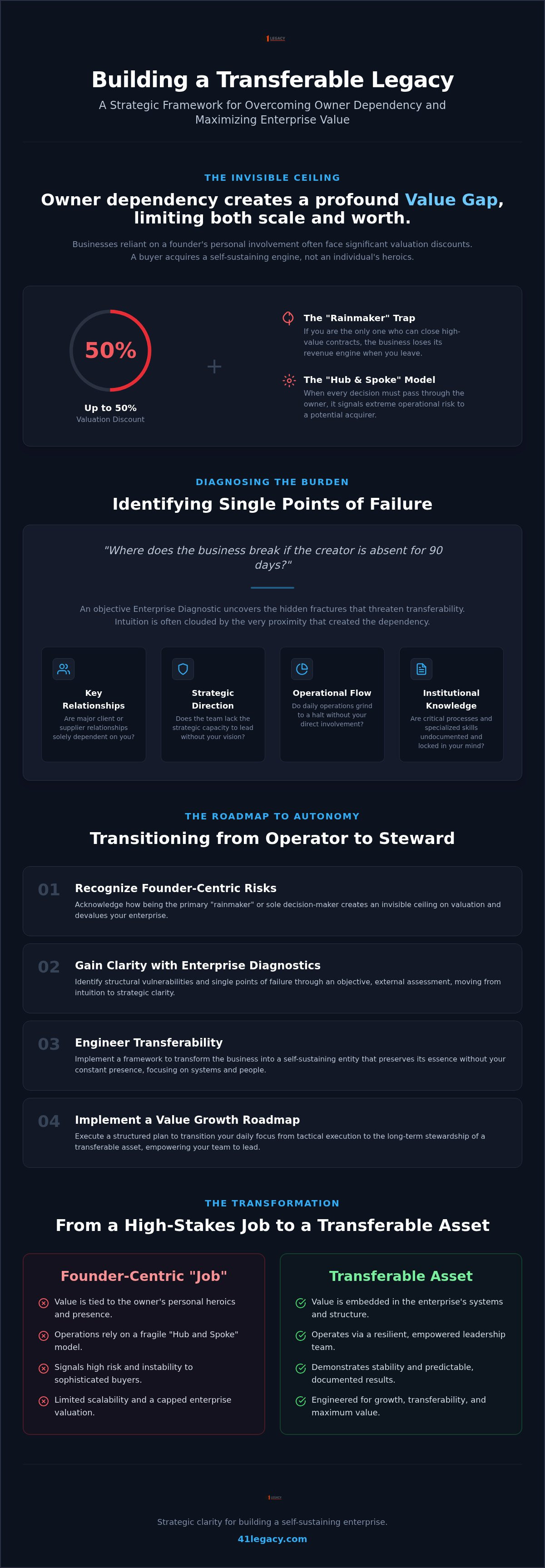
The Roadmap to Autonomy: Shifting from Operator to Steward
The transition from an active operator to a visionary steward is not a single event; it's a deliberate, unhurried progression. This journey is guided by a structured Value Growth Roadmap, which serves as the master blueprint for your company's evolution. Mastering how to reduce owner dependency requires a steady rhythm of implementation that respects the historical significance of your work while preparing it for a future without your daily touch. We act as the "Quarterback" in this process, ensuring your CPAs, attorneys, and other professional advisors are perfectly aligned with this strategic vision. This coordination prevents the friction that often stalls transition readiness, allowing you to rise above tactical fires to a position of high-level strategic oversight. It is a process of refining the enterprise until it possesses the clarity and poise of a finished work of art.
The Phased Transition of Authority
A successful shift in leadership occurs in three distinct, carefully managed stages. The first is the Decoupling Phase. During this period, we systematically separate the founder from high-frequency, low-value tasks that consume strategic capacity and create operational bottlenecks. This is followed by the Delegation Phase, where critical decision-making power is transferred to a leadership team equipped with the precision to uphold your standards. The final stage is the Stewardship Phase. In this state, you are no longer the engine of the business; you are the guardian of its essence. You ensure the enterprise remains true to its core philosophy while allowing the management-led structure to drive daily performance. This phased approach ensures that the company’s internal harmony is preserved even as the seat of power shifts.
Implementing Accountability via Monthly Support
Strategic drift is the silent enemy of transferability. Even the most well-engineered plans can falter without a consistent pulse of accountability. To maintain momentum, we utilize Monthly Implementation Support as the primary antidote to stagnation. This structured cadence ensures that the goals established in your roadmap are met with surgical precision and that every advisor is pulling in the same direction. Regular diagnostics serve as a mirror, reflecting our progress in how to reduce owner dependency while simultaneously increasing the measurable enterprise value. This coordinated effort between the owner and the advisory team transforms the business into a living entity that breathes on its own. To begin this transformation and secure your legacy, we invite you to establish your baseline through our Value Growth Roadmap and take the first step toward true autonomy.
Securing the Legacy: How 41 Legacy Orchestrates Your Independence
The final movement in the symphony of business ownership is the transition from creator to legacy holder. At 41 Legacy, we don't merely offer advice; we orchestrate your independence. We serve as the "Quarterback" for your entire professional team, ensuring that every strategic move aligns with the ultimate goal of transferability. This level of coordination is essential because a business that remains tethered to its founder is a business with a finite lifespan. By focusing on how to reduce owner dependency, we help you transform your enterprise into a living entity that carries its value forward without your constant intervention. We refuse to settle for anything less than a business that stands as a true, transferable asset.
Aligning the Advisory Team for Enterprise Growth
Strategic clarity is often lost when advisors operate in silos. Your CPA may focus on tax mitigation, while your attorney focuses on risk, yet neither may be looking at the enterprise through the lens of exit readiness. We elevate the conversation to a "professional-room altitude," where sophisticated planning takes place in a unified environment. By coordinating these efforts, we ensure that every decision made today contributes to the long-term health and growth of the enterprise. This holistic approach removes the friction from the transition process, allowing you to focus on the higher-level stewardship of your company's essence. It ensures that the technical precision of your advisors is harmonized with your artistic vision for the future.
The Exit Readiness Assessment as a Strategic Compass
Every masterpiece begins with an understanding of the medium. The Exit Readiness Assessment is the strategic compass that provides this essential baseline. It's a comprehensive diagnostic that evaluates everything from current market valuation to granular transferability scores. This isn't a mere checklist; it captures the very essence of your business's current state and highlights the specific "Value Killers" that must be addressed. Knowing how to reduce owner dependency requires this level of surgical precision to identify where the foundation is strong and where it requires reinforcement. It provides the data necessary to move from a place of uncertainty to a position of absolute confidence.
It's time to view your business not just as a source of income, but as a masterpiece of engineering that deserves to endure. You've spent years building something of substance. Now, ensure it has the structural integrity to thrive independently. Discover your path to a transferable asset with an Exit Readiness Assessment and begin the process of securing your legacy today. By building an enterprise that breathes on its own, you aren't just preparing for an exit. You're honoring the history of what you've created.
The Architecture of a Lasting Legacy
Building a business that breathes on its own is the ultimate expression of professional stewardship. You've discovered that owner dependency isn't just a management hurdle; it's a structural defect that prevents your enterprise from reaching its true valuation. By implementing a structured Value Growth Roadmap and refining your leadership's strategic capacity, you bridge the Value Gap. This transformation ensures the company’s essence remains intact long after your daily involvement has ceased. Understanding how to reduce owner dependency is the essential first step in engineering a masterpiece that holds its form through any transition.
Our team, led by Certified Exit Planning Advisors (CEPA), utilizes a rigorous Enterprise Diagnostics process to identify and resolve single points of failure. We act as the strategic "Quarterback" for your advisory team, harmonizing the efforts of your CPAs and attorneys to protect your legacy. Don't settle for a business that is merely a personal extension of yourself. Begin Your Journey Toward a Transferable Asset and ensure your creation continues to thrive with the precision and grace it deserves. Your legacy is waiting to be secured.
Frequently Asked Questions
What is the most common sign of owner dependency in a mid-sized business?
The most visible indicator of owner dependency is the "Hub and Spoke" operational model, where every critical decision requires the founder's direct intervention. If the enterprise cannot function profitably for 90 days in your absence, the business lacks the structural autonomy required for a successful transition. This reliance often manifests as a team that executes tasks with precision but lacks the strategic capacity to lead without constant oversight.
How long does it typically take to reduce owner dependency to a level that satisfies a buyer?
Engineering a truly transferable asset is a multi-year endeavor that typically requires a three to five-year horizon. This timeframe allows for the unhurried implementation of a Value Growth Roadmap, ensuring that new leadership and systems are tested and refined. Rushing this process often results in a fragile structure that sophisticated buyers will view as a significant risk during their due diligence.
Does reducing my involvement in the business mean I have to retire immediately?
Reducing your daily involvement doesn't mandate an immediate exit or retirement. Instead, it transitions your role from a tactical operator to a visionary steward, allowing you to focus on the high-level essence of the business. By learning how to reduce owner dependency, you gain the freedom to choose your level of engagement while simultaneously maximizing the enterprise's future value.
Can standard operating procedures (SOPs) really increase the actual sale price of my company?
Documented standard operating procedures directly influence the final sale price by reducing the buyer's perceived risk. Businesses with strong management teams and documented systems often command EBITDA multiples that are 0.5x to 2.0x higher than their owner-dependent peers. These systems serve as the DNA of the company, proving to a successor that the business's excellence is repeatable and independent of the creator.
What is the difference between a business broker and an exit planning advisor like 41 Legacy?
While a business broker focuses on the transaction itself, 41 Legacy serves as a strategic advisory firm dedicated to Transferability Engineering. We act as the "Quarterback" for your professional team, using structured Enterprise Diagnostics to build value long before a sale is initiated. Our focus is on the long-term health and structural integrity of the asset rather than the immediate brokerage of a deal.
Why is my CPA or attorney not already addressing owner dependency as part of my planning?
Most CPAs and attorneys are specialists focused on tax mitigation or legal compliance rather than the holistic engineering of enterprise value. They operate within specific silos that, while vital, don't naturally address how to reduce owner dependency as a core business objective. Our role is to coordinate these specialists, ensuring their technical expertise is aligned with a comprehensive strategy for transferability.
What happens to the company's value if the owner is still the primary 'Rainmaker' at the time of sale?
If the owner remains the primary "Rainmaker" at the time of sale, the business often faces a valuation discount of 20% to 50%. Buyers recognize that the revenue stream is tied to a personal relationship rather than a transferable process, leading to high attrition risks. This dependency typically results in multi-year earn-outs or seller financing, as the buyer seeks to mitigate the danger of the business collapsing upon the founder's departure.
Disclaimer
This article is for educational and informational purposes only and does not provide legal, tax, investment, or business brokerage advice. 41 Legacy does not offer M&A brokerage services, legal document drafting, tax preparation, or investment advisory services. Business owners should consult licensed professionals in those disciplines before making decisions related to business transactions, legal matters, tax strategy, or financial planning. All examples are illustrative and may not apply to your specific situation.