
How to Protect Your Business from Key Person Risk
What would happen if the person who manages a critical client relationship, makes an essential decision, or keeps a key process moving became unavailable tomorrow? Knowing how to protect your business from key person risk starts with identifying where the business relies on individual knowledge instead of repeatable systems. Vulnerabilities may sit with a founder, a trusted employee, or someone whose expertise has never been documented.
Relying on capable people is normal. But when essential work cannot continue without one person, the business faces more than an operational disruption. Its transferability and long-term value may also be affected.
This article explains how to identify and prioritize critical-person dependencies, reduce bottlenecks through practical operating changes, and prepare for continuity when roles change. It covers documenting essential processes, sharing client knowledge, cross-training, and planning for key decisions, all as part of a broader approach to transferability. At 41 Legacy, Enterprise Diagnostics and a Value Growth Roadmap help owners clarify priorities and strengthen a business so it can thrive beyond any one individual.
Key Takeaways
- Map critical work, decisions, relationships, and information to reveal where continuity depends on one person.
- Rank each dependency by the disruption an absence could cause, then focus first on the most consequential gaps.
- Reduce key person risk with a combination of practical measures, including cross-training, documented procedures, and shared relationships.
- Turn priorities into a phased plan with a responsible owner, realistic milestones, and regular reviews.
- Use Enterprise Diagnostics to connect owner-dependency reduction with broader transferability and enterprise-value priorities.
What key person risk means for your business, and how to recognize it
Key person risk is the possibility that a business’s performance or continuity will be materially disrupted because essential knowledge, decisions, or relationships depend on one individual. This key person risk definition points to a practical issue: the exposure lies not in a person’s importance alone, but in what the business cannot readily continue without them.
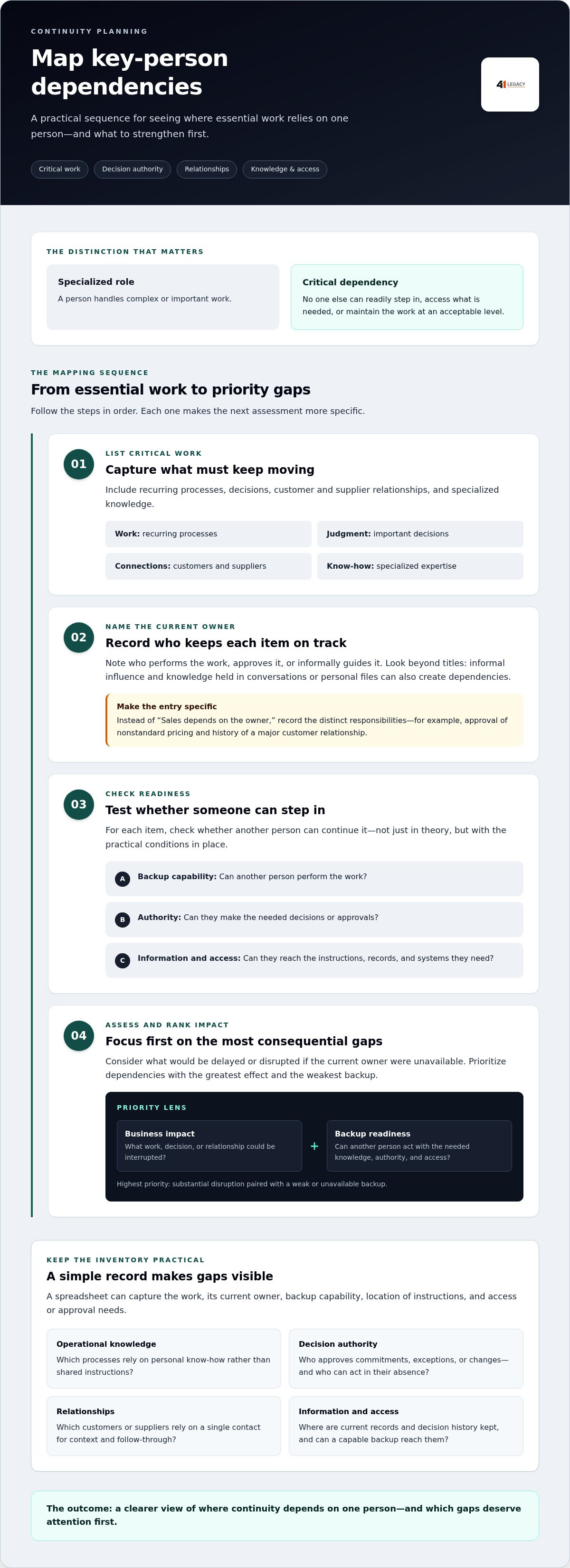
Specialization is normal. A technical lead may handle complex work, or a founder may guide major decisions. A critical dependency exists when no one else can step in, access the necessary information, or maintain the work at an acceptable level. The distinction is whether the role is specialized or whether the business has a single point of interruption.
The effects can reach beyond a missed task. Delayed approvals can slow operations. A relationship known only to one person may leave customers unsure where to turn. Undocumented judgment can make consistent decisions harder. These weaknesses can also affect transferability. A business is harder to understand and continue when essential knowledge and connections remain personal rather than embedded in its operating structure. That may influence how others view its resilience and enterprise value.
Which people and responsibilities can create a critical dependency?
Look beyond the organization chart. Founders and executives may hold decision authority, while revenue leaders, technical specialists, or relationship holders may control important customer, supplier, or operational knowledge. A person’s title is only a starting point. Identify the specific work they perform, the information they hold, and the decisions they shape.
Informal influence matters, too. A team member may resolve exceptions without formal approval, or only one employee may know how a system behaves under unusual conditions. If that knowledge lives in conversations, personal files, or memory rather than shared systems, the dependency may be less visible but still consequential.
Warning signs that too much depends on one person
Notice what stalls when an owner or key employee is unavailable. Do customer questions wait for one person? Do routine decisions repeatedly escalate to the same leader? Are exceptions handled through private messages, or do colleagues lack the context to continue a process?
- Approvals pause because no one else has clear authority.
- Customer or supplier relationships are managed through a single contact.
- Colleagues can’t locate current procedures, access, or decision history.
- Work depends on repeated exceptions that only one person knows how to resolve.
These signs are prompts for assessment, not proof that a business is failing. Record the affected work, who can currently perform it, and what would be delayed if that person were unavailable. This gives owners a clearer starting point for how to protect your business from key person risk, without confusing individual expertise with an unmanageable dependency.
How to map key person dependencies across knowledge, decisions, and relationships
A dependency map turns a broad concern into a practical view of where continuity relies on one person. It helps distinguish a specialized role from a business function with no ready backup. The aim isn’t to make every employee interchangeable. It’s to see where an absence could interrupt important work and identify what the business needs to strengthen first.
Use a repeatable sequence:
- List critical work. Include recurring processes, decisions, customer and supplier relationships, and specialized knowledge.
- Name the current owner. Record who performs, approves, or informally guides each item.
- Check readiness. Identify whether another person can step in, has the authority to act, and can access the necessary instructions and records.
- Assess and rank impact. Consider what would be delayed or disrupted, then prioritize dependencies with the greatest effect and weakest backup.
Build a practical key person dependency inventory
Keep the inventory simple enough to maintain. A spreadsheet can capture the work, its current owner, backup capability, location of instructions, and any access or approval needs. Include knowledge that sits outside formal procedures, such as how a specialist resolves unusual technical issues or how a relationship holder manages a customer’s expectations. Guidance on identifying key persons in your business also emphasizes looking beyond senior titles.
- Operational knowledge: Which processes rely on personal know-how rather than shared instructions?
- Decision authority: Who approves commitments, exceptions, or changes, and who can act in their absence?
- Relationships: Which customers or suppliers rely on a single contact for context and follow-through?
- Information and access: Where are current records, system details, and decision history kept, and can a capable backup reach them?
Be specific. “Sales depends on the owner” is hard to act on. “Only the owner approves nonstandard pricing and holds the history of a major customer relationship” identifies two distinct dependencies with different solutions.
Prioritize exposure by business impact and readiness
Not every single-person dependency deserves the same urgency. Consider whether an interruption could affect continuity, customer service, execution, or the business’s ability to pursue its priorities. Then assess the backup: is someone prepared, authorized, and equipped with the relevant knowledge? A named backup without access or decision authority may not provide meaningful coverage.
Prioritize bottlenecks that combine substantial disruption with little practical backup. A specialist task that can wait may be less urgent than a routine approval that holds up customer commitments each week. Revisit the ranking as roles, systems, and priorities change.
This inventory gives owners a clearer basis for how to protect your business from key person risk and strengthen transferability over time. For owners connecting these findings to broader exit planning and business readiness, 41 Legacy’s strategic guidance helps frame dependencies within the wider picture of a transferable enterprise.
Compare ways to reduce key person risk without relying on one safeguard
Reducing dependency usually takes a combination of operating changes. Each safeguard addresses a different weakness. A procedure can preserve steps, but not necessarily judgment. A backup can learn a task but still lack authority. Financial protection may help address certain financial consequences without keeping work moving. The right mix depends on what the dependency map reveals and how the business operates.
Operational safeguards that make essential work repeatable
Choose measures based on the gap you need to close. If only one person can complete a recurring process, document the steps and have another employee perform them with guidance. If the work depends on judgment, build supervised experience rather than simply naming a backup. Clear procedures should capture essential steps and decision points while allowing appropriate judgment when circumstances differ.
- Cross-training: Builds practical capability through observation, practice, and feedback. It takes time, and a backup may still need support with unusual situations.
- Documented procedures: Preserve repeatable steps, records, and escalation points. They require upkeep and can’t capture every nuance of experience.
- Delegated decision rights: Clarify which decisions a backup can make and when an issue should be escalated. This reduces approval delays, but authority needs clear boundaries.
- Shared relationships: Introduce a second team member to key customers or suppliers and include them in relevant conversations. This builds familiarity, though trust develops through consistent follow-through.
Good procedures make expectations visible without turning work into a rigid script. For example, a customer-service process might set out the information to gather and the person authorized to resolve an issue, while leaving room for judgment in an unusual case.
Succession planning and financial risk transfer serve different purposes
Succession planning considers how responsibilities and decision-making will continue as roles change. It can identify who steps in, what they need to know, and how authority shifts. A plan is useful only if people understand their roles and have opportunities to prepare. Review it as responsibilities and business priorities evolve.
Key person insurance may be considered as a way to address certain financial consequences of losing an essential person. It doesn’t transfer knowledge, decision authority, customer confidence, or the ability to perform the work. Treat it as a possible financial safeguard, not a substitute for operational readiness. Questions about policy terms, tax treatment, or legal arrangements should be reviewed with the owner’s existing qualified advisors.
A layered approach is more durable than relying on any single measure. To decide how to protect your business from key person risk, match each safeguard to a specific dependency, name someone responsible for putting it in place, and check whether it works in practice.
How to reduce key person risk with a phased implementation plan
A dependency inventory creates direction, but improvements need owners, milestones, and follow-through. A phased plan keeps the work manageable and makes progress visible. It also prevents continuity planning from becoming a document that’s written once and left untouched.
- Establish a baseline. Record the most important dependencies, who currently handles them, and what backup capability exists. Note whether procedures are current, another person can access the necessary information, and key relationships are shared.
- Select a priority. Choose a dependency whose interruption would create a meaningful obstacle for customers, operations, or decision-making. Consider both its potential impact and how prepared the business is to respond.
- Build capability. Define one practical improvement, such as documenting a process, training a colleague to complete it, delegating a defined decision, or introducing a second team member to a customer relationship.
- Review progress. Assign a responsible owner and a realistic milestone. Set a review date to check whether the improvement is complete and has made the work easier to continue.
Start with the highest-impact bottleneck
Keep the first action focused. If a customer issue routinely waits for the owner’s approval, define which decisions another leader can make and what should still be escalated. If a process depends on one person’s memory, capture the essential steps and have a colleague use them on real work. Readiness means more than having notes: the backup should be able to find the information and apply it.
Before beginning, describe what improvement would look like. For example, a colleague can complete a defined process using current instructions, or a customer can work with a second team member who understands the relationship. The milestone should reflect observable capability, not simply “create a plan.”
Make continuity improvements part of normal management
Dependencies change as the business adds customers, changes processes, or shifts responsibilities. Build a review into existing planning conversations. Revisit the inventory when a key role changes, a new customer relationship becomes concentrated, or a process is redesigned. Update the named backup and supporting information at the same time.
Test the arrangements in ordinary work. Can the backup locate the current procedure? Can they complete the essential task or make the decisions assigned to them? Is another team member included in important customer conversations? Gaps uncovered during a test provide a concrete next step. Track progress through current procedures, demonstrated backup readiness, clear decision authority, and shared relationships.
This cycle turns how to protect your business from key person risk into an ongoing management practice, while supporting a company that can operate beyond its owner. 41 Legacy’s strategic approach connects these improvements to transferability and enterprise value.
How 41 Legacy helps owners make a business less dependent on one person
Key person exposure is part of a larger question: can the business continue to perform and make sound decisions without relying on its founder or another individual for essential knowledge, authority, or relationships? Addressing that question can strengthen transferability and support long-term enterprise value. It also gives owners a clearer view of where operating practices, leadership capacity, and strategic priorities need attention.
From dependency assessment to a value growth roadmap
41 Legacy uses Enterprise Diagnostics to help owners identify dependencies and clarify strategic priorities. The findings can inform a Value Growth Roadmap, connecting specific improvement areas to a broader view of business readiness. For example, if an essential customer relationship depends on the owner, the priority may be to share context and responsibility, not simply document contact details.
This work turns the question of how to protect your business from key person risk into a broader effort to build a company that can operate beyond its founder. Prioritized actions may include strengthening management capacity, clarifying decision-making, or making essential processes more repeatable. The focus is practical progress toward transferability, rather than a promised result or a fixed formula for every business.
A roadmap helps owners distinguish urgent dependencies from improvements that can be addressed over time. It also provides a shared reference for deciding what to work on, who should be involved, and how progress will be reviewed. The owner remains central to setting direction and stewarding the business’s future.
Coordinate implementation while preserving advisor roles
Identifying priorities is only part of the work. Structured Strategic Advisory and implementation support help maintain alignment as actions move forward. 41 Legacy can serve as a strategic quarterback, helping the owner and existing professional advisors work from a shared direction and coordinate around agreed priorities.
That coordination does not replace professional advice in other disciplines. Legal, tax, and investment questions remain with the owner’s qualified advisors. The strategic role is to keep attention on business priorities, support consistent implementation, and connect individual actions to transferability and enterprise-value readiness.
A coordinated approach can make it easier to see how workstreams relate. For instance, an owner-dependency reduction initiative may involve operational changes, leadership development, and input from existing advisors. A clear strategic direction helps those contributions support the same business objective without blurring professional roles.
41 Legacy’s advisory approach connects dependency reduction with broader business priorities.
Build a business prepared for what comes next
A more transferable business is built through deliberate choices that allow its knowledge, relationships, and leadership to endure as people and priorities change. The next step isn’t to remove the owner from every decision. It’s to create an enterprise where essential work can continue and the owner’s contribution strengthens the business rather than becoming its only point of support.
For owners considering how to protect your business from key person risk, 41 Legacy connects this work to broader enterprise readiness. Founded and led by Chris Giammarco, a Certified Exit Planning Advisor (CEPA), the firm uses Enterprise Diagnostics, Value Growth Roadmaps, and structured Strategic Advisory support to help owners clarify priorities and move them forward.
Reducing dependency is an act of stewardship. It can help preserve what makes the business distinctive while preparing it to thrive through future transitions. Explore 41 Legacy’s advisory support to connect dependency reduction with a more transferable business.
Frequently Asked Questions
What is key person risk in a business?
Key person risk is the possibility that a business’s work or performance could be disrupted because too much depends on one individual. The concern is exposure, not a prediction that something will happen. For example, if only one employee can authorize a time-sensitive customer commitment, work may stall during their absence. An important employee isn’t automatically a bottleneck; the key question is whether the business has a capable way to continue that responsibility.
How do I identify key person risk in my business?
Start by examining how work actually gets done, including responsibilities that aren’t written into job descriptions. To assess how to protect your business from key person risk, ask team members which tasks, customer commitments, or decisions routinely depend on one person. Note who holds the relevant knowledge, what happens if they’re unavailable, and whether another person could step in. Rank the gaps by their likely effect on service, delivery, and business priorities.
Can a small business operate without its owner?
Some small businesses can continue essential work during an owner’s absence if others understand their responsibilities, authority, and access to necessary information. That capability may take time to build. Identify which decisions still require your involvement, then agree on which ones a team member can handle and under what circumstances. Before relying on the arrangement, test it during ordinary operations and note where the person needs more context, practice, or authority.
Does key person insurance protect a business from key person risk?
Key person insurance may help address certain financial consequences, depending on the policy and circumstances, but it can’t keep operations running by itself. It doesn’t transfer an individual’s knowledge, decision-making ability, or customer relationships to someone else. Treat financial risk transfer and business continuity as separate considerations. Questions about coverage, policy terms, legal arrangements, or tax treatment belong with the owner’s existing qualified advisors, who can consider the business’s circumstances.
What should a key person risk plan include?
A practical plan should show which responsibilities need continuity, who currently handles them, and what a backup needs to take over. Include decision boundaries, the location of essential records, and any steps for keeping affected employees or customers informed. Assign someone to maintain the plan and set milestones for readiness. Rather than treating it as a finished document, revisit it when key roles, operating methods, or important relationships change.
How can standard operating procedures reduce key person risk?
Standard operating procedures can make recurring work easier for another team member to learn and carry out. Start with a process where delays or inconsistent execution would matter, and document the actual sequence, needed information, and points that require judgment. Then have someone else follow the procedure on a real task. Their questions reveal missing context. Name a person to keep the instructions current, since outdated steps can create confusion rather than continuity.
When should a business owner address key person risk?
Address it as soon as a critical responsibility has no practical backup, rather than waiting for an absence or ownership transition to expose the gap. A new major customer relationship, a change in leadership, or a process known by only one employee can provide a timely reason to review dependencies. Start with a manageable improvement and build from there. Treating continuity as ongoing stewardship supports a business that can adapt as people and priorities change.

Article by
Mike Laskowski
Mike Laskowski is a Business Value Growth Strategist who helps business owners uncover the truths that drive their performance, risk, and readiness. Blending forensic interviewing from a 26‑year federal career with Strategic Capacity analysis and CEPA methodology, he works upstream to reduce owner dependency, increase transferability, and strengthen enterprise value. Mike guides founders through clarity, operational evolution, and transition readiness so their companies become transferable, owner‑independent assets that endure beyond the founder.
Disclaimer
This article is for educational and informational purposes only and does not provide legal, tax, investment, or business brokerage advice. 41 Legacy does not offer M&A brokerage services, legal document drafting, tax preparation, or investment advisory services. Business owners should consult licensed professionals in those disciplines before making decisions related to business transactions, legal matters, tax strategy, or financial planning. All examples are illustrative and may not apply to your specific situation.

