
How to Prepare Your Business for Sale: Step-by-Step Guide
If you stepped away from your desk for thirty days, would your business return to you as a thriving masterpiece or a collection of silent phones and stalled projects? Many founders realize too late that they haven't built a transferable asset, but rather a high-pressure role where they remain the single point of failure. Understanding how to reduce owner dependency in a business is the fundamental shift from being a weary operator to becoming a true steward of a lasting legacy.
You've likely felt the suffocating weight of the "Rainmaker Trap," where every critical decision and signature rests solely on your shoulders. It's a heavy burden to realize your personal freedom is currently at odds with your organization's survival. We'll provide the strategic framework for evolving into the architect of a self-sustaining asset that commands a premium in any market. This guide details the essential path of transferability engineering, beginning with enterprise diagnostics and moving toward a structured roadmap for your eventual transition.
Strategic Overview
- Recognize the Proprietor’s Paradox and the essential transition from a central operator to a steward of a transferable asset.
- Master the framework for how to reduce owner dependency in a business by implementing transferability engineering and refined infrastructure.
- Elevate your management team into a leadership core that moves the organization from founder-led direction to professional stewardship.
- Utilize the "Vacation Test" and enterprise diagnostics to objectively measure and enhance your company's operational autonomy.
- Apply a structured Value Growth Roadmap to bridge the gap between current operations and a high-value, successful exit.
The Proprietor’s Paradox: Why Your Presence Limits Your Company’s Future
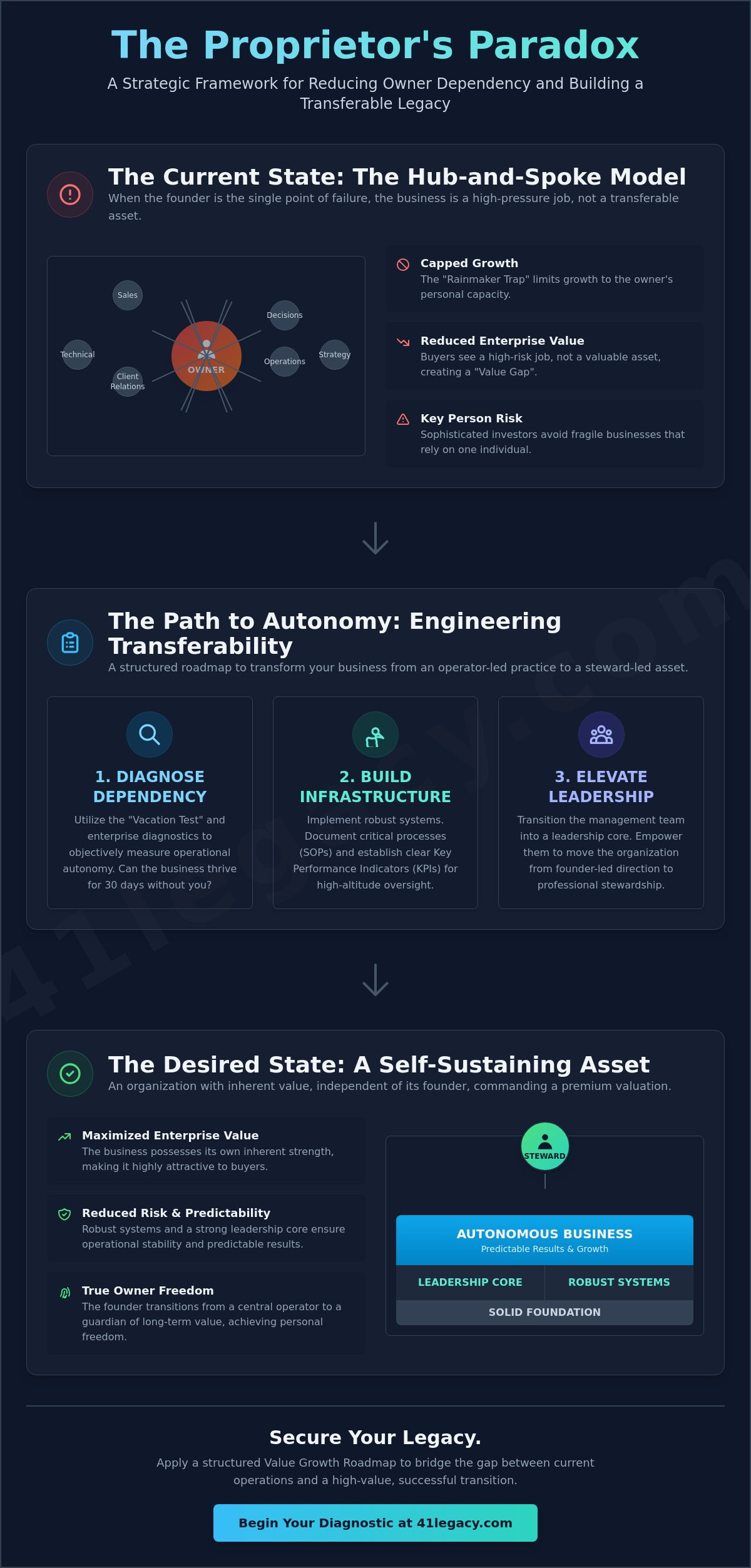
The very brilliance that ignites a company's inception often becomes the shadow that obscures its future. This is the Proprietor’s Paradox. In the early years, your singular vision and relentless execution are the primary catalysts for growth. However, as the organization matures, these same traits can solidify into a "Hub-and-Spoke" model. In this structure, every operational thread leads back to the center. Decisions, regardless of their scale, require your personal touch. This creates a rigid ceiling where growth is limited by your individual capacity, rather than the market's potential.
When you remain the primary salesperson and the lead technical expert, you've fallen into the "Rainmaker Trap." While it's rewarding to be the engine of the enterprise, this reliance creates a profound "Value Gap." A business that cannot function without its creator isn't a transferable asset; it's a high-performance job. Learning how to reduce owner dependency in a business is the essential first step in transforming a personal practice into a legacy that possesses its own inherent strength. Without this evolution, the enterprise remains tethered to your daily presence, which significantly discounts its market attractiveness.
The Emotional Weight of Dependency
Moving from "my business" to "the business" as a separate, living entity requires a significant shift in identity. It's common to fear that stepping back leads to a decline in quality or a loss of the "secret sauce" that made you successful. True stewardship, however, is about building something that outlasts its architect. By implementing succession planning and robust systems, you aren't losing control. You're granting the organization the autonomy it needs to thrive independently. Reframing this independence as an act of respect for the work you've built allows you to move from a central operator to a guardian of long-term value.
The Buyer Perspective on Owner Reliance
Sophisticated investors look for assets, not liabilities. If you're the primary relationship holder or the only one who understands the core technical processes, you represent "key person risk." To a buyer, this dependency signals a fragile investment that could crumble the moment you depart. They don't want to buy your personal expertise; they want to buy a self-sustaining system that generates predictable results. Transferability is the ultimate litmus test for business health. It proves that the value resides within the entity's infrastructure and leadership core, rather than the individual at the helm. Reducing this reliance is not just an operational goal. It's a strategic necessity for anyone seeking to maximize their enterprise value.
Systematization as a Strategic Asset: Building the Infrastructure of Autonomy
The architect of a high-value enterprise understands that systems are the skeletal structure of a lasting legacy. If the previous section identified the "Hub-and-Spoke" trap, this stage provides the structural remedy. Systematization is not a clerical chore; it's a strategic evolution. By treating Standard Operating Procedures (SOPs) as the blueprints of a transferable asset, you create a business that functions with the surgical precision of a fine watch. This process, which we define as transferability engineering, is about building a machine that doesn't require its creator to turn the gears every hour.
When considering how to reduce owner dependency in a business, you must move beyond simple documentation. You're building an infrastructure of autonomy. This includes establishing Key Performance Indicators (KPIs) that provide a clear, high-altitude view of the organization's health. These metrics allow for remote oversight, enabling you to step back from the daily fray while maintaining absolute clarity on performance. In the "new normal" of 2026 business valuations, sophisticated buyers prioritize sustainable profitability and operational stability over chaotic, founder-led growth.
Crafting the Standard Operating Procedure
Precision begins with identifying the "Critical Few" processes. These are the core activities that drive the vast majority of your enterprise value. SOPs should never be dusty manuals relegated to a shelf. They must be living, breathing digital assets. Utilizing video and cloud-based tools ensures rapid knowledge transfer across your team. This systematic approach is essential for navigating the Challenges for Family-Owned Businesses, where the absence of documented wisdom often leads to friction during a transition. When the "how" is clearly defined, the "who" becomes less of a single point of failure.
Leveraging Technology for Strategic Capacity
Modern technology serves as the silent partner in your strategic evolution. Implementing robust CRM and ERP systems centralizes institutional knowledge that once existed only in your memory. By 2026, the rise of agentic automation allows AI to handle entire workflows, further removing the need for owner intervention in routine decision-making. Gartner forecasts that 40% of enterprise applications will include task-specific AI agents this year, a significant leap from previous cycles. Tech-enabled businesses command higher multiples because they represent a polished, lower-risk investment. For those seeking to identify their current bottlenecks, an Exit Readiness Assessment offers the diagnostic clarity needed to begin this transformation.
Elevating the Leadership Core: From Direction to Stewardship
If systems are the blueprints of a transferable asset, then your leadership team represents the master artisans who bring those plans to life. The architect must eventually step back to allow the structure to stand on its own. This transition requires more than just delegation; it demands the intentional cultivation of a leadership core that views the enterprise with the same reverence as its founder. Learning how to reduce owner dependency in a business is as much a psychological evolution as it is an operational one. It marks the shift from a "Command and Control" hierarchy to a culture of decentralized stewardship.
True enterprise value is realized when the organization’s performance is decoupled from the founder's daily input. This is achieved through a "Quarterback" model, where the owner moves into a visionary role, coordinating internal talent with a suite of external professional advisors. By implementing a structured Value Growth Roadmap, you provide your team with a clear, objective path to follow. This ensures that the strategic vision remains intact even when you aren't in the room to enforce it. The goal is a business that breathes and grows as a living entity, sustained by the collective expertise of its people.
The Strategic Capacity Evaluation
Before you can step away, you must conduct a Strategic Capacity Evaluation to determine if your current team possesses the "altitude" for high-level leadership. Many employees are excellent technical managers but lack the strategic depth required to navigate complex transitions. Bridging this gap often requires formal leadership development and the alignment of long-term incentives. For many, this involves exploring structures like Phantom Stock or Employee Stock Ownership Plans (ESOPs). With the IRS deadline of December 31, 2026, for qualified retirement plans to adopt SECURE 2.0 amendments, ensuring your incentive structures are technically precise and legally compliant is more critical than ever.
Empowering the Advisory Team
A sophisticated transition cannot occur in a vacuum. It requires the seamless alignment of your CPA, attorney, and wealth manager toward a singular, uncompromising goal. When these professionals operate in silos, the resulting friction can erode enterprise value and create unnecessary risk. By positioning yourself as the steward and utilizing Strategic Advisory services, you ensure that every legal, financial, and operational lever is pulled in harmony. This coordinated approach prevents the "silo effect" and allows you to focus on the high-level vision of your legacy while your advisors and leadership core handle the intricate details of the execution.
A Diagnostic Framework for Reducing Owner Reliance
A master artisan knows that precision begins with an objective assessment of the raw material. In the context of an enterprise, this requires a rigorous diagnostic framework to move beyond intuition and toward technical certainty. While previous sections detailed the importance of systems and leadership, this stage focuses on the clinical identification of dependency bottlenecks. Understanding how to reduce owner dependency in a business requires a clear-eyed look at where the organization’s pulse still relies on your personal heartbeat. We utilize a structured approach to illuminate these "Single Points of Failure" before they can compromise a future transition.
The "Vacation Test" serves as a primary, practical metric for measuring this autonomy. It isn't merely a period of rest; it's a strategic stress test of the infrastructure you've built. If the business experiences operational friction or a decline in quality during a thirty-day absence, the dependency remains a liability. Mapping the resulting "Value Gap" allows us to quantify the difference between your current market attractiveness and the potential value of a truly self-sustaining asset. This diagnostic clarity ensures that your efforts are focused on the most impactful levers of transferability engineering.
The Enterprise Diagnostic Process
Our diagnostic process involves a meticulous analysis of the eight key drivers of business value. We examine everything from financial performance to the depth of your customer relationships, identifying where your personal involvement creates a ceiling on growth. By establishing a baseline valuation, we create a tangible scoreboard for your progress. This data-driven approach allows you to see exactly how each operational improvement increases your enterprise value. It transforms the abstract goal of exit readiness into a series of precise, manageable milestones.
Monthly Implementation and Accountability
The most sophisticated strategic plans often fail not for lack of vision, but for lack of execution. Transitioning from a central operator to a steward requires consistent, disciplined action over time. This is where monthly advisory and implementation support become essential. We provide the external perspective and accountability needed to ensure the roadmap is followed with uncompromising precision. Moving from theoretical strategy to "Transferability Engineering" in practice requires a partner who understands the intricacies of the process. To begin your own assessment, explore our Enterprise Diagnostics to identify your specific path forward.
Securing Your Legacy: The Path to Exit Readiness with 41 Legacy
Building a legacy is a deliberate, artistic act of engineering. It requires moving beyond the daily mechanics of operation to embrace the role of a visionary steward. At 41 Legacy, we act as the "Quarterback" for your strategic transition, ensuring that every professional advisor and internal leader is aligned with your singular vision. We don't just provide a plan; we provide a structured Value Growth Roadmap designed to increase the inherent strength of your enterprise. This ensures that when the time comes for an internal or external transition, your business stands as a high-value, transferable asset rather than a fragile entity tied to your presence.
The mastery of how to reduce owner dependency in a business is the final triumph of a successful founder. It's the moment your work transcends your individual effort and begins to live on its own. By focusing on owner dependency reduction and strategic capacity evaluation, we help you protect your life’s work from the risks of stagnation. Our approach is unhurried and precise, reflecting the time-intensive nature of high-end craftsmanship. We believe that a business should be as enduring as the history it was built upon.
Aligning Personal and Enterprise Goals
A successful transition is only possible when your personal financial needs and the business’s enterprise value are in perfect harmony. We ensure that your post-exit lifestyle is supported by the asset you've spent decades refining. As your Certified Exit Planning Advisor (CEPA), we navigate the complexities of this alignment with technical precision. This isn't merely about a transaction. It's about ensuring your legacy survives your departure, flourishing under new leadership while maintaining the essence you've cultivated. We help you bridge the gap between your current reality and your future aspirations through dedicated strategic advisory.
Next Steps for the Forward-Thinking Owner
The path to a successful exit begins with a single, clear-eyed evaluation of your current standing. For the owner who values heritage and precision, the diagnostic process is the essential first step to uncovering hidden risks and untapped value. It's time to move from the noise of daily operations to the clarity of strategic stewardship. Our team is ready to provide the implementation support and technical expertise required to secure your company's future. You are invited to Begin your Enterprise Diagnostic with 41 Legacy and start the journey toward a truly transferable legacy.
The Evolution from Operator to Architect
The transformation of a business into a transferable asset is a meticulous process that rewards the patient steward. You've moved beyond the "Rainmaker Trap" to understand that true value lies in the infrastructure of autonomy and the strength of a decentralized leadership core. By mastering how to reduce owner dependency in a business, you ensure your organization survives as a living testament to your vision rather than a fragile entity tied to your daily presence.
Guided by a Certified Exit Planning Advisor (CEPA), our team utilizes comprehensive Enterprise Diagnostics to illuminate your path forward with technical precision. Through a structured Value Growth Roadmap, we provide the strategic framework needed to bridge the gap between current operations and a high-value transition. This unhurried, thoughtful approach ensures that every detail of your legacy is polished to a high sheen.
Secure your legacy and begin your Exit Readiness Assessment with 41 Legacy. Your life's work deserves a future as enduring and impactful as the effort you've invested in its creation.
Frequently Asked Questions
What is owner dependency and why does it matter for valuation?
Owner dependency is the structural reliance of an organization on the founder's daily presence and decision-making capacity. It matters for valuation because sophisticated investors pay a premium for self-sustaining assets rather than high-performance jobs. High dependency creates "key person risk," which signals a fragile investment. This fragility often results in lower valuation multiples as buyers factor in the possibility of the business collapsing after the owner's departure.
How long does it typically take to reduce owner dependency?
Reducing owner dependency typically requires a focused effort of twelve to thirty-six months. This timeframe allows for the thorough implementation of transferability engineering and the seasoning of a leadership core. It's an unhurried process of craftsmanship that requires patience and precision. Rushing this transition often leads to operational friction that can erode the very enterprise value you're attempting to build through how to reduce owner dependency in a business.
Can I reduce dependency without hiring expensive C-suite executives?
You can certainly reduce reliance without immediate C-suite hires by elevating your existing leadership core and leveraging agentic automation. Many organizations find that empowering mid-level managers with decentralized decision-making authority is more effective than bringing in outside executives. Implementing robust ERP and CRM systems also centralizes institutional knowledge that previously resided only with the owner. This creates a more autonomous infrastructure that functions independently of your daily input.
What are the most common signs that my business is too dependent on me?
The most common signs include being the primary salesperson, acting as the final decision-maker for routine tasks, and feeling anxiety about taking a week off. If your phone rings constantly with operational questions while you're away, your organization is likely trapped in a "Hub-and-Spoke" model. These bottlenecks indicate that you've built a role for yourself rather than a transferable asset. True autonomy is achieved only when the business breathes and grows without your constant intervention.
How do documented SOPs specifically increase my company’s value?
Documented Standard Operating Procedures increase value by providing a blueprint for the business's continued success under new ownership. They transform individual expertise into institutional knowledge, which significantly reduces the perceived risk for a buyer. When a company operates with the precision of a fine watch, it commands a higher multiple because the results are predictable and the transfer of power is seamless. SOPs ensure that the "secret sauce" of your legacy is preserved.
What happens if I try to sell an owner-dependent business?
Selling an owner-dependent business often results in a significantly discounted price or a long, arduous earn-out period. Buyers may require you to stay on for several years to ensure the transition doesn't collapse, effectively tethering you to the entity after the sale. In many cases, sophisticated investors will simply pass on the opportunity. They view the "key person risk" as an insurmountable barrier to a successful and profitable investment.
Is it possible to reduce owner dependency in a service-based business?
It's entirely possible to reduce owner dependency in a service-based business by productizing your offerings and building a team of specialists. This transition involves moving away from the founder-centric model toward a structure where the brand's reputation drives growth. Learning how to reduce owner dependency in a business within the service sector requires a commitment to repeatable processes. These systems must deliver consistent quality to clients without your direct intervention or oversight.
What is the "Quarterback" role in an exit readiness plan?
The "Quarterback" is the lead strategic advisor who coordinates your CPA, attorney, and wealth manager toward a singular goal of exit readiness. This role ensures that every professional is aligned, preventing the "silo effect" that can complicate a transition. By managing the complexities of the Value Growth Roadmap, the Quarterback allows the owner to focus on high-level stewardship. This ensures that the technical details of the transition are handled with surgical precision.

Article by
Mike Laskowski
Mike Laskowski is a Business Value Growth Strategist who helps business owners uncover the truths that drive their performance, risk, and readiness. Blending forensic interviewing from a 26‑year federal career with Strategic Capacity analysis and CEPA methodology, he works upstream to reduce owner dependency, increase transferability, and strengthen enterprise value. Mike guides founders through clarity, operational evolution, and transition readiness so their companies become transferable, owner‑independent assets that endure beyond the founder.
Disclaimer
This article is for educational and informational purposes only and does not provide legal, tax, investment, or business brokerage advice. 41 Legacy does not offer M&A brokerage services, legal document drafting, tax preparation, or investment advisory services. Business owners should consult licensed professionals in those disciplines before making decisions related to business transactions, legal matters, tax strategy, or financial planning. All examples are illustrative and may not apply to your specific situation.