
How to Mitigate Key Person Risk: Build a Business That Can Operate Beyond One Person
What would happen to your business if the person who holds its most important knowledge, makes key decisions, or manages essential client relationships became unavailable? Understanding how to mitigate key person risk starts with recognizing that the concern isn’t limited to the owner. A business can depend on any one person in ways that disrupt service, delay decisions, or make a future transition harder.
Financial protection is often the first consideration. Insurance may provide capital after a loss, but it can’t transfer expertise, preserve a client relationship, or give a colleague authority to act. Lasting resilience comes from reducing those dependencies before a disruption occurs.
This article shows how to identify important single-person dependencies, decide which to address first, and reduce them through documentation, cross-training, delegated authority, and stronger client relationships. It also explains where financial protection fits. A clear diagnostic and a sequenced roadmap can strengthen continuity and help build a business that operates beyond its owner.
Key Takeaways
- Map critical activities to the people responsible, available backups, and accessible documentation to reveal where work could stall.
- Prioritize dependencies by their potential to delay decisions, interrupt delivery, weaken client relationships, or leave essential knowledge inaccessible.
- To understand how to mitigate key person risk, pair immediate steps such as documenting processes with cross-training, delegated authority, and tested handoffs.
- Key person insurance may provide financial support, but it doesn’t replace the operational resilience built through shared knowledge and responsibility.
- Turn assessment findings into a sequenced roadmap with clear priorities, assigned owners, and regular progress reviews to strengthen transferability.
What Key Person Risk Means for Business Continuity and Transferability
Essential work can stall if one person becomes unavailable. Decisions may wait, a specialized task may have no capable backup, or a client may be unsure whom to trust. These are signs of key person risk: material dependence on an individual’s knowledge, authority, relationships, or ability to carry out critical work.
Key person risk is the exposure created when essential responsibilities are concentrated in one individual, making continuity and transferability harder to maintain if that person is unavailable. The risk can involve an owner, executive, specialist, or employee who holds important customer relationships. Key person insurance addresses potential financial consequences, but identifying who is essential is the first step in understanding the broader operating risk.
Which People Can Become Critical to Business Continuity?
A person’s title isn’t a reliable measure of their importance to continuity. Look instead at who controls a critical decision, holds specialized knowledge, maintains customer trust, or has access needed to keep work moving. A founder may approve every major commitment, while a technical specialist may be the only person who can resolve a recurring production issue.
Some dependencies are less visible. An employee who manages scheduling, maintains a key system, or knows how an important client prefers to work may be just as consequential as a senior leader. Ask: if this person were unavailable, what would stop, who could step in, and what would that person need to know or be authorized to do?
Why Owner Dependency Can Weaken a Transferable Business
When decisions live in the owner’s memory or client trust rests mainly on the owner’s personal relationships, the business may struggle to maintain performance without that person. Others may not know which commitments were made, how exceptions are handled, or who has authority to respond. The issue isn’t the owner’s importance. It’s whether the organization can carry the work forward.
Transferability means the business has the people, processes, information, and decision-making capacity to operate beyond its current owner. Reducing owner dependency helps preserve continuity and makes the enterprise less reliant on informal knowledge and personal intervention. This is a central consideration in exit planning for business owners, whether a transition is near or still years away.
To understand how to mitigate key person risk, identify where knowledge, authority, execution, or trust is concentrated. Then ask which dependency would most disrupt the business if it remained unchanged. That turns a broad concern into a practical priority.
How to Identify and Prioritize Key Person Risk in Your Business
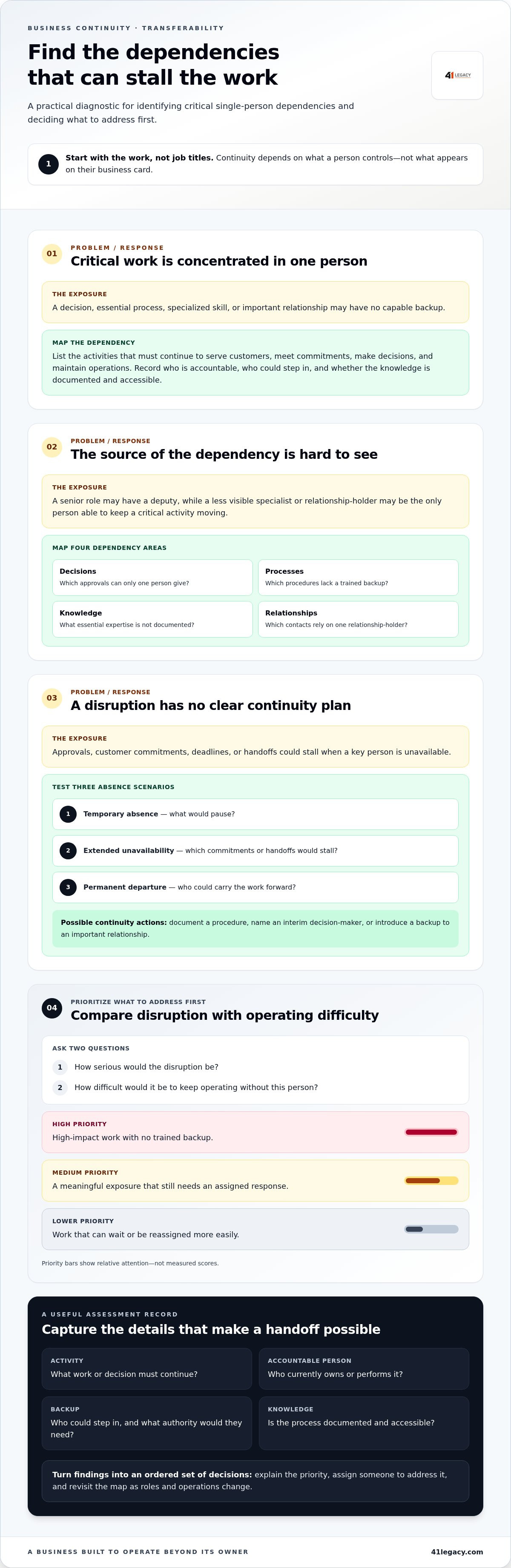
Start with the work, not the job titles. List the activities that must continue for the business to serve customers, meet commitments, make decisions, and maintain operations. For each activity, record who is accountable, whether a capable backup exists, and whether instructions or relevant knowledge are documented and accessible.
A role-based assessment is more useful than title-based assumptions because continuity depends on what a person controls, not what appears on their business card. A senior leader may have a capable deputy, while a specialist in a less visible role may be the only person who can complete a critical process.
Map Decisions, Processes, Knowledge, and Relationships
Organize the map around four areas: recurring decisions, essential processes, specialized knowledge, and relationships with customers, suppliers, or partners. Note which approvals only one person can give, which procedures lack a trained backup, and which contacts rely on a single relationship-holder. A simple list or shared worksheet can reveal where responsibility is concentrated.
- Activity: What work or decision must continue?
- Accountable person: Who currently owns or performs it?
- Backup: Who could step in, and what authority would they need?
- Knowledge: Is the process documented and accessible?
Test the Exposure With Realistic Absence Scenarios
Review each dependency under three possibilities: a temporary absence, an extended period of unavailability, and a permanent departure. For each scenario, ask which approvals, customer commitments, deadlines, or handoffs would stall. Record a practical continuity action, such as naming an interim decision-maker, documenting a procedure, or introducing a backup to an important relationship.
Prioritize findings by asking two questions: How serious would the disruption be? and How difficult would it be to keep operating without this person? A high-impact process with no trained backup deserves attention before a task that can wait or be reassigned easily. Mark each exposure as high, medium, or lower priority, explain why, and assign someone to address it. This turns a broad concern into an ordered set of decisions.
This assessment is a practical starting point for how to mitigate key person risk: identify the most consequential dependency, choose a first action, and revisit the map as roles and operations change. Structured enterprise diagnostics can help owners connect these findings to broader transferability priorities.
Practical Ways to Reduce Key Person Risk Before a Disruption
Address the most consequential dependencies first. Start with immediate barriers: make essential records and systems accessible to authorized people, document high-impact procedures, and name a backup for each critical responsibility. Then build deeper coverage through cross-training, delegated authority, and leadership development.
Make each action specific. If one person is the only one who can approve a customer exception, record the decision boundaries and designate who can act in their absence. If a process depends on unwritten steps, ask the person who performs it to document the sequence, relevant contacts, and recurring exceptions. Business SOPs, or standard operating procedures, can make those steps easier to follow and maintain. See how business SOPs for transferability can help make critical work more repeatable.
Share Knowledge and Build Redundancy Into Essential Work
Start with high-impact tasks rather than trying to document everything at once. Assign a named backup and have that person perform the work, not just observe. The handoff will reveal missing instructions, inaccessible files, or decisions that still depend on the primary person. Update the procedure based on what the backup needs, keep current records in a shared location with appropriate access, and repeat the exercise when the process changes.
Distribute Authority and Strengthen Relationship Continuity
A backup can’t provide meaningful coverage without clear authority. Define which decisions they may make independently, what limits apply, and when an issue should be escalated. Extend important customer, supplier, and partner relationships beyond a single contact, too. Introduce a colleague, include them in relevant conversations, and make responsibilities clear to everyone involved. Trust should have more than one point of connection.
Build these changes into normal operations. Test handoffs during routine work, confirm that backups can find and use the documentation, and revise it when responsibilities or procedures change. Revisit coverage after role changes, new customer relationships, or shifts in company strategy. A document no one can use isn’t a continuity plan.
For owners considering how to mitigate key person risk, the goal isn’t to remove individual expertise. It’s to make sure the organization can carry essential knowledge, authority, and relationships forward. A structured transferability planning approach can connect these operating improvements to broader business priorities.
Does Key Person Insurance Mitigate Key Person Risk on Its Own?
No. Key person insurance and operational risk reduction address different consequences. Insurance may provide financial resources after a covered loss, but it doesn’t ensure essential work continues. It can’t document a process, authorize a colleague to make decisions, transfer technical expertise, or preserve customer trust.
Think of them as distinct parts of a broader risk picture. The business can reduce some dependencies through operating changes it controls. Insurance is a potential financial-risk tool whose role depends on the business’s circumstances and policy terms. Neither replaces the other.
Operational Resilience Versus Financial Protection
Each measure addresses a different exposure:
- Documentation makes procedures, recurring decisions, and key contacts easier for others to find and use.
- Cross-training gives another person practical experience carrying out essential work.
- Delegated authority clarifies who can make decisions and within what boundaries if the usual decision-maker is unavailable.
- Key person insurance may provide financial support following a covered loss, but doesn’t itself maintain operations or relationships.
For example, a business might have financial resources available after losing a key employee and still face delays if only that employee knows how to deliver a critical service. The financial cushion and the operating response solve different problems.
How to Combine Protection With Practical Continuity Planning
Start with exposures the business can address directly. Name backups, document high-impact work, make essential information accessible, and clarify who can act when a key person is unavailable. Test the handoffs so the plan reflects how work actually gets done. These steps strengthen continuity whether or not the business also considers financial protection.
Keep insurance decisions separate from operating decisions. The continuity plan should explain how responsibilities, knowledge, and relationships will be carried forward. Financial protection discussions concern the potential monetary impact of a loss. Don’t assume a policy is appropriate or sufficient for every business, and don’t let the existence of coverage stand in for an operating plan.
Durable operating improvements can also support broader enterprise value growth strategies by helping the business function with less reliance on any one person. To clarify which dependencies to address and how they connect to transferability, explore a structured approach to business transferability.
Turn Key Person Risk Findings Into a Transferability Roadmap
An assessment is useful when it leads to clear action. Turn the findings into a short roadmap: diagnose the exposure, select the highest-priority dependencies, assign a responsible person, and review progress. This connects day-to-day continuity improvements with a larger goal: a business that can operate effectively beyond its current owner.
Set Priorities and Track Progress Without Overcomplicating the Process
Give every action an owner and an observable measure of completion. “Document the process” is difficult to track. “A named backup completes the process using the written procedure” is measurable. Check whether that person can perform the work without informal intervention from the primary expert. If they still rely on undocumented judgment or approvals, the dependency remains.
Keep tracking simple: record the priority, responsible person, next action, and evidence that the handoff works. Revisit the dependency map as roles, customers, and business priorities change. A new client relationship or leadership responsibility can create a dependency that wasn’t present in the first assessment.
Coordinate the Work Around Long-Term Enterprise Readiness
Key person exposure rarely exists in isolation. Enterprise diagnostics can help owners consider these dependencies alongside other factors affecting business readiness and transferability. A Value Growth Roadmap provides a way to sequence improvements so urgent continuity gaps and longer-term owner-dependency priorities receive deliberate attention.
Implementation requires follow-through, review, and adjustment as the business changes. Monthly strategic advisory and implementation support can help owners maintain momentum while coordinating the work with their existing professional advisors, including CPAs and attorneys. The aim is a more resilient enterprise, not a plan that stays on paper.
Reducing founder dependency doesn’t diminish the owner’s contribution. It embeds knowledge, relationships, and decision-making capacity in the business itself, strengthening its ability to continue through change and supporting a more transferable enterprise. Explore a strategic path to a more transferable business.
Build Continuity Into the Business You’re Creating
A more transferable business is built by design. Identify where critical knowledge, decisions, and relationships are concentrated, then turn the highest-impact dependencies into practical actions with accountable owners and regular review. Documentation, cross-training, and delegated authority strengthen the business’s ability to keep operating. Financial protection can play a separate role, but it can’t replace those operating foundations.
That’s the core of how to mitigate key person risk: make the enterprise less reliant on any one individual while preserving the expertise and relationships that support its success. 41 Legacy provides enterprise diagnostics, a Value Growth Roadmap, and monthly strategic advisory support. Founded and led by Chris Giammarco, a Certified Exit Planning Advisor, the firm coordinates with owners’ existing professional advisors as they work toward a more transferable business.
Explore a strategic path to a more transferable business with 41 Legacy. Take the next step toward an enterprise better prepared to continue, adapt, and carry its value forward.
Frequently Asked Questions
What is key person risk?
Key person risk is the possibility that essential business work will be disrupted when an individual becomes unavailable. That person might be an owner, executive, specialist, or employee who holds an important customer relationship. Risk increases when decisions, specialized knowledge, customer trust, or processes depend on one person alone. Identifying these dependencies helps owners see where continuity measures are most needed and where operations may be vulnerable to interruption.
How do you identify key person risk in a business?
Map essential decisions, customer relationships, specialized knowledge, and recurring processes. For each, note who is responsible, whether instructions are documented, and who could provide backup. Then consider what would stop or slow if that person were unavailable. Prioritize dependencies by their potential effect on operations and how difficult it would be to maintain continuity. This practical assessment clarifies how to mitigate key person risk in a deliberate order.
What are the best ways to mitigate key person risk?
Reduce key person risk by documenting essential processes, cross-training employees, delegating appropriate decisions, and building backup coverage for important relationships. Start with dependencies that could interrupt critical work. Have a backup complete the task using written instructions rather than relying on informal explanations from the primary person. Keep records current, clarify decision-making boundaries, and revisit coverage when roles, customers, or business priorities change. These steps make continuity part of normal operations.
Does key person insurance eliminate key person risk?
No. Key person insurance may provide financial protection under the policy’s terms, but it doesn’t automatically transfer knowledge, customer relationships, authority, or operating responsibilities. Those exposures require practical continuity measures, including documentation, cross-training, and delegation. Treat insurance and operational resilience as separate parts of a broader risk discussion. Financial protection may address certain financial consequences, while the business still needs a workable plan for keeping essential activities and relationships moving.
Who should be considered a key person in a business?
Consider anyone whose absence could materially disrupt essential work, regardless of seniority or job title. This may include an owner, executive, technical specialist, salesperson, or employee who holds critical process knowledge or customer trust. A person outside the leadership team may be the only one who can perform a key task or maintain an important relationship. Assess actual responsibilities and dependencies across the business, rather than relying only on the organization chart.
How can a small business reduce dependence on its owner?
A small business can reduce owner dependence by identifying decisions, customer relationships, and routine work that require the owner’s direct involvement. Document repeatable processes, train others to handle essential tasks, and delegate decisions with clear boundaries. Introduce team members to important customers so trust isn’t held by one contact alone. These changes help operations continue with less direct owner involvement and support a business that can become more transferable over time.
How often should a business review its key person risk plan?
Review the plan when important roles, customer relationships, processes, or business priorities change, and revisit it periodically as part of strategic planning. Confirm that named backups still have the knowledge and authority to act. Test whether written procedures reflect current practice and whether a backup can use them independently. Regular attention keeps the plan workable as responsibilities and operations change.

Article by
Mike Laskowski
Mike Laskowski is a Business Value Growth Strategist who helps business owners uncover the truths that drive their performance, risk, and readiness. Blending forensic interviewing from a 26‑year federal career with Strategic Capacity analysis and CEPA methodology, he works upstream to reduce owner dependency, increase transferability, and strengthen enterprise value. Mike guides founders through clarity, operational evolution, and transition readiness so their companies become transferable, owner‑independent assets that endure beyond the founder.
Disclaimer
This article is for educational and informational purposes only and does not provide legal, tax, investment, or business brokerage advice. 41 Legacy does not offer M&A brokerage services, legal document drafting, tax preparation, or investment advisory services. Business owners should consult licensed professionals in those disciplines before making decisions related to business transactions, legal matters, tax strategy, or financial planning. All examples are illustrative and may not apply to your specific situation.

