
Transferability & Owner Dependency
How to Maximize Business Value Before Exit: A Growth Guide
A business that cannot breathe without its creator isn't an asset; it's a beautifully designed cage. You've spent decades refining your craft and building a reputation, yet you likely feel the persistent pull of the "Rainmaker Trap" where every critical sale or strategic pivot still requires your personal touch. It's common to feel a quiet uncertainty regarding whether the market will value your life's work as highly as your personal financial goals require. To truly maximize business value before exit, you must evolve from the primary driver of growth into the architect of a self-sustaining enterprise.
We understand the reverence you hold for your company's heritage and the people who have helped build it. This guide outlines how to transform your operation into a premium, transferable asset that commands maximum value through owner-dependency reduction and clinical process documentation. We'll examine the diagnostic tools and strategic roadmaps required to bridge the "Value Gap," ensuring your legacy thrives long after you've stepped away from the helm.
Key Takeaways
- Recognize that true enterprise value is a clinical reflection of future risk and the seamless transfer of cash flow beyond the founder's tenure.
- Learn how to maximize business value before exit by dismantling the "Rainmaker Trap" and engineering a company that thrives independently of your daily presence.
- Transition from tax-focused accounting to exit-ready financial infrastructure that provides the precision and forecasting buyers demand during scrutiny.
- Discover the strategic necessity of a multi-year Value Growth Roadmap to bridge the gap between your current assets and your ultimate legacy goals.
- Understand the importance of the Quarterback Method in coordinating CPAs, attorneys, and advisors to ensure every professional effort aligns with a single exit objective.
Understanding the Value Gap: The Foundation of Exit Readiness
Enterprise value is a living reflection of future risk and transferable cash flow. It's not merely a historical record of what you've achieved; it's a clinical projection of how the business will perform once your hands are no longer on the wheel. While many owners focus on historical EBITDA, sophisticated acquirers view these figures as a starting point. They're searching for the "essence" of the enterprise, assessing whether the systems you've built can sustain their own momentum. To maximize business value before exit, you must shift your perspective from that of a founder to that of a steward. This stewardship involves refining every internal process until the company operates with the harmony of a masterwork.
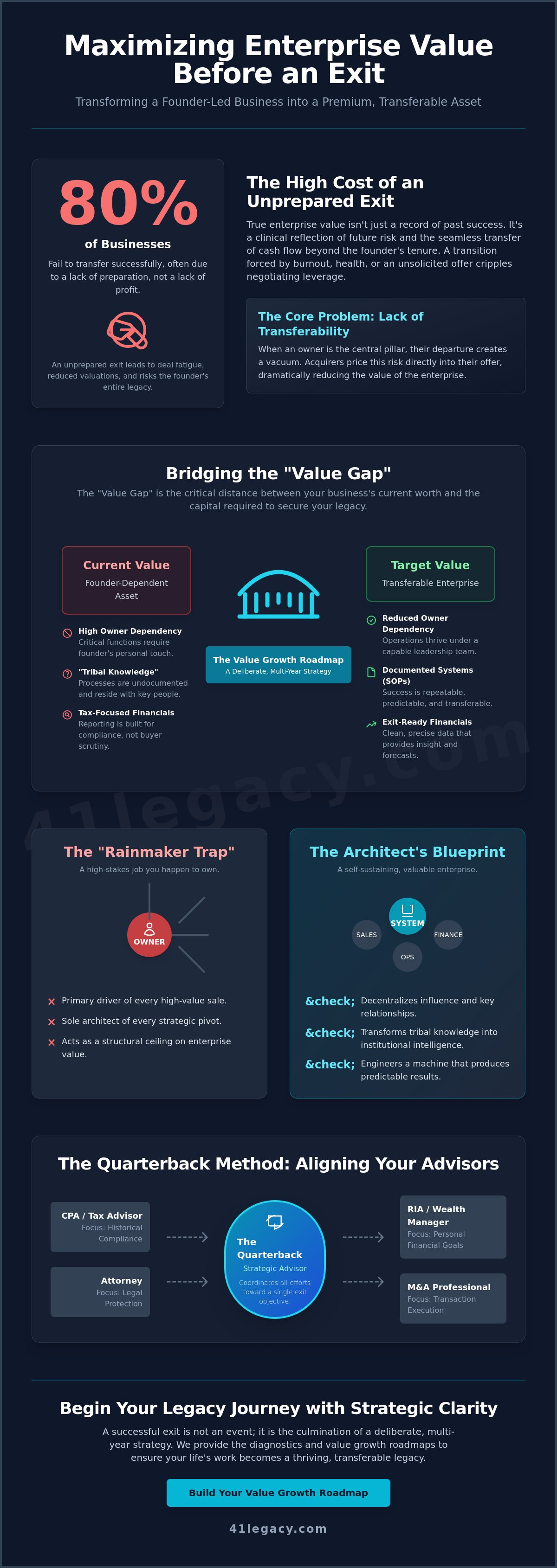
The journey toward a successful transition begins with acknowledging the "Value Gap." This concept represents the distance between what your business is worth today and the capital required to fund your next chapter or secure your family's legacy. Many owners operate under the illusion that their business is worth exactly what they need it to be. In reality, value is dictated by the market's perception of risk. If the enterprise is too dependent on your personal relationships or technical skill, that risk increases, and the value subsequently contracts. Closing this gap requires a deliberate, multi-year evolution of your operational infrastructure.
The Enterprise Diagnostic: Measuring What Matters
A formal assessment is the first essential step in any legacy journey. We utilize established business valuation methodologies to create a baseline of truth, moving beyond guesswork toward strategic clarity. This diagnostic process evaluates your company through two distinct lenses: external market attractiveness and internal operational readiness. Market attractiveness covers factors you cannot control, such as industry trends or economic shifts. Operational readiness, however, is entirely within your grasp. It involves strengthening your Enterprise Diagnostics to prove that your success is repeatable and documented. The Value Gap is the delta between current enterprise value and the net proceeds required for the owner’s next chapter.
The Risks of the "Unprepared Exit"
The cost of lacking a plan is remarkably high. Data from the Exit Planning Institute suggests that approximately 80% of businesses fail to transfer successfully, often leaving owners without the liquidity they anticipated. This failure usually isn't due to a lack of profit, but a lack of preparation. When an owner is forced into a transition by health issues, burnout, or an unsolicited offer, they lack the leverage to negotiate from a position of strength. Unpreparedness leads to "deal fatigue," where the sheer exhaustion of the due diligence process causes transactions to collapse. By failing to prepare, you risk the very legacy you've spent a lifetime building. A structured approach ensures that when the time comes to step away, the transition is a celebration of your work rather than a frantic attempt to salvage value.
Engineering Transferability: Escaping the Rainmaker Trap
The single greatest risk to your legacy is the silent tether that binds the organization's success to your personal presence. This state, known as owner dependency, acts as a structural ceiling on your enterprise value. If you are the primary driver of every high-value sale and the sole architect of every strategic pivot, you haven't yet built a transferable asset. You've created a high-stakes job you happen to own. To maximize business value before exit, you must engage in a meticulous process of transformation. The business must evolve into an independent entity capable of thriving without its creator.
This transition is the essence of transferability engineering. It's a shift from tribal knowledge to institutional intelligence. Acquirers are not looking to hire a founder; they are looking to purchase a machine that produces predictable results. When the vision and sales processes are locked inside your mind, you are caught in the "Rainmaker Trap." Escaping this requires a clinical approach to decentralizing your influence. By doing so, you align your company with successful exit strategies that prioritize a clean handoff and premium enterprise multiples.
Standard Operating Procedures as Value Drivers
Documented Standard Operating Procedures (SOPs) serve as the blueprint for a buyer's future success. They're the evidence that your company's performance is not a fluke of personality but a result of precise engineering. When "the way we do things" is codified into institutional systems, the business becomes a tangible asset. This level of documentation reduces the perceived risk for any successor. It ensures that excellence is a repeatable outcome of the system itself. If you want to see how your current processes measure up, consider a strategic capacity evaluation to identify where systems are lacking.
Talent Development and Leadership Depth
A management tier that can execute the Value Growth Roadmap is the ultimate insurance policy for your legacy. At 41 Legacy, we focus on developing the strategic capacity of your key personnel. This means your team doesn't just follow instructions; they possess the depth to lead. Reducing key-man risk involves rigorous cross-training and the establishment of clear accountability frameworks. When your leadership team can manage daily operations and drive growth independently, you've achieved the ultimate goal of owner-dependency reduction. This independence is what transforms a company into a premium asset, allowing you to maximize business value before exit through proven structural strength.
The Diagnostic Precision of Financial and Operational Infrastructure
The integrity of your financial infrastructure is the lens through which a successor views the future of your enterprise. While many founders operate with "tax-ready" books designed to minimize liabilities, these records rarely capture the true essence of a company's earning power. To maximize business value before exit, you must transition toward "exit-ready" financials that prioritize transparency and clinical precision. Clean data serves as a signal of professional stewardship; it tells a story of an organization managed with the meticulous care of a master artisan. When your records are polished to this high sheen, you remove the shadow of doubt that often lingers over private enterprises.
Financial forecasting plays a vital role in this narrative. It moves the conversation beyond what has happened to what is possible. By providing a clear roadmap of future growth, you reduce the "friction" of a transition and allow a buyer to see the business as a living, evolving entity. This level of infrastructure optimization is a core component of how we increase company's value, ensuring that every dollar of revenue is backed by verifiable data. It's about proving that the success of the past is a reliable predictor of the performance of the future.
Cleaning the Financial Lens
Professionalism in your ledger requires the permanent separation of personal expenses from business operations. Co-mingling funds creates a layer of "noise" that obscures the true performance of the asset. A minimum of three years of consistent, professional financial statements is the required standard for any serious legacy transfer. Sophisticated buyers view messy financials as a proxy for hidden operational risks. By presenting a polished set of books, you eliminate uncertainty and reinforce the stability of the enterprise. This clarity is the foundation upon which trust is built during the due diligence process.
Contractual Integrity and Customer Diversification
The strength of your revenue is often found in its diversity. High customer concentration is a significant risk factor; if a single client represents more than 10-15% of your total revenue, the business's foundation is fragile. True enterprise health requires a broad base of support. We help owners analyze their Enterprise Diagnostics to identify these vulnerabilities before they become structural failures. Ensuring that your contracts are assignable is equally critical. These documents must protect the essence of the business post-transfer, allowing the brand history to continue without interruption. Strengthening your competitive position through long-term, recurring revenue models is one of the most effective ways to maximize business value before exit. It transforms the enterprise from a series of transactions into a reliable, transferable engine of wealth.
Building the Value Growth Roadmap: A Multi-Year Strategy
Exit readiness is not a single event; it's a deliberate 24-to-36 month strategic evolution. This timeframe is necessary to move beyond surface-level aesthetics and address the structural integrity of the enterprise. To maximize business value before exit, you must follow a structured progression that prioritizes long-term stability over short-term gains. By identifying and strengthening specific value drivers, you de-risk the organization. This clinical reduction of risk naturally expands the valuation multiple, transforming the business into a premium asset that commands respect in any market.
We treat this process as an architectural undertaking. Just as a master craftsman relies on a blueprint, we implement monthly accountability cycles to ensure the roadmap remains active and precise. These cycles prevent the "drift" that often occurs when the pressures of daily operations collide with long-term strategic goals. Each step is measured against the baseline established during your initial diagnostic, ensuring that every effort contributes directly to the ultimate objective of a successful, high-value transition.
Phase I: Discovery and Diagnostic
The journey begins with a comprehensive Exit Readiness Assessment. This initial phase is designed to identify immediate "red flags" that could jeopardize a future transfer or lead to significant value erosion. We establish a baseline valuation, providing a clear starting point to measure all future growth. During this period, we focus on "Low Hanging Fruit," which includes operational or financial adjustments that can immediately improve transferability and signal to future successors that the business is under sophisticated stewardship.
Phase II: Implementation and Growth
Once the foundation is secure, we move into the execution of the Value Growth Roadmap. This phase utilizes Monthly Strategic Advisory to maintain momentum and ensure that strategic priorities aren't lost in the noise of the workweek. We monitor specific KPIs that reflect true enterprise health, such as profit margins and customer retention, rather than just top-line revenue. This disciplined approach ensures your legacy is built on a bedrock of operational excellence. If you're ready to begin this evolution, our team can help you design a Value Growth Roadmap tailored to your specific legacy goals.
The Quarterback Method: Coordinating Your Advisory Team
The most sophisticated strategic plans often falter not from a lack of individual skill, but from a lack of alignment. Your CPA, attorney, and wealth advisor are masters of their respective domains, yet they frequently operate in silos, creating strategic friction that can erode enterprise value. Without a central point of coordination, these professionals may offer conflicting advice that prioritizes their specific niche over your ultimate goal. To maximize business value before exit, you need a central intelligence, often called a "Quarterback," to ensure every professional effort is synchronized toward a single, uncompromising vision of perfection.
A Certified Exit Planning Advisor (CEPA) serves as this essential pivot point. This role isn't about replacing your trusted advisors; it's about integrating their expertise into a unified strategy that addresses your personal, financial, and business goals simultaneously. At 41 Legacy, we act as the guardians of the owner's ultimate vision. We ensure that the technical precision of your legal and financial infrastructure serves the preservation of your company's essence, transforming a complex transaction into a seamless legacy transfer.
Bridging the Gap Between Professionals
Your CPA is traditionally focused on the historical record, refining your books for tax efficiency and compliance based on what has already occurred. However, maximizing the value of your asset requires a clinical focus on the future. We bridge this gap by ensuring that your financial reporting and legal documents aren't just compliant, but strategically aligned with our roadmap for transferability. This orchestration ensures that your wealth management goals are perfectly synced with the anticipated net proceeds, preventing the strategic disconnect that often occurs when professional advice is dispensed in isolation.
Securing the Legacy
The final evolution of a founder is the shift from operator to successful exit-maker. This transformation is often accompanied by significant emotional weight and the intense pressure of the due diligence phase. A coordinated advisory team reduces this stress by presenting a unified front of operational and financial excellence. When your advisors speak with one voice, you maintain the leverage necessary to protect your brand history and your employees. Take the first step toward this strategic clarity and choose to Schedule an Exit Readiness Assessment. Our team of specialists is united by a singular vision to help you maximize business value before exit, ensuring your life's work thrives as a lasting, independent asset.
Securing Your Legacy Through Strategic Stewardship
The transformation of a founder-led company into a premium, independent asset is an architectural endeavor that requires both technical precision and a deep respect for the enterprise's history. By addressing the Value Gap and dismantling owner dependency, you ensure that the essence of your life's work remains intact long after your departure. To truly maximize business value before exit, you must move beyond the daily operational noise and commit to a clinical, multi-year evolution of your company's structural integrity. This journey isn't merely about a transaction; it's about the preservation of impact and the fulfillment of your long-term financial goals.
Our team provides the national advisory expertise in transferability engineering required to navigate this complex transition. Led by a Certified Exit Planning Advisor (CEPA), we utilize a structured Value Growth Roadmap process to align your personal vision with operational reality. We act as the guardians of your legacy, ensuring that every professional advisor is coordinated toward a single objective. You don't have to navigate this path alone. Take the first step toward strategic clarity today and Begin Your Legacy Journey with an Exit Readiness Assessment. Your masterpiece deserves a future that is as enduring as its past.
Frequently Asked Questions
What is the difference between business valuation and enterprise value?
Business valuation is the specific economic value of the owner's equity, while enterprise value represents the total value of the entire entity, including both debt and equity. Think of enterprise value as the price a buyer pays for the whole machine, regardless of how it's financed. It's the clinical measure of the company's ability to generate cash flow and absorb risk independently of its current capital structure.
How long does it typically take to maximize business value before an exit?
A strategic evolution to maximize business value before exit typically requires 24 to 36 months of focused effort. This timeframe allows for the clinical documentation of systems and the reduction of owner dependency. It ensures that the changes aren't merely cosmetic but are deeply embedded in the company's operational DNA. Rushing this process often leaves significant value on the table.
Can I still sell my business if it is highly dependent on me?
You can sell a business that is dependent on you, but you'll likely face a significantly lower valuation and restrictive earn-out conditions. Buyers view owner dependency as a structural risk to the company's future essence. Without a team and systems that function independently, the buyer is essentially hiring you as a consultant rather than acquiring a self-sustaining asset that commands a premium.
What are the most common risks that devalue a mid-market company?
Customer concentration and the lack of documented processes are the most frequent risks that erode enterprise value. If a single client represents more than 15% of your revenue, the business's foundation is considered fragile. Additionally, "tribal knowledge" that lives only in the minds of the founder increases the perceived risk for any successor, which leads to lower offers during the due diligence phase.
How does a Value Growth Roadmap differ from a standard business plan?
A Value Growth Roadmap focuses specifically on de-risking the enterprise to expand its valuation multiple, whereas a standard business plan focuses on daily operational goals. The roadmap is a clinical blueprint for building a transferable asset. It prioritizes owner-dependency reduction and financial transparency to prove that the company's success is repeatable and independent of its creator's personal touch.
Why do I need an exit advisor if I already have a CPA and an Attorney?
An exit advisor acts as the "Quarterback," ensuring the technical work of your CPA and attorney aligns with your long-term legacy goals. While these professionals excel in their specific silos, they often lack the strategic framework to coordinate personal, financial, and business readiness. We provide the comprehensive oversight needed to bridge these gaps and ensure every professional effort serves a singular vision.
What is "Transferability Engineering" and why does it matter to buyers?
Transferability Engineering is the meticulous process of codifying systems and decentralizing authority so the business can thrive without the founder. It matters to buyers because it transforms a "job you own" into a premium, transferable asset. By documenting "the way we do things," you provide the blueprint for a successor to maintain the company's mechanical and aesthetic standards after the transition.
How much does an Exit Readiness Assessment typically cost?
The investment for an Exit Readiness Assessment varies based on the complexity and scale of the enterprise. We recommend checking with our advisory team to discuss the specific requirements of your organization. Every assessment is a custom production. It's designed to provide the diagnostic precision needed to establish a baseline for your legacy journey without relying on vague industry averages or estimates.
Disclaimer
This article is for educational and informational purposes only and does not provide legal, tax, investment, or business brokerage advice. 41 Legacy does not offer M&A brokerage services, legal document drafting, tax preparation, or investment advisory services. Business owners should consult licensed professionals in those disciplines before making decisions related to business transactions, legal matters, tax strategy, or financial planning. All examples are illustrative and may not apply to your specific situation.