
How to Make Your Business Attractive to Buyers: A Strategic Guide to Building a Transferable Asset
Your business is a masterpiece of your own creation, yet its ultimate value is realized only when it can stand apart from its creator. For many owners, the enterprise feels less like a transferable asset and more like a personal obligation that demands their constant presence. If you've ever wondered how to make your business attractive to buyers, you must first recognize that true value lies in the company's ability to flourish without you. It's a common struggle to face the uncertainty of market valuations while managing disorganized records that obscure the brilliance of your work.
We understand the profound responsibility of stewardship and the desire to see your legacy endure through a successful transition. This guide provides a strategic roadmap to transform your company from a mere source of income into a high-value, independent asset. You'll learn the technical precision required to reduce owner dependency and engineer a business that operates with the grace of a fine instrument. We'll examine the diagnostic steps necessary to increase enterprise value and ensure your impact remains protected long after the transition is complete.
Key Takeaways
- Shift your focus from generating annual income to building enduring enterprise value based on future cash flows.
- Identify and dismantle the "Rainmaker Trap" to ensure the business operates with excellence independently of your daily presence.
- Learn how to make your business attractive to buyers by treating systems and documented processes as the blueprints of a transferable asset.
- Utilize enterprise diagnostics to identify hidden risks and bridge the gap between your current valuation and your desired exit goal.
- Understand the role of a strategic advisor in coordinating your professional team to protect your legacy and ensure a smooth transition.
Beyond Profitability: Defining the Essence of a Transferable Asset
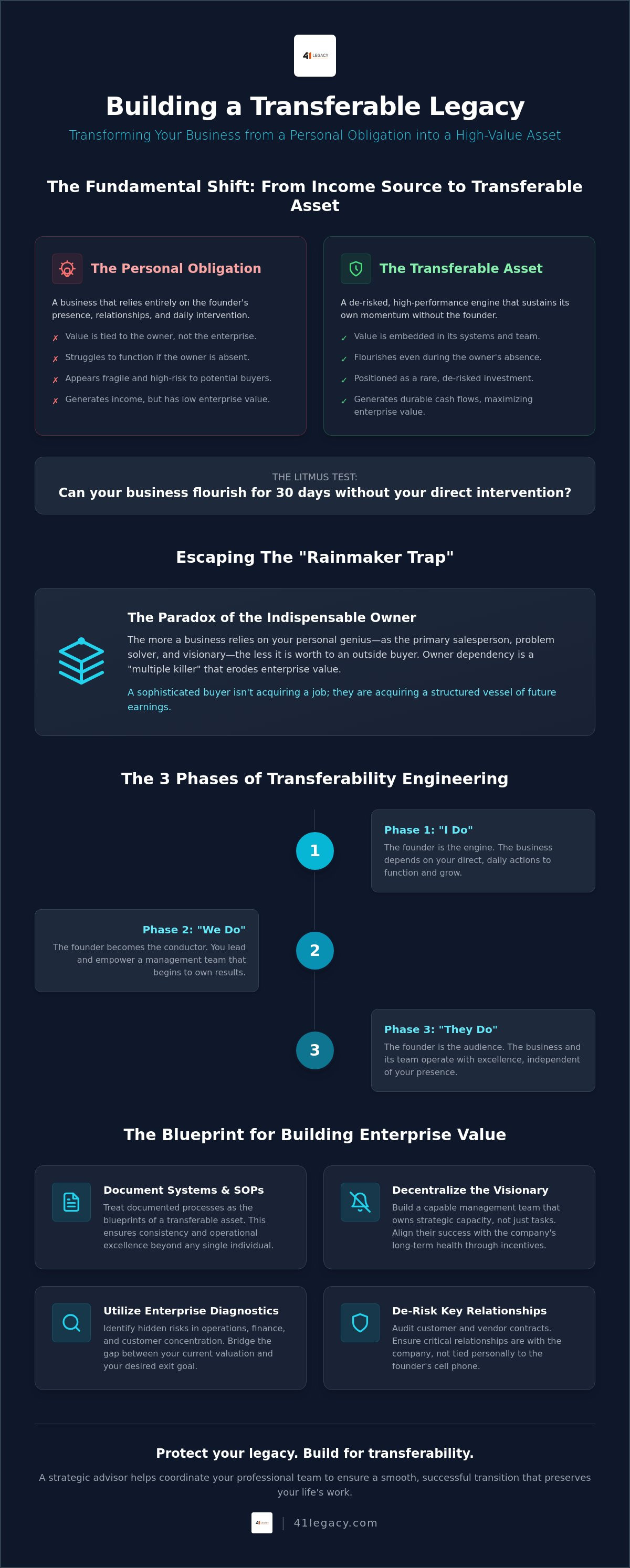
A business is a living testament to a founder’s vision and a vessel for an enduring legacy. Yet, a profound distinction exists between a profitable lifestyle and a transferable enterprise. One provides for the present, while the other secures the future. To truly understand how to make your business attractive to buyers, you must view your company through the lens of a curator. You aren't merely selling a source of income. You are presenting a de-risked, high-performance engine capable of sustaining its own momentum without your daily involvement.
This shift in mindset is the core of sophisticated exit planning. It is a strategic evolution that pays dividends long before any transition occurs. Even if you never intend to step away, building for transferability demands a level of operational excellence that accelerates growth. It transforms the business into an entity that possesses its own internal strength, independent of any single individual. This stewardship ensures the company's essence remains intact, regardless of who sits in the founder's chair.
The Distinction Between Income and Value
High revenue is a historical record, but market attractiveness is a forecast. Many owners assume that a healthy bank account automatically translates to a high valuation. This is a common misconception. The true litmus test of transferability is the thirty-day absence. If the business cannot flourish for a month without your direct intervention, you have built a personal obligation rather than a transferable asset. Enterprise value is the present value of future risk-adjusted cash flows. At 41 Legacy, we guide owners through this transformation, ensuring the essence of the business is preserved within its systems rather than its personalities.
The Buyer’s Lens: Risk vs. Reward
A buyer is essentially purchasing a structured vessel of future earnings. Their primary concern is the durability of those earnings once the founder departs. If the business relies on your personal relationships or unique technical intuition, the asset appears fragile. These dependencies act as a "multiple killer," eroding enterprise value regardless of your top-line growth. By identifying and mitigating these risks with surgical precision, you position your business as a rare, de-risked investment. It's about moving from the volatility of the "rainmaker" model to the harmony of a structured, transferable asset that thrives on its own merits.
The Rainmaker Trap: Reducing Owner Dependency to Protect Value
Many founders take deep pride in being the heart of their enterprise. They're the primary salesperson, the chief problem solver, and the sole visionary. This is the "Rainmaker Trap." It’s a seductive position that offers a sense of control, yet it creates a fragile architecture. If you're exploring how to make your business attractive to buyers, the answer often involves making yourself unnecessary. A sophisticated buyer isn't looking to acquire a job or hire you as a permanent employee. They want an asset that functions with mechanical precision and produces consistent results in your absence.
The paradox of the indispensable owner is stark. The more the business relies on your personal genius, the less it's worth to an outsider. An owner-dependent company is a risk, not a transferable asset. To protect your legacy, you must engage in what we call Transferability Engineering. This is the deliberate process of moving the organization through three distinct phases: "I do," where you're the engine; "we do," where you're the conductor; and finally, "they do," where you're the audience. This transition ensures the business’s essence is preserved within its systems rather than its personalities.
Decentralizing the Visionary
Building a management team that owns results requires more than just delegating tasks. It requires delegating strategic capacity. Buyers prioritize smooth operations and a capable team that can navigate market shifts without a founder's constant guidance. This involves "locking in" key talent through incentives that align their personal success with the company’s long-term health. It’s also vital to audit your customer and vendor relationships. If the most important contracts are tied specifically to your personal cell phone number, that value will evaporate the moment you exit.
The Cultural Shift of Transferability
A buyer values a "self-healing" organization. This is a culture where accountability is baked into the daily rhythm and teams solve problems before they reach the executive level. It’s not about micromanagement; it’s about the clarity of purpose and process. To identify your current vulnerabilities, take a "disconnected" one-week vacation. No emails, no emergency calls, and no check-ins. The breaking points that emerge during your absence provide a clear roadmap for your next steps in Owner Dependency Reduction. By addressing these gaps, you transform the business into a de-risked, high-performance engine that commands a premium in the market.
Engineering Transferability: The Role of Systems and SOPs
Standard Operating Procedures (SOPs) are the blueprints of a transferable asset. They represent the profound difference between a business that relies on the owner’s instinct and one that thrives on institutional intelligence. When an outsider looks at your company, they're searching for evidence that the brilliance of your work is captured in writing. Without this documentation, your years of hard work remain trapped in the minds of a few individuals. This creates a significant risk that no serious steward will want to assume. Systems are the silent guardians of your legacy, ensuring that the essence of your craft survives the transition to new hands.
Understanding how to make your business attractive to buyers requires more than just a healthy balance sheet. It demands a meticulously documented operational framework that reduces anxiety during the scrutiny of due diligence. A de-risked business is a high-value business. By engineering transferability through systems, you ensure that the essence of your company is preserved and scalable. This is the intersection of technical precision and operational harmony. It transforms a collection of tasks into a cohesive, living entity that can thrive under new leadership without losing its soul.
Documenting the "Secret Sauce"
The most valuable components of your business are often the ones least visible. Tribal knowledge, those unwritten rules and methods that your team uses to deliver excellence, must be converted into institutional assets. We focus on prioritizing SOPs for mission-critical functions and revenue-generating processes first. Clean, transparent operations lead to higher valuation multiples because they prove the business is a repeatable engine. At 41 Legacy, we help owners identify these "Strategic Capacity" gaps. This ensures your infrastructure is prepared for the next level of growth without fracturing under the weight of expansion.
Technology and Modern Infrastructure
Operational harmony is impossible without a modern, scalable tech stack. Outdated technology acts as a silent anchor. It slows down performance and raises immediate red flags for sophisticated observers who value efficiency and precision. Your Information Systems (IS) should provide clear, real-time data that proves business performance with surgical accuracy. A buyer-ready infrastructure is one that can be easily integrated or scaled independently. This technical excellence signals that your business is not just a relic of the past. It is a forward-thinking entity built to endure through the progression of time and the shifts of the market.
Bridging the Value Gap: The Importance of Enterprise Diagnostics
Vision is the architect's sketch, but diagnostics are the structural survey. Many owners operate on a "gut feel" regarding their company's worth, yet this intuition often masks a significant Value Gap. This gap is the distance between what your company is currently worth in the open market and the net proceeds required to fund your next chapter. Understanding how to make your business attractive to buyers requires more than just optimism. It demands a rigorous, data-driven evaluation of the enterprise’s internal health. Without this clarity, you risk reaching the end of your tenure only to find that the asset you’ve spent decades building cannot support the legacy you envisioned.
True stewardship involves a commitment to technical precision. You cannot manage what you have not measured. By moving from speculation to data-driven strategy, you transform the business into a de-risked investment that commands respect. This diagnostic phase is the foundation of a successful transition, ensuring that every operational improvement is a deliberate step toward a high-value, transferable asset. It is the process of translating your life's work into a language that the market understands and values.
The Diagnostic Process
A formal Exit Readiness Assessment is the essential first step in this journey. It uncovers the hidden risks that a balance sheet alone cannot reveal. This process evaluates the "8 Drivers of Value," examining everything from recurring revenue and growth potential to the "hub and spoke" risk where the owner remains the center of every decision. Owners frequently overestimate their readiness because they focus on historical top-line revenue. They often underestimate the systemic risks that sophisticated buyers use to discount a purchase price. By performing Enterprise Diagnostics, you gain a clear-eyed view of your starting point, allowing you to address vulnerabilities with surgical precision.
Creating the Value Growth Roadmap
Once the gaps are identified, the work of building value begins in earnest. This isn't a matter of vague improvements; it’s about a structured Value Growth Roadmap. This plan prioritizes specific enhancements based on their potential return on investment and their impact on transferability. It’s a deliberate engineering of the business's architecture. To ensure these changes take root, we provide monthly implementation support. This consistent oversight transforms a static plan into a living progression of value. By setting measurable milestones, you can track the growth of your enterprise value in real-time. If you are ready to move beyond estimation and begin the technical work of building a transferable asset, your journey starts with an Enterprise Diagnostic.
The Strategic Quarterback: Coordinating Your Advisory Team
A successful transition is a symphony, not a solo performance. Most owners have a trusted circle of advisors, yet these professionals often operate in isolation. Your CPA focuses on historical tax mitigation. Your attorney seeks to limit legal liability. Your wealth manager looks toward post-exit preservation. While each is a master of their craft, their advice can become discordant without a central vision. If you're refining how to make your business attractive to buyers, you must ensure that every professional decision is synchronized. A buyer doesn't just look at the individual parts; they evaluate the harmony of the whole enterprise.
The Strategic Advisor serves as the "Quarterback" of this process. It’s a role defined by technical precision and a deep respect for the owner’s life work. By coordinating the existing team, the advisor ensures that growth strategies don't conflict with tax structures or legal protections. This alignment isn't just about efficiency. It's about protecting the essence of the company and maximizing its enterprise value through a unified front. We act as the guardian of that vision, ensuring that the technical intricacies of the transition never overshadow the artistic legacy you've built.
Aligning the Professional Room
Siloed advice is a significant risk during a complex transition. A growth strategy that increases top-line revenue might inadvertently create a tax nightmare if the legal structure isn't prepared. True Strategic Advisory bridges these gaps. It ensures that the legal, financial, and operational facets of the business are in perfect sync. This level of coordination is rare, yet it's exactly what sophisticated observers look for when evaluating a de-risked investment. When your professional room speaks with one voice, the business reflects a level of maturity that commands a premium.
Building Your Legacy
The final stage of your tenure is a transition from an active founder to a steward of a lasting asset. This shift requires a calm, confident approach to both internal and external transfers. Whether you're preparing for a family succession or a third-party transition, the goal remains the same: a successful handoff that protects your impact. To test the alignment of your current strategy, request a coordinated meeting with all your primary advisors. Ask them to define the current exit goal and the timeline. If their answers vary, you've identified a critical gap in your readiness. We are here to help you lead that room, ensuring your legacy is preserved with the dignity and precision it deserves.
The Path to a Transferable Legacy
Building a business is an act of creation; making it endure is an act of stewardship. You've explored the technical steps of how to make your business attractive to buyers, from dismantling the Rainmaker Trap to documenting the systems that preserve your institutional intelligence. These efforts transform a source of daily income into a high-value, transferable asset that thrives independently of its founder. It's the difference between owning a job and curating a lasting enterprise.
Under the guidance of a Certified Exit Planning Advisor (CEPA), our process moves beyond simple transactions to focus on long-term enterprise value growth. Through structured Enterprise Diagnostics and a coordinated advisory approach, we help you bridge the value gap and protect the essence of what you've built. This ensures that when the time for transition arrives, your company stands as a de-risked, premium investment. Every operational refinement you make today serves to solidify the impact you'll leave behind tomorrow.
Your life's work deserves a transition defined by precision and peace of mind. Begin your journey toward a transferable legacy with 41 Legacy and ensure your impact continues for generations to come. You've built something remarkable; now it's time to make it timeless.
Frequently Asked Questions
What makes a business attractive to a buyer beyond profit?
True attractiveness lies in the company's ability to flourish as an independent entity. Beyond historical profits, buyers seek a de-risked asset with a diversified customer base, a capable management team, and sustainable growth potential. They're purchasing a structured vessel of future earnings, so the clarity of your operational framework is just as vital as the health of your balance sheet.
How do I reduce my business’s dependency on me?
Reducing dependency requires a shift from personal intuition to institutional intelligence. You must delegate strategic capacity to key employees and empower them to own results rather than just execute tasks. By identifying breaking points through a "disconnected" absence, you can systematically engineer the business to operate with precision without your daily intervention, turning yourself from the engine into the conductor.
What is an Exit Readiness Assessment and why do I need one?
An Exit Readiness Assessment is a rigorous diagnostic that uncovers structural and operational vulnerabilities. It moves you from a "gut feel" valuation to a data-driven understanding of your company's market position. You need this baseline to identify the specific risks that sophisticated observers use to discount value, allowing you to address them with surgical accuracy before any transition occurs.
How long does it take to make a business "buyer-ready"?
Preparing a sophisticated asset typically requires twelve to thirty-six months of deliberate implementation. This timeline allows for the deep work of transferability engineering and the seasoning of new systems. Understanding how to make your business attractive to buyers isn't a quick fix; it's a patient evolution that ensures the enterprise possesses its own internal strength and a proven track record of independence.
What is the "Value Gap" in exit planning?
The Value Gap is the distance between the current market valuation of your company and the net proceeds you require for your next chapter. Bridging this gap is a central goal of a Value Growth Roadmap. By identifying this discrepancy early, you can focus on the specific operational drivers that increase enterprise value and ensure your life's work supports the legacy you've envisioned.
Can I sell my business if I don’t have documented SOPs?
While a sale is possible without documentation, it often results in a significantly lower valuation multiple. Undocumented "tribal knowledge" represents a high risk for a buyer, as the business's success appears fragile and tied to individuals. Standard Operating Procedures act as the blueprints of a transferable asset, providing the mechanical certainty that a buyer needs to feel confident in the business’s future performance.
Why do I need a strategic advisor if I already have a CPA?
A strategic advisor acts as the "quarterback" who coordinates your entire professional room. While your CPA provides essential historical financial oversight, a strategic advisor aligns tax planning, legal structures, and growth initiatives toward the singular goal of exit readiness. This coordinated harmony prevents siloed advice from creating conflicting strategies, ensuring your legacy is protected through a unified and sophisticated approach.
How does owner dependency affect my business valuation?
Owner dependency acts as a "multiple killer" that erodes enterprise value. If the business relies on your personal relationships or unique technical genius, it is viewed as a high-risk investment rather than a transferable asset. Reducing this dependency is the most effective way to increase your valuation multiple, as it proves the company is a de-risked, repeatable engine capable of sustained excellence.

Article by
Mike Laskowski
Mike Laskowski is a Business Value Growth Strategist who helps business owners uncover the truths that drive their performance, risk, and readiness. Blending forensic interviewing from a 26‑year federal career with Strategic Capacity analysis and CEPA methodology, he works upstream to reduce owner dependency, increase transferability, and strengthen enterprise value. Mike guides founders through clarity, operational evolution, and transition readiness so their companies become transferable, owner‑independent assets that endure beyond the founder.
Disclaimer
This article is for educational and informational purposes only and does not provide legal, tax, investment, or business brokerage advice. 41 Legacy does not offer M&A brokerage services, legal document drafting, tax preparation, or investment advisory services. Business owners should consult licensed professionals in those disciplines before making decisions related to business transactions, legal matters, tax strategy, or financial planning. All examples are illustrative and may not apply to your specific situation.