
How to Make a Business Transferable: Engineering a Lasting Legacy
What if the enterprise you've spent a lifetime cultivating is currently nothing more than a high-stakes job that ceases to function the moment you step away? It's a sobering realization for many founders who view their company as a masterpiece, yet remain the only hand capable of holding the brush. You likely feel the weight of this dependency every day, knowing that without your constant presence, the intricate machinery of your life's work might grind to a halt. Mastering how to make a business transferable is the only way to ensure that the essence of what you've built survives your eventual departure.
We believe that true business ownership is an act of stewardship. In a 2026 M&A landscape where buyers are increasingly selective and focused on quality over size, engineering a self-sustaining asset is the only path to capturing peak enterprise value. This guide provides the strategic framework to transform your company into a high-value, transferable asset that thrives independently of its founder. We'll examine the essential role of Enterprise Diagnostics and Value Growth Roadmaps in reducing owner dependency and securing the peace of mind you've earned through years of dedication.
Key Takeaways
- Distinguish between a merely sellable entity and a truly transferable asset that maintains its essence and performance without the founder’s constant presence.
- Dismantle the Rainmaker Trap by shifting from a hub and spoke model to a decentralized structure that empowers your team to drive results.
- Learn how to make a business transferable through Enterprise Diagnostics, a process that reveals the Value Gap between your current state and your ultimate legacy goals.
- Codify your institutional knowledge into Standard Operating Procedures to provide buyers with the structural capital of a repeatable, low-risk engine.
- Execute a structured Value Growth Roadmap that aligns your advisory team around a singular vision for long-term enterprise health and exit readiness.
The Essence of Transferability: Beyond the Mere Sale
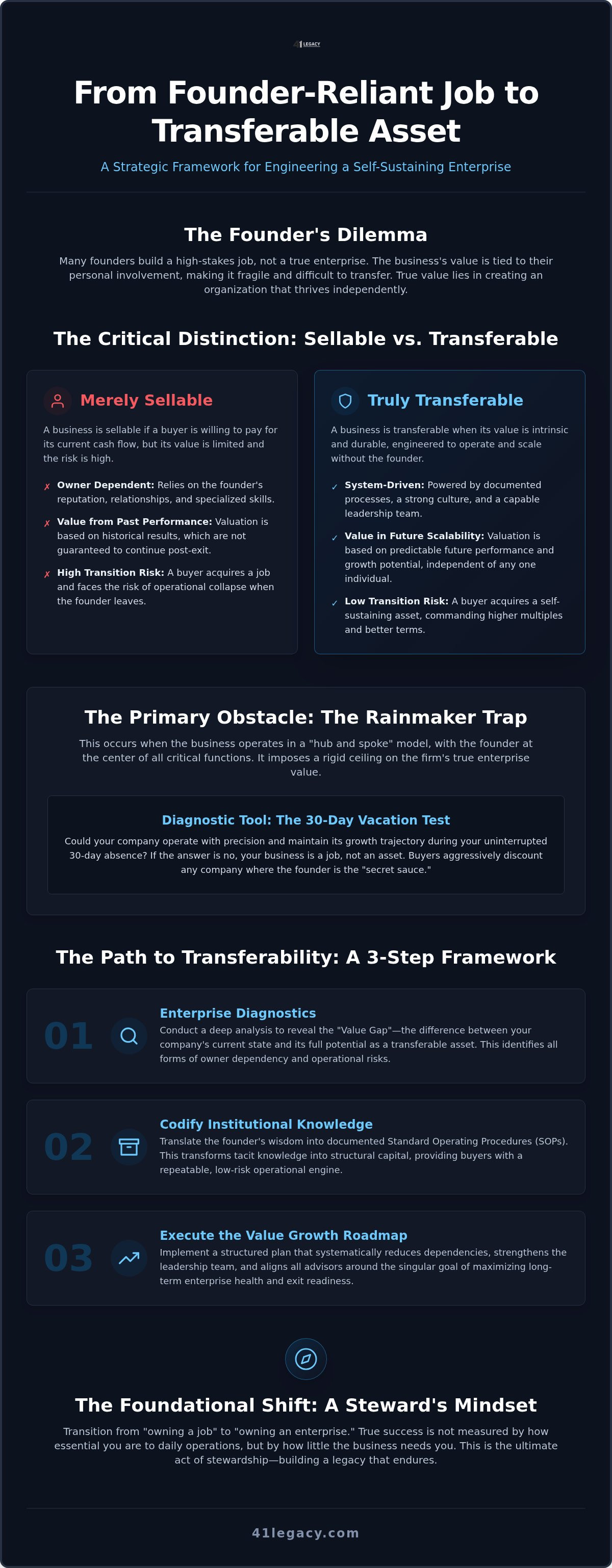
A business is far more than a source of recurring income; it's a living entity with a narrative that deserves to continue. True transferability is the capacity of this entity to breathe, operate, and expand without the founder’s hand on the tiller. Many owners mistake a high-performing "job" for a valuable asset, only to find that their presence is the very thing holding the structure together. Learning how to make a business transferable requires a profound shift in perspective, moving from the daily mechanics of operation to the high-level architecture of an independent enterprise. This transition serves as the ultimate litmus test for a healthy organization, proving that the value resides in the systems, not just the individual.
The Distinction Between Sellable and Transferable
When founders analyze how to make a business transferable, they often discover that market demand alone doesn't guarantee a legacy. A business is "sellable" when there's a buyer willing to pay for its current cash flow, but it's "transferable" only when its value is intrinsic and durable. Without the precision of Transferability Engineering, a company often relies on the owner’s personal relationships or specialized skills, creating a fragile structure. Sophisticated investors don't just want revenue; they want a predictable engine. Consider these key differences:
- Sellable: Dependent on the current owner’s reputation or specific technical expertise.
- Transferable: Driven by documented systems and a capable leadership team.
- Sellable: Offers value based on past performance.
- Transferable: Offers value based on future scalability without the founder.
Consequently, a transferable asset commands higher valuation multiples and more favorable deal terms because the risk of operational collapse upon the founder's exit has been engineered out of the equation.
The Steward’s Mindset: Building for the Next Generation
The journey toward a lasting legacy begins with a fundamental reorientation of the founder's role. You aren't merely a manager of tasks; you're a steward of a legacy. This mindset requires shifting from "owning a job" to "owning an enterprise," where your success is measured by how little the business needs you. It involves a commitment to succession planning that preserves the inner essence of the firm while modernizing its internal functions. At 41 Legacy, we view this as a philosophical endeavor as much as a technical one. Ensuring the business survives its creator is the highest form of professional achievement. Transferability is the definitive measure of a business’s maturity and health.
Breaking the Rainmaker Trap: Reducing Owner Dependency
The most significant barrier to a lasting legacy is often the founder's own brilliance. When you are the primary driver of sales and the sole architect of every high-level decision, you've inadvertently constructed what we call the Rainmaker Trap. This hub and spoke model creates a precarious equilibrium where the business is entirely dependent on your presence. While this structure might support a comfortable lifestyle, it imposes a rigid glass ceiling on the firm's worth. A buyer isn't seeking to purchase your personal effort; they're looking for a self-sustaining engine. Business transition planning must address this fundamental structural flaw before any meaningful transfer can occur.
Breaking the Rainmaker Trap is a prerequisite for any successful exit strategy. It requires the meticulous removal of the founder from the center of operations, replacing personal charisma with institutionalized excellence. This is the heart of how to make a business transferable: ensuring the machine runs perfectly long after the mechanic has left the room.
Identifying the Spoke in the Wheel
Owner dependency often disguises itself as dedication. If you are the only one holding the key customer relationships or the only person capable of solving complex technical failures, the business lacks intrinsic stability. To understand how to make a business transferable, you must apply the Vacation Test. Could your company operate with precision and maintain its growth trajectory during a thirty-day absence? If the answer is no, your business is a job, not an asset. Buyers will aggressively discount any company where the founder is the "secret sauce" because that ingredient disappears the moment the deal closes.
Strategies for Strategic Capacity Evaluation
True engineering of a legacy requires a Strategic Capacity Evaluation of your leadership team. It's not enough to delegate tasks; you must delegate authority. This shift empowers your specialists to take ownership of the firm’s future, ensuring the essence of the work remains intact without your direct intervention. Focusing on this internal development is a core component of how to increase enterprise value. By cultivating a culture of independent execution, you transform the business into a transferable entity. We often guide founders through this extraction process, acting as a strategic partner to ensure the transition is seamless. If you're ready to evaluate your current dependency levels, an Exit Readiness Assessment is the essential first step.
Enterprise Diagnostics: Identifying the Value Gap
Engineering a legacy requires more than intuition; it demands the clinical precision of Enterprise Diagnostics. This process serves as a comprehensive scan of the organization’s structural health, revealing the "Value Gap." This gap represents the distance between what your business is worth today and the capital required to fund your life’s next act. Understanding how to make a business transferable begins by identifying the hidden risks that erode this value before they become fatal to a transaction. We view these diagnostics as the essential first step in ensuring your stewardship results in a durable asset.
We examine the firm through the lens of the "Four Pillars" of value. Human Capital assesses the strength and independence of your team, while Structural Capital evaluates the robustness of your internal systems. Customer Capital measures the diversity and loyalty of your client base, and Social Capital reflects your brand’s reputation and culture. When these pillars are weak, they create friction that devalues the enterprise. By quantifying these intangible assets, we transform the abstract concept of "goodwill" into a measurable, growable component of your legacy.
Conducting a Formal Exit Readiness Assessment
A standard tax valuation or accounting snapshot is often insufficient for strategic planning. These documents focus on historical performance rather than future-facing risk. By determining enterprise value through a diagnostic lens, we establish a baseline that accounts for operational maturity and transferability. This assessment uncovers "Red Flags" like customer concentration or uncodified knowledge that can stop a transfer before it begins. Integrating actionable tips for succession planning into your early diagnostic phase ensures that you aren't just preparing for a sale, but fortifying the company’s core for the long term.
Bridging the Value Gap
Once the gap is identified, we create a Value Growth Roadmap to close it. This isn't about chasing top-line revenue at any cost. It’s about strategic growth that increases the company's valuation multiple by reducing risk. Exit readiness is a profound competitive advantage, even if you never intend to step away. A business that is ready to be transferred is, by definition, a business that is running at peak efficiency. It's a more profitable, less stressful environment for everyone involved. Approximately 80% of a business owner's total wealth is typically locked within the enterprise itself, making the mastery of how to make a business transferable the most critical financial objective of their career.
Standard Operating Procedures: The Blueprint of Transferability
If the leadership team is the soul of an enterprise, then Standard Operating Procedures (SOPs) are its skeleton. These documents represent the "Structural Capital" of your firm, providing the necessary framework for the business to stand independently. When investors or successors evaluate a company, they aren't looking to purchase the founder’s personal stamina or individual heroics. They are seeking a repeatable, predictable engine. Understanding how to make a business transferable requires a commitment to codifying every essential movement of the organization into a clear, executable manual. This ensures that the excellence you’ve established becomes a permanent fixture rather than a fleeting presence.
Documentation is the primary tool for reducing "Key Person Risk," a factor that often leads to significant valuation discounts during a transition. SOPs must be treated as living breathing entities, not as static manuals destined to gather dust. They should evolve alongside the company, capturing the refined wisdom of your specialists and ensuring that the inner essence of the work is preserved. By institutionalizing your processes, you allow the business to function with surgical precision regardless of who holds the scalpel.
What is an SOP in Business?
An SOP is far more than a simple checklist; it is the blueprint for a transferable legacy. While a "task" is an isolated action, a "systematic process" is a series of linked events that produce a consistent result every time. This distinction is vital for anyone learning how to make a business transferable. Documented systems improve current profitability by reducing errors and training time, while simultaneously building future value by proving the firm's scalability. A buyer buys your systems because they offer the one thing every investor craves: certainty.
The Hierarchy of Documentation
You don't need to document every minor detail at once. We advise founders to begin with the "Critical Few" processes that drive the most value or carry the highest risk. Using modern technology to capture video demonstrations or digital workflows can make this knowledge distribution feel seamless and intuitive. Once these core systems are in place, they empower the team to act with the owner’s precision without requiring the owner’s direct oversight. This structural maturity is what separates a chaotic job from a refined asset.
If you are ready to begin codifying your institutional expertise into a durable framework, our Strategic Advisory services provide the structured support needed to engineer a truly independent enterprise.
Executing the Value Growth Roadmap: Your Path to Exit Readiness
The transition from a blueprint to a finished masterpiece requires more than just vision; it demands a relentless commitment to execution. A Value Growth Roadmap serves as your structured multi-year plan, translating the high-level objectives of transferability into a series of disciplined, actionable steps. This is where the theoretical understanding of how to make a business transferable becomes a tangible reality. By focusing on the systematic removal of risk and the enhancement of operational maturity, you ensure that the enterprise's value is not just captured on paper, but realized in its daily rhythm. Stewardship, after all, is measured by the durability of the asset you leave behind.
The Implementation Phase: Moving from Vision to Reality
Most exit plans fail not because the strategy was flawed, but because the owner became overwhelmed by the gravity of daily operations. The implementation phase is often where the "Value Gap" remains unbridged because the necessary changes were never institutionalized. Recurring advisory meetings provide the necessary cadence to track progress against the roadmap, ensuring that the firm remains focused on the "Value Drivers" that increase the company’s multiple. This monthly implementation support acts as a safeguard against the inertia of the status quo, pushing the organization toward its ultimate potential. It's a process of refinement, where every adjustment to your systems adds a layer of protection to your legacy.
Coordinating the Professional Advisory Team
The complexity of a successful transition requires a team of specialists, including CPAs, attorneys, and RIAs, yet these professionals often operate in isolation. This "silo effect" can lead to conflicting guidance that creates friction, confusion, and unnecessary delays. We solve this through the "Quarterback" advisory model, where a singular point of contact coordinates the efforts of all specialists to ensure that tax, legal, and strategic goals are perfectly aligned. The Certified Exit Planning Advisor serves as the architect of this process, providing the technical precision and strategic oversight needed to harmonize these disparate disciplines.
Engineering a transferable asset is a time-intensive endeavor that requires patience and a refusal to settle for mediocrity. It's about building a firm that can thrive for generations, serving as a testament to your dedication and skill. If you're ready to illuminate the path forward and identify the specific actions needed to fortify your organization, an Exit Readiness Assessment is the essential first step in your journey toward a lasting impact. By identifying the value gap early, you gain the clarity needed to lead your team with confidence and purpose.
Securing the Future of Your Life's Work
Transforming a founder-led company into a self-sustaining asset is the ultimate act of professional craftsmanship. It requires a profound shift from daily operational management to strategic stewardship, ensuring that the inner essence of your organization remains intact long after your departure. By dismantling the Rainmaker Trap and codifying your institutional wisdom into structural capital, you solve the fundamental puzzle of how to make a business transferable. This process isn't merely a transaction; it's the meticulous preservation of a legacy that deserves to endure.
We bring the precision of a master artisan to this endeavor through our Certified Exit Planning Advisor (CEPA) expertise and proven Enterprise Diagnostics framework. Our team guides you in identifying the Value Gap and executing a custom Value Growth Roadmap designed for peak enterprise health and independent performance. You've spent years building something exceptional. Now, ensure it has the structural strength to thrive for generations to come. Begin your journey toward exit readiness with 41 Legacy and secure the impact you've worked so tirelessly to create.
Frequently Asked Questions
What is the difference between a sellable and a transferable business?
A sellable business possesses characteristics that attract a buyer, but a transferable one maintains its intrinsic value and operational excellence without the founder's presence. While market demand might make an entity sellable, transferability is an engineered quality. It ensures that the systems, leadership, and customer relationships are institutionalized. This distinction is the core of how to make a business transferable, shifting the focus from a mere transaction to a durable legacy.
How long does it take to make a business transferable?
Engineering a truly transferable asset typically requires a multi-year commitment, often spanning three to five years. This duration allows for the meticulous extraction of the owner from daily operations and the implementation of a Value Growth Roadmap. It takes time to codify institutional knowledge into Standard Operating Procedures and to empower a leadership team capable of independent execution. A rushed transition often leads to significant valuation discounts and operational instability.
Can a small business be transferable if the owner is still involved?
A small business can certainly be transferable while the owner remains involved, provided the organization's health isn't tied to their personal effort. The objective isn't necessarily immediate departure but the creation of a choice. By reducing owner dependency, you ensure the business can function during your absence. This structural maturity proves to potential successors that the firm is a self-sustaining engine rather than a high-stakes job for the founder.
What is the "Value Gap" in exit planning?
The Value Gap is the mathematical difference between the current enterprise value and the net amount an owner needs to fund their next chapter. Identifying this gap through Enterprise Diagnostics is a critical early step in the planning process. It provides a clear target for growth and risk reduction. Closing this gap requires a disciplined focus on value drivers that increase the company’s multiple and ensure financial security post-transition.
Why do I need an SOP if my team already knows what they are doing?
Even a highly skilled team needs documented Standard Operating Procedures to transform their individual talents into institutional Structural Capital. Without SOPs, your company's "secret sauce" resides solely in the minds of your employees, creating immense Key Person Risk. A buyer isn't purchasing your team's current habits; they're purchasing a repeatable, documented system. These living documents ensure that the firm's excellence is preserved regardless of personnel changes or founder exit.
What role does a Certified Exit Planning Advisor (CEPA) play?
A Certified Exit Planning Advisor (CEPA) acts as the strategic architect and quarterback for the owner’s entire advisory team. They coordinate the efforts of CPAs, attorneys, and wealth managers to ensure that all tax, legal, and operational goals are aligned. By utilizing a structured framework, a CEPA helps owners navigate the complexities of how to make a business transferable. Their role is to harmonize technical precision with the founder’s long-term vision.
How does reducing owner dependency increase the value of my company?
Reducing owner dependency directly increases enterprise value by lowering the perceived risk for a successor or investor. When a business can operate independently of its founder, it demonstrates a higher level of operational maturity and predictability. This stability allows buyers to offer higher valuation multiples because the cash flow is no longer tied to a single individual. It transforms the company from a fragile entity into a robust, transferable asset with lasting impact.
Is exit planning only for owners who want to sell their business now?
Exit planning is a strategy for building a better business today, regardless of when you intend to transition. A business that is exit ready is, by definition, a more profitable and efficient organization. By focusing on transferability and value growth early, you gain the freedom to step away on your own terms. It provides peace of mind, knowing that your legacy is protected and the enterprise is prepared for any internal or external transition.

Article by
Mike Laskowski
Mike Laskowski is a Business Value Growth Strategist who helps business owners uncover the truths that drive their performance, risk, and readiness. Blending forensic interviewing from a 26‑year federal career with Strategic Capacity analysis and CEPA methodology, he works upstream to reduce owner dependency, increase transferability, and strengthen enterprise value. Mike guides founders through clarity, operational evolution, and transition readiness so their companies become transferable, owner‑independent assets that endure beyond the founder.
Disclaimer
This article is for educational and informational purposes only and does not provide legal, tax, investment, or business brokerage advice. 41 Legacy does not offer M&A brokerage services, legal document drafting, tax preparation, or investment advisory services. Business owners should consult licensed professionals in those disciplines before making decisions related to business transactions, legal matters, tax strategy, or financial planning. All examples are illustrative and may not apply to your specific situation.