
Transferability & Owner Dependency
How to Increase Business Value Before Selling Your Company
A business that cannot breathe without its founder is a masterpiece trapped in a glass case; it is admired but ultimately impossible to move. You've spent years pouring your soul into your enterprise, yet you likely recognize the quiet danger of the Rainmaker Trap, where your personal involvement remains the primary engine of growth. To truly increase business value before selling, you must transition from being the indispensable driver to the visionary steward of a self-sustaining entity. It's a shift from working in the business to refining the internal machinery of the asset itself.
We understand the weight of this transition and the frustration of receiving fragmented advice that fails to capture the essence of your work. You deserve a clear roadmap to close the Value Gap and ensure your legacy is protected through meticulous transferability engineering. This article reveals our sophisticated framework for identifying hidden risks and utilizing enterprise diagnostics to transform your company into a high-value asset. We'll explore how to reduce owner dependency and engineer a business that flourishes independently, providing you with the strategic clarity and peace of mind you've earned.
Key Takeaways
- Learn to distinguish a lifestyle-dependent business from a high-value transferable asset that maintains its essence and performance without your constant presence.
- Discover how to use enterprise diagnostics to identify value detractors and increase business value before selling by closing the gap between your current valuation and your financial goals.
- Master the principles of transferability engineering to dismantle the Rainmaker Trap and ensure your company functions as a precise, self-sustaining machine.
- Understand the necessity of a coordinated advisory strategy to align your professional guardians and eliminate the risks of fragmented, siloed advice.
- Establish a rhythmic execution plan through a value growth roadmap that prioritizes long-term enterprise health and protects your professional legacy.
The Philosophy of Enterprise Value: Beyond the Balance Sheet
True enterprise value is far more than a multiple of earnings; it's the architectural resilience of the organization itself. It represents the collective strength of your systems, the resilience of your culture, and the clarity of your market position. When we examine The Philosophy of Enterprise Value, we see that sophisticated buyers look past current cash flow to evaluate the sustainability of that income. They seek businesses that possess structural integrity, where every component is designed to endure. To truly increase business value before selling, you must prioritize the health of the asset over the volume of the transactions. This requires a guardian mindset, where you view yourself as a steward of the company's future history rather than just its current operator.
The distinction between a lifestyle business and a transferable asset is profound. A lifestyle business serves the owner's immediate needs but often collapses when the owner departs. A transferable asset, however, is built with the intention of outlasting its creator. Buyers pay a premium for the latter because it represents a lower risk and a higher potential for future growth. At 41 Legacy, we believe that building a business is an act of craftsmanship. It's about refining the inner essence of the organization until it can stand on its own, independent of any single individual.
Intrinsic Value vs. Market Attractiveness
Internal operational excellence creates a distinct essence that attracts sophisticated acquirers. When your processes are documented and your team is empowered, you signal that the business is a professional institution rather than a chaotic collection of tasks. Precision in financial reporting serves as a beacon of quality; it tells a potential successor that the data is reliable and the foundation is solid. A polished business reduces perceived risk, allowing a buyer to focus on the future rather than cleaning up the past. This level of meticulous care is what transforms a standard company into a premium asset.
The Concept of the Transferable Asset
Transferability is the ease with which a new owner can step into the rhythm of the business without disrupting its performance. This requires a psychological shift from being the hero who saves the day to being the architect who designs the system. You're no longer the primary driver of sales or the sole problem solver; instead, you're the curator of a high-performing machine. A transferable asset is one that functions with surgical precision in the founder's absence. By engineering this independence, you ensure that your legacy is preserved and your enterprise value is maximized.
The Enterprise Diagnostic: Identifying the Value Gap
Strategic clarity begins with a cold, clear look at the present. To truly increase business value before selling, you must first define the distance between your current valuation and the financial finish line required for your next chapter. This distance is the Value Gap. It's often filled with invisible detractors that erode your hard-earned equity. Without a systematic identification of these risks, you're essentially flying blind toward a transition that requires absolute precision. Common value detractors often include:
- Concentrated revenue streams that create systemic fragility.
- Lack of documented processes for critical operational functions.
- Financial reporting that lacks the precision required for institutional due diligence.
- Heavy reliance on the founder's personal relationships to maintain sales.
A formal enterprise diagnostic serves as the lens through which we view the internal machinery of your company. It uncovers hidden risks in operations and governance that often escape the notice of even the most diligent owners. This assessment isn't a mere checkbox; it's a foundational exercise in institutional quality. By establishing a baseline, you gain the strategic clarity needed to build a multi-year growth roadmap. It's about moving from a gut-level understanding of your business to a data-driven strategy that prioritizes enterprise health.
Quantifying the Value Gap
The gap between a typical business and a premium asset is often wider than owners realize. In 2026, average EBITDA multiples are expected to reach 6.8x, while premium multiples can soar to 9.8x. This 3x difference represents the reward for structural integrity. Market volatility and shifting interest rates can further complicate the wealth gap for exiting owners. Most entrepreneurs overestimate their value because they lack the rigorous diagnostics used by sophisticated buyers. Without objective data, you risk entering the market with a valuation that doesn't reflect your actual exit needs.
Strategic Capacity Evaluation
Your company's ability to scale is limited by its bench strength. A strategic capacity evaluation assesses whether your management team can handle future growth without your direct supervision. We often find that the owner is the primary bottleneck, where their deep involvement slows down scalability and increases perceived risk for a successor. Identifying these points of friction is essential for engineering independence. Utilizing Exit Readiness Assessments allows you to establish a baseline for your leadership's capacity. If you're ready to see where your business stands, we invite you to begin with a formal Enterprise Diagnostic to illuminate the path forward.
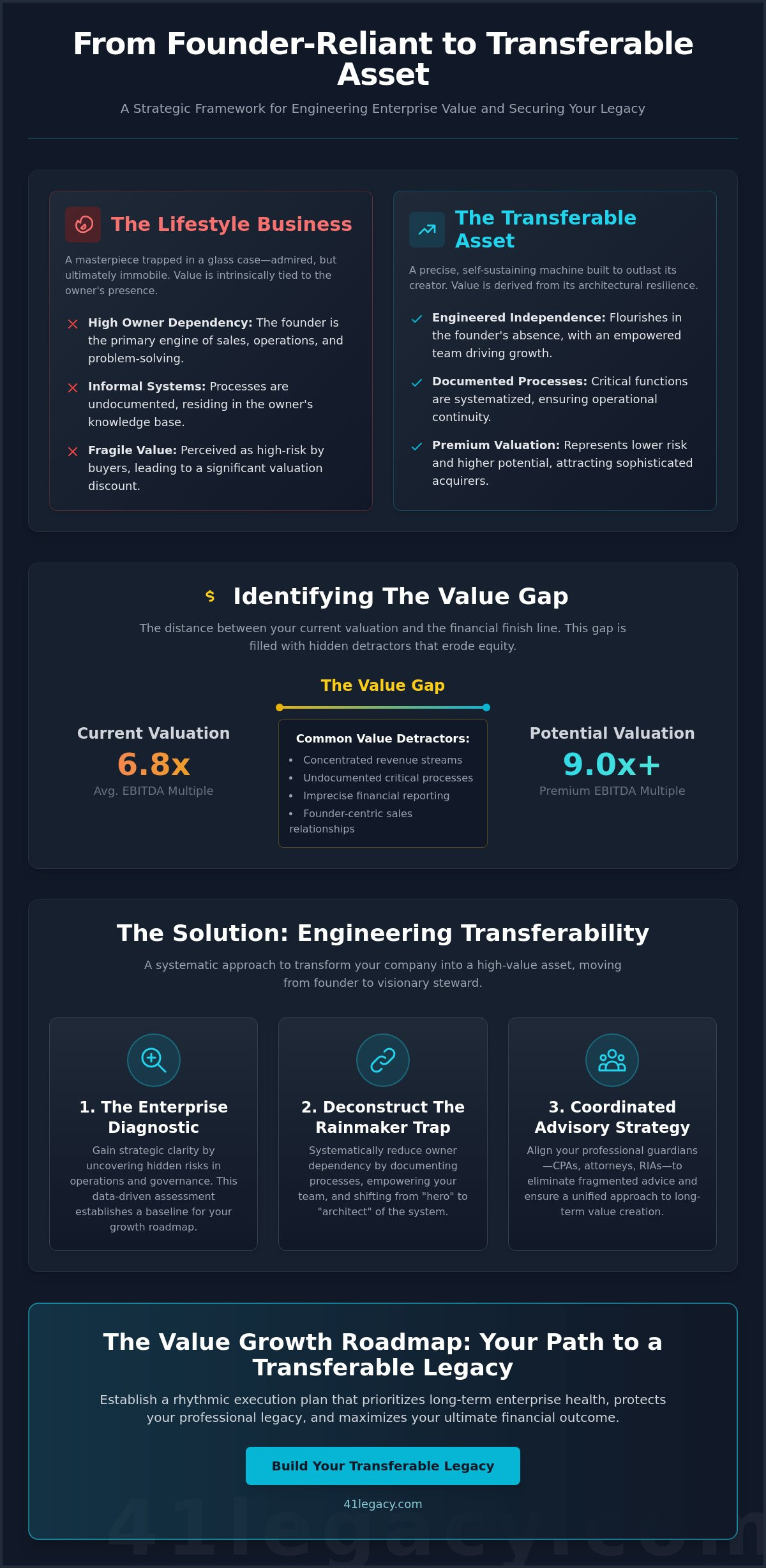
Engineering Transferability: Deconstructing the Rainmaker Trap
The Rainmaker Trap represents a profound paradox in the life of an entrepreneur. While your personal brilliance and sales acumen may have birthed the enterprise, that same dependency now acts as a tether, preventing the business from ascending to its true potential as a transferable asset. To a sophisticated buyer, a founder who is the primary driver of revenue isn't an asset; they're a risk. If the essence of the company’s success resides solely in your personal relationships or unique charisma, the business lacks the structural integrity required to survive your departure. To truly increase business value before selling, you must deconstruct this trap and reconfigure your workflows so the brand’s excellence remains consistent regardless of who is at the helm.
Transferability engineering is the process of extracting your personal "magic" and distilling it into repeatable systems. This isn't merely about delegating tasks. It's about building a culture of accountability where the mission drives the team rather than the founder’s daily intervention. When the team is united by a singular vision of perfection, the business begins to breathe on its own. This shift allows you to move from the role of the indispensable operator to that of a strategic steward, overseeing a legacy that is designed to endure.
The Architecture of SOPs
Tribal knowledge is a liability that erodes enterprise value. By transforming this unwritten wisdom into institutional capital through rigorous documentation, you provide a buyer with a warranty for their future success. These processes signal to an acquirer that the excellence they're purchasing is not a fluke but a deliberate result of engineering. Standard Operating Procedures are the blueprints of a legacy, ensuring the work continues with extreme precision. This level of detail removes the guesswork for a successor and solidifies the company’s reputation for reliability.
Management Team Autonomy
A business that requires your constant presence is a job, not a transferable asset. The "vacation test" is a simple yet brutal diagnostic: can your business grow if you're gone for 30 days? If the answer is no, your strategic capacity is limited by your own involvement. You must move from a "command and control" mindset to one of strategic oversight. This involves incentivizing key employees to stay through the transition and empowering them to make high-level decisions. Reducing owner dependency is the ultimate act of leadership, as it proves the enterprise has the strength to flourish independently of its creator. We help owners master this transition through structured Strategic Advisory, ensuring your team is prepared for the weight of stewardship.
The Coordinated Advisory Strategy: Aligning Your Professional Guardians
A masterfully engineered business requires a symphony of professional expertise, yet many owners find their advisors playing from different scores. This is the danger of siloed advice. Your CPA, attorney, and wealth advisor may each be brilliant in their respective disciplines, but without a central vision, their efforts often lack the cohesion necessary to maximize your enterprise's potential. To truly increase business value before selling, you must move beyond fragmented consultations and establish a coordinated advisory strategy. This approach ensures that every strategic decision is filtered through the lens of long-term transferability and the preservation of your legacy.
We view the role of a strategic advisor as the "Quarterback" of this professional room. This central figure coordinates your team of guardians toward a singular goal: exit readiness. Without this alignment, you risk leaving significant equity on the table. For instance, a decision made for immediate tax mitigation might inadvertently damage the structural integrity of your legal entity or complicate future due diligence. By centralizing the strategic vision, you ensure that tax planning, legal structure, and enterprise growth are all pulling in the same direction to maximize your net proceeds at the finish line.
Aligning the Professional Room
Traditional CPAs often focus on the historical narrative of tax mitigation, while an exit planner prioritizes the future-facing story of value growth. These are both necessary, but they must be reconciled. Your attorney plays a critical role here as well, cleaning up "corporate hygiene" and ensuring that contracts and governance documents are ready for the scrutiny of a sophisticated buyer. Our Strategic Advisory model prevents the expensive mistakes that occur when these professionals operate in isolation. We provide the common data set and the strategic framework that allows your guardians to work in harmony.
Accountability and Implementation
Strategic clarity is worthless without the discipline of execution. The journey to a successful transition is often a multi-year endeavor that requires monthly implementation support to keep the value growth roadmap on track. We help you overcome "advisor friction" by maintaining a steady rhythm of progress and ensuring that no detail is overlooked. By utilizing structured diagnostics, we provide a unified baseline for all your professional advisors, eliminating the guesswork and conflicting opinions that often stall a transition. If you are ready to bring order to your professional room, we invite you to explore our Strategic Advisory services to begin the process of alignment.
The Value Growth Roadmap: Cultivating a Transferable Legacy
The transformation of a business from a founder-led enterprise into a transferable legacy is an act of deliberate stewardship. It's a journey that requires more than just a list of improvements; it demands a multi-year roadmap that prioritizes high-impact value drivers with surgical precision. To truly increase business value before selling, you must move beyond the initial diagnostic and enter a rhythm of steady execution. This rhythmic progress ensures that every operational refinement strengthens the inner essence of the organization while modernizing the infrastructure that supports it. We view this process as the ultimate refinement of your life's work, turning a successful company into a masterpiece of institutional quality.
A structured roadmap provides the strategic clarity necessary to navigate the complexities of a transition. It prevents the common pitfall of attempting to solve every problem at once, which often leads to diluted effort and stagnant growth. Instead, we focus on a disciplined progression that builds momentum over time. This approach ensures that the business remains resilient and attractive to sophisticated acquirers who value structural integrity as much as historical performance. The final outcome is a business that serves as a crowning achievement, standing as a testament to your vision and dedication.
Phase-Based Implementation
- Phase 1: Risk Mitigation and Corporate Hygiene. We begin by fortifying the foundation. This involves cleaning up governance documents, securing intellectual property, and ensuring that financial reporting meets the highest standards of transparency.
- Phase 2: Operational Scalability and Owner Dependency Reduction. Here, we focus on engineering the systems that allow the business to breathe independently. We implement the SOPs and workflows that ensure the brand's essence is maintained without your daily intervention.
- Phase 3: Strategic Capacity Building and Market Positioning. The final phase prepares the business for the spotlight. We elevate your management team's strategic capacity and refine your market position to command the premium multiples your legacy deserves.
Your Legacy as a Transferable Asset
Building for transferability is simply the most sophisticated way to run a business, regardless of when you choose to transition. It creates an environment where excellence is systemic and growth is sustainable. This path provides a profound sense of peace, knowing that your employees, customers, and the essence of what you've built are protected. When a business can flourish in your absence, it has reached its highest form of value. We invite you to begin your journey toward exit readiness with 41 Legacy and transform your enterprise into a lasting asset that thrives for generations to come.
The Architecture of a Lasting Transition
The evolution of your enterprise into a transferable asset is the ultimate act of stewardship. We've examined how bridging the Value Gap and engineering independence allow you to increase business value before selling with absolute precision. By deconstructing owner dependency, you ensure that the essence of your brand remains uncompromised long after your departure. This transition requires the sophisticated alignment of your professional guardians, coordinated through a strategic framework that prioritizes the health of the entire organization.
At 41 Legacy, our process is led by a Certified Exit Planning Advisor (CEPA) who serves as the "Quarterback" for your advisory team. We specialize in long-term enterprise value growth, providing the strategic clarity needed to protect your future history. This is your opportunity to refine the machinery of your business until it stands as a self-sustaining crowning achievement. You've spent years building the foundation; now is the time to ensure the structure is built to endure.
Secure your legacy with a professional Exit Readiness Assessment. The masterpiece you've created deserves a transition defined by excellence and the peace of mind that comes from meticulous preparation.
Common Inquiries Regarding Enterprise Value Growth
How long does it typically take to increase business value before a sale?
Meaningful value growth typically requires a horizon of 24 to 36 months to achieve lasting results. This duration allows for the rhythmic implementation of new systems and provides a track record of performance that is independent of the founder. It takes time to prove to a sophisticated buyer that operational refinements are permanent fixtures rather than temporary spikes. Rushing this process often results in leaving significant equity on the table.
What is the single most important factor in increasing business value?
Transferability is the paramount driver of enterprise value in any industry. A business that functions with surgical precision without its founder is inherently more attractive to an acquirer because it represents lower risk. While revenue and profit margins are critical, they are secondary to the asset's ability to thrive on its own. Engineering this independence is the most effective way to secure a premium multiple at the finish line.
Can I increase my business value if I am the primary salesperson?
You can certainly increase business value before selling by systematically transitioning those sales relationships to a dedicated team or a robust process. While your personal charisma may have built the company, it's a liability to a buyer who cannot replicate your unique traits. Transforming your personal "magic" into a repeatable sales engine is a core requirement of transferability engineering and is essential for maximizing your net proceeds.
How does reducing owner dependency impact my daily operations?
Reducing owner dependency shifts your daily focus from tactical firefighting to strategic stewardship. As you implement structured diagnostics and empower your management team, operations become more predictable and less reliant on your constant intervention. This creates a more professional atmosphere and allows you to focus on high-level initiatives that further enhance the organization's intrinsic value. It's the transition from working in the business to working on the asset.
What is the difference between a business valuation and an exit readiness assessment?
A business valuation is a historical snapshot of what a company is worth today based on past financial performance. In contrast, an exit readiness assessment is a forward-looking diagnostic that evaluates the company's structural integrity and its capacity for a successful transition. While a valuation tells you the current price, the assessment provides the strategic clarity needed to improve that price by identifying and closing value gaps.
Why do I need a 'Quarterback' if I already have a CPA and an attorney?
A 'Quarterback' ensures that your professional guardians are aligned toward a singular strategic vision rather than operating in silos. While your CPA and attorney are experts in their specific disciplines, they often lack a unified framework for long-term value growth. This coordinated advisory model eliminates advisor friction and prevents expensive mistakes that occur when legal and tax strategies aren't perfectly integrated into a broader roadmap.
How do Standard Operating Procedures (SOPs) affect my company's multiplier?
SOPs act as a warranty for a buyer, signaling that your company's success is the result of deliberate engineering rather than tribal knowledge. By documenting every critical process, you reduce the perceived risk of the transition and ensure the brand's essence remains consistent. Buyers pay a premium for a business that offers a clear, repeatable blueprint for future performance, as it guarantees a smoother handoff and more predictable growth.
What happens if I try to sell my business without a value growth roadmap?
Attempting a transition without a roadmap often results in an arduous due diligence process and a lower final valuation. You'll likely encounter unexpected value detractors that a sophisticated buyer will use to negotiate more favorable terms for themselves. A structured plan ensures you are proactive rather than reactive, allowing you to increase business value before selling while protecting your legacy and ensuring your employees are well-positioned for the future.
Disclaimer
This article is for educational and informational purposes only and does not provide legal, tax, investment, or business brokerage advice. 41 Legacy does not offer M&A brokerage services, legal document drafting, tax preparation, or investment advisory services. Business owners should consult licensed professionals in those disciplines before making decisions related to business transactions, legal matters, tax strategy, or financial planning. All examples are illustrative and may not apply to your specific situation.