
How to Get Your Business Ready to Sell in 5 Years: A Master Plan for Transferability
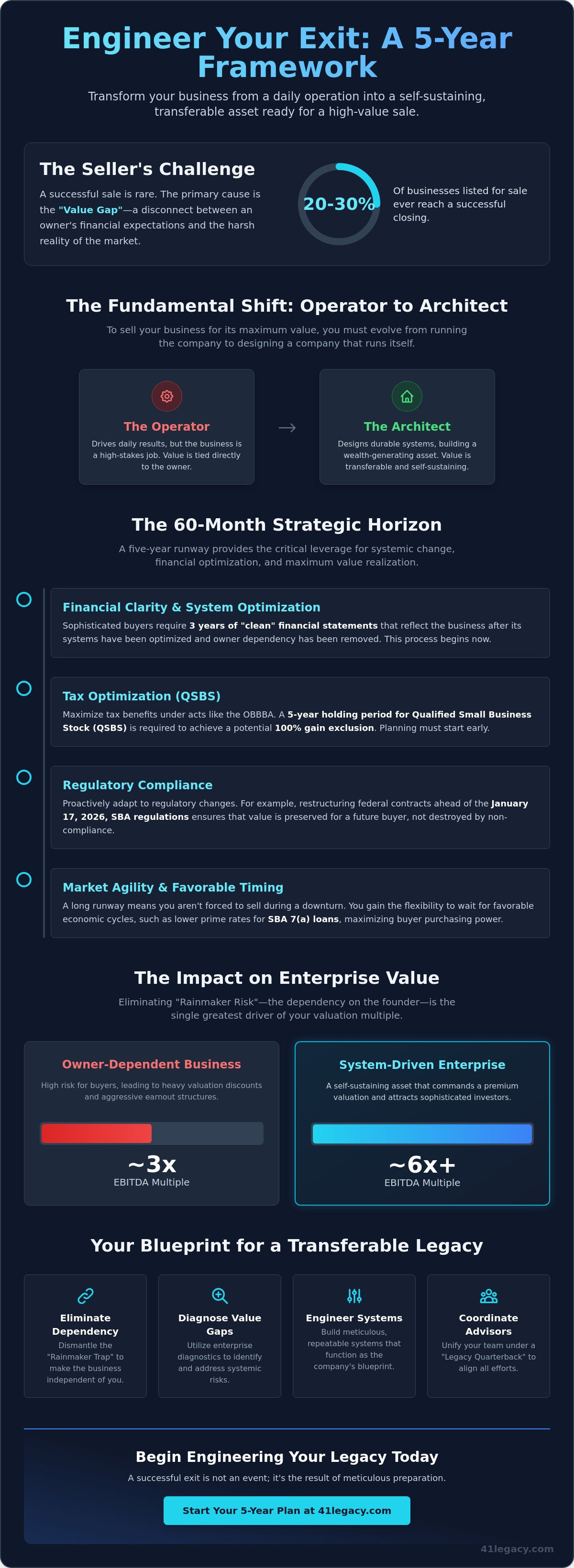
Only 20% to 30% of businesses that go to market ever reach a successful closing. For the dedicated owner, this statistic is a call to action; the legacy you have built requires more than just industry expertise to survive a transition. Learning how to get your business ready to sell in 5 years is the difference between a failed listing and a triumphant exit. It is a process of meticulous engineering. You must shift from being the engine of the company to the architect of a self-sustaining, transferable asset.
You likely recognize that your company remains too dependent on your daily involvement, creating a silent risk to its ultimate value. We believe a business should be a masterpiece of precision that functions independently of its creator. This guide provides the strategic framework to bridge the value gap and transform your operation into a high-value legacy over a deliberate sixty-month horizon. We will explore how to align your advisory team, optimize your enterprise value, and navigate the 2026 regulatory landscape to ensure your business is prepared for its next evolution.
Key Takeaways
- Shift your focus from daily operation to strategic stewardship, ensuring your company is perpetually prepared for a seamless and successful transition.
- Discover how to get your business ready to sell in 5 years by systematically eliminating owner dependency and dismantling the "Rainmaker Trap."
- Utilize enterprise diagnostics to identify the "Value Gap" and address the systemic risks that often hinder the transfer of a high-value asset.
- Apply the principles of transferability engineering to build meticulous, repeatable systems that serve as the blueprints for a self-sustaining enterprise.
- Learn to coordinate your team of professional advisors under a single "Legacy Quarterback" to ensure every financial and legal detail aligns with your ultimate vision.
The Five-Year Horizon: Shifting from Operator to Steward
Exit readiness is not a frantic response to a buyer's inquiry; it's a permanent state of excellence. For the business owner, this means the company is perpetually prepared for a transition, whether that occurs through an internal succession or an external sale. Achieving this level of maturity requires a fundamental shift from being an operator who drives daily results to a steward who guards the enterprise's long-term health. When you focus on how to get your business ready to sell in 5 years, you're essentially committing to a period of meticulous engineering. You're moving away from an income-driven model, which often functions as a high-paying job for the founder, toward a value-driven asset that generates wealth independently.
Statistics from 2025 indicate that only 20% to 30% of businesses that go to market actually close. This low success rate is usually the result of a "Value Gap," where the owner's financial expectations don't align with reality. By utilizing professional business valuation methods early in the process, you can identify hidden risks and structural weaknesses. At 41 Legacy, we view the next sixty months as a window to refine the soul of your business, ensuring it possesses the precision and soul required to attract a sophisticated successor.
Why Five Years is the Strategic Sweet Spot
A sixty-month horizon provides the leverage necessary for systemic change. It's the time required to decouple your personal identity from the brand, ensuring the company's reputation isn't tethered to a single individual. This timeframe is also vital for financial clarity. Sophisticated buyers typically require three years of "clean" financial statements that reflect the business after its systems have been optimized.
- Tax Optimization: Under the July 2025 One Big Beautiful Bill Act (OBBBA), Qualified Small Business Stock (QSBS) issued after July 4, 2025, requires a five-year holding period to reach a 100% gain exclusion. Starting your plan now ensures you maximize this benefit.
- Regulatory Compliance: New SBA regulations effective January 17, 2026, impact businesses with federal contracts. A five-year window allows you to restructure these agreements to preserve value for a future buyer.
- Market Agility: You aren't forced to sell during a downturn. If interest rates for SBA 7(a) loans, which sit at a 6.75% prime rate as of April 2026, fluctuate, you have the luxury of waiting for a more favorable cycle.
The Stewardship Mindset: Building for the Next Generation
Stewardship is the art of preservation. It involves transitioning from the mindset of "I am the business" to "I own a system." This evolution isn't just about efficiency; it's about the emotional weight of building something that outlasts your tenure. A steward views the business as a bespoke machine, where every process is documented and every role is defined. This perspective naturally increases market attractiveness because it reduces the "Rainmaker Risk." When a business can thrive without the founder's presence, its multiple of EBITDA often moves from the standard 3x toward the premium 6x range seen in larger small businesses during 2025. You're not just preparing for an exit; you're engineering a legacy that maintains its integrity long after you've stepped away.
Eliminating Owner Dependency: The Core of Transferability
If a business relies on the founder's daily presence to remain operational, it isn't a transferable asset; it's a high-stakes job. When you analyze how to get your business ready to sell in 5 years, the removal of the founder from the critical path of daily operations becomes your primary objective. Sophisticated investors seek businesses that run on systems and institutional knowledge rather than individual heroics. Owner dependency is the single greatest risk to enterprise value. It signals to a buyer that the "soul" of the company might depart the moment the owner walks out the door, leading to heavy valuation discounts or aggressive earnout structures.
To transition from an operator to a steward, you must perform a "Strategic Capacity Evaluation." This diagnostic measures the company's ability to maintain its growth trajectory and service quality without your oversight. Buyers often look for a decentralized leadership structure where decision-making is pushed down to a capable management team. If you're still the primary point of contact for your top 10% of clients, your business carries a significant "key person" risk that will deter institutional-grade buyers.
The Rainmaker Trap and Its Impact on Valuation
Many founders fall into the "Rainmaker Trap" by remaining the company's best salesperson or lead technician. While this drive initially builds the company, it eventually makes the enterprise worthless to an outsider. If you're responsible for generating 40% or more of new revenue, a buyer sees that revenue as highly unstable. By focusing on making your company sellable, you shift from a "Hub and Spoke" model, where you are the center of all activity, to a model where your team manages the relationships. In the 2025 market, businesses that demonstrated owner independence frequently commanded multiples at the higher end of the 3x to 6x EBITDA range.
Building Strategic Capacity in Your Leadership Team
The first 24 months of your five-year plan should focus on identifying and empowering "Second-in-Command" candidates. This isn't just about hiring; it's about the deliberate transfer of authority through structured delegation frameworks. You're moving from a culture of individual excellence to one of documented institutional knowledge.
- Identify Successors: Look for leaders who can manage the 15% customer concentration risk mentioned in current market trends.
- Document Authority: Create clear boundaries where managers can authorize expenditures or sign contracts without your signature.
- Test the System: Take a 30-day sabbatical in year three to see where the "engine" of your business sputters.
Developing a strategic roadmap for leadership transition ensures the precision of your operation remains intact after you depart. This management depth builds the trust required for a sophisticated investor to commit to a high-value acquisition.
Enterprise Diagnostics: Identifying and Closing the Value Gap
The restoration of a legacy requires more than aesthetic touch-ups; it demands a forensic understanding of every mechanical and structural component. Enterprise Diagnostics serve as this forensic tool, allowing you to discover hidden risks before they become deal-breakers. As you evaluate how to get your business ready to sell in 5 years, you'll likely encounter the Value Gap. This is the difference between what your business is worth today and what you need it to be worth to secure your financial future. Closing this gap is the primary objective of your sixty-month master plan.
Statistics from 2025 reveal a sobering reality: businesses that obtain a professional valuation from a certified appraiser tend to sell for 90% or more of their appraised value. In contrast, those navigating the market without one often settle for approximately 70%. This 20% variance isn't just a number; it's the result of strategic clarity. Diagnostics inform your Value Growth Roadmap, ensuring every hour spent in the next four years directly increases the enterprise's ultimate worth.
The Value Gap Diagnostic Process
The process begins by quantifying the Wealth Gap. This is the capital required to maintain your lifestyle after the transition. We then analyze the Profit Gap through industry benchmarks and pro forma analysis. If a "Main Street" business is currently valued at 2.5x Seller's Discretionary Earnings (SDE), we look for the systemic improvements that can push that multiple toward the 3x to 6x EBITDA range seen in larger enterprises. This diagnostic allows you to prioritize the levers that generate the most significant impact on your final proceeds.
Market Attractiveness vs. Operational Readiness
A profitable business isn't always an attractive one. Market attractiveness is an external metric influenced by industry trends and buyer demand. Operational readiness is internal; it's the strength of your systems and the depth of your management team. Sophisticated investors scrutinize 12-15 specific value drivers, including customer concentration and recurring revenue streams. If one client represents more than 15% of your revenue, buyers will negotiate price reductions to mitigate that risk. You can learn more about our Enterprise Diagnostics to see how your business measures up against these rigorous benchmarks.
Engineering a Transferable Asset: The Role of Precision Systems
Engineering a transferable asset is akin to restoring a vintage engine; every component must be documented, calibrated, and capable of operating under new ownership without losing its power. This meticulous approach is the hallmark of how to get your business ready to sell in 5 years, turning a chaotic operation into a polished asset. It moves beyond simple bookkeeping into the practice of precision systems. You're building a bespoke machine that is repeatable and reliable, ensuring the excellence you've cultivated isn't lost during the handoff. This transition requires a blend of artful leadership and rigorous engineering to create a legacy that survives its founder.
A sophisticated buyer isn't just purchasing your current revenue; they're purchasing the certainty that the revenue will continue. If your processes live only in your head, the business has no skeletal structure to support its weight once you depart. By focusing on how to get your business ready to sell in 5 years, you spend the middle years of your plan codifying your "secret sauce" into a transferable format. This systemic clarity reduces the perceived risk for investors and often leads to higher valuation multiples.
SOPs as the Currency of Transferability
Standard Operating Procedures (SOPs) are the blueprints of your legacy. They shouldn't be dusty binders but living documents that capture the precise mechanics of your operation. A comprehensive "Playbook" allows a new owner to step in seamlessly, maintaining the company's soul while scaling its reach. This documentation is the primary evidence of a business's maturity. You can discover the role of SOPs in business value through our structured advisory frameworks, which prioritize clarity over complexity.
De-risking the Enterprise for the Connoisseur Buyer
A connoisseur buyer—whether a private equity firm or a strategic competitor—looks for flaws in the engineering. They'll negotiate price reductions if they find high customer concentration. As of 2025, any single customer accounting for more than 15% of revenue is considered a major risk that could trigger earnout provisions or valuation haircuts. Meticulous documentation also extends to digital compliance. In 2026, buyers prioritize companies with transparent AI policies and updated customer data protections.
- Intellectual Property: Ensure all trademarks and proprietary processes are legally "walled" and fully transferable.
- Vendor Dependencies: Diversify your supply chain to ensure a single point of failure doesn't compromise the entire engine.
- Strategic Advisory: Use external experts to identify these vulnerabilities before they surface during formal due diligence.
Cleaning up these dependencies early in your five-year window allows you to present a "clean" asset to the market. You should assess your transferability risk today to identify these vulnerabilities before they impact your ultimate exit value.
The Legacy Quarterback: Coordinating Your Professional Advisory Team
The final phase of engineering a legacy asset requires the uncompromising alignment of all professional disciplines. Technical expertise, while essential, often exists in isolation. Your CPA, attorney, and wealth manager are specialists in their own right, yet they rarely collaborate on a single, unified objective. This lack of coordination is where enterprise value is frequently lost. When you master how to get your business ready to sell in 5 years, you introduce a "Legacy Quarterback" to ensure every tactical decision serves your ultimate exit goal. This role isn't about replacing your existing advisors; it's about harmonizing their efforts to protect the soul and the structural integrity of the enterprise you've built.
A business is a complex organism, and its transition is a delicate procedure. If your attorney focuses solely on risk mitigation while your wealth manager focuses on asset allocation, the strategic health of the business itself may be neglected. The Quarterback serves as the guardian of the exit goal, ensuring that every professional is working toward the same definition of success. This coordination is particularly vital when navigating the 2026 regulatory landscape, such as the new SBA rules effective January 17, 2026, regarding federal set-aside contracts. A "Legacy-First" approach ensures these technical details are handled with the precision of high-end engineering rather than as an afterthought.
Breaking Down Advisory Silos
Your CPA is a guardian of historical data and tax compliance, but they aren't naturally an exit planner. Similarly, a legal-first approach might protect you from liability while inadvertently creating friction for a future transition. Without a strategic anchor, these professionals work in silos, leading to conflicting advice that can stall a deal. The Quarterback uses the Value Growth Roadmap as the unifying document, ensuring everyone is playing from the same sheet music. Understanding how to get your business ready to sell in 5 years requires this level of interdisciplinary harmony.
For example, a decision to restructure for the 2026 corporate tax rate of 21% must also be weighed against the 3.8% Net Investment Income Tax (NIIT) that applies to single filers with a modified adjusted gross income above $200,000. When your advisors communicate, they can optimize your position for the 100% gain exclusion on Qualified Small Business Stock (QSBS) provided by the 2025 OBBBA. This level of sophistication is only possible when silos are dismantled in favor of a coordinated, strategic effort.
The Final 12 Months: Execution of the Roadmap
As you enter the final year of your sixty-month horizon, the focus shifts from value growth to transaction readiness. This is the implementation phase, where the meticulous documentation of the previous four years meets the scrutiny of the market. Accountability is paramount during this high-altitude period. Monthly implementation support ensures that the "engine" of your business is running at peak performance before you present it to a successor.
Coordination in these final months prevents the last-minute surprises that often derail transitions. It ensures that the "Value Gap" has been closed and that the systems you've engineered are truly transferable. You've spent years building a masterpiece; the final twelve months are about ensuring the world recognizes its worth. You can start your Value Growth Roadmap with 41 Legacy to ensure your advisory team is aligned and your enterprise is prepared for its next evolution.
Engineering Your Final Act of Stewardship
The transition of a business is the ultimate test of its structural integrity. By shifting from operator to steward and systematically dismantling the "Rainmaker Trap," you ensure the company's soul remains intact long after your departure. We've explored how a structured sixty-month horizon allows you to close the Value Gap and coordinate a professional advisory team under a single strategic vision. Mastering how to get your business ready to sell in 5 years is not about an immediate exit; it's about the meticulous creation of a transferable asset that thrives independently of its founder.
This journey requires the precision of a master craftsman. Led by a Certified Exit Planning Advisor (CEPA), our team provides the structured "Value Growth Roadmap" and specialized owner-dependency reduction needed to elevate your company's market attractiveness. You've spent years building a legacy; now is the time to ensure its permanence. Secure Your Legacy – Begin Your Exit Readiness Assessment today. Your commitment to excellence deserves a transition that is as seamless and sophisticated as the operation you've refined.
Frequently Asked Questions
How much is my business worth today compared to 5 years from now?
Your current value is likely dictated by a multiple of Seller's Discretionary Earnings (SDE), which for businesses under $2 million averaged 2.5x in 2025. By focusing on how to get your business ready to sell in 5 years, you aim to transition into a higher valuation tier. Businesses that operate independently of the owner and exceed $2 million in value typically command 3x to 6x EBITDA, potentially doubling your enterprise value through systemic optimization.
What is the difference between a business broker and an exit planning advisor?
An exit planning advisor is a strategic architect who engineers value years before a transition, whereas a broker facilitates the final transaction. Advisors work to improve transferability, reduce owner dependency, and close the "Value Gap" long before the company reaches the market. This proactive approach addresses the sobering reality that only 20% to 30% of businesses successfully sell, ensuring your legacy is prepared for a sophisticated successor.
Can I really reduce my business's dependency on me in just 5 years?
A sixty-month window is the ideal duration to decouple your personal brand from the enterprise. This timeframe allows for two years of rigorous system implementation followed by three years of clean financial statements that prove the business thrives without your daily involvement. It provides the necessary runway to build a management team capable of handling critical operations, which is the cornerstone of how to get your business ready to sell in 5 years.
What are the most common risks that devalue a business during a sale?
Owner dependency and high customer concentration are the primary drivers of valuation discounts. If any single client accounts for more than 15% of your revenue, buyers will likely negotiate price reductions or aggressive earnout provisions to mitigate their risk. Other significant devaluers include undocumented "secret sauce," unorganized financial records, and a lack of recurring revenue. Identifying these forensic details early in your five-year plan allows you to rectify them before due diligence begins.
Why do I need a 'Quarterback' if I already have a great CPA and Attorney?
A Quarterback ensures your specialized advisors aren't working in silos, which often leads to conflicting tactical advice. While your CPA focuses on tax compliance and your attorney on risk mitigation, the Quarterback aligns these efforts with your ultimate exit goal. This coordination is vital for complex maneuvers, such as optimizing for the 100% gain exclusion on Qualified Small Business Stock under the July 2025 regulations. Every professional must play from the same strategic sheet music.
What happens if I decide not to sell after 5 years of preparation?
You're left with a higher-performing, de-risked asset that provides you with ultimate lifestyle flexibility. The process of preparing for a sale is identical to the process of building a world-class, efficient company. If you choose to remain as a steward, you'll enjoy a business that generates superior cash flow with significantly less personal stress. You've essentially engineered a masterpiece that gives you the option to exit whenever the market is most favorable.
How does 'Transferability Engineering' differ from standard business consulting?
Transferability engineering is a forensic discipline focused specifically on making a business "pluggable" for a new owner. Standard consulting often pursues general growth, but our approach prioritizes the codification of systems and the removal of the founder from the critical path. We treat your business as a bespoke machine where every component must be documented and repeatable. This ensures the company's soul and performance remain intact regardless of who sits in the founder's chair.
What is an Exit Readiness Assessment and when should I get one?
An Exit Readiness Assessment is a comprehensive diagnostic that measures your company's current market attractiveness and operational maturity. It identifies the specific "Value Gap" between your current worth and your financial needs for the future. You should obtain this assessment at the very beginning of your sixty-month journey. It serves as the baseline for your Value Growth Roadmap, ensuring your efforts over the next five years are focused on the levers that generate the most impact.

Article by
Mike Laskowski
Mike Laskowski is a Business Value Growth Strategist who helps business owners uncover the truths that drive their performance, risk, and readiness. Blending forensic interviewing from a 26‑year federal career with Strategic Capacity analysis and CEPA methodology, he works upstream to reduce owner dependency, increase transferability, and strengthen enterprise value. Mike guides founders through clarity, operational evolution, and transition readiness so their companies become transferable, owner‑independent assets that endure beyond the founder.
Disclaimer
This article is for educational and informational purposes only and does not provide legal, tax, investment, or business brokerage advice. 41 Legacy does not offer M&A brokerage services, legal document drafting, tax preparation, or investment advisory services. Business owners should consult licensed professionals in those disciplines before making decisions related to business transactions, legal matters, tax strategy, or financial planning. All examples are illustrative and may not apply to your specific situation.