
How to Document Business Processes for Sale: Engineering a Transferable Asset
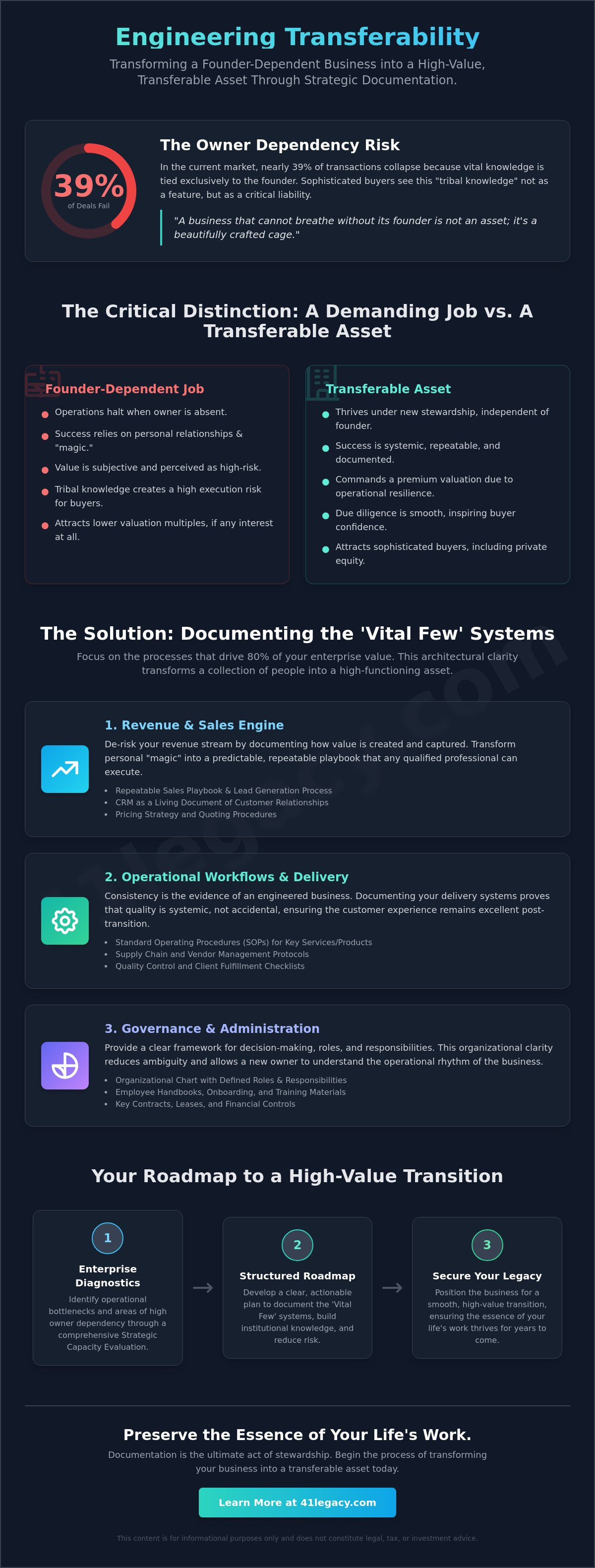
A business that cannot breathe without its founder is not an asset; it's a beautifully crafted cage. In the current 2026 market, nearly 39% of transactions fail because the owner remains the sole guardian of the company's vital knowledge. If your operation stops when you take a vacation, prospective buyers won't see a success story. They'll see a risk. Learning how to document business processes for sale is not an administrative burden; it's a form of transferability engineering that preserves the essence of your life's work and ensures it can survive the transition to new hands.
You likely feel that capturing every nuance of your operation is a tedious distraction from the work itself. We understand that your time is best spent on vision, not manuals. This article will show you how to transform your operational knowledge into a high-value, documented asset that commands a premium and ensures your legacy thrives independently. We'll examine the path to reducing owner dependency, providing you with a roadmap to maximize enterprise value and ensure your due diligence process remains a testament to your stewardship. By the end, you'll understand how to turn your daily execution into a well-oiled machine that functions with surgical precision, regardless of who is at the helm.
Key Takeaways
- Learn why documentation is the soul of enterprise value, transforming a founder-led company into a transferable asset that attracts sophisticated buyers.
- Discover how to document business processes for sale by focusing on the 'Vital Few' systems that contribute the most to your total enterprise value.
- Identify operational bottlenecks through a Strategic Capacity Evaluation to break the 'Founder’s Trap' and reduce owner dependency.
- Understand how to maintain 'Professional-Room Altitude' in your records, ensuring they are precise enough for due diligence yet accessible for your successors.
- Use Enterprise Diagnostics and a structured roadmap to uncover hidden risks and prepare your legacy for a smooth, high-value transition.
Defining Transferability: Why Documentation is the Soul of Enterprise Value
We believe a business should be more than a collection of tasks; it should be a masterpiece of engineering that stands independent of its creator. Many founders mistakenly believe they own an asset when they actually own a demanding job. The distinction lies in transferability. A transferable asset possesses the structural integrity to thrive under new stewardship, while a job-centric business collapses the moment the founder steps away. When you master how to document business processes for sale, you aren't just filing paperwork. You're refining the soul of the enterprise.
The "Value Gap" is a cold reality for the unprepared. In the 2026 market, professional buyers, including the private equity firms that now target 85% of small businesses, prioritize quality over volume. They seek predictable cash flow and operational resilience. A business without documentation is viewed as a high-risk gamble. Statistics from early 2026 indicate that owner dependency is a primary reason for deal collapse, cited in 39% of failed transactions. Without clear systems, a buyer assumes the risk of "execution failure," leading to significantly lower valuation multiples or the abandonment of the deal entirely.
The Buyer’s Perspective on Operational Risk
To a sophisticated acquirer, tribal knowledge is a liability. It's an invisible thread that, if broken, unravels the entire organization. We define transferability as the ease with which a new owner can replicate current success without the original founder's intervention. Implementing rigorous Business process management transforms these invisible threads into visible, durable cables. This shift has a profound psychological impact, replacing a buyer's anxiety with the confidence that the company's performance is systemic, not accidental.
Preserving the Essence of Your Life’s Work
Documentation is the ultimate act of stewardship. It's a gift you leave for the next guardian of your legacy. By articulating the "how" and "why" behind your success, you ensure that the company's culture and standards remain uncompromised after you depart. This strategic clarity protects the people and the mission you've spent years building. When you focus on how to document business processes for sale, you're not just preparing for an exit; you're ensuring that the essence of your life's work remains a lasting, impactful reality for generations to come.
The Critical Systems: What to Document for a Successful Exit
Precision is the hallmark of a master. In the context of an exit, this translates to identifying the "Vital Few" processes that drive 80% of your enterprise value. While financial statements provide a historical record of what has occurred, they fail to capture the mechanical excellence required to sustain it. A sophisticated buyer in the 2026 market sees a high-performing P&L and immediately asks if the success is a repeatable system or a founder's miracle. Mastering how to document business processes for sale requires a surgical focus on the systems that underpin your enterprise value.
We organize this documentation into a clear hierarchy: Governance, Revenue, and Operations. By mapping the customer journey, you create a primary framework that explains how value is created, captured, and delivered. This architectural clarity is what transforms a business from a collection of people into a high-functioning asset. It provides a definitive guide for the next steward on how to document business processes for sale while maintaining the integrity of the original vision.
Revenue and Sales Engine Documentation
The sales process is often the most founder-dependent area of a company. To build a transferable asset, you must document lead generation and conversion without relying on your personal "magic." This involves creating a repeatable sales playbook that any qualified professional can execute with precision. Your CRM should serve as a living document of customer relationships, ensuring that historical context and future opportunities are preserved for the incoming owner.
Operational Workflows and Delivery Systems
Consistency is the evidence of a well-engineered business. Standard Operating Procedures (SOPs) for product or service delivery ensure that quality remains high without your direct oversight.
- Implement quality control checkpoints to verify excellence at every stage of the process.
- Document supply chain and vendor management to ensure continuity of service.
- Define the technical standards that govern your production or service delivery.
The Organizational Blueprint
An organizational chart is more than a list of names; it's a roadmap for the buyer's first 100 days. It defines roles and responsibilities through the lens of future growth rather than past habits. Documenting the unwritten culture and values of the enterprise ensures that the spirit of the organization survives the transition. This blueprint allows a buyer to see exactly how the team functions and where strategic capacity exists for further expansion, turning the company into a truly autonomous entity.
A Master’s Approach to Process Documentation: Precision Without Complexity
Documentation is an act of curation. It requires the discerning eye of a master who knows what to highlight and what to leave in the background. When considering how to document business processes for sale, many owners fall into the trap of creating exhaustive, thousand-page manuals that no one reads. True excellence lies in "Professional-Room Altitude." This is the practice of keeping records strategic enough to provide clarity for a buyer, yet accessible enough for a team to execute daily without friction. We believe that clarity is the ultimate form of sophistication.
Mastering how to document business processes for sale means prioritizing plain language over complex jargon. If a process requires a dictionary to understand, it isn't transferable; it's a barrier. Modern documentation also embraces visual storytelling. Flowcharts, diagrams, and short video captures often convey more than pages of text ever could. These tools allow a new owner to grasp the rhythm of the enterprise instantly. By avoiding the "Over-Documentation Trap," you ensure your systems remain living, breathing entities rather than stagnant relics of a previous era.
The Collaborative Documentation Method
The most accurate records aren't written by the founder; they're authored by the specialists who perform the work. We advocate for a collaborative approach that empowers your team to document their own workflows. This ensures the technical precision of the front lines is captured faithfully. Conducting "Process Discovery" sessions allows you to surface hidden efficiencies without disrupting daily operations. These sessions are thoughtful reflections on how work actually flows. To maintain this momentum, we provide Monthly Implementation Support to ensure the documentation remains a priority. This structured cadence prevents the project from becoming a secondary administrative burden and keeps the focus on building a transferable asset.
Tools and Architecture for the Modern Enterprise
A master's workshop is organized with intent. Your company documentation requires a "Single Source of Truth." This is a central, digital repository where all processes live. It eliminates the confusion of scattered files and ensures that everyone is working from the same blueprint. Architecture matters. Your system must be searchable and intuitive so a new owner can find answers without calling you. Version control and regular audits are essential to preserve the integrity of the data. When your records are organized with this level of care, the due diligence process becomes a showcase of your company's internal health rather than a frantic search for answers.
Breaking the Founder’s Trap: Using Documentation to Reduce Owner Dependency
The "Rainmaker Trap" is a seductive illusion of success. Many founders believe their personal involvement in every high-level sale is a testament to their dedication, yet in reality, it signals to a buyer that the revenue engine is fragile. To secure a premium valuation, you must shift from being the primary driver to the architect of the system. This begins with a Strategic Capacity Evaluation. This diagnostic identifies the specific nodes where your involvement creates a bottleneck, preventing the enterprise from reaching its full potential.
True exit readiness is measured by the "Vacation Test." If you can step away for thirty days and return to a thriving, growing company, you have built a transferable asset. If the gears grind to a halt in your absence, you have merely built a complex job. Learning how to document business processes for sale provides the structural integrity needed to pass this test. It ensures that the company's momentum is fueled by its systems rather than your daily presence.
Transferring Authority, Not Just Tasks
Effective documentation captures the "Why" behind critical decisions, not just the "How" of mundane tasks. By systematizing your decision-making frameworks, you empower your management team to act with your level of discernment. This creates a management layer that serves as a protective buffer for the buyer. A business is only as valuable as it is independent of its creator. When authority is successfully transferred, the buyer sees a resilient organization capable of sustaining its own success.
Mitigating Key-Person Risk
Just as the business shouldn't depend on you, it shouldn't depend solely on a single "key person" in any department. Identifying these risks is a vital part of knowing how to document business processes for sale. We help owners implement cross-training protocols that serve as a form of operational documentation, ensuring that technical knowledge is distributed across the team. This process reduces the risk of institutional memory loss. You can learn more about reducing owner dependency on our homepage. By documenting these roles, you ensure the enterprise remains stable regardless of individual personnel changes.
To begin engineering your departure, consider an Owner Dependency Reduction strategy that transforms your personal expertise into a permanent corporate asset.
Engineering Your Legacy: How a Structured Roadmap Secures Your Future
The final phase of preparing your enterprise for transition is the most critical. It's the moment where individual systems are woven into a cohesive, high-value asset. We begin this refinement through Enterprise Diagnostics, a rigorous process designed to uncover hidden "Value Killers." These are the subtle operational risks or documentation gaps that, if left unaddressed, allow a buyer to negotiate a lower multiple. By identifying these friction points early, you can resolve them with the precision they deserve, ensuring your company remains in the high-performing tier of the 2026 market.
Successful transitions are rarely the result of a single effort. They require a coordinated symphony of expertise. We often serve in the "Quarterback" role, ensuring that your team of professionals, including CPAs and attorneys, is aligned with the ultimate goal of transferability. This coordination prevents the common fragmentation that occurs when advisors operate in silos. When everyone is working from the same Value Growth Roadmap, the documentation process aligns perfectly with your financial milestones, turning the abstract idea of "exit readiness" into a tangible, measurable reality.
The Role of the Strategic Advisory Team
A Certified Exit Planning Advisor (CEPA) understands that documentation must reflect market demand. It isn't enough to record what you do; you must record it in a way that satisfies the sophisticated requirements of modern acquirers. This is why we prioritize Monthly Implementation Support. Consistent, incremental progress is far more effective than a frantic, last-minute attempt to organize years of history. You can discover our Exit Readiness Assessment process to see how we evaluate the maturity of your systems and identify the specific steps needed to reach a premium valuation.
Your Next Chapter Starts Today
The process of learning how to document business processes for sale is ultimately about peace of mind. It's the quiet confidence that comes from knowing your life's work is protected and that your team is prepared to thrive without you. There is a common adage in our craft: the best time to document your business was five years ago. The second best time is today. By taking action now, you shift your role from an exhausted owner to a visionary steward who has engineered a transferable masterpiece.
We invite you to consider the legacy you wish to leave behind. Through structured Strategic Advisory and a commitment to excellence, you can ensure that your transition is not just a transaction, but a successful hand-off of a living, breathing entity. Your next chapter depends on the structural integrity you build today. Let us help you master how to document business processes for sale so your enterprise can stand as a testament to your dedication for years to come.
The Final Architecture of Your Legacy
You've explored the transition from a founder-led company to a high-functioning, autonomous entity. By mastering how to document business processes for sale, you provide the structural evidence that your success is systemic rather than accidental. This meticulous recording of your most critical systems bridges the gap between your years of dedication and a buyer's requirement for institutional stability. It's the final act of stewardship that ensures your company's essence remains intact long after your departure.
We approach this transition as dedicated guardians of your history. Our CEPA-led advisory team provides the structured Value Growth Roadmap necessary to elevate your enterprise value through technical precision and strategic clarity. We act as the quarterback for your transition team, ensuring seamless coordination with your CPAs and attorneys to protect every nuance of your life's work. It's about more than a transaction; it's about the preservation of an impact.
Secure Your Legacy with a Comprehensive Exit Readiness Assessment
Your business is a masterpiece of your own creation. It deserves a future that honors its heritage while embracing its potential to thrive under new stewardship.
Frequently Asked Questions
How long does it typically take to document a business for sale?
A comprehensive transformation typically requires six to twelve months of deliberate effort. This timeline allows for the identification, capture, and testing of systems without disrupting the company's daily rhythm. Rushing the process often leads to shallow records that fail to withstand the scrutiny of due diligence. By starting early, you ensure the documentation is a true reflection of operational excellence rather than a last-minute administrative burden.
What is the single most important document a buyer looks for?
The most vital document is the Revenue Playbook. Buyers look for proof that lead generation and sales conversion are systemic rather than dependent on your personal relationships. This playbook should detail the customer journey with surgical precision. It demonstrates that the company's growth is a repeatable result of its engineering, which provides the buyer with the confidence required to offer a premium price.
Do I need to document every single minor task in my company?
You don't need to document every minor task. Focus on the Vital Few processes that drive 80% of your enterprise value. Excessive detail creates noise and leads to stagnation. Maintain a Professional-Room Altitude by documenting the strategic workflows and quality control checkpoints. This approach ensures your records are precise enough for a successor but flexible enough for the team to evolve as the market changes.
How do I keep my team from panicking when I start documenting everything for a sale?
Frame the initiative as a pursuit of operational excellence and team empowerment. Explain that clear documentation reduces their daily friction and provides a roadmap for their own professional growth. When the team sees that systems create a more stable, less chaotic environment, they become active participants in the process. This shift in perspective transforms the project from a perceived threat into a shared commitment to the company's legacy.
Can I use AI to help document my business processes?
AI is an excellent tool for initial process mapping and data synthesis. You can use it to transcribe discovery sessions or draft initial outlines from raw notes. However, a master's touch is required to refine these drafts into strategic assets. When exploring how to document business processes for sale, use AI for the heavy lifting of transcription while reserving the architectural decisions for your senior leadership and advisors.
What happens if my processes change during the sale process?
Documentation should be treated as a living entity that evolves with the enterprise. It's natural for processes to be refined even during a transition. Maintaining strict version control ensures that the buyer is always looking at the most current blueprint. Transparency about these improvements actually builds trust. It shows the buyer that the organization possesses a culture of continuous improvement and operational resilience.
Is there a specific software you recommend for SOPs?
The specific platform is less important than the underlying architecture and accessibility. You should look for a Single Source of Truth that allows for easy searching, video integration, and clear version control. Whether you choose a dedicated SOP platform or a robust project management tool, the goal is to ensure the new owner can find answers intuitively. We recommend evaluating tools based on how well they facilitate cross-departmental clarity.
How does documentation specifically impact the EBITDA multiple?
Documentation directly influences the risk profile of your enterprise. In the 2026 market, owner dependency is cited as a reason for 39% of failed transactions. By providing clear evidence of transferability, you reduce the execution risk for the buyer. This risk reduction justifies a higher valuation multiple, as the buyer is purchasing a predictable system. Understanding how to document business processes for sale is the most direct path to protecting your enterprise value.

Article by
Mike Laskowski
Mike Laskowski is a Business Value Growth Strategist who helps business owners uncover the truths that drive their performance, risk, and readiness. Blending forensic interviewing from a 26‑year federal career with Strategic Capacity analysis and CEPA methodology, he works upstream to reduce owner dependency, increase transferability, and strengthen enterprise value. Mike guides founders through clarity, operational evolution, and transition readiness so their companies become transferable, owner‑independent assets that endure beyond the founder.
Disclaimer
This article is for educational and informational purposes only and does not provide legal, tax, investment, or business brokerage advice. 41 Legacy does not offer M&A brokerage services, legal document drafting, tax preparation, or investment advisory services. Business owners should consult licensed professionals in those disciplines before making decisions related to business transactions, legal matters, tax strategy, or financial planning. All examples are illustrative and may not apply to your specific situation.