
How to De-Risk Your Business for Sale: A Strategic Guide to Building a Transferable Asset
The most profound legacy an owner can leave is a business that no longer requires their presence. You've spent years refining your craft and building a firm with meticulous care, yet you likely feel a lingering uncertainty about its true enterprise value. It's a common paradox; the very dedication that built the company often becomes the owner dependency that threatens its future. Understanding how to de-risk your business for sale is not merely a defensive tactic for a transaction. It's a strategic evolution that transforms a personal occupation into a sophisticated, transferable asset.
We understand the weight of this transition and the desire for your life's work to endure. This guide provides a professional framework to help you identify and eliminate the hidden risks that quietly erode valuation. You'll gain a clear roadmap to increase market attractiveness and ensure your enterprise functions with the precision of a fine instrument, independent of your daily oversight. We'll examine the specific diagnostics and value growth strategies required to secure the maximum financial return your heritage deserves.
Key Takeaways
- Recognize how risk acts as the inverse of enterprise value and why quantifying your "Value Gap" is the essential first step toward a meaningful exit.
- Master the art of neutralizing owner dependency to ensure your business functions as a transferable asset that thrives independently of your daily presence.
- Uncover the specific operational vulnerabilities, such as high customer concentration, that cause sophisticated buyers to penalize your company's market multiple.
- Follow a structured framework for how to de-risk your business for sale by utilizing enterprise diagnostics to prioritize the most impactful value-growth initiatives.
- Understand the critical distinction between standard transactional support and the strategic advisory required to preserve the integrity of your life's work.
Defining Risk as a Lever for Enterprise Value
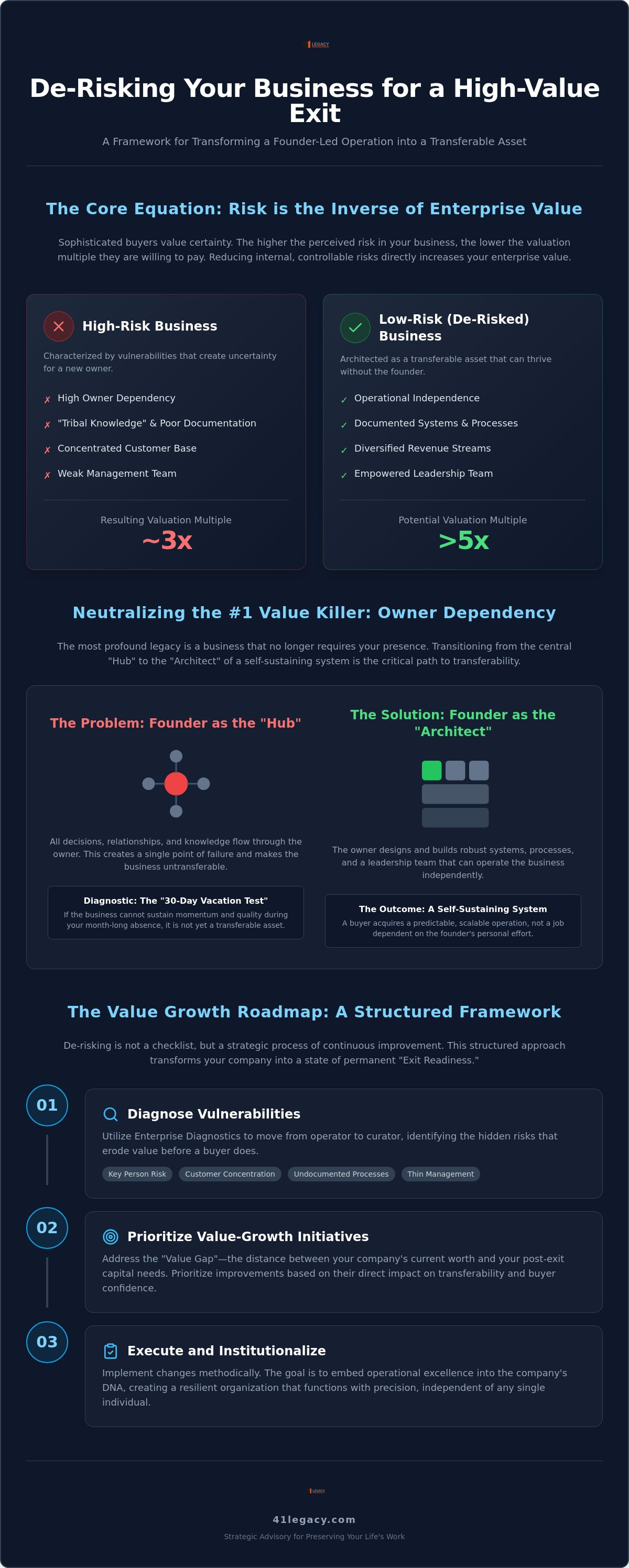
Risk is the silent architect of valuation. While many owners focus exclusively on top-line growth, the sophisticated steward understands that true value is preserved through the meticulous removal of uncertainty. In the context of exit planning, risk acts as the inverse of value. The higher the perceived uncertainty within your operations, the lower the multiple a buyer is willing to pay. It's a simple, uncompromising equation that dictates the final reward for your life's work.
We must first define the "Value Gap." This is the distance between the current market worth of your enterprise and the specific capital required to fund your post-exit aspirations. Closing this gap isn't only about increasing revenue. It's about making that revenue more "certain" for a successor. You cannot control systemic market fluctuations or federal interest rates, but you have absolute authority over idiosyncratic risks. These are the internal friction points, such as poor documentation or thin leadership, that you can mitigate with precision. Learning how to de-risk your business for sale involves a transition from viewing "Exit Readiness" as a final checklist to seeing it as a continuous state of operational excellence.
The Buyer's Lens: How Risk Impacts the Multiple
A buyer views your business through the lens of a discount rate. They aren't just buying your past success; they're buying the right to your future cash flows. A company that commands a 5x multiple can see that figure drop to 3x overnight if the buyer discovers that revenue depends entirely on the founder's personal relationships. Transferability is the currency of the exit. Enterprise risk is the probability that future cash flows will not persist after the owner departs. When you reduce this probability, you aren't just preparing for a sale; you're engineering a more resilient and valuable organization today.
Identifying the 'Value Gap' Through Diagnostics
We utilize Enterprise Diagnostics to uncover the hidden vulnerabilities that often go unnoticed during the daily rush of operations. This process requires a profound psychological shift. You must move from the role of an active operator to that of a curator of a transferable asset. By identifying these "Value Killers" early, you can prioritize improvements based on their potential return on investment. Establishing clear financial goals and understanding how to de-risk your business for sale ensures that your eventual transition is a triumph of deliberate strategy rather than a compromise of necessity.
Neutralising Owner Dependency: The Path to a Transferable Asset
The most enduring enterprises are those designed to thrive in the founder's absence. Many owners fall into the "Rainmaker Trap," where their personal brilliance as the primary salesperson or lead technician becomes the very thing that devalues the company. To a buyer, an owner who serves as the "Hub" for every decision represents a significant point of failure rather than a strength. True stewardship requires you to step back and become the "Architect" of a self-sustaining system. Learning how to de-risk your business for sale starts with acknowledging that if you are the business, there is nothing for a successor to acquire.
Transitioning from the "Rainmaker" role often reveals the physical and mental toll that years of intense leadership have taken on an owner. For high-performers seeking to maintain peak performance during this shift, 5280 Restorative Medicine offers functional medicine solutions to help executives reclaim their vitality and prepare for a successful next chapter.
A simple yet profound diagnostic tool for this transition is the "Vacation Test." If your business cannot sustain its momentum during a thirty-day absence, it lacks the structural integrity required for a high-value exit. This test reveals exactly where the "tribal knowledge" resides and where the systems are fragile. By removing yourself from the daily friction of operations, you prove to prospective buyers that the company's essence is contained within its structure, not just its founder.
The Architecture of a Self-Sustaining Management Team
Building strategic capacity means empowering a second-tier management team that possesses both the authority and the technical skill to lead. Institutional investors are often deterred by "Key Person" risk, fearing that your departure will lead to a collapse in client retention or operational quality. To mitigate this, you must identify key roles that must function independently and implement long-term incentives that align their success with the company's future. This creates a narrative of stability that commands respect and preserves the legacy of your work.
Transferability Engineering and Process Maturity
A sophisticated buyer is not merely purchasing your past revenue; they're acquiring the systems that generate it. Moving from informal "tribal knowledge" to documented, repeatable excellence is the essence of transferability engineering. It ensures that the company's inner essence is preserved through a transition, regardless of who sits in the executive chair. Utilizing 41 Legacy's Enterprise Diagnostics allows you to measure this maturity with surgical precision, identifying exactly where operational friction points exist. By refining these processes, you transform a personal occupation into a transferable asset. If you're ready to evaluate your current standing, our Strategic Capacity Evaluation can provide the clarity needed to begin this evolution.
Operational Integrity and Structural De-Risking
The structural integrity of an enterprise is not merely a matter of balance sheets; it's a reflection of the meticulous care invested in its foundation. To build a truly transferable asset, one must look beyond the surface of profitability and examine the underlying framework that supports it. Operational de-risking is the process of identifying and reinforcing the load-bearing elements of your company. It ensures that the beauty of what you've created isn't compromised by hidden fractures. When you understand how to de-risk your business for sale, you aren't just tidying up for a transaction. You're fortifying the enterprise so it can withstand the scrutiny of the most disciplined institutional buyers.
Standard Operating Procedures (SOPs) serve as the blueprints for this continuity. They translate the artisan's intuition into a repeatable system that a successor can operate with precision. Without these documented rituals, the business remains a personal performance rather than a plug-and-play asset. A company with high operational integrity is one where excellence is captured in process, ensuring that the quality of service remains consistent long after the founder has departed.
The Danger of Customer and Vendor Concentration
Concentration is a fracture in the foundation of your legacy. If a single client represents more than 15% of your total revenue, you've introduced a significant vulnerability that sophisticated buyers will penalize. This "single point of failure" risk often prevents a buyer from securing necessary acquisition financing, as lenders view the revenue stream as precarious. To mitigate this, we develop a roadmap to diversify your client base and supplier network. Diversification ensures that the loss of one relationship doesn't destabilize the entire structure. It's a strategic move that transforms a fragile income stream into a resilient, transferable asset.
Financial Transparency and Pro Forma Accuracy
Financial records are the provenance of your business. There's a profound difference between "tax-ready" books, which aim to minimize liability, and "sale-ready" books, which highlight the true earning power of the company. Normalizing EBITDA is an essential exercise in financial hygiene. It involves identifying legitimate "add-backs"—such as one-time expenses or owner-related costs—that reflect the actual profitability a new steward would inherit. Every contract and piece of intellectual property must be legally assignable, ensuring that the transition of ownership is seamless. By polishing your financial narrative with surgical precision, you provide a defensible account of value that commands respect. This level of transparency is a core pillar of how to de-risk your business for sale, providing the clarity required for a successful and lasting transition.
Executing the Value Growth Roadmap
The transition of an enterprise is rarely a single event; it's a sequence of intentional acts. While identifying risks is a vital first step, the true preservation of value occurs during the execution of a structured plan. This process moves through four distinct phases that turn abstract vulnerabilities into concrete strengths. It's a journey that demands technical precision and a refusal to settle for less than operational perfection.
Phase 1 begins with the Diagnostic. This is a surgical assessment designed to uncover "Value Killers," those hidden friction points that quietly erode your market multiple. Once these are identified, we move to Phase 2: the creation of a prioritized Roadmap. Not all risks are equal. We focus on mitigation efforts that offer the highest return on investment and the greatest ease of implementation. Phase 3 is the Implementation phase, where monthly accountability ensures that strategic goals aren't lost to the noise of daily operations. Finally, Phase 4 is Verification. We measure the actual increase in enterprise value over a 12 to 24-month period, providing the defensible proof of worth that sophisticated buyers demand. Understanding how to de-risk your business for sale requires this level of disciplined, chronological focus.
Prioritising Your De-Risking Efforts
Focus is the rarest commodity in business leadership. When considering how to de-risk your business for sale, it's essential to first address the "low-hanging fruit." These are the immediate valuation bumps, such as clarifying customer contracts or formalizing a leadership meeting rhythm, that require minimal capital but offer significant clarity. We employ a "Quarterback" approach to this work. This involves aligning your existing team of specialists, including your CPA and attorney, with the overarching exit strategy. Utilizing a Value Growth Roadmap ensures that every professional is moving in harmony toward a singular objective: the creation of a premier, transferable asset.
The Role of Monthly Implementation Support
Most exit plans fail not because of poor strategy, but because of a lack of implementation. The daily demands of the business often pull the owner back into the role of the "operator," causing strategic initiatives to stall. This is why third-party accountability is a necessity for the business owner who values their legacy. The Quarterback acts as the guardian of the owner's long-term legacy. By providing a steady, unhurried rhythm of support, we ensure that the transformation remains on course. If you seek to move beyond theory and begin the work of engineering a more valuable company, we invite you to explore our Strategic Advisory services.
The Coordinated Advisory Team: Protecting Your Life's Work
The preservation of a legacy is a collective masterpiece. While your current advisors are undoubtedly skilled in their respective disciplines, the strategic evolution required for a transition often falls outside their traditional scope. A CPA ensures historical accuracy, and an attorney mitigates legal liability, yet neither is inherently designed to engineer enterprise value or reduce owner dependency. To truly master how to de-risk your business for sale, you need a central point of coordination that bridges these professional silos. It's the difference between maintaining a set of documents and curating a transferable asset.
We distinguish between transactional advice and strategic enterprise advisory. Transactional support focuses on the mechanics of a deal, whereas strategic advisory focuses on the health and transferability of the asset long before a buyer arrives. By acting as the Quarterback, we ensure that every professional on your team is moving in harmony toward a singular goal: the protection of your life's work. This collaborative approach prevents the strategic drift that often occurs when advisors operate in isolation, ensuring that every tactical decision contributes to the overall strength of the enterprise.
Aligning Your Professional Advisors
Coordination is the antidote to friction. When tax planning, legal protection, and value growth initiatives are handled as separate entities, the business owner often faces conflicting guidance. We align these professional efforts so that "Exit Readiness" becomes the primary filter for every major business decision. This synchronized approach ensures that the transition of ownership is seamless and that the integrity of the company remains intact. By reducing the administrative and strategic friction between your advisors, you create a clear path toward a high-value exit that respects the history of the firm.
The 41 Legacy Commitment to Excellence
Our mission is defined by a profound reverence for what you've built. We operate at the rare intersection of technical precision and the preservation of essence, treating your business with the same care a curator would a private collection. We believe that a successful transition is the ultimate testament to an owner's stewardship. It's about ensuring that the company you've spent a lifetime building can thrive under new leadership without losing its core identity.
If you're ready to understand the true potential of your enterprise, we invite you to begin your journey with an Exit Readiness Assessment. This formal diagnostic is the first step in discovering how to de-risk your business for sale while maximizing the financial return your dedication deserves. Together, we can ensure that your enterprise functions as a sophisticated, transferable asset that serves as a lasting tribute to your professional legacy.
Engineering Your Final Act of Stewardship
The journey from active founder to successful steward concludes with a deliberate transformation of your enterprise into a self-sustaining asset. We've explored how risk serves as the primary lever for valuation and why neutralizing owner dependency is the essential prerequisite for a high-value exit. By focusing on operational integrity and following a structured roadmap, you ensure the essence of your company survives the transition. Understanding how to de-risk your business for sale is the ultimate act of professional precision, protecting both your financial future and the impact of your life's work.
Our mission is to guide you through this evolution with the surgical expertise of a Certified Exit Planning Advisor (CEPA). Through our unique "Quarterback" approach, we coordinate your existing advisors to ensure every tactical move supports a singular, elevated vision of transferability engineering. Don't leave the culmination of your career to chance or market fluctuations. Secure your legacy with an Exit Readiness Assessment from 41 Legacy to uncover your true enterprise value. You've spent years building something exceptional; it's time to ensure it endures.
Frequently Asked Questions
What is the single biggest risk that devalues a business during a sale?
Owner dependency is the primary "Value Killer" that devalues an enterprise. A business that relies on the founder's personal relationships or unique technical skill is perceived as a high-risk liability rather than a transferable asset. If the company's success is tied to your daily presence, a buyer will significantly discount the multiple to account for the uncertainty of your departure.
How long does it typically take to de-risk a business before it's ready for market?
Strategic de-risking typically requires 12 to 24 months of focused implementation. This timeline allows for the successful transition of responsibilities to a leadership team and ensures that financials reflect the new, more resilient operational structure. This period is essential to prove that the company's excellence is repeatable and independent of the founder.
Can I de-risk my business without hiring an M&A broker?
You can certainly begin this process without a broker, as de-risking is an operational evolution rather than a transactional event. This phase is about building a better company today. Understanding how to de-risk your business for sale is best handled through strategic advisory and enterprise diagnostics that focus on internal value growth long before a sale process begins.
What is the difference between an Exit Readiness Assessment and a business valuation?
A valuation provides a snapshot of current worth based on historical data, while an Exit Readiness Assessment identifies the specific risks preventing that worth from being higher. The assessment serves as a diagnostic tool to uncover operational friction and owner dependency. It provides a roadmap for improvement, whereas a valuation is simply a backward-looking financial calculation.
How does customer concentration specifically affect my company's multiple?
High customer concentration increases the discount rate applied to your earnings by introducing a single point of failure. When one client represents more than 15% of your revenue, buyers see a higher probability of revenue collapse if that relationship ends. This perceived instability leads to a lower multiple compared to a business with a diversified and resilient client base.
Is it possible to reduce owner dependency if I am the primary 'face' of the brand?
It is possible through deliberate "Transferability Engineering" and the empowerment of a leadership team. You must shift the brand's identity from your personal charisma to a documented methodology or a unique system of delivery. By codifying your expertise into repeatable processes, you ensure the brand's essence is preserved even when you are no longer the primary representative.
What role does an SOP play in the due diligence process?
Standard Operating Procedures (SOPs) provide the objective evidence of operational maturity that sophisticated buyers demand. They demonstrate that your cash flow is generated by a repeatable system rather than individual heroics. During due diligence, clear SOPs reduce the buyer's anxiety and provide confidence that the business can be transitioned without a loss in quality or performance.
How do I know if I have a 'Value Gap' in my retirement planning?
You have a Value Gap if the projected net proceeds from your current business valuation are insufficient to fund your desired post-exit lifestyle. Identifying this gap is a core part of how to de-risk your business for sale. It allows you to prioritize specific value growth initiatives that bridge the financial divide between your current worth and your future capital needs.

Article by
Mike Laskowski
Mike Laskowski is a Business Value Growth Strategist who helps business owners uncover the truths that drive their performance, risk, and readiness. Blending forensic interviewing from a 26‑year federal career with Strategic Capacity analysis and CEPA methodology, he works upstream to reduce owner dependency, increase transferability, and strengthen enterprise value. Mike guides founders through clarity, operational evolution, and transition readiness so their companies become transferable, owner‑independent assets that endure beyond the founder.
Disclaimer
This article is for educational and informational purposes only and does not provide legal, tax, investment, or business brokerage advice. 41 Legacy does not offer M&A brokerage services, legal document drafting, tax preparation, or investment advisory services. Business owners should consult licensed professionals in those disciplines before making decisions related to business transactions, legal matters, tax strategy, or financial planning. All examples are illustrative and may not apply to your specific situation.