
How to Close the Business Value Gap: A Strategic Guide for Enterprise Transferability
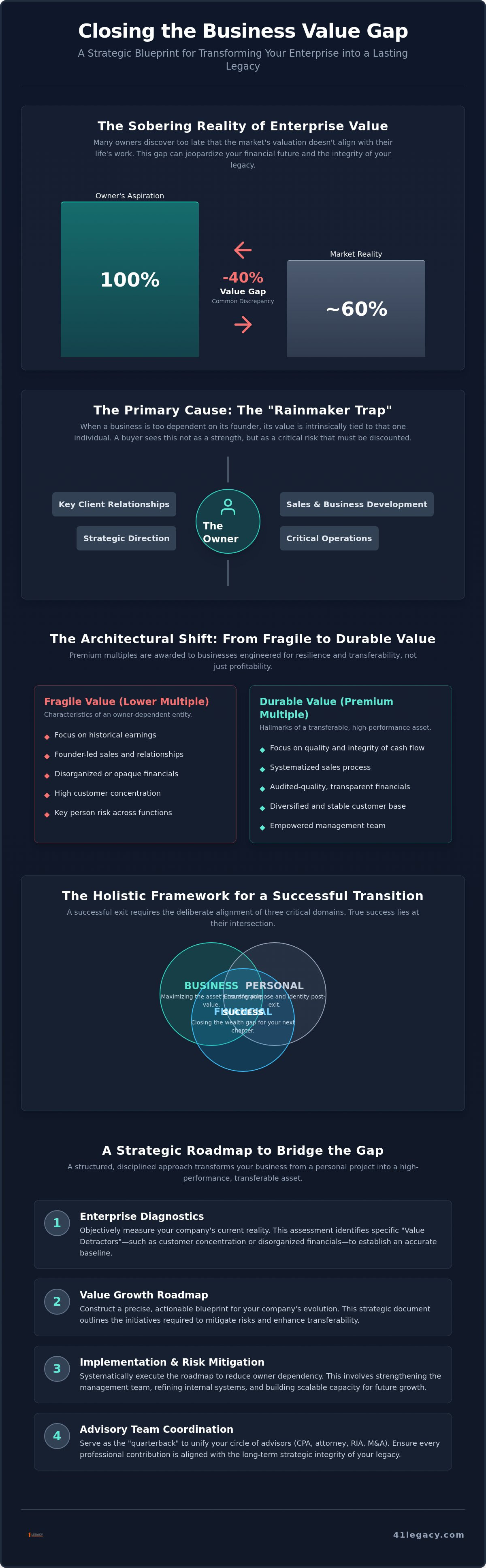
What if the enterprise you've spent decades refining is worth forty percent less than the legacy you intended to leave? It's a sobering realization that often arrives too late; specifically when an owner prepares to step away and discovers the market doesn't share their internal valuation. We believe your business is more than a series of transactions. It's a living entity that requires a specific, technical precision to reach its full potential. Understanding how to close the business value gap isn't merely a financial exercise. It's an act of stewardship that ensures your company’s essence survives your departure.
You likely feel that your dedication should naturally translate into a premium exit, yet you may worry that the company is currently too dependent on your daily presence. We agree that a business should be a transferable asset that thrives independently of its founder. This guide provides the precise methodology to identify, measure, and bridge the divide between your current standing and your ultimate goals. We'll examine the mechanics of transferability, the reduction of owner dependency, and the essential coordination of your advisory team to secure your lasting impact.
Key Takeaways
- Recognize the discrepancy between internal estimates and market reality to protect the net proceeds required for your next chapter.
- Shift focus from mere earnings to the architecture of value, prioritizing transferability as the ultimate measure of an enterprise’s health.
- Master the methodology of how to close the business value gap by identifying and mitigating the risks associated with excessive owner dependency.
- Implement a structured roadmap that begins with enterprise diagnostics to transform your company into a standalone, transferable asset.
- Learn to coordinate your circle of advisors through a unified strategy, ensuring every professional contribution serves the long-term integrity of the legacy.
Defining the Business Value Gap: A Matter of Legacy and Logic
The enterprise you've built is more than a ledger of profit and loss. It is the culmination of years of calculated risk and relentless dedication. Yet, for many owners, a profound discrepancy exists between the perceived worth of their life's work and the actual market reality. This is the Value Gap. It represents the distance between your current enterprise value and the net proceeds required to fund your next chapter without compromise. To ignore this gap is to risk the integrity of your legacy. It forces a choice between a diminished lifestyle and a delayed exit. Understanding how to close the business value gap is not merely a financial strategy; it is a fundamental act of stewardship for everything you have created.
A rigorous Business valuation serves as the mirror for this reality. While an owner may see the historical sweat equity and the "essence" of the brand, a buyer sees risk and transferability. When these perspectives diverge, the gap widens. Bridging this divide requires a blend of technical precision and strategic vision, ensuring the business is prepared to stand on its own merits.
The Three Circles of Exit Planning
Successful transition requires harmony between three distinct yet intersecting spheres. The Business Circle focuses on the asset itself, refining its internal systems to maximize its worth. The Personal Circle addresses the founder’s identity, ensuring there is a compelling purpose waiting beyond the boardroom. Finally, the Financial Circle quantifies the "Wealth Gap," which is the specific dollar amount your portfolio needs to sustain your standard of living post-exit. If any circle is neglected, the entire structure of your transition becomes unstable. We believe that true success is found only at the intersection of these three disciplines.
Enterprise Diagnostics: Measuring the Current Reality
You cannot bridge a distance you haven't accurately measured. Moving beyond "gut feelings" requires Enterprise Diagnostics. This objective assessment identifies the "Value Detractors" that silently erode your company's potential sale price. These detractors often take the form of disorganized financials, customer concentration, or excessive owner dependency. By establishing this baseline, we can construct a precise Value Growth Roadmap. This strategic document serves as the blueprint for your company’s evolution. It transforms the business from a founder-led entity into a transferable asset that can thrive independently of your daily presence. This is the first essential step in how to close the business value gap and secure the future of your enterprise.
The Architecture of Value: Identifying the Primary Drivers
True enterprise value is an architectural achievement, not a fortunate accident of the market. While many owners fixate on EBITDA as the sole measure of success, sophisticated buyers look at the structural integrity of the cash flow. This explains why two companies with identical earnings can command wildly different multiples. One is a fragile collection of processes dependent on a founder, while the other is a resilient machine designed for growth. Understanding how to close the business value gap requires a shift from income-focused thinking to risk-focused engineering. By refining the inner essence of the organization, we transform it from a personal project into a high-performance asset.
Strategic capacity is a critical, often overlooked driver. It represents the ability of your business to scale without adding proportional complexity or strain. A business that hits a ceiling every time it grows is a liability for a buyer. According to the Corporate Finance Institute on bridging the valuation gap, the discrepancy between an owner's expectation and a buyer's offer often stems from these hidden operational risks. Identifying "Red Flags" during the early stages of enterprise diagnostics prevents deal fatigue and ensures the foundation is solid before any transition begins.
Financial Performance vs. Financial Quality
Premium multiples are reserved for those who treat their financials with the reverence of a master artisan. It isn't enough to be profitable; your books must be beyond reproach, reflecting clean, audited-quality data that leaves no room for doubt. Recurring revenue serves as the rhythmic heartbeat of a stable enterprise, providing the predictability that de-risks future projections for a successor. Pro forma statements serve as the bridge between current historical performance and the future potential a buyer is actually purchasing by illustrating the business's health once owner-specific expenses are removed. Our team provides Enterprise Diagnostics to help you uncover these opportunities for financial refinement.
The Switzerland Structure
A business that relies on a single pillar is a fragile structure. We advocate for the "Switzerland Structure," where the entity remains neutral and independent of any single customer, supplier, or key employee. Diversification is a powerful tool for de-risking the enterprise, ensuring that the departure of one individual or the loss of one contract doesn't threaten the whole. When the business ceases to rely on the "Rainmaker" for its survival, its market attractiveness increases exponentially. This independence is the hallmark of a transferable asset, allowing the company to thrive on day one of a new era.
The Rainmaker Trap: Why Owner Dependency Widens the Gap
There exists a profound paradox in the life of an enterprise. The very brilliance that fuels a company’s inception often becomes the primary obstacle to its ultimate liberation. When a founder’s personal genius is the engine of every critical decision, the business ceases to be a transferable asset and instead becomes a high-stakes extension of the individual. This is the Rainmaker Trap. To a successor, your essentiality is not an asset; it is a significant liability. Understanding how to close the business value gap requires a candid, often difficult assessment of the founder’s role within the daily rhythm of operations. If the essence of the company cannot survive your absence, the market will discount its worth accordingly.
Most businesses operate under a "Hub and Spoke" model, where every vital process, relationship, and strategic choice flows directly through the founder. This structure creates a ceiling on growth and a floor on valuation. We utilize Transferability Engineering to extract this tribal knowledge and crystallize it into the company’s structural DNA. Owner Dependency Reduction is perhaps the most immediate lever available to increase an EBITDA multiple. By shifting the weight of the enterprise from your shoulders to a resilient system, you transform a founder-led project into a legacy-grade institution.
Standard Operating Procedures (SOPs) as Intellectual Property
We view Standard Operating Procedures not as mere manuals, but as the intricate blueprints of a transferable masterpiece. These documents serve as the intellectual property that de-risks the transition for a new steward. When processes are documented with surgical precision, the perceived risk of a successor failing on day one vanishes. This documentation builds a culture of accountability where excellence is a repeatable system rather than a sporadic act of founder oversight. It ensures that the "how" of your success is preserved long after your departure.
Talent Development and Management Teams
A business’s true worth is often found in the depth of its second-tier management. Transitioning from a "Founder-Led" to a "Management-Run" organization is a vital step in how to close the business value gap. This evolution requires identifying and incentivizing key employees to remain as guardians of the company’s future. By empowering a team to carry the strategic weight, you demonstrate to the market that the enterprise possesses the independent capacity to scale. This management depth provides the stability that sophisticated buyers prize, ensuring the impact of your work continues to resonate through time.
A Strategic Roadmap to Close the Gap in 5 Steps
Closing the distance between your current valuation and your ultimate exit goal isn't a matter of chance. It's a deliberate sequence of refinement. This roadmap serves as the technical blueprint for your company’s evolution, ensuring that every action taken increases the structural integrity of the asset. By following a structured methodology, we move beyond the chaos of daily operations and into the clarity of strategic growth. This sequence is the definitive answer for how to close the business value gap while preserving the essence of what you've built.
- Step 1: Conduct an Exit Readiness Assessment. We begin by establishing a truthful starting point, identifying the operational and structural barriers that currently limit your market attractiveness.
- Step 2: Quantify the Wealth Gap. In collaboration with your financial advisor, we define the exact net proceeds required to fund your post-exit life, providing a concrete target for our value growth efforts.
- Step 3: Implement Value Growth Roadmaps. We focus on high-impact drivers, specifically building Strategic Capacity so the business can scale without adding proportional complexity or founder strain.
- Step 4: Execute Monthly Implementation Support. Strategy without execution is merely a wish; we provide the consistent accountability needed to ensure these refinements take hold.
- Step 5: Coordinate the Professional Advisory Team. We align your CPA, attorney, and wealth manager into a unified front, ensuring every professional contribution serves the singular goal of a successful transition.
Strategic Advisory and Implementation
There's a significant chasm between knowing what to do and actually getting it done. Many owners possess the vision but lack the capacity to manage the granular technical changes required for transferability. This is why we prioritize Monthly Implementation Support over one-time projects. Consistent advisory maintain the "professional-room altitude" necessary to see the business as an outsider would. It ensures that the momentum of value growth isn't lost to the gravity of daily fires. We invite you to begin this journey with our Exit Readiness Assessment to illuminate the path forward.
De-Risking the Enterprise
Value isn't just about what you make; it's about what a buyer fears they might lose. De-risking the enterprise involves a meticulous "due diligence" pre-check, addressing legal, operational, and environmental risks before they ever reach a buyer’s desk. It's like cleaning the house before the guests arrive. When you eliminate these "Red Flags," you directly reduce the discount rate a buyer applies to your cash flow. This technical refinement is the most direct way to understand how to close the business value gap, as a de-risked business always commands a premium multiple.
The Quarterback Role: Coordinating Your Advisory Team
A masterpiece is never the result of a single, isolated brushstroke. Similarly, a successful transition requires the harmonious coordination of multiple disciplines. Business owners often find themselves at the center of a storm of conflicting advice. The CPA focuses on immediate tax mitigation; the attorney prioritizes risk containment; the wealth manager looks toward the future portfolio. Without a central vision, these silos create friction that stalls progress. This lack of coordination is a primary reason why many find it difficult to understand how to close the business value gap with precision. At 41 Legacy, we embrace the "Quarterback" model. We act as the strategic lead to ensure every professional advisor is aligned with the same Value Growth Roadmap.
Strategy requires harmony. We provide the technical lead. Our specialists utilize the CEPA (Certified Exit Planning Advisor) methodology to harmonize these voices, transforming a collection of independent advisors into a high-performance team. This designation is the gold standard in professional exit planning, ensuring that the business, personal, and financial circles of your life are in perfect alignment. By acting as the guardian of your enterprise value, we protect the integrity of your transition from the fragmentation that often plagues uncoordinated exits.
Aligning Tax, Legal, and Strategic Decisions
High-impact growth strategies must never create unforeseen tax liabilities. By coordinating with your legal counsel on Transferability Engineering and corporate structure, we ensure the business remains an attractive, clean asset for a successor. A unified front doesn't just reduce stress. It maximizes exit readiness by presenting a professionally curated enterprise to the market. This unified approach is the final, essential component in how to close the business value gap through strategic coordination.
Building a Transferable Legacy
We invite you to view your role not merely as an owner, but as a temporary steward of an enduring institution. The goal is to build an entity that can thrive for the next 41 years and beyond. This long-term perspective shifts the focus from a quick transaction to the creation of a lasting impact. When the business is built to outlast its founder, it becomes a true legacy. Secure the future of your life's work today. Discover how our Exit Readiness Assessment can identify your gap today.
Securing Your Enterprise Legacy
Your enterprise is the definitive statement of your life's work. We've explored the architecture of value and the necessity of extracting your personal genius into resilient systems. Understanding how to close the business value gap is ultimately an exercise in technical precision and strategic coordination. By utilizing Transferability Engineering and our structured Quarterback advisory model, you ensure that your company's essence remains intact through the transition. Every step taken to reduce owner dependency is a step toward a more resilient and valuable future.
Led by a Certified Exit Planning Advisor (CEPA), our specialists provide the strategic depth required to transform a founder-led business into a legacy-grade institution. It's time to move beyond the daily gravity of operations and focus on the long-term health of your asset. We invite you to Request Your Exit Readiness Assessment to begin the process of refining your masterpiece. Your dedication deserves a transition that reflects the true worth of your stewardship and ensures your impact continues for years to come.
Frequently Asked Questions
What is the difference between a Value Gap and a Wealth Gap?
The Value Gap is the discrepancy between your company’s current worth and its potential value or the amount needed from a sale to fund your next act. In contrast, the Wealth Gap is the specific shortfall in your personal investment portfolio required to sustain your standard of living once you no longer have a business salary. We address both by refining the business's architectural strength to ensure the eventual transition satisfies your total financial requirements.
How long does it typically take to close a significant business value gap?
Significant enterprise transformation typically requires a horizon of three to five years to achieve lasting results. This duration provides the necessary runway to implement robust systems, develop a second-tier management team, and demonstrate consistent performance independent of the founder. Rushing this process often compromises the structural integrity of the asset and fails to convince sophisticated buyers of the company's long-term stability.
Can a business have a high valuation but still be untransferable?
A company can possess high earnings but remain untransferable if those profits are tied exclusively to the founder's personal relationships or specialized skills. In these instances, the "essence" of the business is the individual rather than the organization itself. Without Transferability Engineering to decouple the owner from daily operations, the business remains a personal project rather than a transferable asset that can thrive under new stewardship.
How do I know if I have a value gap before I'm ready to sell?
You can identify a discrepancy early by conducting an Exit Readiness Assessment or Enterprise Diagnostics long before you intend to depart. These diagnostics provide an objective view of your company’s marketability compared to your internal expectations. Discovering how to close the business value gap during a period of operational strength gives you the strategic advantage of time to implement refinements without the pressure of an immediate exit.
Why isn't my CPA already closing the value gap for me?
Most CPAs focus on historical reporting and tax compliance, which are vital for the health of the enterprise but distinct from strategic value growth. Closing the gap requires a forward-looking advisory model that prioritizes operational transferability and risk mitigation rather than just financial post-mortem. We serve as the strategic lead, coordinating with your CPA to ensure their technical expertise supports your broader goal of enterprise value growth.
What is the most common reason for a business failing to sell at its desired price?
The most frequent cause for a failed transition is the "Rainmaker Trap," where the business cannot prove it will survive the founder's departure. Buyers are inherently risk-averse and will discount or abandon deals where operational knowledge is not documented or the management team is underdeveloped. This lack of structural independence creates a gap that no amount of top-line sales growth can bridge on its own.
How does owner dependency specifically impact a business's valuation multiple?
Owner dependency acts as a significant "risk premium" that buyers apply to your cash flow, which directly depresses your valuation multiple. A business that relies on the founder for sales or technical execution is seen as a fragile investment; therefore, it commands a lower multiple than a peer company with a standalone management team. Reducing this dependency is the most effective way to increase the multiple applied to your earnings.
Is it possible to close the value gap without significantly increasing sales?
It is entirely possible to increase your company’s worth by refining its internal architecture rather than just chasing top-line revenue growth. By improving your transferability and reducing operational risks, you command a higher multiple for your existing profit. This approach focuses on the quality of the earnings, ensuring the business is a more attractive and de-risked asset that can thrive independently for the next generation.

Article by
Mike Laskowski
Mike Laskowski is a Business Value Growth Strategist who helps business owners uncover the truths that drive their performance, risk, and readiness. Blending forensic interviewing from a 26‑year federal career with Strategic Capacity analysis and CEPA methodology, he works upstream to reduce owner dependency, increase transferability, and strengthen enterprise value. Mike guides founders through clarity, operational evolution, and transition readiness so their companies become transferable, owner‑independent assets that endure beyond the founder.
Disclaimer
This article is for educational and informational purposes only and does not provide legal, tax, investment, or business brokerage advice. 41 Legacy does not offer M&A brokerage services, legal document drafting, tax preparation, or investment advisory services. Business owners should consult licensed professionals in those disciplines before making decisions related to business transactions, legal matters, tax strategy, or financial planning. All examples are illustrative and may not apply to your specific situation.