
Transferability & Owner Dependency
How to Build a Transferable Business for Maximum Value
What if the masterpiece you've spent decades crafting remains unfinished because you're the only artisan who knows how to hold the brush? Many founders discover too late that their constant involvement, while vital for initial growth, has become the primary constraint on their company's ultimate worth. You've poured your life into this endeavor; it's natural to feel that your personal touch is what defines the brand. However, a truly transferable business is one where the essence of the enterprise is preserved through systems and strategic precision rather than individual effort.
We recognize the profound sense of stewardship you feel toward your organization. It's difficult to step back when you've been the architect of every success. Our focus is to help you transition from a founder-dependent operation into a sophisticated, independent asset that commands maximum enterprise value. This article explores how to bridge the Value Gap and establish a clear roadmap for exit readiness. You'll learn to refine your internal structures so your legacy isn't just a memory, but a thriving, permanent entity that functions flawlessly without you.
Key Takeaways
- Distinguish between transient annual profits and the enduring value of a transferable business that functions independently of its creator.
- Recognize the "Founder’s Trap" and implement strategies to reduce owner dependency, making the enterprise more resilient and attractive to successors.
- View standard operating procedures as the essential architecture of your company, protecting the essence of your work through technical precision.
- Coordinate your advisory team toward a unified goal to ensure that strategic clarity is never lost in the silos of separate disciplines.
- Utilize an Exit Readiness Assessment to diagnose your current standing and build a bespoke roadmap for long-term enterprise growth.
Defining Transferable Value: Why a Profitable Business Isn't Always a Transferable One
Profitability is often mistaken for worth. While a healthy bottom line is essential for survival, it doesn't guarantee that your enterprise possesses true market appeal. A transferable business is defined not by its past earnings, but by its ability to generate future results under new ownership. If the gears of your company stop turning the moment you step away, you haven't built an asset; you've created a high-stakes job. Sophisticated buyers don't just purchase historical cash flow. They invest in the systems, culture, and structural integrity that ensure those profits continue without your personal intervention.
Establishing this baseline requires a rigorous look at your current state through Enterprise Diagnostics. This process uncovers the hidden friction points that decrease your multiple. While a standard business valuation might reflect your current financial health, it often fails to account for the qualitative risks that a buyer will use to negotiate a lower price. True value lies in the predictability of the machine you've built. We believe that clarity is the first step toward lasting impact; you cannot refine what you haven't first measured with precision.
The Concept of the Value Gap
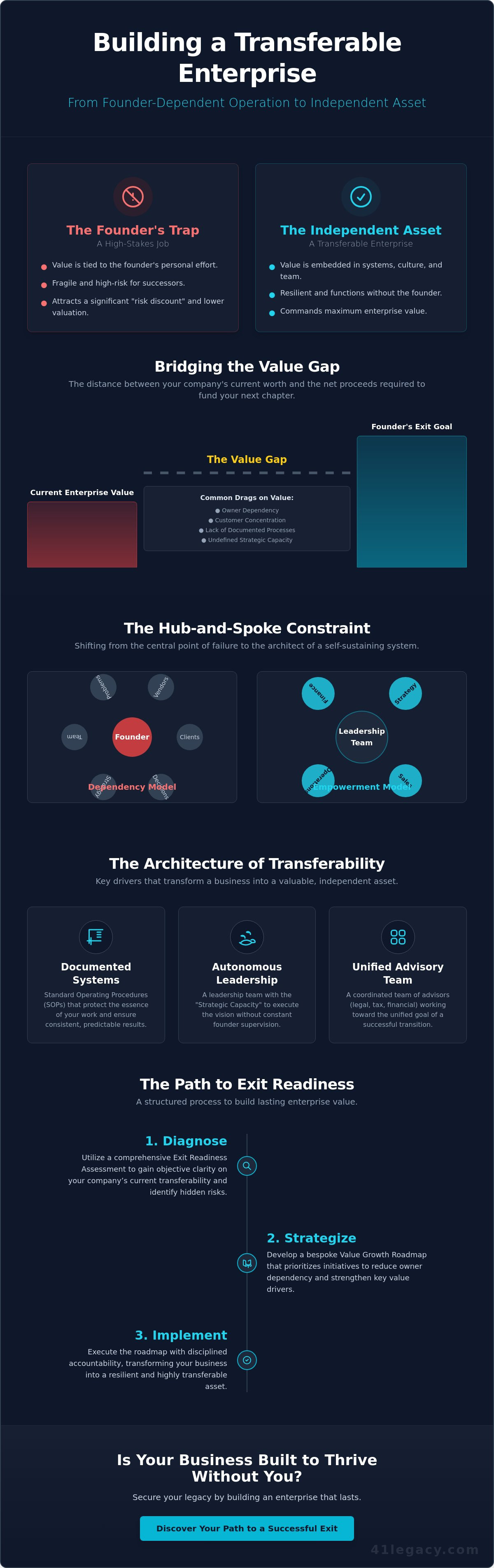
Many founders operate under the assumption that their business will naturally fund their next chapter. However, there's often a significant distance between what the company is worth today and the net proceeds required to sustain a founder's post-exit lifestyle. This discrepancy is widened by unrecognized risks, such as customer concentration or a lack of documented processes, which act as a heavy drag on your potential transfer price. The Value Gap is the critical metric for every steward of a business, representing the distance between current reality and the freedom of a fully realized exit.
The Steward vs. The Rainmaker
Being the company's most effective salesperson or its primary problem solver is a structural weakness, not a badge of honor. When you're the "Rainmaker," the business's success is tied to your individual charisma and effort. This makes the enterprise fragile. Building a transferable business requires a profound psychological shift. You must move from being the central hub of every decision to becoming a steward who empowers a self-sustaining system. This transition transforms the company from a founder-dependent operation into a sophisticated asset that thrives independently of its creator, ensuring your legacy is preserved through excellence rather than effort.
The Founder's Trap: Identifying and Reducing Owner Dependency
The founder’s presence often becomes the very ceiling that limits a company’s growth. In the early years, your direct involvement was the catalyst for every milestone; however, as the enterprise matures, this reliance evolves into the "Hub-and-Spoke" model. In this structure, every critical decision and relationship flows through a single point: you. This creates a fundamental risk for any potential successor. If you're the primary source of the company’s essence, a buyer sees a fragile entity that might crumble once you depart. To build a truly transferable business, you must decouple your personal identity from the operational mechanics of the firm.
Market attractiveness is inextricably linked to the autonomy of your team. When an organization is owner-dependent, valuation multiples suffer because the risk of failure increases during a transition. Sophisticated investors look for "Strategic Capacity," which is the ability of your leadership team to execute the vision without constant supervision. Identifying and cultivating this capacity within your existing ranks is a technical necessity for long-term preservation. You aren't just managing people; you're engineering a self-sustaining asset that holds its value regardless of who sits in the corner office.
The Litmus Test for Transferability
Consider a simple, yet profound question: Could your business survive a 90-day absence by its founder? For many, the honest answer reveals hidden operational bottlenecks and single points of failure. True transferable business value is proven when the machine continues to hum in your absence. Reducing owner dependency is the most effective way to eliminate the "risk discount" applied during transitions. It requires a meticulous audit of your daily functions to identify which tasks can be delegated through a Strategic Capacity Evaluation.
Empowering the Next Generation of Leadership
Transitioning from command-and-control to strategic oversight is a difficult but essential evolution. This shift demands a culture of accountability where the next generation of leadership is given the agency to make decisions and the structure to correct course when necessary. Talent development isn't a soft skill; it's a rigorous value driver. By investing in the growth of your team, you ensure that the company’s standards remain intact long after your tenure ends. This creates a legacy that is both durable and exceptionally valuable in the eyes of the market.
Engineering Transferability: Key Value Drivers and Roadmaps
Engineering a transferable business requires a fundamental shift from reactive management to proactive design. While many view transferability as a final polish applied before an exit, it's actually a foundational structural requirement. It involves identifying the specific levers that drive enterprise value and meticulously refining them over time. This process ensures that the organization’s worth is anchored in its internal mechanics rather than the owner's daily presence. A well-engineered business is a masterpiece of coordination, where every department functions as a synchronized component of a larger, high-performance machine.
A structured Value Growth Roadmap serves as the definitive guide for this transformation. This isn't a generic checklist, but a bespoke strategy designed to increase valuation multiples by addressing specific operational weaknesses. For instance, moving beyond simple tax returns toward strategic forecasting provides the financial transparency that sophisticated successors demand. It demonstrates a level of professional-grade oversight that distinguishes a legacy asset from a standard small business. By focusing on long-term health rather than short-term gains, you build a company that is prepared for any transition, whether internal or external.
The Role of Systems and Documentation
Standard Operating Procedures serve as the technical blueprint of the enterprise. They provide the precision necessary to replicate excellence across every client interaction, ensuring that the brand’s essence remains intact during a transition. SOPs are the artistry of a well-run firm. They are the primary tool for standardizing excellence, allowing the business to deliver consistent results without the founder's constant intervention. When processes are documented with surgical clarity, the "keys" to the business represent a functional system rather than a collection of unwritten rules.
De-risking the Enterprise
De-risking is an essential stage in building a transferable business. Certain "Red Flags," such as high customer concentration or a lack of recurring revenue, can stop a transition in its tracks. If a single client represents more than 15% of your total revenue, the enterprise is inherently fragile in the eyes of a buyer. Identifying these vulnerabilities early allows for strategic intervention. We provide the diagnostic tools necessary to uncover these hidden risks before they impact your exit. You can learn how 41 Legacy helps owners engineer transferability by addressing legal, financial, and operational vulnerabilities through a disciplined advisory framework.
The Quarterback Model: Aligning Your Advisory Team for Exit Readiness
A masterpiece is never the result of isolated efforts; it requires the perfect synchronization of every discipline involved. The problem of the "Siloed Advisor" is a common vulnerability for established founders. Your CPA, attorney, and wealth manager may each be masters of their respective crafts, yet they often operate within private chambers. Without a unified objective, their advice can become contradictory, creating a fragmented strategy that fails to serve the ultimate goal of enterprise value. This lack of coordination is often where the most significant risks to your legacy reside.
Creating a truly transferable business is a team sport that demands a central "Quarterback" to oversee the entire process. This role isn't about replacing your existing specialists; instead, it's about acting as the guardian of your vision across all professional disciplines. By ensuring that every tactical decision aligns with the long-term roadmap, the Quarterback transforms a collection of disconnected tasks into a harmonious progression toward exit readiness. This elevated level of oversight ensures that the essence of your work is never compromised by administrative friction.
Coordinating the Professional Advisory Team
A Certified Exit Planning Advisor (CEPA) serves as this essential coordinator, bridging the gap between business value and personal legacy. This structure significantly reduces "Advisory Fatigue" for the owner, who no longer needs to repeat the same narrative to multiple firms. Instead, the Quarterback ensures that tax strategy, legal structure, and personal wealth goals are in perfect alignment. This creates a strategic clarity that is often missing in traditional advisory relationships, allowing the founder to focus on stewardship rather than mediation.
Monthly Implementation and Accountability
A plan that sits on a shelf is merely a collection of aspirations. Real progress is made through consistent, monthly implementation that maintains the momentum of the Value Growth Roadmap. We provide the recurring strategic advisory necessary to ensure that every milestone is met with technical precision. As part of our process, we coordinate with your existing advisors to ensure exit readiness remains the primary focus. This disciplined approach ensures that the transition is not a chaotic event, but the graceful culmination of years of intentional engineering.
The Path to Exit Readiness: From Diagnostics to Implementation
True stewardship requires moving beyond conceptual planning into the rigorous discipline of execution. The journey to a truly transferable business is not a single event, but a meticulous process of engineering and refinement. It begins with the realization that your company is a living entity, one that deserves a future independent of your daily presence. By transforming your role from a central operator to a strategic architect, you ensure that the essence of your life's work is preserved through technical precision and structural integrity. This path demands a commitment to long-term value over short-term convenience.
Executing this transformation requires a structured approach that replaces uncertainty with strategic clarity. We utilize a disciplined framework that moves from initial discovery to sustained growth. This process involves continuous "Transferability Engineering," where we identify and eliminate the risks that act as a drag on your enterprise multiples. By focusing on the health and autonomy of the organization, we help you build an asset that is ready for transfer at any time. This readiness is the ultimate safeguard against the unpredictability of the market, ensuring that your legacy remains secure regardless of external conditions.
Starting with Enterprise Diagnostics
The first stage of our engagement focuses on uncovering the hidden value and unrecognized risks within your organization. During the initial assessment phase, we conduct rigorous Enterprise Diagnostics to establish a baseline for all future growth initiatives. We examine the strengths and weaknesses of your current enterprise value, looking past the balance sheet to evaluate the durability of your systems and the capacity of your leadership. This diagnostic phase provides the technical clarity needed to build a bespoke Value Growth Roadmap tailored to your specific legacy goals.
Securing Your Legacy
Exit readiness is the ultimate form of business health. It is the peace of mind that comes from knowing your organization can thrive without your constant intervention. When a business is truly transferable, it represents a sophisticated asset that commands respect from successors and investors alike. This architectural stability is what allows a founder to transition with confidence, knowing their impact will endure for generations. Begin your journey toward strategic freedom and maximum value by scheduling an Exit Readiness Assessment. Our team of dedicated specialists provides the monthly implementation support required to ensure your plan is executed with the high-end craftsmanship your legacy deserves.
Securing the Future of Your Enterprise
The transition from founder to steward is the ultimate test of a creator's vision. You've seen how reducing owner dependency and engineering specific value drivers can transform your company from a personal obligation into a sophisticated, independent entity. By aligning your professional advisory team under a coordinated Quarterback model, you ensure that every tactical decision serves the singular goal of preserving the essence you've spent years building. This disciplined alignment eliminates the friction of siloed advice and keeps the focus on long-term enterprise health.
A truly transferable business is the greatest gift you can leave to your successors and your community. It represents a commitment to excellence that transcends your daily presence. Our team, led by a Certified Exit Planning Advisor, is dedicated to this pursuit of long-term stewardship and legacy preservation. We invite you to begin this deliberate process of refinement today by moving beyond the constraints of the present toward a more durable future.
Build a Transferable Asset with 41 Legacy
Your legacy is too significant to be left to chance. With the right roadmap and a disciplined advisory structure, you can ensure your masterpiece continues to flourish for generations to come. We're here to help you navigate this path with the precision and reverence your life's work deserves.
Frequently Asked Questions
What exactly makes a business 'transferable'?
A business is considered transferable when its operational success and financial performance are entirely decoupled from the founder's daily involvement. It is characterized by documented systems, a resilient leadership team, and diversified revenue streams that function as a self-sustaining machine. This architectural stability ensures that a successor can step in without a drop in performance, preserving the essence of the work you've built.
How long does it take to build a transferable business?
Transforming a founder-dependent company into a sophisticated asset typically requires a multi-year commitment of twenty-four to thirty-six months. This timeline allows for the rigorous testing of new systems and the maturation of your leadership team's strategic capacity. Building a transferable business is a deliberate engineering process that demands time to ensure every component of the enterprise is polished to a high sheen.
Why is owner dependency considered a major risk by buyers?
Buyers view owner dependency as a structural fragility because the company’s future cash flows are tied to a single individual who is departing. If you are the primary source of sales or technical expertise, the business possesses a single point of failure. This perceived risk leads buyers to apply a heavy discount to your valuation, as they're uncertain the enterprise can survive your exit.
What is the difference between an exit plan and a succession plan?
An exit plan focuses on the founder's personal and financial transition away from the firm, while a succession plan details the transfer of leadership and management. Both are essential for long-term stewardship. While the exit plan secures your financial legacy, the succession plan ensures the organization's internal mechanics continue to operate with precision under new ownership, maintaining the brand's lasting impact.
Can a small business really be run without its founder?
Small organizations can achieve complete operational independence by shifting from a command-and-control model to one of strategic oversight. This requires a profound psychological shift where you empower your team through standard operating procedures and clear accountability. When the enterprise’s success is a result of its systems rather than your individual charisma, you've successfully transitioned from a job owner to a true business builder.
How does an Exit Readiness Assessment differ from a standard business valuation?
A standard valuation provides a historical financial snapshot, but an Exit Readiness Assessment evaluates the qualitative factors that determine future market appeal. It identifies the "Value Gap" and uncovers hidden risks that a balance sheet might miss, such as customer concentration or weak documentation. This diagnostic provides the strategic clarity needed to begin a transferable business journey with a baseline of technical excellence.
What role does a 'Quarterback' advisor play in the exit process?
The Quarterback advisor coordinates your entire professional team, including CPAs and attorneys, to ensure every discipline is aligned with your ultimate legacy goals. This model eliminates the friction of siloed advice and reduces the founder's advisory fatigue. By acting as a central point of accountability, the Quarterback ensures that every tactical decision contributes to the overarching goal of maximizing enterprise value.
Is it ever too early to start planning for a business transfer?
It is never too early to begin the engineering process, as the drivers that make a business ready for transfer also make it a healthier company today. Starting years in advance allows you to address vulnerabilities and increase multiples without the pressure of an urgent deadline. Early planning ensures that you remain a steward of a valuable asset that is prepared for a transition at any time.
Disclaimer
This article is for educational and informational purposes only and does not provide legal, tax, investment, or business brokerage advice. 41 Legacy does not offer M&A brokerage services, legal document drafting, tax preparation, or investment advisory services. Business owners should consult licensed professionals in those disciplines before making decisions related to business transactions, legal matters, tax strategy, or financial planning. All examples are illustrative and may not apply to your specific situation.