
How to Bridge the Gap Between Current and Potential Business Value
What if one of the most practical ways to increase your company’s potential value is to make it less dependent on you? Many owners see opportunities ahead but aren’t sure which ones are realistic, what is holding the business back, or whether a proposed improvement will add unnecessary complexity. Understanding how to bridge the gap between current and potential business value starts with an evidence-based view of how the company performs today and how well it can operate without its founder.
This article explains how to identify the gaps that matter, distinguish practical opportunities from assumptions, and turn findings into a focused plan. An Exit Readiness Assessment can clarify the distance between your current position and your goals. A Value Growth Roadmap can translate priorities into specific actions with accountable owners and practical measures. The aim isn’t to promise a particular outcome. It is to strengthen the business as a transferable asset through clearer priorities, reduced owner dependency, and a more deliberate path toward its potential.
Key Takeaways
- Separate your business’s current condition from its potential, treating potential as a planning scenario rather than a promised outcome.
- Assess financial visibility, customer concentration, leadership depth, and owner reliance to uncover constraints behind the symptoms.
- Compare growth and transferability opportunities by evidence, strategic relevance, risk reduction, and your capacity to execute.
- To understand how to bridge the gap between current and potential business value, turn the strongest findings into a roadmap with clear owners, next steps, and measures.
- An Exit Readiness Assessment and Value Growth Roadmap can help clarify priorities and strengthen transferability without promising a specific valuation result.
What the Gap Between Current and Potential Business Value Really Means
The value gap is not simply the distance between today’s performance and an ambitious target. It is the difference between the business’s present condition and a realistic future scenario shaped by evidence, owner goals, and the company’s ability to operate and transition with less reliance on its founder. The value gap is the distance between what a business can support today and what it could credibly support after specific improvements.
That distinction matters. Potential value is a planning concept, not a promised valuation or transaction outcome. It helps an owner decide what to strengthen while recognizing that execution and market conditions can change.
Current value and potential value are different planning questions
Current value asks what the business’s financial performance, risks, and operational resilience show today. The answer depends on the quality of the available information and how consistently the company delivers results. Understanding Business Valuation can help owners see why different methods may be used for different purposes. A planning baseline should state its assumptions rather than present one figure as a complete account of the business.
Potential value asks what could reasonably change if the company addresses identifiable constraints. For example, if key customer relationships depend on the founder, documenting account history and assigning relationship ownership to a capable team member may reduce a specific operational risk. It does not guarantee a higher valuation. It can, however, create evidence of stronger continuity and reduce reliance on one person.
Make the comparison useful by recording the current condition, the evidence supporting it, and the change being considered. This gives you a grounded basis for assessing which improvements deserve attention. Avoid building the future scenario around a single aspirational number. Tie it instead to actions the business has the capacity to carry out.
Why the owner goal changes how the gap is understood
The right priorities depend partly on what the owner wants the business to make possible. Personal financial goals are not the same as the strategic health of the enterprise. A company may provide strong income to its owner while depending on that owner for decisions, customer confidence, or daily problem-solving. Its value to the founder can be substantial even when its transferability is limited.
Preparation also differs by intended path. An internal succession may call for developing leadership capacity and clarifying decision-making authority. An external transition may place greater emphasis on documented processes, dependable financial information, and a clear account of how the company creates value. In either case, making the company’s strengths and dependencies visible is a useful starting point.
So, how to bridge the gap between current and potential business value? Define the owner’s goal, then assess the business against the capabilities and evidence needed to support it. This keeps the work focused on building a transferable enterprise rather than assuming a particular outcome.
How to Diagnose the Biggest Gaps Between Today and Potential
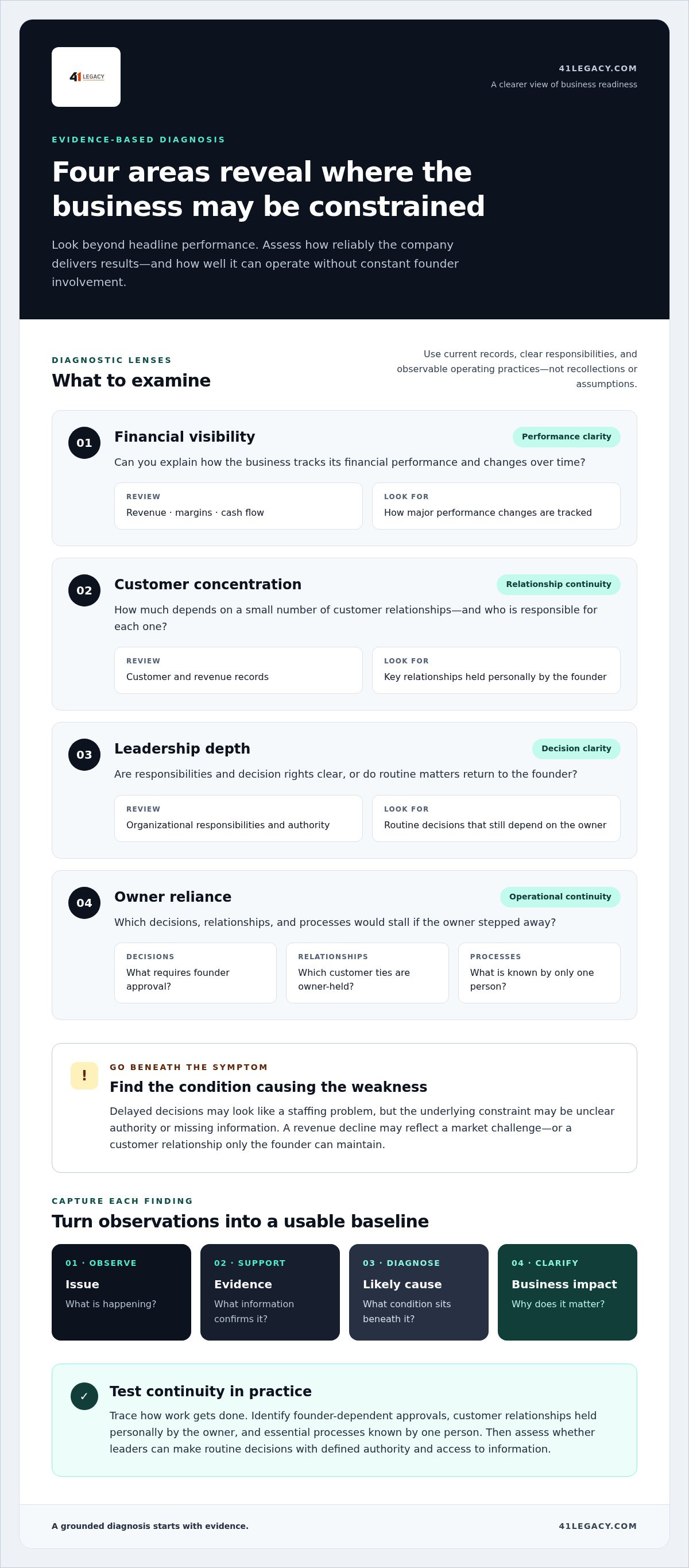
A useful diagnosis looks beyond headline performance. It asks how reliably the business produces its results, where important risks sit, and whether its strengths can continue without constant founder involvement. Gather current financial reports, customer and revenue records, organizational responsibilities, and core operating procedures. A grounded baseline relies on evidence that can be reviewed, not recollections or assumptions.
Review four areas:
- Financial visibility: Can you explain how revenue, margins, cash flow, and major changes in performance are tracked?
- Customer concentration: How much of the business depends on a small number of customer relationships, and who is responsible for each one?
- Leadership depth: Are responsibilities and decision rights clear, or do routine matters return to the founder?
- Owner reliance: Which decisions, relationships, and processes would stall if the owner stepped away?
Look for causes beneath visible symptoms. Delayed decisions may appear to be a staffing problem, for example, when the underlying constraint is unclear authority or missing information. A revenue decline may reflect a market challenge, or a customer relationship that only the founder can maintain. A strong diagnostic identifies the conditions causing a weakness, not just the weakness others can see.
For each finding, record the observed issue, supporting evidence, likely cause, and business impact. Then compare perspectives with the owner’s existing professional advisors, who can interpret information within their respective roles. For valuation context, Harvard Business School’s overview of Company Valuation Methods explains that different approaches can inform how a company is assessed. The purpose here is to establish a consistent planning baseline, not to treat any one method as a guaranteed result.
Assess transferability and owner dependency
Trace how work actually gets done. List decisions that require the founder’s approval, customer relationships held personally by the owner, and essential processes known by only one person. Then test whether leaders can make routine decisions with defined authority and access to the information they need. If a critical task depends on unwritten judgment, document the steps and identify someone who can perform the task consistently.
Test the evidence behind potential value
Separate documented results from forecasts and untested assumptions. A forecast may describe a credible opportunity, but it is not the same as a demonstrated trend. For each projection, note what supports it, what must change for it to occur, and what could weaken confidence, such as losing a customer or depending on a key employee. These findings can help frame strategic priorities for a more transferable business and connect diagnosis to practical strategies to increase enterprise value.
How to Compare Value-Growth Opportunities and Choose Priorities
A list of possible improvements is not yet a plan. Each initiative competes for leadership attention, time, and organizational capacity. Compare opportunities against the owner’s goals, the evidence behind the expected benefit, the risk addressed, and the company’s ability to execute. A growth initiative may expand revenue. A transferability improvement may make performance less dependent on the founder. Neither automatically guarantees greater enterprise value.
Use a simple comparison to make trade-offs visible. The examples below are illustrative. Adjust the measures to fit your company, and establish a baseline before setting targets.
| Illustrative initiative | Potential impact | Effort | Owner dependency | Practical measure |
|---|---|---|---|---|
| Develop a new customer channel | Supports growth if demand is evidenced | High | May remain high if the founder leads sales | Qualified opportunities progressing through a defined sales process |
| Document a core operating process | Improves consistency and continuity | Medium | Reduces reliance on individual know-how | Process documented, assigned, and followed by the responsible team |
| Delegate routine approvals | Strengthens leadership capacity | Medium | Reduces routine decisions requiring founder input | Routine decisions completed within agreed authority |
Consider sequence as well as merit. A new sales channel may depend on clear customer data, delivery capacity, or a repeatable sales process. If those foundations are weak, expansion could add strain instead of durable growth. Identify prerequisites, name who owns each one, and schedule larger initiatives only when the business can support them.
Separate high-potential improvements from attractive distractions
Prioritize work that addresses a material risk, improves resilience, or directly supports the owner’s stated goals. Challenge initiatives that rely on unsupported forecasts, lack an accountable leader, or have no defined next action. Before committing resources, ask what must be true for the opportunity to succeed and which dependencies need to be resolved first. If the answers are unclear, gather more evidence before proceeding.
Choose measures that reveal durable progress
Pair financial indicators, such as revenue or margin trends, with operational evidence showing how results are produced. A sales measure, for example, becomes more informative when viewed alongside customer retention and the team’s ability to manage relationships without constant founder involvement. Track relevant progress in leadership independence and documented processes, too. No single metric is a guaranteed proxy for enterprise value.
To decide how to bridge the gap between current and potential business value, select a manageable set of priorities, define the evidence that will show progress, and review each one against the company’s capacity to execute. This keeps ambition connected to what the business can deliver and focuses leaders on improvements that support both performance and transferability.
How to Turn the Value Gap Into an Accountable Roadmap
A diagnosis becomes useful when it changes what the business does next. Convert findings into a focused set of initiatives, each with a responsible leader, a clear next action, a practical measure, and evidence that shows when the work is complete. A priority without an owner rarely becomes consistent execution. Without accountability, it can remain an intention while daily demands take precedence.
Use a sequence that keeps the plan grounded:
- Establish the baseline. Record the finding, the evidence behind it, and the business risk or opportunity it represents.
- Select priorities. Choose work tied to owner goals, transferability, resilience, or a material constraint. Defer initiatives that lack a clear rationale or depend on unresolved foundations.
- Assign ownership. Name the leader responsible for moving each initiative forward. Clarify who contributes and who makes decisions.
- Define the next action and measure. Specify the first practical step and the evidence that will demonstrate progress or completion.
- Review and adjust. Revisit progress, capacity, and assumptions at a cadence that fits the company’s operating rhythm.
Keep each initiative specific enough to act on. “Improve leadership depth” is difficult to execute. “Document decision authority for routine customer exceptions and review its use with the leadership team” gives the responsible leader a concrete starting point and observable evidence of progress.
Build a sequence the company can actually carry out
Address foundational risks and bottlenecks before layering on broad new initiatives. If growth depends on a repeatable delivery process, strengthen that process before increasing demand. Set review points that leaders can sustain alongside their operating responsibilities. If performance changes materially or the owner’s goals shift, revisit the assumptions and reprioritize instead of treating the roadmap as fixed.
Keep professional advisors aligned around the same priorities
Strategic coordination helps keep related work pointed toward shared business goals without blurring professional roles. The owner can share relevant priorities with the CPA, attorney, and other existing advisors, clarify what input is needed from each, and track how their work relates to the roadmap. Each advisor remains responsible for guidance within their own discipline. Strategic planning should not be presented as legal, tax, or investment advice.
Process documentation can support continuity by making important work easier to repeat and transfer. Tie that effort to a specific operational need, such as reducing reliance on the founder for a recurring decision, rather than creating paperwork without a clear purpose.
For structured support in translating findings into accountable priorities, explore 41 Legacy’s strategic advisory support.
How 41 Legacy Helps Owners Move From Diagnosis to Transferability
Diagnosis has value when it leads to decisions the business can carry forward. 41 Legacy helps owners connect the company’s current condition with what it needs to become more transferable through an Exit Readiness Assessment that examines the business against owner goals. The assessment clarifies the value gap and identifies strategic priorities. It does not promise a specific valuation or transaction result.
From enterprise diagnostics to a value growth roadmap
Enterprise diagnostics help surface the business’s strengths, constraints, and areas of owner dependency. Those findings can then be considered alongside the owner’s goals and the company’s capacity to act. A Value Growth Roadmap turns the assessment into sequenced strategic work, giving each priority a practical direction and helping leaders focus on improvements that support a more resilient, transferable business. Strategic advisory can keep this work aligned with the company’s priorities.
The roadmap is a planning tool, not a valuation promise. If the assessment identifies that routine customer decisions rely on the founder, for example, a priority may be to clarify decision authority and build leadership capacity. The roadmap can define the intended outcome, responsible owner, next action, and evidence of progress. This ties potential value to work the company can undertake rather than to an unsupported forecast.
Owners who want to see how this process can bring greater clarity to their priorities can explore 41 Legacy strategic guidance.
Sustain progress while preparing the business to operate beyond its owner
Even a well-designed plan needs attention as conditions change. Monthly implementation support provides continuity and accountability as agreed priorities move from planning into practice. Progress reviews keep attention on next actions, surface obstacles, and revisit assumptions when business performance or owner goals materially change.
41 Legacy helps coordinate strategic priorities with the owner’s existing professional advisors without replacing their distinct roles. The CPA, attorney, and other advisors continue to provide guidance within their own disciplines, while the broader strategic effort stays connected to the business’s goals. Coordination can help prevent important work from becoming fragmented across separate conversations.
As implementation advances, look for durable evidence of change: leaders making routine decisions with appropriate authority, essential work performed consistently, and knowledge captured in processes the team can use. These practices support a company that is less dependent on its founder and better prepared for an internal or external transition. To discuss an assessment of your value gap and a practical path toward greater transferability, connect with 41 Legacy.
Build a Business Prepared for What Comes Next
The next step isn’t to chase an idealized number. Choose one meaningful improvement that makes the company stronger, clearer, or less reliant on you, then give that work the attention and ownership it needs. Over time, deliberate decisions can help turn the business you’ve built into an asset better prepared for change.
Understanding how to bridge the gap between current and potential business value is ultimately about stewardship: making the company more resilient and better able to carry its strengths forward. That work can begin before a transition is near. 41 Legacy, founded and led by Chris Giammarco, a Certified Exit Planning Advisor, helps owners bring structure to that effort.
Explore a structured path from diagnosis to business transferability and take a considered next step toward a company that can thrive beyond its founder. With clear priorities and sustained attention, you can build a stronger foundation for the future you intend to create.
Frequently Asked Questions
How long does it take to bridge the gap between current and potential business value?
There’s no fixed timetable for how to bridge the gap between current and potential business value. The effort depends on the issues identified, the company’s capacity to address them, and how quickly leaders can put changes into practice. Clarify the scope, then set review points around actual milestones, such as completing a process handoff or establishing a new leadership responsibility. Treat timing as a working plan, not a promised result.
Can a business close its value gap without increasing revenue?
Yes. Improvements to margins, operating consistency, or reliance on a single person can strengthen a business without adding revenue. Reviewing recurring expenses may reveal avoidable costs, while clarifying responsibility for customer accounts may reduce disruption if the founder is unavailable. These changes can improve resilience and transferability, but their effect on enterprise value depends on the full business context and should not be assumed in advance.
Is potential business value the same as a guaranteed future valuation?
No. Potential business value describes a reasoned scenario based on assumptions about future performance and business improvements. It is not a guaranteed valuation or a promise of a particular outcome. A useful plan makes assumptions visible, distinguishes demonstrated results from expectations, and revisits projections as evidence changes. External conditions can also affect how a business is assessed, even when the company makes meaningful progress internally.
What happens if the owner goals change during a value-growth plan?
Revisit the plan and test its priorities against the owner’s new goals. A strategy designed around preparing for internal succession may differ from one focused on reducing the owner’s day-to-day role while continuing to lead the company. Some initiatives may support both aims; others may need adjustment or a pause. Update the measures and responsibilities so leaders know which outcomes matter now.
Do I need to be preparing for a sale to improve business transferability?
No. Transferability work can strengthen the business well before any transition is planned. Clear decision-making, capable leadership, and repeatable operations can help the company maintain continuity through growth, leadership changes, or an owner’s evolving role. These practices can also make internal succession more considered. The aim is to build an enterprise that can function effectively beyond one person, not to assume a particular transition will occur.
Can my existing CPA and attorney participate in value-gap planning?
Yes. Your CPA and attorney can contribute perspectives within their respective professional roles. Share relevant priorities and findings, then clarify where each advisor’s input is useful. A planning decision may have financial and legal dimensions that call for their separate expertise. Strategic coordination can keep those conversations connected without replacing the advice each professional provides.
How often should a business reassess its current and potential value?
Reassess at planned points in the company’s strategy or operating cycle, and sooner when a material change could affect the assumptions behind the plan. Examples include a leadership departure, a major shift in customer relationships, or results that differ from expectations. Review whether the original priorities still fit, what new evidence has emerged, and whether the business has capacity to continue the agreed work.

Article by
Mike Laskowski
Mike Laskowski is a Business Value Growth Strategist who helps business owners uncover the truths that drive their performance, risk, and readiness. Blending forensic interviewing from a 26‑year federal career with Strategic Capacity analysis and CEPA methodology, he works upstream to reduce owner dependency, increase transferability, and strengthen enterprise value. Mike guides founders through clarity, operational evolution, and transition readiness so their companies become transferable, owner‑independent assets that endure beyond the founder.
Disclaimer
This article is for educational and informational purposes only and does not provide legal, tax, investment, or business brokerage advice. 41 Legacy does not offer M&A brokerage services, legal document drafting, tax preparation, or investment advisory services. Business owners should consult licensed professionals in those disciplines before making decisions related to business transactions, legal matters, tax strategy, or financial planning. All examples are illustrative and may not apply to your specific situation.

