
How to Assess Business Value for Exit Planning: A Guide to Strategic Transferability
What if the ultimate measure of your life's work is not found in its daily operations, but in its ability to flourish without your touch? For many founders, the business is a masterpiece in progress, yet it remains tethered to their personal presence, creating a fragility that sophisticated buyers view with caution. Understanding how to assess business value for exit planning is the first step in moving beyond mere ownership toward true stewardship. You likely feel the weight of this dependency and the uncertainty of whether your retirement readiness is a reality or a hope. It's a common tension where the essence of the enterprise is obscured by the founder's shadow.
We believe your business should be a high-value, transferable asset rather than a job you happen to own. This guide provides the strategic clarity needed to bridge the distance between current operations and a legacy that endures. You'll discover a roadmap to close the Value Gap and gain a clear understanding of enterprise value through the lens of transferability engineering. We'll examine how to reduce owner dependency and build a firm that thrives independently, ensuring your transition is as seamless as it is profitable.
Key Takeaways
- Distinguish between a standard accounting valuation and a strategic assessment of your company as a resilient, transferable asset.
- Master how to assess business value for exit planning by conducting a rigorous enterprise diagnostic to identify and mitigate risks that suppress market multiples.
- Identify the four intangible capitals—human, structural, customer, and social—that serve as the architectural foundation for a business that thrives without founder dependency.
- Quantify the Value Gap to ensure your current enterprise worth is strategically aligned with the financial requirements of your next chapter and the preservation of your legacy.
- Learn how a coordinated advisory approach aligns your existing professional team toward a singular roadmap for successful transferability and long-term impact.
The Essence of Enterprise Value: A Diagnostic Approach to Exit Planning
Enterprise value is the soul of the firm. It encompasses the intricate systems, the cultural legacy, and the structural resilience that allow a company to function as a self-sustaining entity. Many owners mistake their annual tax returns for a definitive statement of worth, yet a true assessment requires a diagnostic lens that views the business as a living entity with a story to tell. Understanding how to assess business value for exit planning requires a shift in perspective. You aren't just measuring what you've built; you're measuring how well it can survive without you. This is the essence of transferability.
A business should be viewed as a legacy, not merely a series of transactions. In 2025, global M&A deal value reached $4.81 trillion, the second-highest on record. This surge in activity highlights a market hungry for quality, but it's a market that rewards precision. Sophisticated buyers aren't looking for a job they can buy. They're seeking a high-value asset that offers a predictable future. When you focus on building an enterprise that thrives independently, you elevate the company from a personal income stream to a sought-after masterpiece of engineering.
Valuation vs. Exit Readiness Assessment
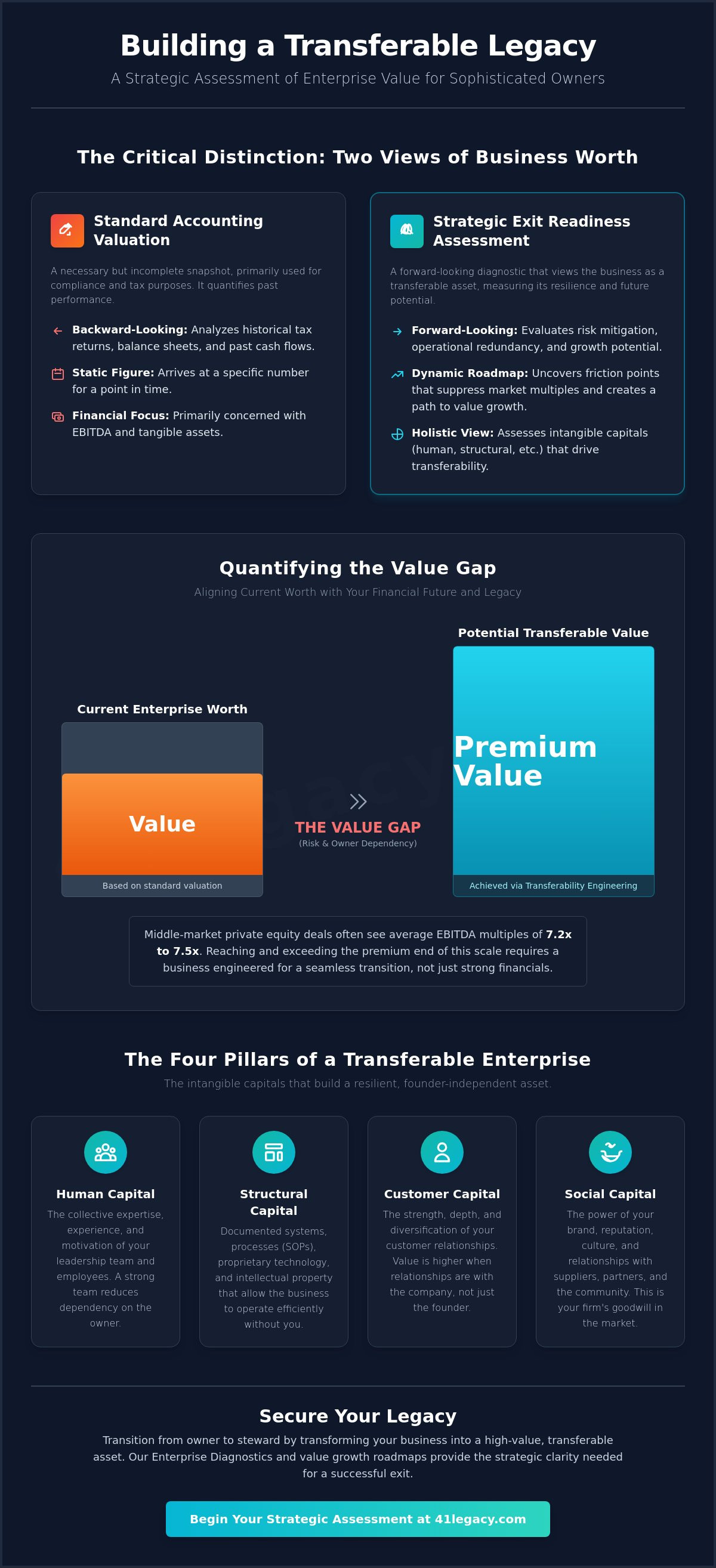
Traditional business valuation methods are often backward-looking. They analyze historical tax returns, balance sheets, and past cash flows to arrive at a static number. While these figures are necessary for accounting, they don't capture the strategic readiness of the firm. An exit readiness assessment looks forward. It evaluates risk mitigation, operational redundancy, and future growth potential. We consider Enterprise Diagnostics the foundational step in stewardship. It uncovers the hidden friction that might suppress your eventual market multiple. While middle-market private equity deals saw average EBITDA multiples of 7.2x to 7.5x in 2025, reaching the premium end of that scale requires more than just strong financials; it requires a business that's ready for a seamless transition.
The Role of the Steward in Value Creation
The transition from founder to steward is a profound shift in identity. It requires moving from the daily mechanics of the shop floor to the high altitude of strategic design. This focus on working on the business rather than in it creates an atmosphere of excellence that sophisticated buyers find irresistible. Our approach at 41 Legacy emphasizes this evolution, helping you refine the inner essence of your organization. By learning how to assess business value for exit planning through the lens of owner-dependency reduction, you transform your company into a rare and durable asset. Strategic clarity is the magnet for high-value buyers. These connoisseurs of enterprise aren't looking for a role to fill; they're looking for a legacy they can build upon. This process ensures the essence of your impact remains intact long after your departure.
The Pillars of Transferability: Beyond EBITDA and Financial Statements
If financial strength provides the foundation of a company, transferability is its ceiling. While accounting metrics like EBITDA offer a snapshot of current performance, they often fail to capture the true latent value of the organization. To understand how to assess business value for exit planning, one must look beyond the balance sheet to the four intangible capitals: human, structural, customer, and social. These are the hidden gears of the enterprise. Human capital represents the collective expertise of your team. Structural capital includes the systems and SOPs that allow work to continue in your absence. Customer and social capitals reflect the depth of your market relationships and brand reputation. When maximizing the value of your business, these intangibles are what drive the multiples sophisticated buyers are willing to pay. Through Transferability Engineering, we help owners evolve their firm from a founder-centric operation into a robust institutional asset.
The Rainmaker Trap: Assessing Owner Dependency
A business that relies on a single hero is a business with a fragile future. Buyers view owner dependency as a significant risk; if the founder is the primary source of sales or technical expertise, the enterprise value vanishes the moment they walk out the door. This Rainmaker Trap forces a steep discount on the final valuation. Determining how to assess business value for exit planning requires a cold, objective look at whether your systems can withstand the departure of their creator. To identify these bottlenecks, consider the following:
- Does the founder hold the majority of key client relationships?
- Are there critical decisions that only the owner can authorize?
- Would the company’s growth stall if the owner took a 30-day absence?
Reducing these dependencies is essential for any successful transition. It transforms the business from a personal extension of the owner into a transferable piece of machinery.
Structural Integrity and Scalability
The strength of your middle management team is a primary value driver. A buyer is purchasing the future cash flows of the business, and those flows are only as reliable as the systems that produce them. Consistent, repeatable customer experiences must be hard-coded into the company's DNA through documented processes. Our Strategic Capacity Evaluation helps determine the ceiling of your future growth by analyzing whether your current infrastructure can support a larger scale. This level of precision ensures that the essence of the company remains intact during a handoff. If you are ready to begin this refinement, our Transferability Engineering services can help you build a more resilient organization.
Quantifying the Value Gap: Aligning Current Worth with Future Legacy
The distance between where your business stands today and where it must be to fulfill your vision is known as the Value Gap. This isn't merely a financial discrepancy; it's a structural divide that determines the quality of your next chapter. When you investigate how to assess business value for exit planning, you're essentially performing an audit of this gap. It's the bridge between a business that supports your lifestyle and an asset that funds your legacy. A precise diagnostic reveals exactly where the enterprise's current essence falls short of its ultimate potential. By identifying these voids early, you transition from a passive owner to a deliberate architect of your company's future.
Strategic clarity requires dissecting the specific voids that often exist within a founder's portfolio. We view this process as a necessary refinement, much like an artisan polishing a precious stone to reveal its inner brilliance. Without this quantification, your exit strategy remains a hope rather than a roadmap. Our Enterprise Diagnostics provide the data required to turn these abstract goals into actionable milestones.
The Three Gaps of Exit Planning
There are three distinct gaps that every steward must address. First is the Wealth Gap. This is the difference between your current net worth and the specific amount you need to net, after taxes and fees, to sustain your desired lifestyle post-exit. In the 2026 tax year, single filers with taxable income above $545,500 face a 20% long-term capital gains tax rate, plus potential surtaxes like the 3.8% Net Investment Income Tax. Second is the Value Gap. This represents the untapped potential within your current structure that a buyer would pay for if operational risks were mitigated. Finally, the Profit Gap measures the distance between your current EBITDA and that of best-in-class peers. Closing these gaps ensures that you don't leave significant wealth on the table due to avoidable inefficiencies.
Market Attractiveness vs. Exit Readiness
It's entirely possible to own a business that is highly attractive to the market yet completely unready for transfer. A company in a high-demand sector may command interest because of its industry, but if it lacks structural integrity, the deal will likely collapse during due diligence. Market attractiveness is driven by external forces, such as the $1.5 trillion in private equity dry powder estimated in early 2026. Exit readiness, however, is an internal metric. While middle-market private equity deals saw average EBITDA multiples of 7.2x to 7.5x in 2025, those at the higher end of that range were businesses with high readiness scores. We maintain a refusal to settle for average market multiples. By focusing on internal precision, you ensure that external market conditions serve your goals rather than dictating them.
How to Assess Business Value for Exit Planning: A Four-Step Framework
Building a transferable asset is a disciplined sequence of refinements. It's not a single event but a multi-year strategic process that aligns your personal, financial, and business goals. Understanding how to assess business value for exit planning requires a framework that moves beyond guesswork into the realm of surgical precision. This four-step path ensures that every action taken strengthens the essence of the enterprise while preparing it for a future beyond the founder's tenure. By following a structured methodology, you transition from the uncertainty of daily operations to the calm confidence of a prepared steward.
Step 1: The Diagnostic Baseline
The first step in any meaningful transition is establishing a professional-grade baseline. Relying on a "rule of thumb" or a casual industry multiple is a risk no serious owner should take. An Enterprise Diagnostic provides the clarity needed to understand the current reality of the firm. We focus on data gathering that is calm and authoritative, looking at metrics that truly influence a buyer's decision. This includes a deep analysis of EBITDA, the percentage of recurring revenue, and customer concentration levels. For example, if a single client accounts for more than 15% of your total revenue, a buyer will perceive this as a significant risk to future cash flows. This diagnostic is the essential first step in stewardship, revealing the hidden friction that may be suppressing your current value.
Step 2 & 3: Mitigation and Growth
True value creation begins with protection. We prioritize reducing risk first because protecting existing value is often more impactful than pursuing immediate growth. Identifying "Value Killers"—such as undocumented processes or a lack of middle management—allows you to shore up the foundation before scaling. Once these risks are mitigated, we shift focus to increasing value. A Value Growth Roadmap provides the strategic clarity required for this implementation, serving as a master plan for the business's evolution. To ensure these steps are not lost in the noise of daily operations, we provide Monthly Implementation Support. This structured rhythm keeps the team focused on the high-altitude goals of transferability rather than just the granular tasks of the week.
The final stage of the framework involves coordinating with your existing professional advisory team. This ensures that legal and tax structures are fully aligned with your roadmap, preventing costly disconnects during a transition. If you are ready to move beyond theoretical planning and begin the work of refinement, you can start your Exit Readiness Assessment today to establish your baseline and identify your path forward.
The 41 Legacy Path: Coordinating Your Path to a Transferable Asset
The final stage of the journey from founder to steward is the orchestration of the transition itself. You've gained the strategic clarity to understand how to assess business value for exit planning, but the true test lies in the execution of that vision. In a market defined by increased buyer scrutiny and higher expectations for operational resilience, as seen in the first half of 2026, a fragmented approach is a liability. We believe that a masterpiece requires a conductor. This is why we adopt the role of the "Quarterback," ensuring that every element of your professional world is synchronized toward the preservation of your legacy. Without this central alignment, the most sophisticated plans can succumb to strategic drift.
The Coordinated Advisory Team
Your existing professional advisors are masters of their specific disciplines, yet they often operate within isolated silos. A CPA focuses on the precision of tax compliance, while an attorney prioritizes the mitigation of legal risk. An RIA manages the complexities of your wealth gap. While these specialists are essential, they're rarely positioned to lead a holistic exit strategy. This lack of coordination often leaves the business owner as the only person seeing the full picture, which inadvertently increases the owner dependency we seek to reduce. Our CEPA-led process provides the high-altitude perspective required to harmonize these efforts. By acting as the Quarterback, we coordinate your CPAs, attorneys, and RIAs toward a singular goal: the creation of a high-value, transferable asset. This ensures that the technical engineering of your business matches the philosophical weight of your impact.
Building Your Legacy
We invite you to view your business not as a series of operational tasks, but as a curated collection of value. Protecting a life's work requires more than just financial management; it requires a profound reverence for the essence of what you've built. Our Monthly Implementation Support serves as the guardrail against the noise of the day-to-day, keeping your team focused on the long-term health of the enterprise. This steady, unhurried rhythm reflects the time-intensive nature of high-end craftsmanship, allowing the details of your transferability engineering to be polished to a high sheen. With global private equity dry powder estimated at $1.5 trillion in early 2026, there is an immense opportunity for those who refuse to settle for average market multiples. The first step toward this refined future is our Exit Readiness Assessment. We are here to help you bridge the gap between the past you've built and the future you deserve. Start your Enterprise Diagnostic with 41 Legacy and begin the work of turning your life's work into an enduring legacy.
Securing the Future of Your Masterpiece
The transition of a business is the final stroke on a canvas years in the making. By moving beyond backward-looking financials and embracing the pillars of transferability, you transform a founder-led firm into a durable, institutional asset. We've explored the necessity of closing the Value Gap and the discipline required to engineer a company that thrives in your absence. Mastering how to assess business value for exit planning is not a transactional hurdle; it's a profound act of stewardship that ensures the essence of your work endures for generations. This process requires a refusal to settle for average market multiples through meticulous refinement.
Our team provides national advisory expertise focused on enterprise diagnostics to illuminate the path forward. Led by a Certified Exit Planning Advisor (CEPA), we utilize a structured Value Growth Roadmap process to align your strategic goals with operational reality. This coordination prevents the drift that often occurs when advisors work in silos. Your life's work deserves the precision of a master artisan. Begin your journey toward a transferable legacy with an Exit Readiness Assessment. The legacy you've built is a living story; let's ensure its next chapter is its most impactful yet.
Frequently Asked Questions
How is enterprise value different from a standard business valuation?
Enterprise value represents the total worth of the company as a self-sustaining, transferable asset, while standard valuations often focus on historical tax returns and backward-looking financial snapshots. A strategic assessment evaluates the resilience of your systems, the depth of your management team, and the quality of your intangible capitals. This distinction is vital for those learning how to assess business value for exit planning, as it highlights the difference between a static price and true transferable worth.
Can I assess my business value if I am not planning to sell for 10 years?
Assessing your business value a decade before a transition is the ultimate act of strategic clarity and stewardship. This significant lead time allows for deep Transferability Engineering and the mitigation of structural risks that can take years to resolve. By starting early, you ensure the business evolves into a curated asset that provides both a premium lifestyle today and a lasting legacy for the future.
What are the most common "value killers" in a privately held company?
The most frequent value killers include high customer concentration, undocumented operational systems, and a lack of a capable middle management team. These structural flaws create friction and increase the perceived risk for any successor, which directly suppresses your market multiple. Identifying these friction points through Enterprise Diagnostics is essential for protecting the inner essence of what you've built over decades of hard work.
How does owner dependency impact the final sale price of a business?
Owner dependency creates a fragility that sophisticated buyers view with extreme caution and skepticism. If the company's daily operations or key client relationships rely solely on the founder, the enterprise value is significantly discounted to account for the risk of your departure. Reducing this dependency is a core component of our Strategic Advisory, ensuring the business survives and thrives long after you've stepped away from the helm.
What is the "Value Gap" and why does it matter for my retirement?
The Value Gap is the mathematical distance between your company's current worth and the net proceeds required to fund your next chapter. It matters for retirement because it quantifies the specific amount of growth needed to bridge your personal wealth requirements. Understanding this gap is a critical step in how to assess business value for exit planning effectively, as it turns abstract retirement hopes into a concrete roadmap for implementation.
Do I need a Certified Exit Planning Advisor (CEPA) if I already have a CPA?
A CEPA provides a high-altitude perspective that complements the technical tax and accounting expertise of your CPA. While your CPA manages historical compliance, the CEPA acts as a Quarterback to align your entire advisory team toward the singular goal of transferability. This coordination prevents the strategic drift that often occurs when professional silos like attorneys and wealth managers operate independently without a master plan.
How long does a typical Exit Readiness Assessment take to complete?
The diagnostic phase of an Exit Readiness Assessment typically requires several weeks of calm and authoritative data gathering to establish an accurate baseline. This initial period reveals the hidden risks and opportunities within the firm's current structure. The subsequent implementation of a Value Growth Roadmap is a multi-year journey, reflecting the time-intensive and thoughtful nature of building high-end enterprise craftsmanship.
Can I increase my business value without significantly increasing my sales?
You can increase enterprise value by improving your market multiple even if your top-line sales remain entirely static. By documenting SOPs, diversifying your customer base, and strengthening the structural integrity of the firm, you reduce the risk for a future buyer. These refinements make your existing cash flows more predictable and valuable to a connoisseur who values heritage and performance as much as revenue.

Article by
Mike Laskowski
Mike Laskowski is a Business Value Growth Strategist who helps business owners uncover the truths that drive their performance, risk, and readiness. Blending forensic interviewing from a 26‑year federal career with Strategic Capacity analysis and CEPA methodology, he works upstream to reduce owner dependency, increase transferability, and strengthen enterprise value. Mike guides founders through clarity, operational evolution, and transition readiness so their companies become transferable, owner‑independent assets that endure beyond the founder.
Disclaimer
This article is for educational and informational purposes only and does not provide legal, tax, investment, or business brokerage advice. 41 Legacy does not offer M&A brokerage services, legal document drafting, tax preparation, or investment advisory services. Business owners should consult licensed professionals in those disciplines before making decisions related to business transactions, legal matters, tax strategy, or financial planning. All examples are illustrative and may not apply to your specific situation.