
How to Assess Business Value for Exit: A Strategic Guide to Transferable Assets
A business is more than a sequence of transactions; it is a curated legacy, a testament to years of disciplined stewardship. While the mechanics of a balance sheet provide a foundation, they rarely capture the true essence of what makes an enterprise attractive to the market. You've likely spent decades perfecting your craft, yet the uncertainty of whether your life's work is a sellable asset can be a heavy burden. Understanding how to assess business value for exit requires a shift in perspective, moving from basic arithmetic to the precise engineering of transferability.
We recognize the weight of the Value Gap and the complexity of coordinating a chorus of professional advisors. You deserve clarity on whether your company can thrive independently of your daily presence. This guide introduces the Enterprise Diagnostic, a process designed to identify hidden risks and illuminate the drivers of enterprise value. We'll outline a strategic roadmap to bridge the distance between your current worth and your ultimate retirement needs, ensuring your transition is as polished and intentional as the business you built.
Key Takeaways
- Learn to look beyond standard accounting metrics to evaluate the four foundational pillars of enterprise health: Financial, Structural, Customer, and Human Capital.
- Gain a sophisticated understanding of how to assess business value for exit by quantifying the "Wealth Gap" between your current worth and your long-term transition goals.
- Identify the structural "red flags" and owner-dependency risks that can diminish the transferability of your life's work during professional due diligence.
- Discover how to translate diagnostic findings into a prioritized Value Growth Roadmap designed to strengthen the enterprise and ensure it thrives independently of its founder.
Beyond the Spreadsheet: Redefining Business Value for a Legacy Exit
A business is a living entity. It possesses a history, a culture, and an inner essence that cannot be captured by mere financial statements. When you begin to understand how to assess business value for exit, you must look beyond the standard columns of a spreadsheet. Traditional business valuation methods often focus on historical performance or tangible asset totals. While these metrics are necessary for tax reporting, they rarely reflect the strategic "Market Attractiveness" that a sophisticated buyer seeks. An appraisal for a CPA is a backward-looking autopsy; a strategic assessment is a forward-looking diagnostic of potential.
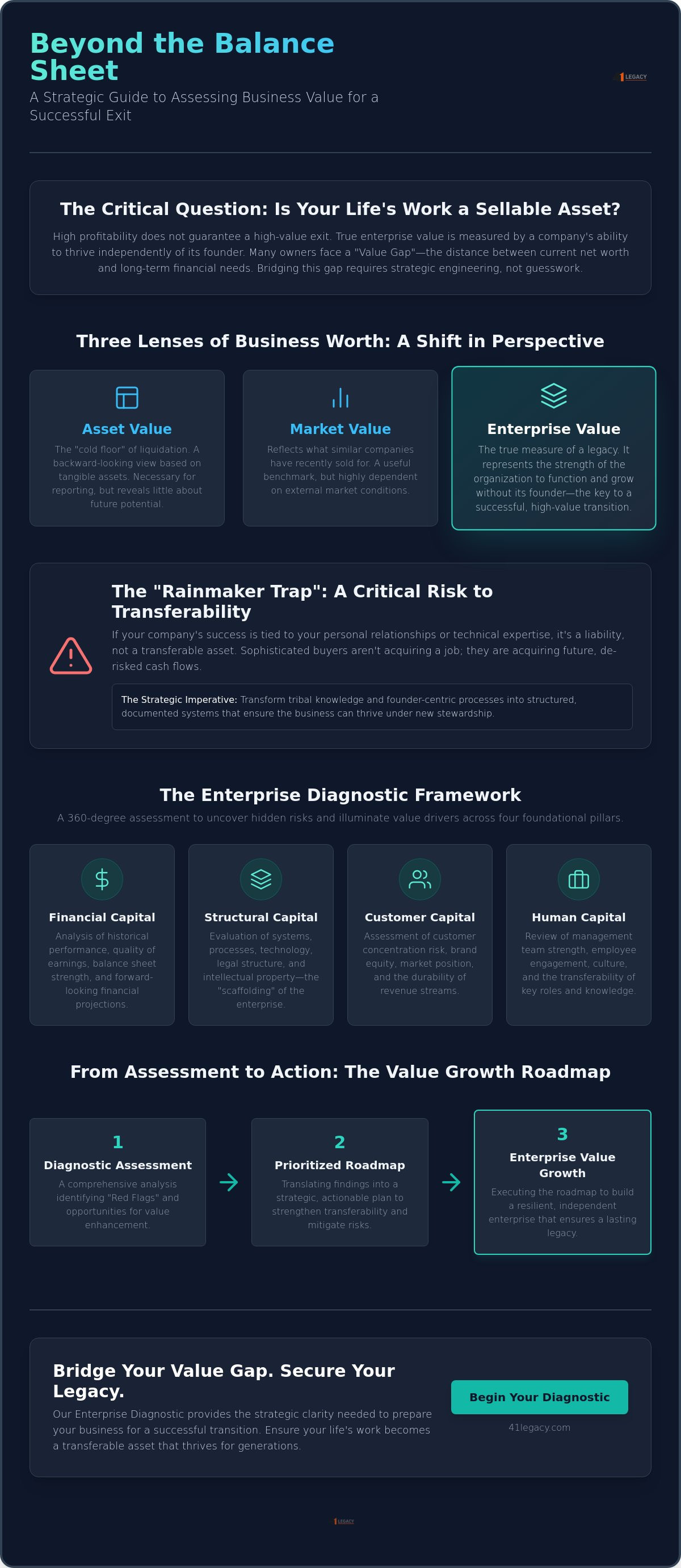
We distinguish between three distinct lenses of worth to provide strategic clarity. Asset value represents the cold floor of liquidation. Market value reflects what similar companies have commanded recently in the open market. Enterprise value, however, is the true measure of a legacy. It represents the strength of the organization to function and grow without its creator. Many owners face a sobering "Value Gap," which is the distance between their current net worth and the capital required to fund their post-exit life. Bridging this gap is not a matter of luck, but of intentional, meticulous engineering.
The Distinction Between Profit and Transferability
High profitability does not always equate to high value. If a firm’s success is tethered solely to the founder’s personal relationships or technical genius, it is a liability, not a transferable asset. Professional buyers discount companies where the "Rainmaker Trap" exists. They aren't buying your past success; they're buying future stability. Enterprise value is the present value of future de-risked cash flows. Through Transferability Engineering, we transform tribal knowledge into structured systems, ensuring the business remains a vibrant, independent entity that can thrive under new stewardship.
The Emotional Weight of Exit Readiness
The transition from operator to steward is a profound psychological shift. It requires you to view your life's work as a separate being that must eventually stand on its own. Learning how to assess business value for exit early prevents the quiet tragedy of discovering your legacy is unsellable only when you are finally ready to leave. By aligning your personal identity with the strategic health of the firm, you ensure that your impact endures. This stewardship is the ultimate act of respect for the masterpiece you've built over decades of dedicated effort.
The Enterprise Diagnostic: A Sophisticated Framework for Assessment
True clarity requires a 360-degree view of the organization. To understand how to assess business value for exit, one must look beyond the surface of the ledger. We utilize a rigorous Enterprise Diagnostic framework built upon four foundational pillars: Financial, Structural, Customer, and Human Capital. This process acts as a high-resolution lens, revealing the "Red Flags" that professional due diligence teams will inevitably exploit. By identifying these vulnerabilities early, we transform them from liabilities into opportunities for refinement and growth.
Market attractiveness is another critical variable in the valuation equation. Your industry and specific niche dictate the multiple range, but your internal health determines where you fall within that range. A company in a high-growth sector may still languish with a low multiple if it lacks structural integrity. We adopt a "Quarterback" approach, coordinating seamlessly with your CPAs and attorneys. This ensures that every perspective is harmonized, creating a unified narrative of value that commands respect. Insights from Harvard Business School on exit strategy emphasize that understanding your company’s scarcity value is paramount to a successful transition.
Analyzing the Qualitative Value Drivers
Understanding how to assess business value for exit means recognizing that brand equity and intellectual property are the silent engines of enterprise value. They represent the "Inner Essence" of the firm that an outsider can actually own. However, if your revenue is tied to a single customer, your risk profile rises sharply. Customer concentration is a significant anchor on valuation. Similarly, the strength of your middle management team serves as a barometer for transferability. A business that relies on a team of specialists rather than a single founder is a far more resilient and attractive asset.
Financial Forensics for Exit Readiness
Standard financial statements are rarely sufficient for a strategic transition. We move beyond basic EBITDA to arrive at "Adjusted EBITDA," a more precise reflection of the company's true earning power. This involves identifying and "scrubbing" lifestyle expenses or one-time costs that don't reflect future operations. It is about presenting the business in its leanest, most efficient form. Pro forma statements then project this refined value into the future, allowing a buyer to see the potential you've cultivated. If you are ready to uncover the hidden drivers of your firm's worth, our Enterprise Diagnostics provide the necessary depth for an accurate assessment.
Quantifying the Value Gap: Aligning Realities with Exit Goals
The true measure of a successful exit isn't found in the gross sale price, but in the sufficiency of the net proceeds to fund your next chapter. When you begin to understand how to assess business value for exit, the first calculation must be the "Wealth Gap." This is the delta between your total financial requirement for a dignified transition and your current net worth outside the business. Without this clarity, you're navigating without a compass. Identifying this gap early, ideally three to five years before a transition, provides the only meaningful window to influence the final outcome through intentional value growth.
We compare the "As-Is" value of the enterprise against its "Potential" value. The "As-Is" value reflects the company in its current state, often burdened by owner dependency or structural inefficiencies. The "Potential" value represents the masterpiece the business can become when these friction points are removed. Through a Strategic Capacity Evaluation, we identify where growth is stalled and what systems must be refined to unlock higher tiers of market attractiveness. This isn't about mere expansion; it's about the sophisticated alignment of the firm's trajectory with your personal legacy goals.
The Math of the Next Act
A successful transition requires a clear-eyed look at the "Net-to-Owner" figure. This is what remains after taxes, transaction fees, and the retirement of any outstanding corporate debt. Understanding this number is vital because the Value Gap dictates the required growth trajectory of the business. If the gap is substantial, the enterprise must grow more aggressively or become significantly more efficient. Beyond the numbers, we also prioritize non-financial goals. Your legacy involves the preservation of your culture and the continued stewardship of your employees, which are essential components of a truly successful exit.
Risk Mitigation as Value Creation
In the language of finance, risk is often expressed as "Beta." When you reduce the risk inherent in your operations, you naturally expand your valuation multiple. Investors pay a premium for certainty. We focus on identifying the "Silent Killers" of value, such as legal vulnerabilities or a lack of documented Standard Operating Procedures (SOPs). These gaps create friction during due diligence and allow buyers to justify lower offers. By institutionalizing tribal knowledge, you protect the inner essence of the firm. You can Learn more about our Enterprise Diagnostics to see how we uncover these hidden risks before they become obstacles to your transition.
The Transferability Test: Reducing Owner Dependency
The most profound paradox in business ownership is that being the most vital person in your company makes it significantly less valuable to a successor. This is the "Rainmaker Trap." If the firm’s growth depends on your personal charisma, unique technical skill, or private relationships, the enterprise lacks the structural integrity required for a legacy transition. When learning how to assess business value for exit, you must evaluate the company through the eyes of a buyer who will not have you in the building. They aren't seeking to acquire a job; they're looking for a self-sustaining engine of cash flow.
Codifying the "Inner Essence" of your operations is the only way to protect what you've built. Tribal knowledge, while romantic, is a risk factor that professional due diligence will penalize. We focus on moving this knowledge from your mind into documented Standard Operating Procedures (SOPs). This transition ensures that the masterpiece you’ve created remains intact long after your departure. A business is only an asset if it produces cash flow without the owner’s labor. By building a management team capable of executing strategy without your intervention, you elevate the firm from an owner-led operation to a system-led enterprise.
Engineering the Independent Enterprise
Transferability Engineering is the disciplined process of creating a plug-and-play asset. One of the most effective ways to gauge your current status is the "Vacation Test." If you cannot step away from your firm for thirty days without a decline in performance or morale, the business is still too dependent on your presence. We help you evaluate your "Transferability Score" by identifying the specific operational nodes where your involvement is still required. Reducing these dependencies isn't just about efficiency; it's about honoring the resilience of the organization you've cultivated.
The Role of Systems and SOPs
Buyers pay a premium for certainty, and nothing provides certainty like documented, repeatable processes. Moving from owner-led to system-led growth transforms the business into a transferable asset that commands a higher multiple. When your processes are institutionalized, the risk of human error or individual departure is mitigated. This meticulous approach to documentation is a hallmark of a firm ready for its next act. If you're ready to secure your legacy, you can strengthen your business transferability with 41 Legacy through our structured advisory support.
To ensure your life's work is truly ready for a transition, it's essential to look at the enterprise as a separate entity with its own story to tell. You can begin your Transferability Engineering journey today to uncover and address the dependencies that may be holding back your true market potential.
Executing the Roadmap: From Assessment to Enterprise Value Growth
While understanding how to assess business value for exit is an essential first step, a static number on a page is not a strategy. The assessment serves as a prologue to the more profound work of value creation. Once the Enterprise Diagnostic reveals the structural and financial gaps within the firm, we translate those findings into a prioritized Value Growth Roadmap. This document is a living masterpiece of strategic intent, designed to move the enterprise from its "As-Is" state to its ultimate market potential. Without a clear execution path, even the most precise diagnostic remains a mere observation rather than a catalyst for change.
Strategic accountability is the hallmark of a disciplined steward. We provide Monthly Implementation Support to ensure that the roadmap is not merely admired, but executed with surgical precision. This ongoing advisory prevents the fragmentation of effort that often occurs when business owners attempt to manage transition preparations alone. By acting as the "Quarterback" for your entire professional team, we harmonize the efforts of your CPAs, attorneys, and wealth advisors. This coordination ensures that no "advice silos" exist to destroy value, creating a unified front that protects the inner essence of your legacy.
The Continuous Value Growth Cycle
True stewardship requires a commitment to constant refinement. Learning how to assess business value for exit should be viewed as an annual ritual rather than a one-time event. By revisiting the assessment every twelve months, you can track your progress against the Wealth Gap with extreme precision. This rhythmic evaluation allows you to adjust the roadmap as global economic conditions, such as the projected 2.8% global GDP growth in 2026, or shifting personal goals evolve. It ensures that the enterprise remains a sharp, transferable asset regardless of when you choose to step away.
Preparing for the Transition
There is a critical distinction between being "ready to exit" and the business being "ready to transfer." You may be emotionally prepared for your next act, but if the enterprise cannot function without your daily labor, it is not yet a transferable asset. The final steps of our process focus on securing the legacy through a smooth leadership handoff and the final de-risking of operations. This meticulous preparation ensures that the transition is a celebration of a life’s work rather than a frantic attempt to salvage value. You may begin your journey to exit readiness with 41 Legacy to ensure your masterpiece is truly prepared for its future.
Securing the Future of Your Masterpiece
The journey from operator to steward is the ultimate expression of a founder's dedication. You've built an entity with a story to tell, and ensuring it continues to thrive requires more than a casual glance at the balance sheet. By shifting your focus from simple accounting to the rigorous engineering of transferability, you protect the inner essence of your firm. We've explored how a sophisticated understanding of how to assess business value for exit moves beyond the spreadsheet to identify the hidden drivers that command a premium in the market.
At 41 Legacy, our mission is to act as the guardian of your impact. Led by a Certified Exit Planning Advisor (CEPA), we provide a structured "Quarterback" approach that harmonizes your entire advisory team. We prioritize long-term enterprise value over transactional speed, focusing on the health of the organization rather than just a brokerage outcome. The masterpiece you've cultivated deserves a transition that is as polished and intentional as its creation. Secure your legacy by starting your Exit Readiness Assessment today and begin the disciplined work of bridging your value gap. Your life's work is ready for its next act.
Frequently Asked Questions
What is the difference between a business valuation and an exit readiness assessment?
A business valuation is a numerical snapshot that estimates worth at a specific point in time, often for tax or compliance purposes. An exit readiness assessment is a deeper diagnostic of the firm's structural health and transferability. It identifies the specific risks and dependencies that might prevent a successor from achieving projected returns, focusing on the company's ability to thrive independently of its founder.
How much does a professional business assessment cost for a mid-market firm?
The investment for a professional diagnostic varies based on the complexity and operational scale of the organization. While standard ranges exist for certified appraisals, a strategic assessment involves a higher level of qualitative analysis regarding systems and human capital. Owners should prioritize the depth of the diagnostic over the initial cost, as identifying a single structural risk can protect millions in enterprise value during a transition.
How long does the business value assessment process typically take?
A comprehensive assessment typically spans four to eight weeks. This duration allows for the meticulous gathering of financial records and the qualitative evaluation of operational systems. It is a deliberate, unhurried process that requires interviews with key leadership to understand the firm's inner essence. Rushing this diagnostic risks overlooking the subtle red flags that sophisticated due diligence teams will eventually uncover.
Can I perform a business value assessment myself using online calculators?
Online calculators provide a rudimentary glimpse into market multiples but fail to capture the nuances of transferability. They cannot measure the strength of your management team or the resilience of your customer base. To truly understand how to assess business value for exit, you need a diagnostic that weighs qualitative risks against quantitative performance. A calculator is a simple tool; a professional assessment is a strategic roadmap.
Why do buyers care about owner dependency if the business is profitable?
Profitability is a measure of past success, but transferability is a measure of future certainty. If a firm's growth is tethered to your personal genius or private relationships, a buyer views that profit as a fragile asset. They are seeking a self-sustaining engine of cash flow that operates without your intervention. Reducing owner dependency ensures that the essence of the firm remains intact after the stewardship changes hands.
What is a "Value Gap" and how do I know if I have one?
The Value Gap is the distance between the net proceeds of a transition and the capital required to fund your post-exit goals. You identify it by comparing your current "As-Is" value against your long-term financial requirements after accounting for taxes and debt retirement. We utilize Enterprise Diagnostics to quantify this gap, providing a clear path to bridge the distance through intentional, system-led growth.
How often should I have my business value assessed before I plan to exit?
We recommend an annual assessment to track your progress against your Value Growth Roadmap. This ritual keeps the organization aligned with its strategic goals and allows for adjustments as market conditions evolve. Regular assessments transform the exit from a singular event into a disciplined process of stewardship. It ensures that you understand how to assess business value for exit long before you actually intend to leave.
What role does my CPA play in the business valuation process?
Your CPA is a vital member of the advisory team, providing the historical financial data and tax perspective necessary for a 360-degree view. They ensure the accuracy of the ledger while we focus on the strategic drivers of enterprise value. In our "Quarterback" approach, we coordinate with your CPA to ensure that the financial narrative supports the broader goal of a successful and dignified legacy transition.

Article by
Mike Laskowski
Mike Laskowski is a Business Value Growth Strategist who helps business owners uncover the truths that drive their performance, risk, and readiness. Blending forensic interviewing from a 26‑year federal career with Strategic Capacity analysis and CEPA methodology, he works upstream to reduce owner dependency, increase transferability, and strengthen enterprise value. Mike guides founders through clarity, operational evolution, and transition readiness so their companies become transferable, owner‑independent assets that endure beyond the founder.
Disclaimer
This article is for educational and informational purposes only and does not provide legal, tax, investment, or business brokerage advice. 41 Legacy does not offer M&A brokerage services, legal document drafting, tax preparation, or investment advisory services. Business owners should consult licensed professionals in those disciplines before making decisions related to business transactions, legal matters, tax strategy, or financial planning. All examples are illustrative and may not apply to your specific situation.