
How to Assess Business Exit Readiness: A Practical Owner's Guide
Exit readiness is demonstrated by what continues to perform when you step back, not by your intention to leave. Learning how to assess business exit readiness starts with a practical question: can the business maintain customer relationships, make sound decisions, and generate reliable revenue without depending on you at every turn?
It’s reasonable to feel uncertain. A company may look well organized while key processes live in the owner’s memory, or seem financially strong while a handful of relationships drive its revenue. Readiness depends on evidence, not optimism. Consistent records, capable leaders, repeatable operations, and customer relationships supported by the organization all point toward transferability. Gaps show where the business still relies heavily on its founder.
This guide offers a practical framework for identifying both. You’ll learn how to test documented strengths against assumptions, prioritize improvements without committing to an immediate exit, and align your existing professional advisors around a shared direction. Through enterprise diagnostics, a Value Growth Roadmap, and structured advisory support, 41 Legacy helps owners turn assessment findings into practical steps toward a business built to thrive beyond its founder.
Key Takeaways
- To learn how to assess business exit readiness, look for documented evidence that performance, decisions, and customer relationships can continue without relying on you.
- Review financial reporting, revenue resilience, leadership capacity, and core operations to identify where transferability is strong and where it remains exposed.
- Treat readiness work as a way to strengthen the business, not as a commitment to pursue a transition now.
- Turn findings into action by ranking continuity and reporting risks alongside longer-term opportunities, then assigning clear ownership and reviewing progress.
- Enterprise diagnostics and a Value Growth Roadmap can help translate current conditions into focused improvements in transferability and owner dependency.
What business exit readiness means, and why it matters before a transition
Business exit readiness is not a declaration that an owner is ready to leave. It is evidence that the company can sustain performance and transfer responsibility beyond its current owner. A business may be profitable and well regarded, yet still depend on the founder to approve routine decisions, retain key customers, or explain how essential work gets done.
That distinction matters. An owner’s intention to exit is a personal and strategic decision. A valuation estimates business worth at a point in time. A sale process is a separate course of action. None, on its own, proves that the business can operate successfully under new leadership. For background on the broader concepts, see this overview of exit planning.
What does exit readiness look like in practice?
Look for practices and records that others can observe and use. Financial reports should be consistent enough to explain performance, while operating information should make responsibilities, workflows, and key measures clear. A capable leadership team can manage important decisions without every issue returning to the owner. Repeatable processes help staff deliver reliably. Customer continuity is stronger when relationships are supported by the organization rather than held solely by one person.
Evidence is the test. If you believe a manager can run a function, can that manager demonstrate it? If a process is described as documented, can an employee follow it without informal instructions from you? To understand how to assess business exit readiness, compare these observable practices with the assumptions that still depend on your presence.
Why assess readiness if you are not planning to exit soon?
Because the findings can improve the business you operate today. Clearer reporting can support better decisions. Stronger delegation can reduce interruptions and help leaders grow into greater responsibility. Documented processes can make work more consistent and help the company withstand an unexpected absence or changes in customer needs.
Assessing readiness also gives you time to address vulnerabilities before a transition becomes urgent. A concentrated customer relationship, an undocumented approval process, or a leadership gap may be manageable now but harder to resolve under pressure. Identifying the issue early lets you decide what to strengthen and when, based on your goals rather than a fixed timetable.
More transferable operations can support different future paths, including a planned leadership transition or another change in ownership. Readiness work preserves options; it doesn’t require you to choose one now. Treat the assessment as a disciplined review of the enterprise’s current condition and its distance from the future you want to build.
How to assess business exit readiness across six essential dimensions
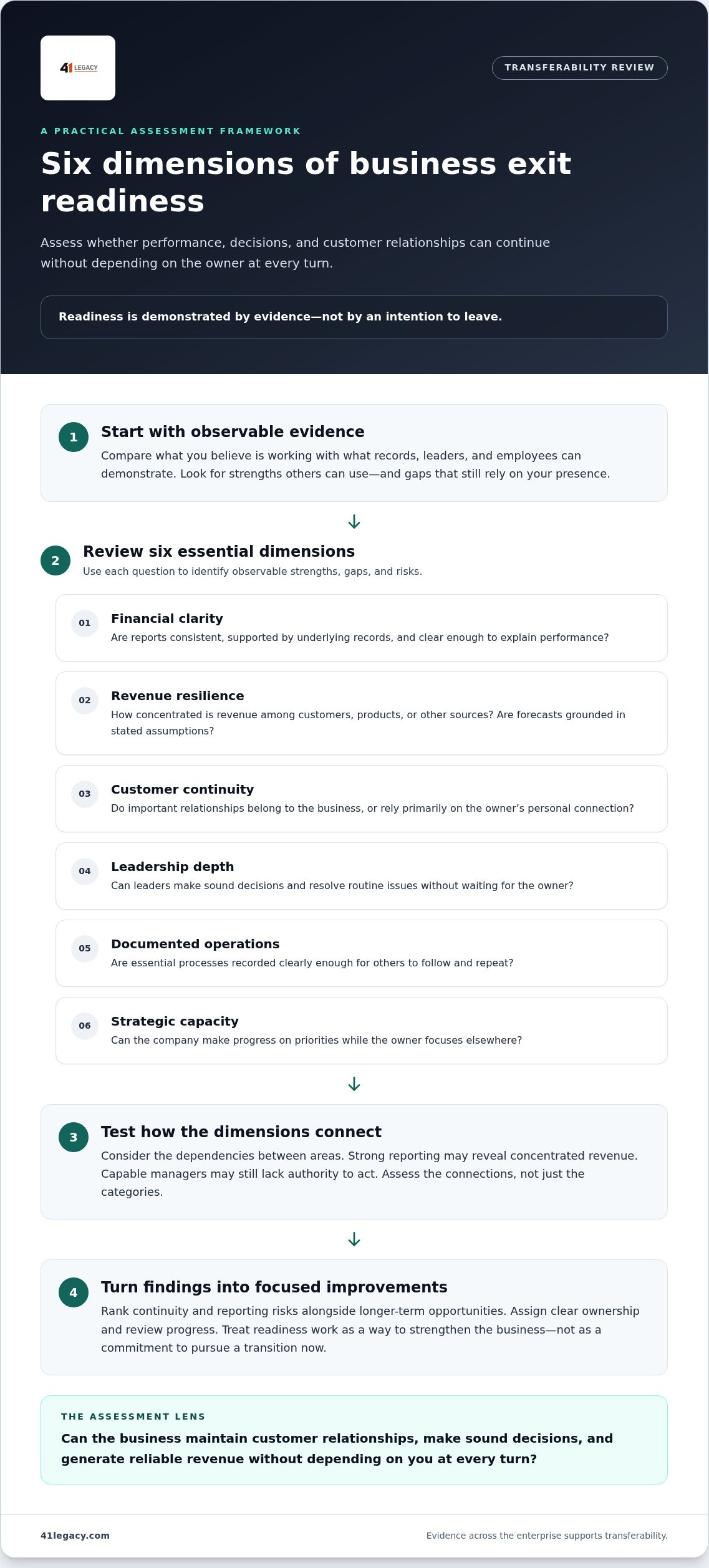
A useful assessment looks beyond the financial statements. Readiness requires evidence across multiple dimensions, not a single score. Review each area for observable strengths, gaps, and risks that could affect the company’s ability to operate without your constant involvement.
- Financial clarity: Are reports consistent, supported by underlying records, and clear enough to explain performance?
- Revenue resilience: How concentrated is revenue among customers, products, or other sources? Are forecasts grounded in stated assumptions?
- Customer continuity: Do important relationships belong to the business, or do they rely primarily on the owner’s personal connection?
- Leadership depth: Can leaders make sound decisions and resolve routine issues without waiting for the owner?
- Documented operations: Are essential processes recorded clearly enough for others to follow and repeat?
- Strategic capacity: Can the company make progress on priorities while the owner focuses elsewhere?
These dimensions interact. Strong reporting may reveal that revenue depends heavily on a few relationships; capable managers may still lack authority to act. Assess the connections, not just the individual categories. That is the practical core of how to assess business exit readiness.
What financial and commercial evidence should owners review?
Compare internal reports with the records that support them, and investigate material differences rather than smoothing them over. Review revenue patterns, customer concentration, margins, and forecast assumptions. Ask what would need to remain true for a forecast to hold, and identify where the answer rests on a single customer, person, or uncertain operating condition. For example, note whether a forecast depends on a renewal, a key employee, or a process that has not been tested without the owner. Avoid relying on a general benchmark to judge whether performance is durable. For a separate reference on business-closing steps, the IRS closing a business checklist outlines considerations relevant to closing; it does not assess the company’s overall transferability.
How dependent is the company on its owner?
Make an inventory of decisions that require your approval, relationships you personally maintain, and essential processes that depend on your knowledge. For each item, note who could take responsibility and what information or authority they would need. Then test whether leaders can handle routine exceptions and maintain customer service when you’re unavailable. Written procedures can show that work is repeatable, but stronger evidence is that the team can use them in practice.
For owners who want a structured view of current strengths and gaps, 41 Legacy’s enterprise readiness support connects diagnostic findings to transferability priorities.
Ready to sell now? Separate readiness from timing
An assessment doesn’t commit you to a sale. It helps you see how well the business can sustain performance beyond your direct involvement and where it may need attention. You can strengthen continuity, reduce owner dependency, and build leadership capacity while retaining control over whether and when to pursue a transition.
Keep two questions distinct: Is the business becoming more transferable? And have you chosen a transition path and timing? The first is ongoing strategic work. The second is an owner’s decision, informed by personal goals, company conditions, and input from appropriate professionals.
Readiness work versus an active transition decision
| Readiness work | Decision to pursue a transition |
|---|---|
| Strengthens reporting, leadership, processes, and continuity. | Chooses whether to pursue a transition and which path to consider. |
| Identifies owner-dependent risks and priorities for improvement. | Sets direction and timing for a specific transition effort. |
| Can support the business whether or not a transition is near. | May draw on readiness findings to guide next discussions. |
Readiness findings can inform conversations about internal succession or other future ownership changes, but no single route fits every owner or company. The assessment clarifies current conditions and priorities; it doesn’t promise a buyer, establish a certified business valuation, or guarantee a particular outcome.
What a readiness assessment cannot tell you by itself
An assessment is a strategic view of the enterprise, not a certified valuation. It can surface factors that affect transferability, but it doesn’t determine a definitive value or predict what another party may decide. Likewise, findings can help frame future discussions without selecting the right path or timing for you.
Legal, tax, and investment decisions require guidance from appropriately qualified advisors. A readiness assessment can help organize the business questions and identify where specialized professional input may be relevant, while leaving that advice to the appropriate professionals.
Think of the findings as a starting point for deliberate action, not a guarantee of transfer or transaction success. Owners learning how to assess business exit readiness can use that distinction to prepare the enterprise while keeping the decision about timing firmly in their hands.
Turn readiness findings into a focused business improvement plan
An assessment is useful only when its findings shape decisions and action. Avoid turning every gap into a task at once. Separate issues that could disrupt continuity or weaken reporting from longer-term opportunities to strengthen transferability and enterprise value. Then create a focused plan that connects each priority to a practical measure of progress and a person responsible for it.
1. Gather evidence. Bring together relevant financial reports, operating information, customer and revenue details, leadership responsibilities, and documented processes. Note where information is incomplete or depends on one person’s explanation.
2. Identify constraints. Describe the specific condition behind each concern. For example, distinguish inconsistent reporting from its underlying cause, such as unclear responsibility for reviewing records.
3. Rank priorities. Consider each gap’s effect on continuity, transferability, risk, and your strategic goals. Address urgent weaknesses first while preserving capacity for longer-term improvements.
4. Assign ownership. Name the leader responsible for moving each change forward, along with a practical measure that will show whether it’s working.
5. Review progress. Revisit the plan regularly to surface obstacles, test assumptions, and adjust priorities as the business changes.
How to prioritize the gaps you uncover
Prioritization depends on context, not a universal score. A process that only the owner can perform may pose a continuity concern; a growth initiative may be important but depend on first strengthening leadership capacity. Map those dependencies before committing resources or sequencing work. The aim is a deliberate order of action, not an arbitrary readiness threshold.
For broader ideas on strengthening enterprise value, use an enterprise value growth guide as a companion to your assessment. Keep recommendations tied to your company’s evidence and goals rather than treating general guidance as a prescribed plan.
How to keep implementation accountable
Assign each operational change to the leader best placed to carry it out. At recurring reviews, look at the agreed measure, discuss barriers, and decide whether the original assumption still holds. Bring existing professional advisors into the conversation where their expertise relates to a priority, so their work supports the owner’s broader strategic direction.
Knowing how to assess business exit readiness is only the beginning; disciplined follow-through turns findings into stronger continuity and transferability. To connect assessment findings with a focused improvement plan, explore 41 Legacy’s Value Growth Roadmap.
How 41 Legacy helps owners assess and strengthen exit readiness
An effective readiness assessment should do more than identify weaknesses. It should give the owner a grounded view of the business today, clarify the distance between current conditions and desired outcomes, and help turn that understanding into focused improvement. 41 Legacy begins with enterprise diagnostics to examine the company’s strengths, constraints, and areas of owner dependency.
What 41 Legacy’s structured assessment and roadmap address
Diagnostic findings inform a Value Growth Roadmap that helps prioritize improvements in transferability and owner-dependency reduction. For example, if critical operating knowledge rests with the founder, the work can focus on making responsibilities and processes easier for capable leaders to carry forward. If decisions regularly return to the owner, priorities may include building leadership capacity and clarifying where authority sits.
This is strategic improvement, not a promise of a sale, valuation, or financial result. The roadmap establishes direction and helps the owner focus effort on changes that support the enterprise’s goals. Learn more about 41 Legacy’s readiness approach and consider which business conditions you most want to strengthen.
Monthly implementation support helps maintain momentum as priorities move from plan to practice. 41 Legacy can also act as a strategic coordinator alongside the owner’s existing professional advisors, helping keep their work aligned with the business’s broader direction. Legal, tax, accounting, and investment matters remain with the relevant qualified professionals.
A practical next step for an owner considering readiness
Before beginning, clarify what you want the business to be capable of, whether that means less reliance on you, greater leadership depth, stronger continuity, or readiness for a future transition. Gather current financial and operating information, along with existing plans or records that help explain how the company performs. This gives the assessment a clear starting point.
With that context, an assessment can identify where evidence supports your goals and where further work may be needed. Owners learning how to assess business exit readiness can use this structured process to build clarity without committing to a particular transition path or timetable.
Explore 41 Legacy’s assessment and advisory approach to take the next step toward a more transferable business.
Build a Business That Can Thrive Beyond You
Readiness is demonstrated through the business’s ability to sustain performance beyond its owner, not through an intention to exit. Clear financial and operating evidence, capable leadership, and reliable customer continuity reveal where the company is transferable. A focused improvement plan turns gaps into practical priorities while leaving the timing and path of any future transition in your hands.
Knowing how to assess business exit readiness can bring clarity well before a transition becomes urgent. It helps you strengthen continuity, reduce reliance on your individual knowledge, and build an enterprise better positioned to support its next chapter.
Founded and led by Chris Giammarco, a Certified Exit Planning Advisor, 41 Legacy combines enterprise diagnostics, a Value Growth Roadmap, and implementation advisory to help owners move from assessment to sustained action alongside their existing professional advisors. Explore 41 Legacy’s exit readiness approach and take a practical next step toward a business built to thrive beyond you.
Frequently Asked Questions
How do I assess whether my business is ready to sell?
To understand how to assess business exit readiness, examine evidence across the company, not just its recent performance. Review financial clarity, customer and revenue resilience, leadership depth, documented operations, and how much still depends on you. Compare reports with supporting records and test whether leaders can manage routine decisions and customer needs independently. The review identifies strengths, gaps, and priorities; it doesn’t guarantee a sale or establish a certified business valuation.
What are the most important signs of business exit readiness?
Key signs include consistent financial information, durable customer relationships, capable leaders, repeatable processes, and decisions that don’t rely solely on the owner. Look for proof in records and demonstrated practices. For example, a documented process is more meaningful when another team member can follow it successfully, and a customer relationship is more resilient when the business, not only the owner, supports it. There’s no universal readiness score or threshold.
Can I assess exit readiness if I am not planning to sell soon?
Yes. Readiness work can strengthen continuity, reduce owner dependency, and clarify strategic priorities even when no transition is imminent. Improving delegation or documenting essential processes can benefit the company’s operation today, not only a future transition. Building a more transferable enterprise is separate from deciding to sell. You retain control over whether and when to pursue a transition, and an assessment doesn’t require you to choose a path or timetable.
How does owner dependency affect exit readiness?
When key customer relationships, decisions, or operating knowledge rest primarily with the owner, it can be harder to demonstrate that the business will continue smoothly without them. Start by mapping which relationships you personally maintain, what approvals routinely wait for you, and which tasks depend on your knowledge. Then consider developing capable leaders and documenting repeatable processes. These steps can reduce reliance, but no single action removes every continuity risk.
Does an exit readiness assessment determine my company's value?
No. A strategic readiness assessment examines conditions that affect transferability and identifies gaps, but it isn’t automatically a certified business valuation. A valuation depends on appropriate methods and the specific context of the company. Keep the purposes distinct: readiness work helps clarify what supports a transferable enterprise, while valuation addresses a separate question. For valuation, legal, tax, or investment decisions, rely on appropriately qualified professionals.
What should I prepare before assessing business exit readiness?
Gather current financial reports and forecasts, customer and revenue information, organizational responsibilities, key operating processes, and known business risks. The aim is to create a fact-based picture of how the company performs and where it relies on particular people or relationships. You don’t need to assemble a polished sale package. Clear, current information, including records that reveal uncertainties or inconsistencies, gives the assessment a useful starting point.
What happens after a business exit readiness assessment?
Findings can be organized into strengths, gaps, and actions tied to your goals. From there, prioritize the issues, assign responsibility to leaders positioned to address them, and review progress regularly. You can also coordinate your existing professional advisors around relevant priorities. The assessment informs strategic work; it doesn’t commit you to a particular transition path or guarantee a transaction outcome. Use the findings to guide improvements while retaining control over timing and direction.

Article by
Mike Laskowski
Mike Laskowski is a Business Value Growth Strategist who helps business owners uncover the truths that drive their performance, risk, and readiness. Blending forensic interviewing from a 26‑year federal career with Strategic Capacity analysis and CEPA methodology, he works upstream to reduce owner dependency, increase transferability, and strengthen enterprise value. Mike guides founders through clarity, operational evolution, and transition readiness so their companies become transferable, owner‑independent assets that endure beyond the founder.
Disclaimer
This article is for educational and informational purposes only and does not provide legal, tax, investment, or business brokerage advice. 41 Legacy does not offer M&A brokerage services, legal document drafting, tax preparation, or investment advisory services. Business owners should consult licensed professionals in those disciplines before making decisions related to business transactions, legal matters, tax strategy, or financial planning. All examples are illustrative and may not apply to your specific situation.

