
How Owner Dependency Affects Business Valuation: Building a Transferable Asset
Your presence at the helm of your company is often viewed as its greatest asset, yet in the eyes of a sophisticated buyer, it may be the very thing devaluing your legacy. It's a common paradox for the dedicated founder. The more your personal identity is woven into the fabric of the firm, the less transferable that firm becomes. Understanding how owner dependency affects business valuation is essential for any leader who feels trapped in daily operations or fears their life's work isn't a truly transferable asset.
We'll show you how decoupling your personal influence from the engine of the business can dramatically increase its market attractiveness and enterprise value. This guide provides a clear roadmap for transition, focusing on how strategic clarity and transferability engineering can turn your company into an independent entity that thrives long after your departure. By shifting your role from operator to steward, you can ensure your business remains a valuable, living artifact that survives the test of time.
Key Takeaways
- Recognize how personal involvement functions as a structural anchor that prevents your company from achieving its peak enterprise value.
- Learn how owner dependency affects business valuation by introducing perceived risk, which frequently leads to a significant compression of valuation multiples.
- Identify the specific bottlenecks in sales and operations where your individual mastery must be converted into documented, repeatable systems for the team.
- Discover how transferability engineering transforms your life's work into a self-sustaining asset that thrives independently of your daily presence.
- Understand how a structured Value Growth Roadmap aligns your professional advisors to bridge the value gap and ensure a legacy of stability.
Defining Owner Dependency: The Invisible Anchor on Enterprise Value
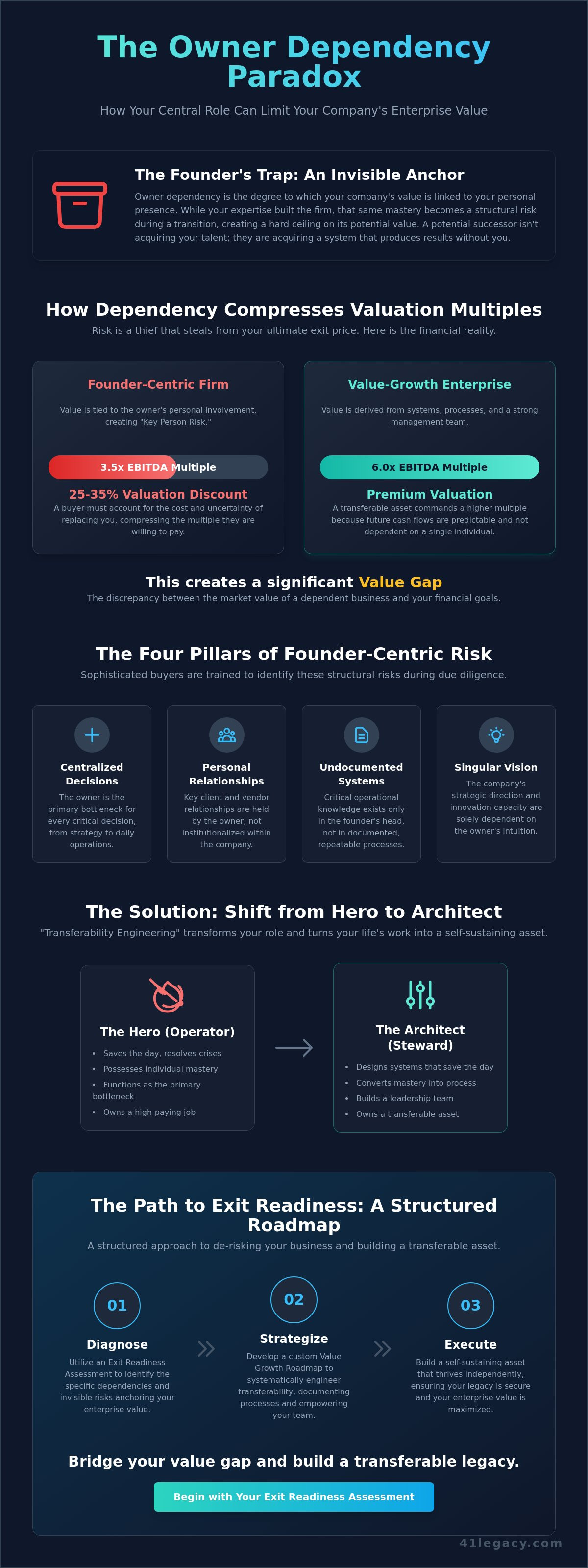
Owner dependency is the quiet gravity that pulls against the upward trajectory of your firm. It is a precise measure of how much of your company’s enterprise value is inextricably linked to your personal presence. While your expertise likely built the foundation, that same mastery can become a structural defect during a transition. This creates the "Founder’s Trap," a state where your previous success establishes a hard ceiling because you remain the primary bottleneck for every critical decision.
To understand how owner dependency affects business valuation, one must look through the eyes of a potential successor. They aren't looking to buy your individual talent; they're looking to acquire a machine that produces results without you. This is the core of a "Value-Growth Enterprise." Unlike a lifestyle business that exists to fund the owner's current needs, a value-growth firm is a transferable asset designed to maintain its essence and operational integrity long after the keys change hands.
The Difference Between a Job and an Enterprise
There is a profound distinction between owning a company and simply owning a high-paying job. An enterprise generates profit through the harmonious interaction of systems, while a job generates income through the owner’s constant labor. A transferable asset is one where the buyer inherits a proven process rather than a specific person. If the business requires your "final check" on every deliverable, you haven't built an asset; you've built a cage. Buyers view these owner-centric firms as knowledge-intensive liabilities because the value walks out the door the moment you do.
Quantifying the Intangible Risk
During the due diligence phase, sophisticated buyers are trained to identify "Key Person Risk." This is the probability that the business will falter if the founder is no longer present. While some firms attempt to mitigate this through Key Person Insurance, savvy investors know that capital cannot replace a missing operational engine. They want to see that the company's story can continue without its original author.
The path to a premium exit requires a psychological shift. You must move from being the "Hero" who saves the day to the "Architect" who designs the systems that save the day. This transition is not an overnight event. It begins with a deep diagnostic of your current state. Our Exit Readiness Assessment is designed to identify these invisible anchors, allowing us to see exactly how owner dependency affects business valuation in your specific context. By surfacing these risks early, we can begin the work of engineering them out of the enterprise, positioning you as a steward of a lasting legacy.
The Financial Cost: How Dependency Compresses Valuation Multiples
Valuation multiples are not merely arbitrary rewards for years of effort. They're a mathematical expression of confidence in the future. When a potential successor views your balance sheet, they aren't merely tallying historical receipts; they're calculating the probability of those receipts continuing in your absence. Understanding how owner dependency affects business valuation requires a shift in perspective from historical profit to future risk. In the eyes of a sophisticated buyer, risk is a thief that steals from your ultimate exit price.
This reality manifests as the "Multiple Discount." While a well-structured enterprise might command a 5x or 6x multiple of EBITDA (Earnings Before Interest, Taxes, Depreciation, and Amortization), a founder-centric firm often sees that multiple compressed by 25% to 35%. This discount exists because the buyer must account for the cost of replacing you. They aren't just buying your cash flow; they're buying the uncertainty of whether that flow survives your departure. This often creates a significant "Value Gap," which is the painful discrepancy between what you need for a secure retirement and what the market is actually willing to pay for a business that cannot function without its creator.
The distinction between "Self-Employed" earnings and "Enterprise" earnings is critical here. Seller’s Discretionary Earnings (SDE) are often used to value smaller, owner-operated shops, but they're inherently valued lower than EBITDA. EBITDA assumes the cost of professional management is already baked into the expenses. If you're the one performing that management for free, your profit is artificially inflated, and a buyer will quickly normalize those numbers by subtracting the cost of your replacement. This normalization can be a sobering experience for many founders.
Risk-Adjusted Returns and the Buyer’s Perspective
Buyers seek "sleep-at-night" cash flow. This is revenue that doesn't walk out the door at 5 PM or require your personal cell phone number to close a deal. If you're the primary rainmaker, a 5x multiple can quickly erode into a 3x multiple. Beyond the price tag, dependency also dictates deal structure. Buyers mitigate their fear of your exit by insisting on larger earn-outs or seller notes, keeping your capital at risk long after you've handed over the keys. They want to ensure the transition is a bridge, not a cliff.
The 2026 Valuation Landscape
Current trends among private equity and strategic buyers show an increasing reliance on data to audit owner involvement. They use sophisticated Enterprise Diagnostics to detect process gaps and dependency before an offer is even made. In this era, automation and technical precision are used to verify that your systems are living entities, not just stagnant documents. By identifying which financial levers to pull now, you can transform your firm from a fragile, owner-dependent shop into a robust, transferable asset that commands a premium multiple.
Identifying the Four Pillars of Founder-Centric Risk
To secure a premium exit, you must first deconstruct the architecture of your firm to find where your personal influence has become a structural liability. Understanding how owner dependency affects business valuation requires a clinical examination of four specific pillars. These are the areas where a buyer’s due diligence will be most surgical. If the enterprise's success is rooted in your individual charisma or technical genius rather than institutionalized processes, the market will view your legacy as a fragile artifact rather than a durable asset.
- Sales and Marketing: If you're the primary engine of revenue generation, the business lacks a sustainable pulse.
- Operations and Technical Mastery: If every project requires your "final check" to ensure perfection, your team hasn't truly mastered the craft.
- Strategic Vision: If the roadmap for the next five years exists only in your mind, the company has no compass without you.
- Relationship Concentration: If key vendors and customers are loyal to you personally rather than the brand, the revenue is non-transferable.
The Rainmaker Problem
Being the most effective salesperson in your company is a point of pride that often masks a fatal valuation flaw. To a third party, a "Rainmaker" owner is a single point of failure. If your top three customers still call your personal cell phone to resolve issues or place orders, you have a dependency problem that will immediately trigger a multiple discount. The transition from active Rainmaker to a strategic Sales Manager is a vital step in value multiplication. By engineering a sales process that functions without your direct intervention, you prove the brand's strength is independent of its creator.
Operational Silos and Knowledge Hoarding
Many founders possess "tribal knowledge," a collection of unwritten rules and master-level nuances that have never been documented. This creates operational silos where the team is perpetually reliant on the founder for guidance on "Critical Path" tasks. True stewardship requires the surgical development of Standard Operating Procedures (SOPs) that capture the essence of your excellence. This isn't just about manuals; it's about building a second-tier management layer capable of executing the Value Growth Roadmap. When your team can deliver the core service with extreme precision without your oversight, you've successfully moved from being the hero of the story to the architect of the system. This structural integrity is exactly how owner dependency affects business valuation in the most positive sense, turning a job into a transferable legacy.
Transferability Engineering: Building a Business That Outlasts Your Tenure
Engineering a business for transferability is a deliberate act of stewardship. It requires the precision of a master artisan, refining the enterprise until it functions as a self-sustaining work of art. To address how owner dependency affects business valuation, one must move beyond the cosmetic and focus on the structural. This process begins with an Enterprise Diagnostic to identify the "Value Gap," the distance between your current reality and the premium multiple your legacy deserves.
The roadmap to independence follows five essential movements:
- The Diagnostic: Establishing a baseline for enterprise health and identifying the invisible anchors of dependency.
- Documenting the Essence: Translating your unique mastery into a repeatable system that the team can execute with extreme precision.
- Strategic Capacity Evaluation: Ensuring your human capital and operational infrastructure possess the depth to handle future expansion.
- The Role Evolution: Orchestrating your transition from the "Chief Everything Officer" to a "Chairman of the Board" who governs rather than operates.
- Advisor Orchestration: Aligning your CPA, attorney, and wealth manager around a singular Value Growth Roadmap.
The Role of Standard Operating Procedures (SOPs)
Standard Operating Procedures are often misunderstood as mere bureaucracy. In a high-value enterprise, they are the blueprints of the masterpiece. These documents preserve the "essence" of your work, ensuring that quality remains uncompromised when you're no longer in the room. By providing clear, surgical instructions for every critical path, you effectively eliminate "Buyer’s Anxiety." A successor isn't just buying a list of clients; they're buying a proven engine of excellence. Our strategic advisory services facilitate this documentation, turning your personal genius into a permanent institutional asset.
Empowering Second-Tier Management
A business that relies on a single hero is inherently fragile. To increase enterprise value, you must identify high-potential employees and cultivate them into a second-tier management layer. This team must be capable of executing the vision without your daily intervention. Proper incentive alignment ensures these key individuals remain committed to the company's long-term health after your departure. Through Monthly Implementation Support, we hold your team accountable to the new systems, ensuring that the transition from owner-led to management-run is both fluid and permanent. This systematic reduction of risk is the most direct way to solve how owner dependency affects business valuation, transforming your company into a highly sought-after, transferable asset.
The Path to Exit Readiness: Strategic Alignment with 41 Legacy
True stewardship requires more than a desire to transition; it requires a coordinated architecture for the future. At 41 Legacy, we serve as the "Quarterback" of your transition team, orchestrating the efforts of your existing professional advisors to ensure a harmonious outcome. While your CPA and attorney provide essential technical oversight, our role is to provide the central vision that unites their work. We understand that protecting the essence of your life's work isn't a transactional event, but a philosophical and operational commitment to transferability.
The guiding document for this transformation is the Value Growth Roadmap. This isn't a static plan that gathers dust in a drawer; it is a living strategic compass that informs every decision you make. By aligning your team around this roadmap, we ensure that every operational adjustment serves the ultimate goal of increasing enterprise value. This structured approach is the most effective way to address how owner dependency affects business valuation, turning a fragile, founder-led firm into a robust, transferable asset that commands respect in the marketplace.
The Enterprise Diagnostic Process
The journey toward a premium exit begins with absolute clarity. Our Enterprise Diagnostic process is designed to surface the invisible risks and untapped opportunities within your current structure. This phase provides the strategic clarity necessary to move forward with confidence, replacing uncertainty with a precise understanding of your firm’s health. We believe that professional guidance should be rooted in evidence. Our diagnostic process turns gut feelings into data-driven valuations, allowing you to see your business through the same clinical lens as a sophisticated buyer.
The Quarterback Advantage
A successful transition requires the seamless alignment of multiple disciplines. Your CPA, Attorney, and Wealth Manager are masters of their respective crafts, yet they often operate in silos without a unifying strategy. We bridge this gap. By coordinating these specialists, we ensure that your legal structure, tax strategy, and operational improvements are all pulling in the same direction. This alignment is critical because exit readiness is a multi-year journey of refinement, not a last-minute fix.
Our Monthly Implementation Support ensures that the work of transferability engineering remains a priority even amidst the demands of daily operations. We hold the team accountable to the systems we design, ensuring that the reduction of founder-centric risk becomes a permanent part of the company's DNA. This steady, unhurried pace of improvement is what eventually creates the most significant impact on the market price. If you are ready to secure your legacy and solve the problem of how owner dependency affects business valuation once and for all, it is time to begin the process of intentional refinement. Start your journey toward exit readiness with 41 Legacy.
The Architecture of a Permanent Asset
We've explored how a business tethered to its founder remains a fragile instrument, often devalued by the very expertise that built it. By identifying the four pillars of risk and applying the principles of transferability engineering, you transform your company from a personal obligation into a durable, market-ready asset. This shift is not merely a financial strategy; it is an act of stewardship that preserves the essence of your labor for future generations. Understanding how owner dependency affects business valuation is the essential first step in reclaiming the true worth of your life's work.
At 41 Legacy, we provide the strategic depth required for this evolution. Led by a Certified Exit Planning Advisor (CEPA), our team employs a structured "Quarterback" approach to align your existing advisors under a singular, cohesive vision. We utilize a proven Value Growth Roadmap methodology to bridge the value gap and ensure your transition is executed with the precision of a master artisan. Your company has a story worth telling. We ensure it has the structural integrity to continue long after you've turned the final page.
Secure Your Legacy: Request an Exit Readiness Assessment
The path to a premium exit is a journey of refinement, and it's one you don't have to walk alone.
Frequently Asked Questions
What exactly is an owner-dependent business?
An owner-dependent business is an enterprise where critical operational, sales, or strategic functions are inextricably linked to the founder's daily presence. In these organizations, the business cannot maintain its momentum or profitability without the founder's constant, direct intervention. It is essentially a high-paying job disguised as a company; it lacks the institutionalized systems and second-tier management depth required to function as a standalone, transferable asset that thrives independently.
How much does owner dependency actually reduce my business valuation?
Owner dependency can frequently result in a "multiple discount" of 25% to 35% compared to firms with independent management teams. This reduction occurs because sophisticated buyers perceive higher operational risk and must factor in the substantial cost of hiring a professional replacement. Understanding how owner dependency affects business valuation is vital, as this discount directly impacts the net proceeds you receive at the time of your exit.
Can I sell my business if I am the primary salesperson?
You can sell your business while serving as the primary salesperson, but it will likely command a lower price and involve more restrictive deal terms. Buyers often view a "Rainmaker" owner as a single point of failure for the company's revenue stream. To mitigate this risk, they may insist on a larger earn-out or a lengthy transition period where you remain on staff to ensure the relationships successfully transfer to the new owner.
How long does it take to reduce owner dependency before a sale?
Most successful transitions require eighteen to thirty-six months of deliberate operational refinement to yield the best results. This timeframe allows you to document complex processes, train second-tier management, and prove that the company can thrive without your daily oversight. It's a multi-year journey of craftsmanship, not a last-minute adjustment made just before you decide to hand over the keys to a successor or an outside investor.
What is the 'Value Gap' in exit planning?
The Value Gap is the discrepancy between what you need for a secure post-exit life and the current market value of your business. This gap often exists because owners overestimate their company's readiness or underestimate the impact of dependency on their final price. Closing this gap requires a structured Value Growth Roadmap that focuses on increasing enterprise value through strategic operational improvements, risk reduction, and the enhancement of transferability.
Do I need to hire a new CEO to make my business transferable?
You don't necessarily need a new CEO, but you must empower a leadership layer that can execute the company's core functions autonomously. This could involve promoting high-potential internal talent or refining your systems so that the team can operate without your constant "final check." The goal is to ensure the "essence" of the business remains intact without you, regardless of the specific job titles used in your management structure.
What is the difference between a Lifestyle Business and a Value-Growth Enterprise?
A lifestyle business exists primarily to fund the owner's current needs and is often built around their personal labor and expertise. In contrast, a value-growth enterprise is designed as a transferable asset with institutionalized systems and a clear roadmap for future expansion. While both can be profitable, only the value-growth model offers the scalability and independence required to command a premium valuation multiple from sophisticated buyers and investors.
How do I know if my business is ready for an Exit Readiness Assessment?
You are ready if you have a desire to understand your firm’s true market attractiveness and want a clear path to independence. Even if you don't plan to transition for several years, an assessment provides the strategic clarity needed to build a more robust organization. It's the first step in discovering how owner dependency affects business valuation and beginning the work of engineering a legacy that survives your tenure.

Article by
Mike Laskowski
Mike Laskowski is a Business Value Growth Strategist who helps business owners uncover the truths that drive their performance, risk, and readiness. Blending forensic interviewing from a 26‑year federal career with Strategic Capacity analysis and CEPA methodology, he works upstream to reduce owner dependency, increase transferability, and strengthen enterprise value. Mike guides founders through clarity, operational evolution, and transition readiness so their companies become transferable, owner‑independent assets that endure beyond the founder.
Disclaimer
This article is for educational and informational purposes only and does not provide legal, tax, investment, or business brokerage advice. 41 Legacy does not offer M&A brokerage services, legal document drafting, tax preparation, or investment advisory services. Business owners should consult licensed professionals in those disciplines before making decisions related to business transactions, legal matters, tax strategy, or financial planning. All examples are illustrative and may not apply to your specific situation.