
How Long Does It Take to Sell a Business? A Clear Timeline
The sale clock often starts before a business goes to market. If you’re asking how long does it take to sell a business, the answer depends not only on finding a buyer, but also on whether the company can operate and perform without its owner at the center. It’s reasonable to want a date to plan around, especially when a transition affects employees, family, and future plans.
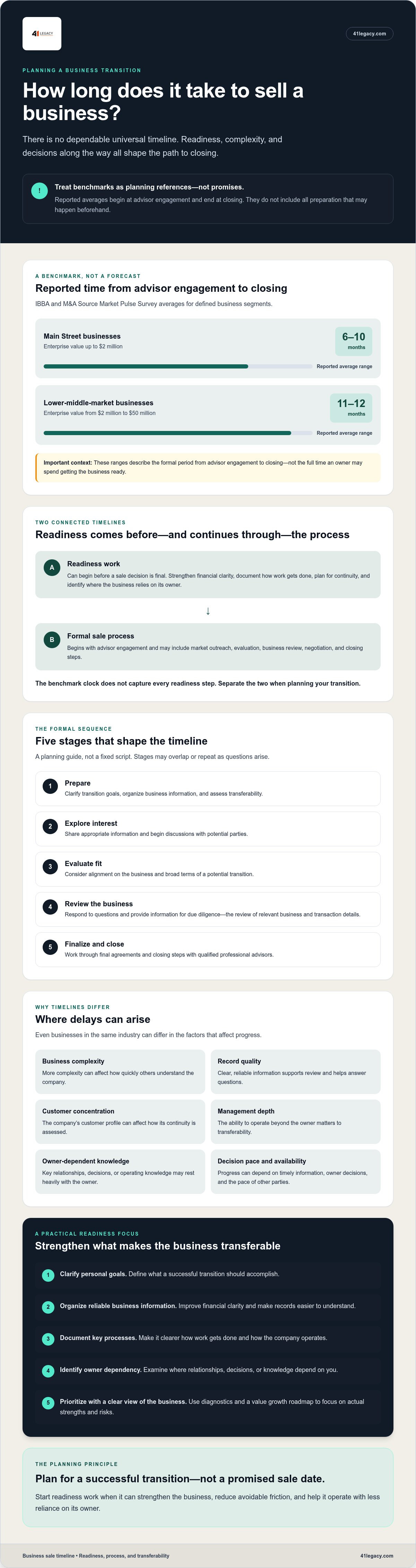
Recent benchmarks offer a reference, not a promise. The IBBA and M&A Source Q2 2026 Market Pulse Survey reported an average of 6 to 10 months from advisor engagement to closing for Main Street businesses with enterprise values up to $2 million, and 11 to 12 months for lower-middle-market businesses valued at $2 million to $50 million. Those figures don’t include all the preparation an owner may need before beginning a sale process.
This article separates readiness from the active transaction, then maps the stages that shape the timeline, how they depend on one another, and where delays can arise. You’ll see how preparation can reduce avoidable friction by strengthening financial clarity, reducing owner dependency, and improving transferability. The aim isn’t to promise a closing date. It’s to help you decide when to begin, what to address first, and how to build a practical plan for the business you’re stewarding.
Key Takeaways
- How long does it take to sell a business depends on the company’s readiness and decisions made throughout the process. Treat timeline estimates as planning references, not promises.
- Understand how preparation, market outreach, review, and closing fit together, and why stages may overlap or take different amounts of time.
- Spot potential delays early by checking business records, continuity, and the company’s ability to operate without the owner.
- Start preparing before a sale decision is final by clarifying personal goals, documenting key processes, and identifying where the business relies on you.
- Use diagnostics and a value growth roadmap to prioritize readiness work based on the business’s actual strengths and risks.
How long does it take to sell a business? Start with the honest answer
There’s no dependable universal timeline. If you’re asking how long does it take to sell a business, start by separating preparation from the formal sale process. A company may need to strengthen its records, clarify how work gets done, or reduce its reliance on the owner before a sale process begins. Readiness work can start whether or not the owner has made a final decision to sell.
For context, the IBBA and M&A Source Q2 2026 Market Pulse Survey reported average periods from advisor engagement to closing of 6 to 10 months for Main Street businesses with enterprise values up to $2 million, and 11 to 12 months for lower-middle-market businesses valued at $2 million to $50 million. These are reported averages for defined segments, not forecasts for a particular company. They also don’t account for all preparation that may happen beforehand.
Business sale timeline: The full period of readiness work and formal sale activity through closing. Preparation may begin before an owner decides to pursue a sale. An anticipated timeline is a planning estimate, not a guaranteed completion date.
What does the business sale timeline include?
The formal process can involve preparing information about the company, bringing the opportunity to market, evaluating interested parties, reviewing business records, negotiating key terms, and completing closing steps. Some activities overlap or repeat as questions arise. The broader Mergers and acquisitions (M&A) process can involve multiple parties and decisions, so this sequence is a guide rather than a fixed script.
Preparation is distinct from that formal sequence. An owner may work on reliable reporting, documented processes, and continuity planning long before engaging an advisor or choosing a transition path. Separating readiness work from transaction time gives owners a clearer basis for planning.
Why can two similar businesses take different amounts of time?
Businesses in the same industry can differ in complexity, record quality, customer concentration, management depth, and how much operational knowledge rests with the owner. Each difference can affect how quickly others understand the company and assess whether it can continue operating through a transition. Progress may also depend on the owner’s availability to answer questions, provide information, and make timely decisions, as well as the pace of other parties involved.
No single timeline fits every sale because readiness, complexity, and decision-making differ from one business and process to the next.
The stages of selling a business, and where time is spent
A sale process is easier to plan when its stages are visible, even though they don’t always unfold in a straight line. Preparation may begin well before an owner decides to pursue a sale. That distinction matters when considering how long does it take to sell a business: the formal process is only one part of the overall transition effort.
Stage-by-stage view
- Prepare: Clarify transition goals, organize business information, and assess transferability.
- Explore interest: Share appropriate information and begin discussions with potential parties.
- Evaluate fit: Consider whether there is alignment on the business and the broad terms of a potential transition.
- Review the business: Respond to questions and provide information for due diligence, the review of relevant business and transaction details.
- Finalize and close: Work through final agreements and closing steps with qualified professional advisors.
This sequence is a planning aid, not a fixed timetable. Discussions or information reviews may overlap, and new questions can send work back to an earlier stage. The process also varies with the business and the parties involved.
Preparation before a business goes to market
Start by clarifying what a successful transition should accomplish for you. Then identify the information others may need to understand how the company operates. Consider whether key relationships, decisions, or operating knowledge depend heavily on you. If they do, documenting processes and strengthening management capacity may help the business function more independently. Owners exploring exit planning for business owners can use this work to build readiness before choosing a path.
From initial discussions through diligence and closing
Early conversations help establish interest and determine whether further evaluation makes sense. If discussions progress, the review stage can surface questions about records, operations, customer relationships, or continuity. An unclear document or unanswered question may require follow-up, coordination, or additional review before the parties can move forward.
Final agreements and closing involve detailed work that should be handled with the owner’s qualified legal, tax, and other professional advisors. The owner’s role is to provide accurate information, make decisions promptly, and coordinate with those advisors. Preparation doesn’t remove every unknown, but organized information and clear responsibilities can make it easier to address issues as they arise.
What can speed up or delay a business sale?
Preparation can make a sale process clearer and reduce avoidable back-and-forth. It can’t determine whether every party will move quickly or agree. A business may be ready to go to market in the owner’s view, yet still depend on undocumented knowledge, inconsistent records, or relationships that only the owner can manage. Listing immediately doesn’t necessarily mean the company is ready to transfer.
Conditions that can support progress
- Business and financial information is organized, consistent, and easy to explain.
- Key processes and responsibilities are documented, so operations aren’t held in one person’s memory.
- Revenue sources and customer relationships are understood, including any concentration that may prompt questions.
- The owner and relevant stakeholders can respond to requests and make decisions in a timely way.
Conditions that may create delays
- Missing or unclear records require explanations, reconciliation, or follow-up.
- Important processes, customer relationships, or approvals depend heavily on the owner.
- Questions about customer concentration or business continuity require further review.
- Stakeholders are unavailable, decisions are slow, or professional advisors need time to assess newly surfaced issues.
Readiness factors owners can influence
Start with practical steps: create a clear, current set of business records; write down recurring processes; and clarify who is responsible for key decisions and relationships. If the owner remains the only person who can resolve daily issues, build management capacity and delegate where appropriate. These efforts support transferability and can strengthen enterprise value growth, whatever transition path the owner eventually chooses.
Customer concentration deserves thoughtful attention, too. There’s no universal threshold that determines whether concentration is a problem. Instead, understand how much the business relies on particular customers or revenue sources, why those relationships continue, and what would happen if they changed. Clear context helps surface risks early rather than leaving others to infer the story from incomplete information.
Delays to plan for without assuming the worst
A review may raise questions that weren’t apparent during preparation. An explanation may need supporting records, a contract or financial item may warrant review by a qualified advisor, or a decision may require coordination among several stakeholders. These are possible process complications, not proof that a transition is off course. Keep a list of open questions, assign someone to each item, and track what information or decision will resolve it.
Preparation can reduce avoidable uncertainty, but it can’t control every decision or set the final timeline. That’s a more useful planning principle than assuming a listing date alone determines how long does it take to sell a business.
How to prepare for a business sale before the clock starts
Preparation doesn’t require a final decision to sell. Begin with a clear-eyed review of what you want from a future transition and whether the business could continue to perform without your daily involvement. This work can also support other paths, including an internal transition, while giving you a stronger basis for deciding what to do next.
Build a clear picture of the business as it operates today
Look beyond the organization chart. Identify who handles important responsibilities, which customer relationships depend on you, and what decisions or processes could stall if you were unavailable. For example, if only the owner knows how a key service is delivered or how a major account is managed, that dependency deserves attention. Documenting procedures makes the company’s operating knowledge more visible and supports transferability.
Use this checklist to establish a practical starting point:
- Map your responsibilities: List the work only you can currently perform, approve, or resolve.
- Trace business continuity: Identify who could step in for essential tasks and where responsibilities are unclear.
- Review customer and revenue relationships: Note which relationships are concentrated in the owner or otherwise require context to understand.
- Organize core business information: Make current records easy to find and explain how the company operates. Ask your existing professional advisors about matters within their expertise.
- Record open questions: Capture information gaps, operational risks, and decisions that need an owner.
Set priorities and coordinate the right advisors
Write down what a successful transition would mean to you. Consider the role you want after a transition, the continuity you hope to preserve, and which outcomes matter most. You don’t need every answer yet. A short list of unresolved questions can help focus discussions with your CPA, attorney, and other relevant advisors, each working within their professional role.
Then decide which readiness issues deserve attention first. Some may concern business continuity; others may involve owner dependency or unclear responsibilities. An enterprise diagnostic can help identify these priorities and inform a value growth roadmap. This is strategic readiness work, not transaction representation, and it doesn’t set a sale date.
If you’re asking how long does it take to sell a business, a useful first step is understanding what the business needs before a formal process begins. Explore 41 Legacy’s strategic readiness support to consider how diagnostics and structured advisory can help clarify priorities and strengthen transferability.
Plan for a successful transition, not a promised sale date
A responsible advisor can help you prepare and make clearer decisions, but can’t promise when a sale will close. Timing depends on the business’s readiness, decisions made by its owner and other parties, and factors no advisor controls. A more useful goal is to build a company that can operate with less reliance on its founder and support a well-considered transition, whether that path is external or internal.
What an Exit Readiness Assessment can clarify
An Exit Readiness Assessment provides a structured view of the business as it stands today and how that position compares with your goals. It can help identify strengths to preserve, risks to address, and gaps in transferability, such as responsibilities or relationships that remain concentrated with the owner. The findings can inform priorities before you decide whether or when to pursue a transition.
The assessment is a strategic planning tool. It isn’t a certified business valuation, sale representation, or guarantee of a particular outcome or timeline. Its value lies in bringing greater clarity to the choices ahead, so preparation can be guided by the company’s actual conditions rather than assumptions about a closing date.
Turn insight into a deliberate next step
Once priorities are clear, a Value Growth Roadmap can organize work around strengthening transferability and reducing owner dependency. For example, a roadmap may help focus attention on documenting key processes, clarifying management responsibilities, or improving continuity around important customer relationships. The right priorities depend on the findings and the owner’s objectives.
Monthly Implementation Support helps owners carry agreed strategic priorities forward and coordinate with their existing professional advisors. 41 Legacy provides strategic advisory and readiness support, not business sale representation. Legal, tax, and other professional questions remain with the owner’s qualified advisors, each working within their area of expertise.
If you’re considering how long does it take to sell a business, begin with what you can shape: the readiness and transferability of the enterprise. An Exit Readiness Assessment can help establish a clearer starting point without turning preparation into a promise about timing. Explore 41 Legacy’s strategic readiness support.
Build readiness that supports your next chapter
There’s no reliable calendar promise for a business transition. The answer to “how long does it take to sell a business” depends on the company’s readiness, the decisions of everyone involved, and factors no owner can fully control. What you can shape is the work that happens before a formal process: clarifying your goals, strengthening continuity, and helping the business operate with less dependence on you.
A thoughtful transition plan begins with understanding the enterprise as it stands today, then choosing practical priorities that support transferability. 41 Legacy, founded and led by Chris Giammarco, a Certified Exit Planning Advisor (CEPA), helps owners use structured diagnostics to identify readiness priorities, develop a Value Growth Roadmap, and make progress through Monthly Implementation Support. This strategic support coordinates with your existing professional advisors. It doesn’t include business sale representation or promise a timeline or outcome.
If you’re ready to understand where the business stands and what to address next, explore 41 Legacy’s strategic readiness support. Begin with clarity, and build an enterprise prepared to carry its purpose forward.
Frequently Asked Questions
How long does it usually take to sell a business?
There’s no reliable universal duration. If you’re asking how long does it take to sell a business, separate preparation from the formal sale process: an owner may work on readiness before deciding to pursue a transition. Complexity, record quality, transferability, diligence questions, and the pace of decision-making can all affect timing. Treat any estimate as a planning reference, not a guaranteed completion date or promise of a particular outcome.
What is the longest stage of selling a business?
No single stage is always the longest. Preparation may take meaningful time if the business needs clearer records, documented processes, or less reliance on the owner. Later, diligence and closing may also involve follow-up as questions arise or information needs review. Rather than assume one stage will take the most time, identify readiness gaps specific to your company and consult qualified professional advisors about transaction matters within their roles.
Can I sell my business quickly if it is profitable?
Profitability alone doesn’t determine timing or whether a business is ready to transfer. Others may also need a clear picture of how operations work, how customer relationships are managed, what the records show, and how much depends on the owner. Preparing this information can reduce avoidable uncertainty, but it can’t guarantee a faster process, agreement among all parties, or a completed sale. Treat profitability as one part of the broader readiness picture.
What can delay the sale of a business?
Possible complications include incomplete information, unanswered questions, complex operations, owner dependency, and slow decisions by people involved. These factors don’t predict that a process will be delayed, and not every issue can be prevented. A review may raise questions that call for additional information or assessment by the owner’s existing professional advisors. Tracking open items and who is responsible for addressing them can help maintain clarity as the process develops.
Should I prepare my business before I decide to sell?
Yes. You can clarify your transition goals, organize business information, document important processes, and assess where the company relies on you before committing to a sale. These steps can strengthen strategic clarity and help reveal transferability gaps, though they can’t promise a particular timeline or transaction outcome. Coordinate with your existing professional advisors on matters within their expertise. If you want a structured view of readiness, consider an assessment before choosing your next step.
Does 41 Legacy sell my business for me?
No. 41 Legacy doesn’t provide business sale representation or M&A brokerage. Its work focuses on enterprise diagnostics, a Value Growth Roadmap, transferability, reducing owner dependency, and structured strategic support, including monthly implementation support. 41 Legacy can coordinate with your existing professional advisors, who remain responsible for their own services. This work helps clarify readiness priorities, but it doesn’t guarantee a sale or a particular outcome. Owners can explore 41 Legacy’s strategic readiness support to assess potential next steps.

Article by
Mike Laskowski
Mike Laskowski is a Business Value Growth Strategist who helps business owners uncover the truths that drive their performance, risk, and readiness. Blending forensic interviewing from a 26‑year federal career with Strategic Capacity analysis and CEPA methodology, he works upstream to reduce owner dependency, increase transferability, and strengthen enterprise value. Mike guides founders through clarity, operational evolution, and transition readiness so their companies become transferable, owner‑independent assets that endure beyond the founder.
Disclaimer
This article is for educational and informational purposes only and does not provide legal, tax, investment, or business brokerage advice. 41 Legacy does not offer M&A brokerage services, legal document drafting, tax preparation, or investment advisory services. Business owners should consult licensed professionals in those disciplines before making decisions related to business transactions, legal matters, tax strategy, or financial planning. All examples are illustrative and may not apply to your specific situation.

