
Transferability & Owner Dependency
How Financial Health Affects Business Valuation: The Architecture of Transferable Assets
Your business is more than a commercial entity; it's a living legacy and a masterpiece of your own design. Many owners realize too late that a profitable company isn't always a transferable one. We believe the true measure of your life's work rests in the structural integrity of your balance sheet. Understanding how financial health affects business valuation is the difference between a quiet exit and a celebrated transition.
It's common to feel a sense of uncertainty about the true market value of your work or to fear a gap between your current worth and your retirement goals. We respect the weight of this concern. This article explores how the intricate layers of your company's financial health dictate its ultimate enterprise value and long-term legacy. We'll provide a clear view of the levers that drive value, actionable steps to reduce owner dependency, and a roadmap to ensure your organization is prepared for its next chapter.
Key Takeaways
- Understand how financial health affects business valuation by viewing your company’s earnings as a carefully preserved asset rather than a mere income stream.
- Discover why transferability is the ultimate measure of success, requiring a level of financial transparency that allows a successor to step in with absolute confidence.
- Identify the specific "Value Detractors" that create a gap between your current enterprise worth and the legacy you intend to leave behind.
- Learn how to utilize a Value Growth Roadmap to systematically address financial weaknesses and prepare your business for a successful internal or external transition.
- Explore the "Quarterback" advisory model, which harmonizes the efforts of your professional team toward a single, unified vision of enterprise value growth.
The Silent Multiplier: Why Financial Health is the Bedrock of Business Valuation
A business is an intricate composition, a legacy forged through years of dedication and strategic intent. Yet, the market does not value a company based on the effort of its founder. It values the reliability of what remains when that founder departs. Business valuation is a cold, precise reflection of perceived risk and the sustainability of future cash flows. It's a verdict on whether your organization is a fleeting performance or a permanent monument.
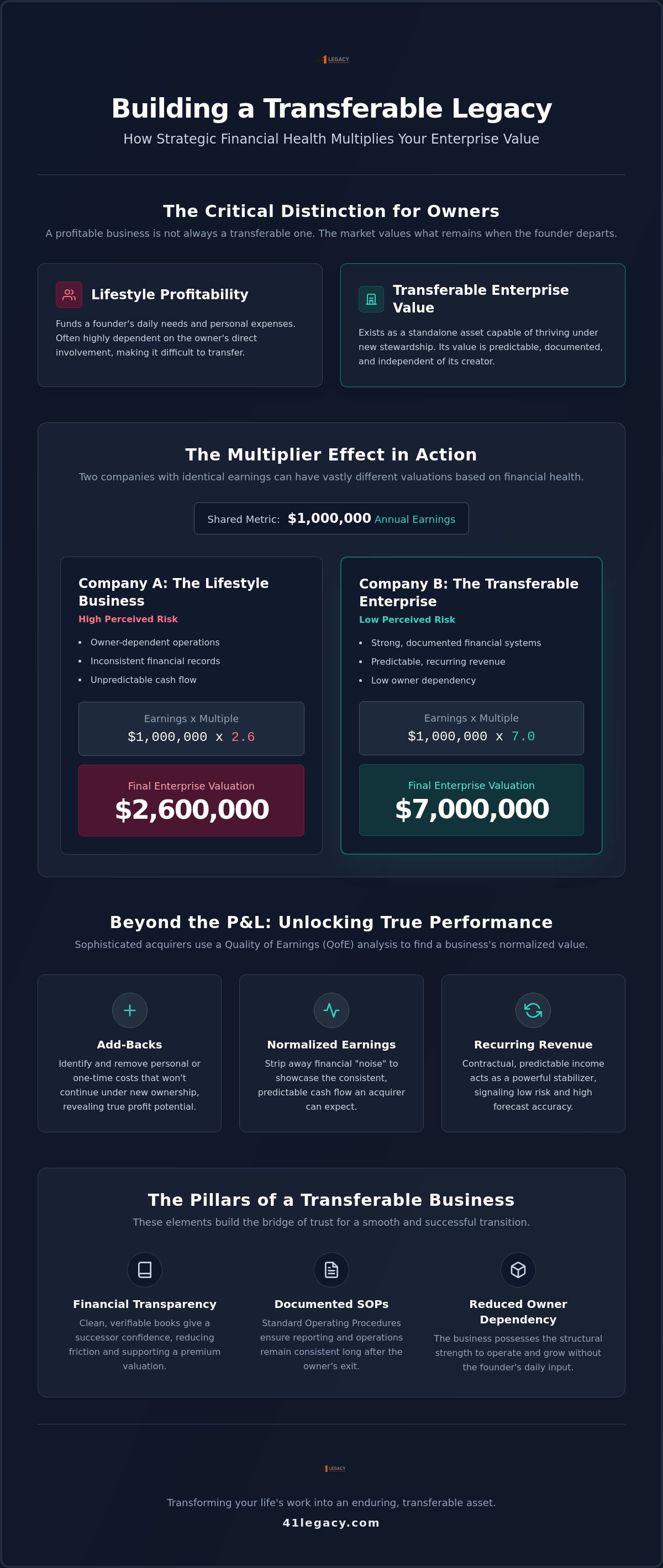
When we examine how financial health affects business valuation, we're looking at the structural integrity of a company's earnings. A healthy organization doesn't just produce profit; it produces profit that's predictable, documented, and entirely independent of its creator. This distinction separates "lifestyle profitability," which funds a founder's daily needs, from "enterprise value," which exists as a standalone asset capable of thriving under new stewardship. To master the value of your work, you must look past the bottom line and into the bones of the enterprise.
The "Multiplier Effect" is where this health becomes visible in the market. Consider two firms with identical earnings of $1 million. According to 2026 data, a small business might sell for 2.6x its earnings, while a company with stronger financial systems in the lower-middle market could command a 6x or 7x multiple. The difference isn't found in the industry alone. It's found in the clarity and resilience of the financial foundation. A healthy balance sheet doesn't just add value; it multiplies it.
The Relationship Between Risk and Reward
Sophisticated buyers view every financial statement as a map of potential hazards. They use financial health to determine the discount rate, which is essentially the premium they require for taking a risk on your future. Clean, transparent books act as a beacon of trust. They reduce the friction of a transition and give a successor the confidence to pay a premium. Enterprise value is the present value of future transferable cash flows. If those flows are clouded by poor record-keeping or owner-dependency, the value inevitably contracts.
Quality of Earnings (QofE) vs. Net Income
A standard P&L statement is often a tool for tax mitigation. It rarely captures the true essence of a business's value to an outsider. Sophisticated acquirers look toward a Quality of Earnings analysis to find the "normalized" performance of the asset. This process involves several critical adjustments:
- Add-backs: These identify personal expenses or one-time costs that won't continue under new ownership, revealing the true profit potential.
- Normalized Earnings: These strip away the noise of the past to show what the business can consistently generate.
- Recurring Revenue: Contractual, predictable income acts as a stabilizer. For example, SaaS companies in 2026 often see multiples as high as 15x because their revenue models are perceived as exceptionally healthy and low-risk.
By focusing on these levers through Enterprise Diagnostics, an owner transitions from a mere operator to a steward of a transferable masterpiece.
Beyond the Balance Sheet: Assessing Financial Health Through the Lens of Transferability
A masterpiece is only as valuable as its ability to be appreciated by others. In the same vein, the true worth of your organization isn't found in a static snapshot of assets, but in its transferability. Transferability is the ease with which a business can change hands without losing its essential vitality or earning power. It's the difference between a collection of parts and a self-sustaining engine. When analyzing how financial health affects business valuation, we must look at how well your financial systems serve as a bridge to the next steward.
Financial transparency serves as the primary pillar of this bridge. If a successor can't clearly see the mechanics of your cash flow, they'll perceive risk where there should be opportunity. We believe that documented financial Standard Operating Procedures (SOPs) are more than just administrative tasks; they're the blueprints of trust. These protocols ensure reporting remains consistent long after you've stepped away. A Strategic Capacity Evaluation also allows us to determine if the business possesses the structural strength to handle growth under new leadership. Without this capacity, the enterprise is merely a fragile vessel rather than a resilient asset.
Owner Dependency: The Financial Health Indicator Most Owners Ignore
Many founders find themselves caught in the "Owner Trap," where the business’s financial success is inextricably linked to their personal involvement. From a valuation perspective, this is a profound indicator of poor financial health. If you're the primary driver of sales or operations, a buyer must factor in the significant replacement cost of your expertise. We help owners quantify this risk by evaluating the market salary required to hire a professional team to replicate your output. You can learn more about reducing owner dependency on our homepage to begin decoupling your identity from the company’s value.
The Role of Working Capital and Liquidity
During the transition process, sophisticated parties scrutinize the "working capital peg." This metric represents the amount of capital required to keep the business operating smoothly on a day-to-day basis. A healthy, transferable asset maintains robust cash reserves, signaling a resilience that can withstand market fluctuations. A history of neglected Capital Expenditure (CapEx) can signal a "value leak" that a successor will eventually have to repair. By maintaining a disciplined approach to liquidity and reinvestment, you ensure the enterprise remains a polished, high-performance asset. To ensure your financial foundation is truly exit-ready, consider engaging in Transferability Engineering to fortify these critical levers.
Identifying the Value Gap: How Financial Risks Erode Enterprise Worth
Every business owner eventually faces a mathematical reality known as the Value Gap. This is the silent distance between what your business is currently worth and what you need to fund your next chapter with dignity. While profit margins may seem robust, hidden structural risks often act as a slow erosion on your enterprise worth. Discovering how financial health affects business valuation requires a clinical examination of these vulnerabilities before they're exposed to the open market.
A common misconception persists among even the most diligent stewards. Many believe that because their CPA says their "taxes are fine," their valuation must be high. Tax accounting is a retrospective discipline focused on mitigation. Valuation, however, is a forward-looking discipline focused on risk. A "Value Detractor" like inconsistent margins or poor record-keeping might not impact your tax return, but it will certainly compress your valuation multiple. We utilize Enterprise Diagnostics to uncover these hidden financial leaks, ensuring the integrity of the asset remains intact.
Customer and Vendor Concentration Risks
Concentration is a quiet predator of enterprise value. If a single client represents more than 15% of your total revenue, a successor will view your cash flow as fragile rather than resilient. This "key man" risk extends to vendor relationships as well. When your supply chain relies on a single source, you've introduced a single point of failure. Diversifying these streams isn't just an operational preference; it's a financial necessity that directly increases your valuation multiple by lowering the perceived risk of a transition.
The Burden of Historical Baggage
Unresolved debt, messy capitalization tables, or lingering legal disputes create a "Historical Baggage" that complicates the valuation process. These issues act as a weight on the business, dragging down the potential for a clean handover. It's vital to begin "cleaning the slate" at least 24 to 36 months before a planned exit. This period of strategic hygiene allows you to present a polished, uncomplicated asset to the market. We invite you to explore our Enterprise Diagnostics to identify your Value Gap and begin the process of fortifying your legacy against these common detractors.
The Roadmap to Resilience: Strategic Financial Hygiene for Exit Readiness
Exit readiness isn't a destination reached through a single transaction. It's a state of operational excellence. To achieve this peak condition, a steward must shift their perspective from tax-mitigation accounting to value-growth accounting. While traditional tax strategies focus on minimizing current liabilities, value-growth strategies focus on maximizing the enterprise multiple. This shift is fundamental to understanding how financial health affects business valuation. It transforms your books from a simple record of history into a testament of future potential.
Implementing a Value Growth Roadmap provides the structure needed to systematically address financial weaknesses. This process is supported by Monthly Implementation Support, ensuring that strategic goals don't get lost in the noise of daily operations. By maintaining a steady, unhurried rhythm of improvement, you ensure the business remains in a constant state of readiness for whatever transition the future may hold.
Step 1: Conduct an Enterprise Diagnostic
The journey toward resilience begins with a formal assessment to establish a baseline for strategic planning. An Enterprise Diagnostic identifies the "Low-Hanging Fruit" where immediate improvements in financial hygiene can yield significant results. This diagnostic acts as a high-resolution mirror, reflecting the true state of your organization. You cannot grow what you have not yet measured. By quantifying current strengths and vulnerabilities, we create the clarity necessary for a disciplined path forward.
Step 2: Formalize Financial SOPs and Reporting
Precision requires consistency. Moving from annual reviews to monthly, dashboard-driven oversight provides real-time strategic clarity. Sophisticated successors often place a higher premium on audited or reviewed financials than on simple "compiled" statements, as they offer a verified narrative of performance. Standardizing the "Month-End Close" ensures that your financial reporting remains accurate and compelling. This level of technical excellence signals to the market that the business is managed with the care of a master artisan.
Step 3: Reduce Owner Dependency Through Systems
A business that relies entirely on its founder is a fragile asset. Resilience is built by reinvesting profits into middle management and robust systems rather than extracting every available dollar as a dividend. This Transferability Engineering approach transforms a demanding job into a sophisticated investment. When the enterprise can thrive independently of your daily presence, its valuation naturally ascends. To begin your journey toward a resilient legacy, we invite you to explore our Value Growth Roadmap and secure the future of your life's work.
Orchestrating the Legacy: The 41 Legacy Approach to Value Growth
The stewardship of a business is a profound responsibility that transcends daily operations. It's the act of curating a legacy. Many owners treat their departure as a single, transactional event, often seeking representation only when they're exhausted. We propose a different path. Realizing how financial health affects business valuation requires a shift from a transactional mindset to one of strategic advisory. At 41 Legacy, we don't just facilitate a handoff; we engineer an asset that's worthy of your life's work.
Our "Quarterback" model serves as the central point of coordination for your entire professional circle. A business owner shouldn't be forced to bridge the gap between their CPA, attorney, and wealth advisor. These professionals are masters of their respective crafts, but without a unified vision, their advice can become siloed or even contradictory. We ensure that every financial and legal lever is pulled in the same direction: toward exit readiness and enterprise value growth. This approach positions you as a steward of a lasting legacy rather than just a seller of a company.
The Power of a Coordinated Advisory Team
Misaligned advice is a quiet destroyer of enterprise value. Your CPA might focus on tax mitigation while your attorney focuses on liability, yet neither may be optimizing for the ultimate transferability of the asset. We act as the guardian of your strategic intent, aligning these disciplines into a single, cohesive strategy. This coordination ensures that your financial health isn't just adequate for tax season, but exceptional for a successor. Discover how our Strategic Advisory services protect your legacy by bringing harmony to your professional team.
Building a Transferable Asset for the Long Term
The most opportune time to prepare for an exit was five years ago. The second best time is today. This isn't about rushing toward a sale; it's about the peace of mind that comes from knowing your organization is ready for any transition, planned or otherwise. When you focus on how financial health affects business valuation, you're building a company that can thrive independently of your presence.
True freedom for a founder is the choice to stay or go, backed by the knowledge that the asset is optimized. You've spent years building this masterpiece. Now is the time to ensure its architecture is sound. Start your journey toward a transferable legacy with a team dedicated to the precision and preservation of your life's work.
The Final Polish: Securing Your Enterprise Legacy
The true value of your work isn't found in a single year's profit. It resides in the enduring strength of the asset you've crafted. We've explored how financial health affects business valuation by looking past the surface of profitability and into the structural resilience of your systems. A transferable asset requires meticulous attention to detail, from reducing owner dependency to harmonizing your advisory team toward a unified goal.
At 41 Legacy, we provide the technical precision and strategic depth required to protect your life's work. Under our Certified Exit Planning Advisor (CEPA) leadership, we utilize the Quarterback model to ensure your professional team operates with a singular vision. Through comprehensive Value Growth Roadmaps, we help you bridge the gap between where your business is today and the legacy you intend to leave behind. Your business is a masterpiece. It deserves a transition that reflects its worth.
Begin Your Exit Readiness Assessment with 41 Legacy
Frequently Asked Questions
How much does a poor credit score or high debt-to-equity ratio affect my business valuation?
High debt-to-equity ratios and poor credit scores significantly compress valuation by increasing the perceived risk and the cost of capital for a buyer. Buyers view excessive leverage as a strain on future cash flows. A balanced capital structure signals a resilient, well-managed asset that can withstand economic fluctuations without compromising its operational integrity or its ability to secure future growth capital.
Can my business have a high valuation if I am the primary salesperson?
A business where the founder is the primary salesperson typically faces a lower valuation due to high owner dependency. This creates a transferability risk because the revenue is tied to a personal relationship rather than a systemic process. To maximize value, you must institutionalize the sales function so the enterprise continues to thrive long after your departure. Successors pay for systems, not personalities.
What is the difference between a "Certified Business Valuation" and an "Exit Readiness Assessment"?
A Certified Business Valuation provides a formal estimate of current worth, while an Exit Readiness Assessment evaluates the structural strength and transferability of the enterprise. The former is a snapshot of the past; the latter is a roadmap for the future. We focus on the assessment to identify the levers that will actually grow your ultimate legacy and reduce the risk of a value gap.
How many years of "clean" financial records do I need before a buyer will trust my valuation?
Most sophisticated buyers require at least three years of clean, consistent financial records to establish a reliable baseline of performance. This duration allows a successor to see how financial health affects business valuation through various market cycles. Providing 24 to 36 months of transparent data reduces due diligence friction and builds essential trust in the accuracy of your financial reporting.
Does "financial health" include the physical assets and real estate owned by the business?
Financial health considers physical assets, but real estate is often treated as a separate entity from the operating business during a valuation. Buyers generally focus on the enterprise's ability to generate cash flow from its operations. While well-maintained equipment reflects good stewardship, the true value lies in the intangible systems and human capital that make those physical assets productive and profitable.
What happens to my valuation if my industry enters a downturn but my internal financials are strong?
Strong internal financials act as a shield during an industry downturn, often allowing a healthy business to command a higher relative multiple than its struggling peers. While macro trends influence the baseline, your specific financial hygiene determines your resilience. A buyer will pay a premium for a flight to quality when the rest of the market is characterized by uncertainty and risk.
Is profitability the most important factor in determining enterprise value?
Profitability is a critical component, but it's not the only factor in determining enterprise value. A highly profitable business that relies on a single customer or a single founder is far less valuable than a moderately profitable one with diversified revenue and robust systems. Value is found at the intersection of earnings and the absolute reliability of those earnings under new stewardship.
How does "Quality of Earnings" differ from the profit shown on my tax returns?
A Quality of Earnings (QofE) analysis focuses on the normalized, sustainable cash flow of a business, whereas tax returns focus on minimizing taxable income. Understanding how financial health affects business valuation requires looking past paper profits to identify non-recurring expenses and owner add-backs. This process reveals the true economic essence of the organization to a sophisticated successor who values long-term performance.
Disclaimer
This article is for educational and informational purposes only and does not provide legal, tax, investment, or business brokerage advice. 41 Legacy does not offer M&A brokerage services, legal document drafting, tax preparation, or investment advisory services. Business owners should consult licensed professionals in those disciplines before making decisions related to business transactions, legal matters, tax strategy, or financial planning. All examples are illustrative and may not apply to your specific situation.