
How Customer Concentration Impacts Business Value: The Complete Strategic Guide
Customer concentration is not merely a commercial metric; it is an enterprise fragility tax. While landing a dominant flagship account often feels like a triumph, understanding how customer concentration impacts business value reveals a very different reality under institutional scrutiny. When prospective buyers and lenders evaluate your company, they don't just see impressive top-line growth. They see catastrophic downside risk wrapped inside an otherwise healthy income statement.
You have spent years earning the trust of these key clients, and it's natural to view their loyalty as proof of operational excellence. Still, you likely carry the quiet worry that your enterprise value remains vulnerable to the decisions of one or two executives. This guide unpacks the structural mechanisms acquirers use to discount concentrated earnings, practical strategies to de-risk revenue without alienating vital accounts, and the diagnostic path required to engineer lasting transferability. What follows is a blueprint for safeguarding your life's work and ensuring your business thrives independently of any single customer relationship.
Key Takeaways
- Explore how customer concentration impacts business value by elevating perceived operational risk and suppressing deal multiples during institutional review.
- Uncover why sophisticated buyers look past top-line billing to penalize margin exposure and single-point points of failure.
- Learn diagnostic techniques to evaluate true revenue vulnerability, measuring gross profit contribution alongside relationship tenure.
- Implement targeted diversification strategies that expand wallet share across internal departments without jeopardizing core enterprise relationships.
- Discover how structured strategic advisory and value growth roadmaps engineer genuine transferability well ahead of any ownership transition.
What Is Customer Concentration and How Does It Threaten Enterprise Value?
Customer concentration occurs when an outsized share of revenue flows from a single client or a narrow cluster of accounts. While substantial billing volume can create an impression of robust financial health, enterprise value rests on the predictability, resilience, and transferability of cash flow. When receipts depend heavily on a handful of relationships, understanding how customer concentration impacts business value becomes a critical exercise in risk management rather than a simple accounting calculation.
Revenue scale alone does not ensure stability. The sudden loss of an anchor account can lead to immediate operational distress, eroding operating margins and threatening cash reserves. Without broad revenue dispersion, an enterprise behaves less like an institutional asset and more like an overgrown, fragile lifestyle venture. Much like the principles underpinning classical financial diversification strategies, real business sustainability requires distributing risk across independent, non-correlated counterparties.
Defining the Critical Concentration Thresholds
Acquirers, lenders, and advisors generally evaluate revenue concentration against well-defined benchmarks:
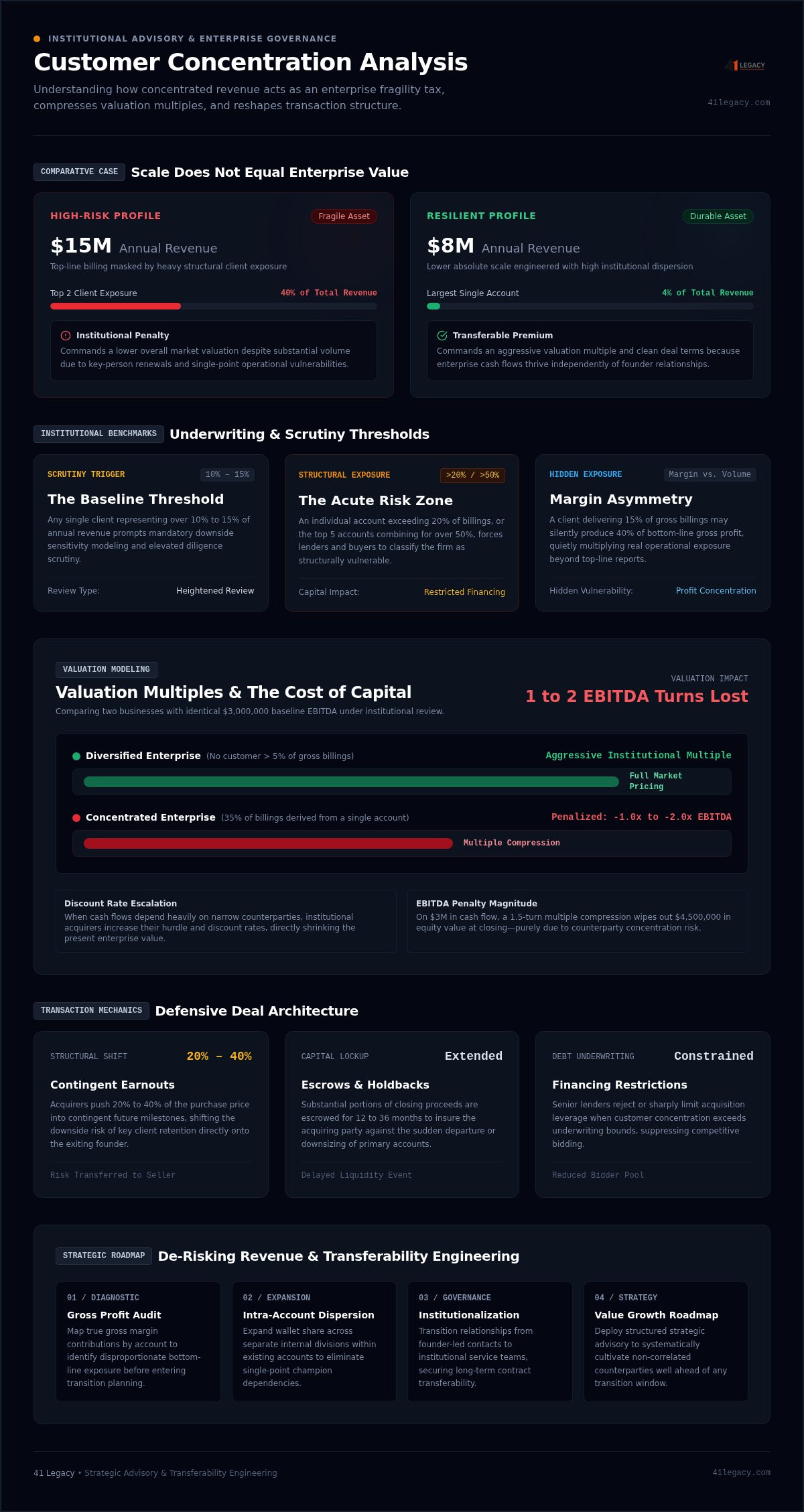
- The Baseline Threshold: Any single client generating more than 10% to 15% of annual revenue prompts heightened scrutiny during institutional reviews.
- The Acute Risk Zone: When an individual account exceeds 20% of billings, or the top five accounts combine for more than 50%, lenders and prospective successors treat the company as structurally exposed.
- Margin versus Volume Disconnect: A client contributing 15% of gross billings might generate 40% of bottom-line gross profit. That disparity quietly amplifies operational vulnerability beyond what top-line reports suggest.
Why Revenue Scale Does Not Equal Enterprise Value
Top-line growth frequently masks internal structural exposure. A company generating $15 million in annual revenue with 40% tied to two contracts often commands a lower value than an $8 million business whose largest account accounts for only 4% of sales. True enterprise worth reflects what remains after the founder departs and the initial contracts face renewal.
Evaluating this dynamic requires an honest assessment of asset quality and durability. Through structured Transferability Engineering, owners can systematically identify where client concentration threatens capital preservation. De-risking these relationships ensures that years of dedicated stewardship translate into an enduring, valuable enterprise rather than an unhedged operational liability.
How Prospective Buyers and Acquirers Penalize Concentrated Revenue
Institutional acquirers do not view revenue concentration as an operational quirk. They analyze it as unmitigated downside exposure. When examining how customer concentration impacts business value during an acquisition or recapitalization, prospective successors immediately recalibrate their financial models. If cash flow relies on a narrow client base, the enterprise is priced for volatility rather than sustained durability.
Valuation Multiples and the Cost of Capital Adjustment
Every valuation model balances anticipated returns against perceived risk. When key accounts make up an outsized portion of gross billings, institutional buyers raise the discount rate applied to future cash flows. That higher cost of capital directly compresses the company's valuation multiple.
Consider two enterprises, each generating $3 million in EBITDA. The first maintains a diversified client base where no customer exceeds 5% of billings. It commands an aggressive market multiple. The second produces identical earnings, yet 35% of its volume stems from a single relationship. Acquirers often penalize this second business by one to two turns of EBITDA, wiping out millions in enterprise value simply because the risk profile is substantially higher.
Structural Deal Penalties: Earnouts, Holdbacks, and Escrows
Beyond lowering headline multiples, concentrated receipts force defensive deal architecture. Buyers routinely restructure proposals to insulate themselves against relationship churn, including:
- Contingent Earnouts: Shifting 20% to 40% of the enterprise value into post-closing performance milestones, effectively transferring the risk of client defection back to the founder.
- Extended Indemnification Escrows: Holding substantial funds in escrow specifically tied to the renewal or retention of marquee accounts.
- Lender Rejections: Commercial debt providers, including SBA lenders facing strict internal exposure limits, frequently reduce borrowing capacity or walk away entirely, collapsing transactions during formal diligence.
The Intersection of Customer Concentration and Owner Dependency
Concentration risk expands exponentially when marquee client accounts depend entirely on the founder's personal presence. If key accounts exist because of historical friendships, handshake agreements, or founder-led problem solving, buyers cannot trust that cash flow will survive a leadership change. They view that revenue as non-transferable personal goodwill.
Addressing these interconnected risks requires methodical, long-term preparation. Through an early Exit Readiness Assessment, owners can identify where customer concentration intersects with executive reliance. By replacing personal charisma with institutional systems, contracts, and team-led account management, you transform vulnerable client accounts into verifiable, transferable enterprise value.
Diagnosing Your Exposure: Assessing Client Concentration Risk
Diagnosing client dependency requires looking beyond standard sales reports. While an income statement records gross volume, it often conceals fragile operational fault lines. Gaining strategic clarity on how customer concentration impacts business value requires an objective forensic audit that weighs both financial distribution and relationship structure.
A resilient company is designed with intention. Stewarding an enterprise toward enduring transferability means identifying which accounts supply reliable margin and which ones drain company resources while creating single-point vulnerabilities.
The Quantitative Audit: Revenue and Margin Distribution
A rigorous numerical review separates perceived volume from true profitability. When analyzing customer concentration, advisors run specific diagnostic models:
- The Herfindahl-Hirschman Index (HHI): Squaring the revenue percentage of each client provides a mathematically sound measure of customer dispersion across the whole firm.
- Gross Margin Stratification: Evaluating cost of goods sold per client frequently reveals that marquee accounts consume disproportionate delivery resources, delivering lower real margins than smaller accounts.
- The 80/20 Stress Test: If 80% of operating cash flow traces back to two or three clients, routine operational friction with those accounts can jeopardize payroll and debt service.
The Qualitative Diagnostic: Relationship Depth and Contract Durability
Mathematical dispersion tells only half the story. The legal architecture and operational depth supporting each key client define whether that revenue is genuinely transferable to a successor.
Institutional acquirers examine whether key accounts are tied to multi-year master service agreements featuring clear assignment clauses, or if they rely on informal monthly purchase orders. They also look at organizational depth. When five team members across multiple departments interface directly with a client, the relationship belongs to the company. When communication runs solely through the founder's mobile phone, the relationship remains personal goodwill.
Operationalizing these touchpoints protects institutional continuity. Implementing rigorous Enterprise Diagnostics helps leadership measure account vulnerability against specific transferability standards. Documented delivery workflows, account-management procedures, and formal operational standards turn relationship management into an institutional discipline, ensuring that client retention survives any future leadership transition.
Strategic Methods to Diversify Revenue and Protect Enterprise Value
Remediating client exposure does not mean cutting ties with your most profitable accounts. Discarding a major client to balance an arbitrary ratio destroys real cash flow and destabilizes your operational base. Instead, solving how customer concentration impacts business value requires an intentional strategy: holding core client volume steady while methodically building diversified capacity around it.
Protecting enterprise value takes deliberate operational discipline. By treating diversification as an architectural upgrade rather than an emergency measure, you expand top-line performance while systematically insulating your underlying asset.
Executing the "Grow Around" Strategy
Rebalancing your revenue profile relies on purposeful, phased execution across three clear steps:
- Cap Relative Capacity: Maintain the absolute dollar volume of your largest account, but channel incremental sales resources, marketing capital, and operational bandwidth entirely toward secondary and emerging clients.
- Penetrate Disconnected Divisions: Within a marquee enterprise customer, branch into distinct subsidiaries, separate geographic regions, or independent operating units with their own discrete budgets and decision-makers. Acquirers view multi-division revenue as distinct counterparties rather than a single point of failure.
- Productize Specialized Work: Take the custom deliverables developed for your primary client, extract their proprietary value, and standardize them into modular offerings tailored for adjacent industries.
Institutionalizing Accounts Away from Founder Control
Diversification requires delegating relationship ownership alongside expanding client numbers. As long as key clients call the founder for strategic decisions, those accounts carry personal goodwill rather than enterprise worth.
You can break this reliance by assigning dedicated account teams to manage day-to-day operations, project execution, and quarterly reviews. Back these teams with documented standard operating procedures and repeatable delivery frameworks. When a company demonstrates that client satisfaction, project fulfillment, and annual renewals happen without executive oversight, prospective successors view those revenue streams as predictable, transferable assets. As explored in our guide on how to increase enterprise value, operational autonomy remains the primary driver of institutional pricing.
Deploying a Structured Value Growth Roadmap
Mitigating concentration risk requires structured execution over an 18 to 36 month horizon. Establishing rolling quarterly benchmarks ensures that top-client revenue percentages shrink steadily through organic expansion.
Executing this transformation demands continuous strategic accountability. Discover how building a tailored Value Growth Roadmap protects enterprise value and turns your business into a durable, transferable asset.
The Strategic Advisor as Quarterback: Maximizing Transferable Legacy
Remediating revenue exposure is not an eleventh-hour accounting tactic. When owners wait until an impending transition to evaluate how customer concentration impacts business value, their options dwindle down to heavy valuation discounts or punitive earnouts. True enterprise resilience requires disciplined, multi-year stewardship long before entering the transition window.
A founder's life's work deserves more than reactive damage control. Transforming an owner-dependent enterprise into a self-sustaining, transferable asset requires orchestrating operational strategy, corporate governance, and organizational design with surgical precision.
Harmonizing the Professional Advisory Team
Most business owners work with capable outside professionals, including corporate attorneys, CPAs, and wealth advisors. Yet these experts frequently operate in disconnected silos. An attorney focuses on liability covenants, a CPA concentrates on annual tax minimization, and a wealth manager evaluates personal asset allocation. None are actively tasked with engineering holistic enterprise transferability.
This structural void is where a strategic advisory quarterback changes the equation. Working alongside your established team, a certified exit planning advisor aligns disparate advisory efforts behind a unified roadmap. The quarterback ensures that commercial contracts, financial reporting, and operational workflows pull in the same strategic direction, methodically de-risking the business while preserving founder equity.
From Vulnerable Enterprise to Enduring Asset
Lasting transformation begins with an unsparing diagnostic baseline. By assessing client risk, gross margin durability, and executive dependency, leadership gains the clarity needed to make high-impact capital allocation decisions.
Through structured advisory frameworks and ongoing Monthly Implementation Support, founders receive steady accountability to execute necessary changes. Client relationships shift from personal goodwill to institutional standard operating procedures. Sales pipelines expand into adjacent markets. Top-account concentrations normalize naturally over time.
You didn't invest decades building a company only to leave its value exposed to the decisions of one or two commercial accounts. Take deliberate control of your company's future by partnering with 41 Legacy advisory services, building a transferable enterprise that protects your wealth and sustains your legacy for generations.
Securing Your Legacy Through Strategic Transferability
Mastering how customer concentration impacts business value empowers you to shift from defensive vulnerability to proactive enterprise stewardship. Left unaddressed, heavy reliance on marquee accounts erodes valuation multiples and subjects transactions to punishing contingency structures. By implementing intentional diversification roadmaps and decoupling core accounts from executive oversight, you forge an organization that commands institutional respect.
True transferability requires a coordinated advisory approach. Led by a Certified Exit Planning Advisor (CEPA), 41 Legacy acts as the strategic quarterback alongside your CPA and legal counsel. Through our proven enterprise diagnostics and structured advisory frameworks, we align operational discipline with your broader succession goals. Take deliberate control of your company's equity today. Begin your enterprise diagnostic with 41 Legacy to safeguard your life's work and build a resilient asset that endures across generations.
Frequently Asked Questions
What percentage of revenue is considered dangerous customer concentration?
Institutional buyers and commercial lenders generally flag any customer accounting for 10% to 15% of annual gross billings as a material risk. Once a single account exceeds 20%, or your top five clients generate more than 50%, the risk profile intensifies dramatically. Lenders often restrict debt financing above these levels, while prospective successors begin factoring in significant downside protection.
Can high customer concentration cause a business sale to collapse?
Yes, high customer concentration routinely derails prospective recapitalizations and ownership transfers during diligence. When commercial lenders review exposure and refuse to underwrite acquisition financing, buyers cannot secure the debt required to complete the transaction. In other cases, buyers discover that a marquee account lacks transferability, prompting severe purchase price reductions that cause sellers to walk away from closing negotiations.
How do prospective buyers calculate a valuation discount for revenue concentration?
Prospective acquirers calculate discounts by raising their discount rate to reflect added cash flow risk, which directly compresses the transaction multiple. Understanding how customer concentration impacts business value helps explain why heavily exposed companies often face a discount of one to two turns of EBITDA. Alternatively, acquirers enforce structural discounts, withholding 20% to 40% of the enterprise value through multi-year earnouts contingent on account retention.
What happens if my largest client is also my most profitable customer?
When your largest client delivers an outsized share of gross profit, operational vulnerability multiplies. A customer generating 20% of revenue might account for 45% of bottom-line net cash flow. Prospective buyers evaluate this as extreme margin fragility, realizing that losing that single account could wipe out operating profit entirely. Mitigating this risk requires optimizing pricing models and margin structures across your broader client base.
Is it possible to reduce customer concentration without dropping existing revenue?
You should never reduce concentration by severing profitable accounts; it's far safer to deploy a "grow around" approach. Maintain your core accounts while directing incremental operational capacity, new business development, and marketing investment toward secondary clients. Repackaging bespoke deliverables into standardized offerings also allows you to acquire adjacent clients rapidly, naturally lowering the percentage share of your primary account without sacrificing revenue.
How long does it typically take to diversify a concentrated customer base?
Meaningfully rebalancing a concentrated client roster typically requires 18 to 36 months of disciplined execution. Diluting an anchor account's revenue share while scaling adjacent operations cannot happen overnight. Successfully executing a Value Growth Roadmap over this multi-year timeline ensures that your company expands market share systematically, solidifying institutional transferability without straining working capital or disrupting delivery excellence.
Does having multi-year contracts with top clients eliminate concentration risk?
Long-term contracts mitigate concentration risk, but they don't eliminate it entirely. While multi-year master service agreements provide legal predictability, buyers recognize that agreements can still be terminated for convenience or breached. Crucially, analyzing how customer concentration impacts business value shows that contract length matters little if delivery depends on the founder. Institutionalization, customer diversification, and documented operating systems remain necessary to achieve genuine transferability.

Article by
Mike Laskowski
Mike Laskowski is a Business Value Growth Strategist who helps business owners uncover the truths that drive their performance, risk, and readiness. Blending forensic interviewing from a 26‑year federal career with Strategic Capacity analysis and CEPA methodology, he works upstream to reduce owner dependency, increase transferability, and strengthen enterprise value. Mike guides founders through clarity, operational evolution, and transition readiness so their companies become transferable, owner‑independent assets that endure beyond the founder.
Disclaimer
This article is for educational and informational purposes only and does not provide legal, tax, investment, or business brokerage advice. 41 Legacy does not offer M&A brokerage services, legal document drafting, tax preparation, or investment advisory services. Business owners should consult licensed professionals in those disciplines before making decisions related to business transactions, legal matters, tax strategy, or financial planning. All examples are illustrative and may not apply to your specific situation.

