
Financial Readiness for Business Exit: Transferable Value
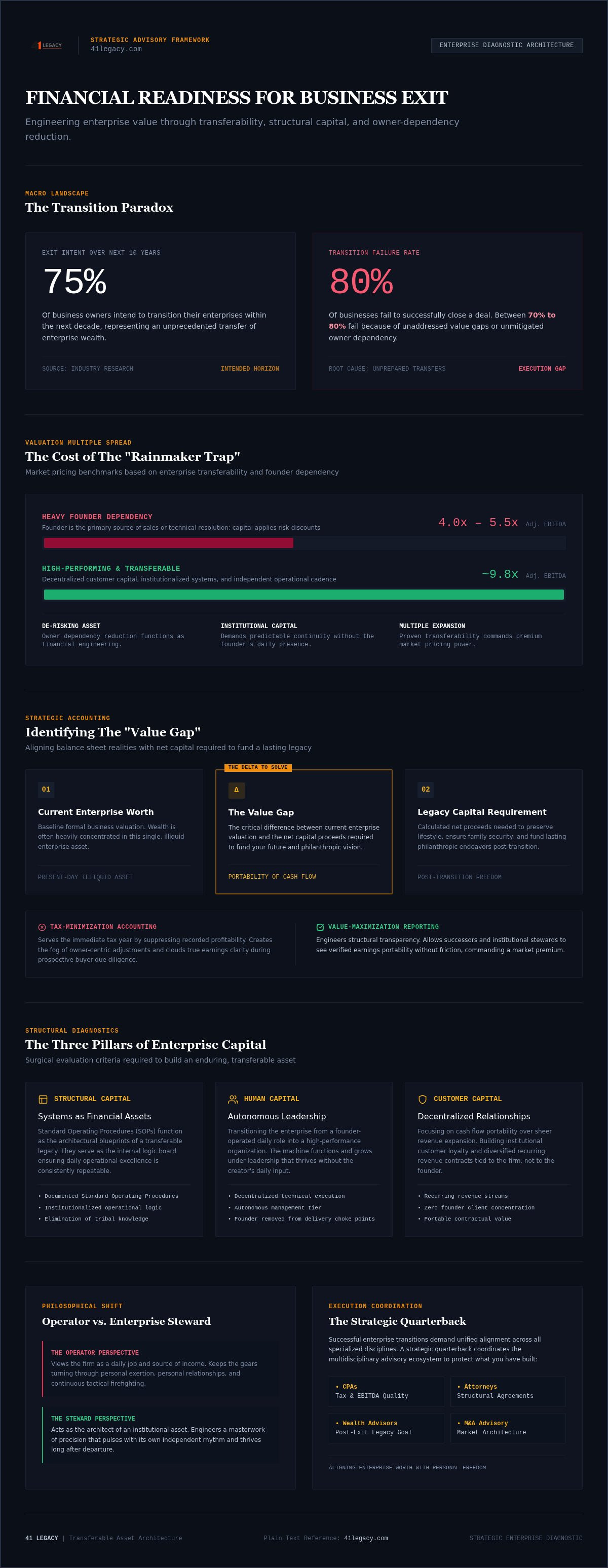
Research indicates that while 75% of owners intend to transition their companies within the next decade, a sobering 80% of those businesses fail to successfully close a deal. This disparity isn't a failure of effort, but a lack of technical precision in preparing for a transition. True financial readiness for business exit requires more than a healthy balance sheet; it demands the creation of a transferable asset that thrives independently of its creator. You've poured your life's essence into this enterprise, yet the uncertainty regarding its actual market value often creates a quiet, underlying anxiety.
We understand the stewardship required to protect a legacy. You deserve a clear roadmap that aligns your enterprise value with your personal financial goals. This article provides the strategic framework necessary to bridge the gap between your current standing and the requirements of a lasting impact. We'll explore how structured enterprise diagnostics and a commitment to owner-independence reduce risk and command premium market multiples. By treating your business as a masterwork of engineering rather than a daily obligation, you ensure it remains a vital, living entity long after your departure.
Key Takeaways
- Identify the "Value Gap" between your current enterprise worth and the capital required to fund your lasting legacy.
- Learn how reducing owner dependency transforms a business from a personal role into a high-performance, transferable asset.
- Utilize structured enterprise diagnostics to assess your financial readiness for business exit by evaluating human, structural, and customer capital.
- Prioritize strategic initiatives that enhance cash flow portability over simple revenue expansion to command premium market multiples.
- Understand the importance of a strategic quarterback to coordinate your advisory team and protect the essence of what you've built.
The Anatomy of Financial Readiness: Beyond the Balance Sheet
Financial readiness for business exit isn't a static number on a ledger. It's the deliberate alignment of your enterprise's structural integrity with your personal requirements for a lasting legacy. While many view their books through the lens of tax minimization, true readiness requires a shift toward value maximization. We see the business not merely as a source of income, but as a masterwork of engineering that must eventually stand on its own. A formal business valuation provides a snapshot of the present, yet it often fails to account for the portability of that value. We distinguish between the operator, who keeps the gears turning, and the steward, who ensures the machine functions without them.
Identifying the Value Gap
The "Value Gap" is the delta between your current enterprise worth and the net proceeds required to fund your future. For many owners, wealth is heavily concentrated in this single, illiquid asset. This concentration creates a precarious dependency. We begin our process by calculating the precise amount needed to sustain your lifestyle and philanthropic goals after the transition. Industry data shows that roughly 70% to 80% of businesses fail to close a deal because of these unaddressed gaps or unmitigated owner dependency. When we assess your financial readiness for business exit, we look at the portability of your cash flow. We determine if the market's perception of your business matches your internal requirements for financial peace.
The Stewardship Mindset
Adopting a stewardship mindset means viewing your business as a separate entity with its own story and future. You're no longer just the engine; you're the architect of an institutional asset. This transition is essential for reducing owner dependency and increasing the overall attractiveness of the enterprise. By determining enterprise value through a surgical diagnostic lens, 41 Legacy establishes a foundation for growth that respects the history of the firm while preparing it for new leadership. It's about building something that thrives because of your vision, not because of your daily presence. This shift in perspective ensures that the essence of what you've built is preserved through the transition and beyond.
The Pillars of Transferable Enterprise Value
Transferability functions as the quiet architecture of value. It's the distinction between a company that requires your breath to survive and one that pulses with its own independent rhythm. Achieving financial readiness for business exit requires a fundamental shift in how you document your success. While tax-minimization accounting serves the immediate present, value-maximization reporting prepares the enterprise for its next chapter. This transparency allows a successor to see the clarity of your earnings without the fog of owner-centric adjustments. It transforms the business into a high-performance asset that speaks for itself.
Strategic business succession and transition planning often reveals that revenue quality outweighs revenue quantity. A business supported by diverse, recurring revenue streams and decentralized customer relationships commands a premium. It signals to the market that the essence of the work is institutionalized, not personal. This structural health is what allows a legacy to endure through the changing of the guard.
Owner Dependency and Risk Mitigation
The "Rainmaker Trap" is perhaps the most significant threat to enterprise value. If the founder remains the primary source of sales or technical resolution, the business carries a high risk profile that institutional capital will discount. Current market data suggests that high-performing companies with proven transferability can command multiples near 9.8x adjusted EBITDA, whereas those with heavy founder dependency often struggle at 4.0x to 5.5x. Pursuing owner dependency reduction isn't just about personal freedom; it's an act of financial engineering that de-risks the asset for its future steward.
Systems as Financial Assets
Standard Operating Procedures (SOPs) are the blueprints of a transferable legacy. They represent the precise instructions for how excellence is repeated daily. When a buyer enters due diligence, they aren't just looking at bank statements; they're looking for the internal logic board that ensures consistency. Understanding what is sop in business allows you to package your institutional knowledge as a tangible, high-value asset. Documented systems protect the soul of the company, ensuring the quality you've cultivated remains intact after the transition. They turn your expertise into a portable, durable engine of growth.
If you're ready to evaluate the structural integrity of your enterprise, our Enterprise Diagnostics can illuminate the path toward a more transferable future.
The Enterprise Diagnostic: Measuring Exit Readiness
Measuring the true worth of an enterprise requires more than a cursory glance at a profit and loss statement. It demands a surgical inquiry into the hidden drivers of value that standard accounting often overlooks. Our approach to Enterprise Diagnostics involves a deep, technical examination of the business as a living entity. We look beyond the surface to understand the durability of your cash flows. While a tax-focused CPA provides essential compliance, their work is often retrospective. To achieve financial readiness for business exit, you need a forward-looking analysis that identifies how a successor will perceive risk and opportunity within your halls.
The SBA guide on selling or transferring a business provides a foundational overview of the transition process, yet the internal mechanics of value growth require a more specialized lens. We evaluate the business through a structured diagnostic that probes the structural integrity of the organization. This process ensures that when the time comes to transition, the asset is de-risked and prepared for the scrutiny of institutional due diligence.
The Four Pillars of Capital
We categorize the intangible essence of your business into four distinct pillars of capital. Human Capital evaluates the depth of your leadership team and their ability to operate without your daily involvement. Structural Capital examines the systems, intellectual property, and internal blueprints that drive efficiency. Customer Capital measures the quality and "stickiness" of your client base, ensuring no single relationship holds the business hostage. Finally, Social Capital assesses the strength of your brand and company culture. True financial readiness for business exit is found in the harmony of these four elements, creating a business that is both portable and resilient.
Coordinating with Professional Advisors
A successful transition is never a solo endeavor. It requires a coordinated effort from a diverse team of specialists, including your attorney, CPA, and wealth manager. We act as the strategic quarterback in this process, ensuring that every advisor is aligned with your ultimate legacy goal. The role of the certified exit planning advisor is to eliminate the "silo effect," where professionals work at cross-purposes without a unified master plan. By integrating technical precision with strategic clarity, we ensure that your legal and financial structures support the transferability of the asset. This collaborative environment protects the essence of what you've built while preparing the enterprise for a seamless transition into its next chapter.
Bridging the Gap: Your Value Growth Roadmap
A masterwork is never completed by accident. It requires a sequence of deliberate, technical refinements that transform raw potential into a lasting legacy. Once the diagnostic phase reveals the delta between your current standing and your exit requirements, the focus shifts to construction. Developing a Value Growth Roadmap is the process of architecting institutional permanence. It ensures that financial readiness for business exit becomes an operational reality rather than a conceptual goal. We prioritize the fortification of the enterprise, ensuring every strategic movement serves to de-risk the asset and elevate its standing in the eyes of future stewards.
Traditional growth strategies often chase top-line revenue at the expense of structural health. We reject this approach. A business that grows without de-risking its operations often finds itself less valuable during due diligence. We focus on creating an enterprise that is ready for scrutiny at any moment, ensuring that the transition occurs on your terms and according to your vision. This discipline prepares the business to withstand the rigorous examination of institutional capital.
Prioritizing Value Drivers
We begin by identifying the specific levers that increase valuation multiples with the greatest efficiency. While revenue growth is visible, it's often the "low-hanging fruit" of operational de-risking that provides the most immediate impact. Understanding how to increase enterprise value requires a surgical focus on cash flow portability. We balance long-term expansion with the immediate necessity of transferability, ensuring that the business remains a high-performance asset independent of the founder's daily influence. This balance is the hallmark of a de-risked and highly attractive enterprise.
Implementation and Accountability
A roadmap is only as effective as the discipline used to follow it. The transition from planning to execution requires a steady, unhurried rhythm of professional support. We provide monthly implementation support to ensure that strategic initiatives aren't lost to the noise of daily operations. By monitoring key performance indicators that sophisticated buyers prioritize, we maintain the professional-room altitude required for a successful transition. This structured accountability ensures that the business evolves into a transferable asset that preserves the essence of your life's work. It's about maintaining the trajectory of excellence until the final changing of the guard.
If you're ready to begin architecting your transition, you can request a Value Growth Roadmap to start the journey toward a transferable legacy.
Legacy and Stewardship: The 41 Legacy Commitment
The final act of a visionary is ensuring that their creation outlasts their presence. You've spent decades refining the essence of your enterprise, and true stewardship requires that this excellence persists through the changing of the guard. Achieving financial readiness for business exit is not merely a personal milestone; it's a commitment to the employees, families, and communities that rely on the institution you've built. By transforming your business into a transferable asset, you protect its history while securing its future. This transition is a philosophical endeavor that requires the same precision you applied to the business's founding.
We believe that a legacy is only as strong as the framework supporting it. When an owner prepares for a transition, the complexity of the process can often obscure the original vision. Our role is to serve as the guardian of that vision, ensuring that every technical adjustment and strategic refinement honors the soul of the company. This process demands a level of dedication that transcends simple service provision, moving into the realm of professional curation.
The Strategic Quarterback
Managing a transition involves a sophisticated ensemble of professional advisors, from CPAs and corporate attorneys to wealth managers. Without a central point of coordination, these specialists often operate in silos, leading to fragmented results that can jeopardize the "Value Gap" we've worked to close. We act as the strategic quarterback, ensuring that every member of your advisory team is executing the same master plan. This allows you to remain the visionary architect of your legacy rather than becoming a project manager of technical details. By maintaining a professional-room altitude, we keep the project focused on the high-level goals of transferability and risk reduction.
Securing the Future
A business that is prepared for exit is a business that is prepared to thrive for generations. When you achieve true financial readiness for business exit, you gain more than just a successful transition; you gain the peace of mind that comes from knowing your life's work is durable. This readiness is the ultimate gift to your successors, providing them with a de-risked, high-performance engine of growth. It ensures that the values and standards you've cultivated remain the guiding principles of the organization long after your departure. The journey toward this level of institutional permanence begins with a single, surgical look at your current standing.
If you're ready to assess the structural integrity of your life's work and protect your transferable legacy, Begin your Exit Readiness Assessment today.
Architecting Your Institutional Permanence
Building a business that thrives beyond its founder is the ultimate expression of stewardship. It requires moving beyond standard accounting to embrace the technical precision of value growth. By identifying the Value Gap and engineering transferability into your daily operations, you transform a personal role into an enduring, institutional asset. True financial readiness for business exit isn't a reactive event; it's a deliberate masterpiece of planning and execution. It ensures that the heart of your enterprise remains vital long after the transition.
Our specialists, guided by Certified Exit Planning Advisor (CEPA) expertise, focus exclusively on enterprise value growth and the preservation of your legacy. We act as the strategic quarterback, ensuring your advisory team operates with surgical alignment toward a singular vision of excellence. This structured approach de-risks the organization, allowing its core essence to flourish for decades to come. You've spent a lifetime building something of profound value. Now, you can take the steps to ensure its portability and permanence. Your future as a successful steward begins with clarity.
Secure Your Business Legacy: Start Your Exit Readiness Assessment
Frequently Asked Questions
What is the difference between a business valuation and an exit readiness assessment?
A business valuation provides a calculated estimate of current market worth; however, it's merely a snapshot in time. An exit readiness assessment goes deeper, evaluating the structural integrity and transferability of the enterprise. Valuation is a destination, while assessment is a diagnostic. We analyze whether the business can function without the founder. This process identifies risks that a simple price tag might hide, ensuring the asset is truly prepared for a successor's scrutiny.
How long does it typically take to achieve financial readiness for an exit?
Achieving financial readiness for business exit typically requires a horizon of twenty-four to thirty-six months. This timeframe allows for the systematic implementation of value growth initiatives and the reduction of owner dependency. It's a thoughtful progression rather than a rushed event. By starting early, you provide the necessary space to de-risk the enterprise and ensure that the transition aligns with your long-term personal and financial legacy goals. Quality preparation cannot be forced.
Can I still increase my business value if I plan to exit in less than two years?
You can certainly enhance enterprise value within a shorter window by prioritizing high-impact operational refinements. We focus on identifying "low-hanging fruit" such as formalizing customer contracts or documenting critical standard operating procedures. These actions reduce perceived risk for a buyer almost immediately. While a longer lead time is ideal for deep structural changes, rapid improvements in transparency and management depth can still yield a higher multiple during a transition. Precision matters more than duration.
Why do I need an exit advisor if I already have a trusted CPA and Attorney?
An exit advisor serves as the strategic quarterback who coordinates the efforts of your entire professional team. While CPAs and attorneys provide essential technical expertise in their respective fields, they often operate in silos. We ensure that legal, tax, and financial strategies are unified toward your ultimate exit goal. This collaborative approach prevents conflicting advice and ensures that the essence of your legacy is protected throughout the complex transition process. We provide the master blueprint.
What are the most common financial risks that devalue a business during an exit?
Significant devaluation often stems from unverified pro-forma adjustments and high customer concentration. If a single client represents a large portion of your revenue, a buyer will perceive extreme risk. Other common factors include poor financial reporting systems and deferred maintenance on core infrastructure. These vulnerabilities signal a lack of institutional discipline to a sophisticated buyer. Addressing these risks early through enterprise diagnostics ensures the business remains a premium, de-risked asset during the transition.
How does owner dependency specifically impact the final sale price of a company?
Owner dependency acts as a heavy anchor on your company's valuation multiple. If you're the primary rainmaker or technical problem-solver, a buyer must account for the risk that the business will falter after you depart. This uncertainty leads to lower offers, larger earn-outs, or heavier seller notes. Reducing your daily involvement transforms the business into a portable asset, allowing you to command a premium price based on institutionalized performance rather than personal effort.
What is a "Value Gap" and how do I know if I have one?
A "Value Gap" is the disparity between the current net worth of your business and the capital required to fund your post-exit lifestyle and legacy. We identify this gap during the initial diagnostic phase of our financial readiness for business exit process. Knowing this number is critical for strategic clarity. It allows us to build a roadmap that focuses on growing enterprise value until it matches your personal financial requirements for a lasting impact.
Do I need to be ready to sell my business immediately to start exit planning?
You don't need to be ready to sell today to begin the planning process. In fact, exit planning is simply good business strategy that happens to prepare you for a future transition. Building a transferable asset improves profitability and lowers risk in the present. It provides you with the freedom of choice. Whether you exit in three years or ten, a business that operates independently of its owner is a more valuable asset.

Article by
Mike Laskowski
Mike Laskowski is a Business Value Growth Strategist who helps business owners uncover the truths that drive their performance, risk, and readiness. Blending forensic interviewing from a 26‑year federal career with Strategic Capacity analysis and CEPA methodology, he works upstream to reduce owner dependency, increase transferability, and strengthen enterprise value. Mike guides founders through clarity, operational evolution, and transition readiness so their companies become transferable, owner‑independent assets that endure beyond the founder.
Disclaimer
This article is for educational and informational purposes only and does not provide legal, tax, investment, or business brokerage advice. 41 Legacy does not offer M&A brokerage services, legal document drafting, tax preparation, or investment advisory services. Business owners should consult licensed professionals in those disciplines before making decisions related to business transactions, legal matters, tax strategy, or financial planning. All examples are illustrative and may not apply to your specific situation.

