
Family Business Succession Planning vs. Exit Strategy: A Master’s Guide to Preserving Your Legacy
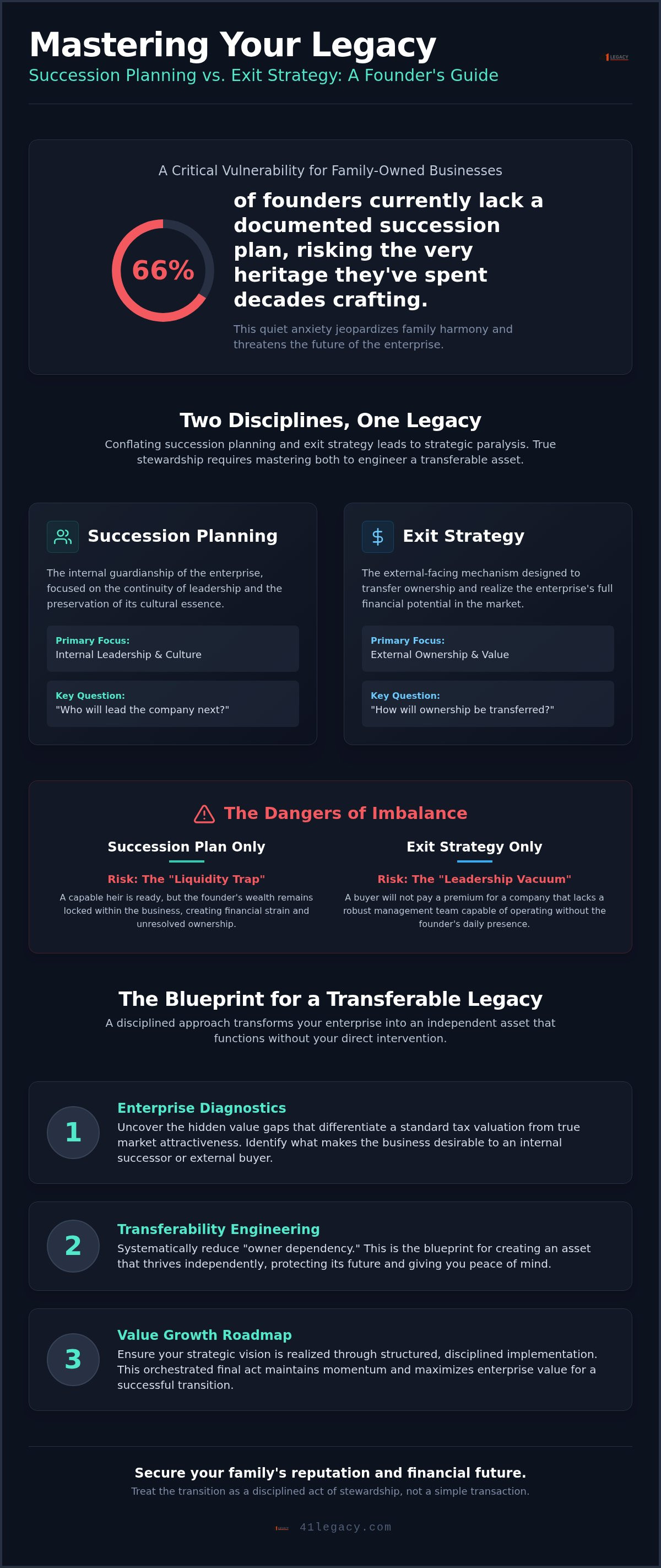
Approximately 66% of family-owned businesses currently lack a documented succession plan, a vulnerability that risks the very heritage you've spent decades crafting. It's a weight many founders carry, the quiet anxiety that the enterprise might falter without their daily presence or that family harmony could dissolve during a transition. You've built more than a company. You've curated a living legacy that deserves a meticulous future. Understanding the nuances of family business succession planning vs exit strategy is the first step toward ensuring your life's work doesn't just survive but flourishes under new stewardship.
We believe that a transition is not a transaction to be survived; it's a masterpiece of engineering to be perfected. This guide clarifies how to transform your enterprise into a transferable asset through strategic clarity and owner-dependency reduction. You'll discover how to navigate the intersection of leadership continuity and market-ready positioning to secure your family's financial future and reputation. We'll explore the technical distinctions between internal transitions and external exits, providing a roadmap to preserve the essence of your impact for generations to come.
Key Takeaways
- Distinguish between internal leadership continuity and external value realization by understanding the nuances of family business succession planning vs exit strategy.
- Utilize Enterprise Diagnostics to uncover the hidden value gaps that differentiate a standard tax valuation from true market attractiveness.
- Employ Transferability Engineering to systematically reduce owner dependency, transforming the business into an independent asset that functions without your direct intervention.
- Secure your family's reputation and financial future by treating the transition as a disciplined act of stewardship rather than a simple transaction.
- Commit to a Value Growth Roadmap to ensure your strategic vision is realized through structured, monthly implementation support that maintains momentum.
The Stewardship of Transition: Why Family Business Exits Require Precision
The transition of a family enterprise is not merely a financial conclusion; it is the ultimate expression of stewardship. For the founder, the business represents decades of precision, sacrifice, and vision. Viewing an exit strategy as the final polish on a masterwork allows you to preserve the essence of what you've built while ensuring its survival. Too often, owners wait until they feel "ready to sell" before beginning this process. This delay is a quiet thief of value. By the time a founder is exhausted, the enterprise's market attractiveness has often begun to erode. True stewardship requires you to view your company as a transferable asset long before you intend to step away.
Understanding the distinction between family business succession planning vs exit strategy is vital for any owner acting as a guardian of their legacy. While one focuses on the internal continuity of leadership and culture, the other ensures the business holds objective value in the eyes of the market. Both are necessary to ensure the impact of your life's work survives the transition. At 41 Legacy, we see this as a process of engineering excellence, where the goal is a business that thrives independently of its creator. The nuances of family business succession planning vs exit strategy allow you to address both the human and the financial side of the enterprise with surgical precision.
The Burden of the Founder’s Shadow
A founder's identity often weaves itself into the very fabric of the company's operations. This creates a condition known as owner dependency. If the business cannot breathe without your lungs, it is not yet a transferable asset. For second or third-generation transfers, this shadow can be suffocating, leading to stagnation or failure. A structured exit plan serves as a gift of clarity. It provides the next generation with a blueprint for success rather than a chaotic inheritance. By engineering the business to function independently, you protect its future and your own peace of mind.
Protecting the Harmony of the Family Circle
Family dynamics introduce a layer of emotional complexity that traditional corporate transitions lack. You must balance the interests of active family members who run the daily operations with inactive stakeholders who hold an emotional or financial interest. Succession planning is a philosophical progression that requires transparent communication to prevent future conflict or litigation. When you position the transition as a shared journey toward preserving the family's reputation, you transform a potentially volatile event into a moment of collective pride. This precision in planning ensures that the family circle remains unbroken long after the leadership changes hands, allowing your legacy to remain a source of unity rather than division.
Family Business Succession Planning vs. Exit Strategy
To master the preservation of a legacy, one must first distinguish between two distinct yet symbiotic disciplines. Succession planning is the internal guardianship of the enterprise; it addresses the continuity of leadership and the preservation of the organization's cultural essence. Conversely, an exit strategy is the external-facing mechanism designed to transfer ownership and realize the enterprise's full financial potential. While many use the terms interchangeably, conflating family business succession planning vs exit strategy often leads to strategic paralysis that can jeopardize the health of the asset.
A succession plan without a corresponding exit strategy creates a "liquidity trap." You may have a capable heir ready to take the helm, but without a structured plan for the transfer of equity, the founder's wealth remains locked within the walls of the business. Conversely, an exit strategy devoid of succession planning leaves a leadership vacuum. A buyer will rarely pay a premium for a company that lacks a robust management team capable of operating without the founder. Understanding the balance between family business succession planning vs exit strategy ensures you don't fall into common pitfalls. Bridging this gap requires a surgical approach to determining enterprise value, ensuring that the internal transition and external valuation are in perfect harmony.
Succession: The Internal Guardianship
Succession is the art of grooming the next generation through structured leadership development. It's about more than just a name on a door; it's the intentional transfer of institutional wisdom and cultural DNA. A well-crafted Buy-Sell agreement acts as a vital safeguard, defining the terms of equity transfer within the family circle and preventing future discord. This meticulous preparation ensures the founder can transition into a new chapter with dignity while the business retains its operational momentum and soul.
Exit Strategy: The External Valuation
An exit strategy prepares the business for the cold rigor of an institutional or third-party buyer. It demands that the enterprise thrive independently of the family name, proving its worth through scalable systems and predictable cash flows. This process must align the financial harvest with the owner's personal "Wealth Gap," ensuring the transition provides total financial security for the next chapter. By focusing on transferability engineering, you ensure that the final valuation reflects the true strength of the asset. For those seeking to evaluate their current standing, our Exit Readiness Assessment provides the necessary diagnostic clarity to begin this journey.
Enterprise Diagnostics: Identifying the Value Gap in Your Legacy
Before any meaningful transition can occur, a rigorous assessment of the enterprise's current health is required. We view Enterprise Diagnostics as the essential "physical exam" for your business, providing a clear-eyed look at the structural integrity of your life's work. Many owners rely on tax-focused valuations, which are historically oriented and designed for compliance. However, these documents rarely reflect market attractiveness. A market-ready valuation looks forward, evaluating the enterprise as a living entity capable of generating future cash flow without the founder's intervention.
This diagnostic process exposes two critical discrepancies: the Value Gap and the Wealth Gap. The Value Gap is the chasm between current enterprise value and its optimized market potential. It represents the "unlocked" value that remains trapped due to inefficiencies or risks. Simultaneously, we analyze the Wealth Gap, which is the difference between your current net worth and the capital required to fund your desired lifestyle after the transition. Balancing family business succession planning vs exit strategy requires closing both gaps to ensure the transition is a triumph of both legacy and financial security.
Measuring What Matters to Buyers
Institutional buyers and sophisticated successors look beyond the balance sheet to the "4 Capitals" of transferability. These intangible assets often dictate the final purchase price in a family business. Diagnostics reveal hidden risks within these capitals that often devalue family firms during the scrutiny of external due diligence. To build a masterpiece of stewardship, you must optimize these four pillars:
- Human Capital: The strength, depth, and retention of your management team.
- Customer Capital: The diversity and loyalty of your client base, free from concentration risk.
- Structural Capital: The systems and processes that capture tribal knowledge and ensure consistency.
- Social Capital: The brand's reputation and its internal culture of excellence.
Reducing Owner Dependency
The most common obstacle to a successful transition is the "Rainmaker Trap." This occurs when the enterprise's value is inextricably tied to the founder's personal relationships or daily decision-making. If you're the primary driver of revenue or the sole keeper of key operational secrets, the business is a job, not a transferable asset. Reducing owner dependency is a core tenet of family business succession planning vs exit strategy. By documenting diagnostics and optimizing systems, you prepare the business for the rigor of an external transition. This ensures the essence of the enterprise remains intact while the founder steps into a well-earned next chapter. Our Enterprise Diagnostics provide the clarity needed to begin this essential work.
Engineering Transferability: The Blueprint for a Legacy That Lasts
Engineering transferability is the deliberate process of decoupling an enterprise's performance from the founder's daily presence. In the ongoing dialogue regarding family business succession planning vs exit strategy, transferability acts as the mechanical foundation for both paths. Without it, a successor inherits a burden rather than an opportunity, and a buyer sees a liability rather than an asset. We define Transferability Engineering as the systematic process of making the owner irrelevant to daily operations. It transforms the founder from a Master Craftsman, whose hands are on every lever, into a Strategic Architect who designs the systems that drive growth.
The most potent tool in this transformation is the institutionalization of tribal knowledge. Understanding what is sop in business is critical for any owner seeking to protect their legacy. These procedures ensure that the essence of your craftsmanship is captured and repeatable. When a management team can operate autonomously using these blueprints, the business transitions from a person-dependent entity to a durable, transferable asset. This shift is essential to ensure the business thrives long after your transition, regardless of whether the next leader shares your last name.
Documenting the Master Craftsman’s Process
Decades of experience often reside solely in the founder's mind, creating a single point of failure that devalues the firm. Documenting these Standard Operating Procedures (SOPs) allows you to empower your management team to make autonomous strategic decisions without your constant oversight. SOPs serve as the blueprint for a transferable legacy that persists beyond the founder. This clarity reduces friction during a transition and provides a sense of security to both family heirs and external investors who require proof of operational stability.
The Role of Strategic Capacity
Strategic Capacity is the firm's ability to thrive and expand under new leadership. It requires a leadership bench that commands respect from institutional buyers and remains deeply aligned with the family's core values. This bench must include key non-family employees who are properly incentivized, perhaps through stay bonuses or phantom equity, to ensure continuity during the transition. By building a "transferable culture," you ensure the family's impact is preserved even as the leadership structure evolves. Our Transferability Engineering services help you identify these capacity gaps and build a management structure that maximizes enterprise value.
The Value Growth Roadmap: Orchestrating the Final Act
The journey from founder to steward reaches its crescendo in the execution of the Value Growth Roadmap. This isn't a static report destined for a dusty shelf; it's a living strategic document that orchestrates every tactical move toward your ultimate goal. While the tension between family business succession planning vs exit strategy can feel overwhelming, the roadmap provides the necessary clarity to move forward with confidence. It ensures that every operational improvement directly translates into increased enterprise value and strengthened transferability. By treating the transition as a symphony of well-timed actions, we ensure the final act of your leadership is your most impactful.
Success requires more than just a plan; it demands a conductor. A Certified Exit Planning Advisor (CEPA) serves as the "Quarterback" of this process, ensuring that your vision isn't lost in the technical silos of various disciplines. By providing monthly implementation support, we bridge the gap between diagnostic theory and the tangible growth of your legacy. This structured advisory ensures that the momentum of the enterprise remains unshakeable as you move toward a successful transition.
Coordinating Your Advisory Team
Your CPA, attorney, and RIA are essential specialists, but they often operate without a unified strategic horizon. Without a central coordinator, the owner is forced to manage the noise of conflicting advice, which often stalls progress. We centralize communication, ensuring that tax strategies, legal protections, and wealth management goals all align with a singular exit objective. The CEPA designation is specifically designed to bridge the gap between business growth and the eventual transition, ensuring that every advisor's contribution serves the harmony of the whole. This alignment reduces risk and ensures that the technical details of family business succession planning vs exit strategy are handled with surgical precision.
Implementation and Accountability
Momentum is the most fragile element of a transition. We move beyond theory into the monthly execution of value-driving tasks, holding the leadership team accountable to the strategic architect's vision. As market conditions or family needs evolve, the roadmap is adjusted with deliberate care to keep the enterprise on its optimal trajectory. Reaching "Exit Readiness" is the ultimate milestone. It's the point where you no longer leave because you have to, but because you choose to. The business has become a masterpiece of independence, a transferable asset that thrives on its own merits. To begin this orchestration, we invite you to take the first step with our Exit Readiness Assessment.
Mastering the Architecture of Your Business Legacy
Preserving a legacy requires more than just hard work; it demands the precision of a master architect. You've learned that the distinction between family business succession planning vs exit strategy is the difference between passing the torch and ensuring the flame continues to burn bright. By identifying the Value Gap through diagnostics and implementing Transferability Engineering, you transform your company from a daily obligation into a durable asset. This process ensures your family's impact remains unshakeable long after your transition.
At 41 Legacy, we provide the strategic clarity needed to orchestrate this final act. Led by Chris Giammarco, a Certified Exit Planning Advisor (CEPA), we offer quarterback-style coordination with your existing advisors to ensure every detail is polished to a high sheen. Through our structured Value Growth Roadmap process, we bridge the gap between today's performance and tomorrow's transition. It's time to move beyond uncertainty and toward a future defined by choice.
Secure your legacy with a professional Exit Readiness Assessment. Your life's work deserves nothing less than perfection.
Frequently Asked Questions
What is the primary difference between succession planning and an exit strategy?
Succession planning focuses on the internal continuity of leadership and the preservation of a family's cultural essence. An exit strategy is an external facing mechanism designed to transfer ownership and realize the enterprise's full financial potential. Understanding family business succession planning vs exit strategy is critical because one ensures the business survives, while the other ensures the founder's wealth is unlocked. Most successful transitions require a masterfully engineered blend of both disciplines to protect the family legacy.
When should a family business owner start exit planning?
Ideally, you should begin the planning process three to five years before your anticipated departure. This timeline allows for the meticulous implementation of a Value Growth Roadmap to close any existing value gaps. Research indicates that 42% of family businesses anticipate a leadership transition within this window, yet many delay action. Starting early transforms the enterprise into a transferable asset, ensuring you leave on your own terms rather than being forced by external circumstances or exhaustion.
What is 'owner dependency' and why does it lower business value?
Owner dependency occurs when a company's daily operations and revenue generation are inextricably tied to the founder's personal presence. This condition significantly lowers business value because it represents a high risk for any potential buyer or successor. If the enterprise cannot function without your direct intervention, it's a job rather than a transferable asset. Reducing this dependency through Transferability Engineering is essential to command a premium valuation and ensure the company thrives long after your transition.
How do I choose between an internal family succession and an external sale?
Choosing between an internal family transfer and an external sale requires a cold, objective evaluation of your leadership bench and financial needs. You must determine if the next generation possesses the strategic capacity and desire to lead the enterprise. Simultaneously, you must analyze your personal wealth gap to see if an internal transfer provides sufficient financial security. This decision is a pivotal moment of stewardship that balances family harmony with the long-term health of the enterprise.
What is a Value Gap in exit planning?
The Value Gap is the difference between the current enterprise value of your business and its optimized market potential. It represents the "trapped" value that could be unlocked through better systems, reduced owner dependency, and stronger structural capital. Identifying this gap is a core component of family business succession planning vs exit strategy. Closing it requires a disciplined implementation of value-driving tasks to ensure you receive the maximum possible harvest for your life's work.
What role does a Certified Exit Planning Advisor (CEPA) play in a family business?
A Certified Exit Planning Advisor (CEPA) acts as the strategic quarterback for your entire transition process. They coordinate with your existing team of CPAs, attorneys, and wealth managers to ensure all professional advice aligns with your ultimate exit goals. This centralized leadership reduces the noise and friction often found in complex family transitions. By focusing on enterprise diagnostics and value growth, a CEPA ensures the business is prepared for a successful and profitable transfer of ownership.
How do Buy-Sell agreements impact family business succession?
Buy-Sell agreements act as vital legal safeguards that define the terms of equity transfer within a family circle. These documents prevent future discord by establishing clear protocols for how shares are handled during retirement, disability, or death. Without a properly structured agreement, family harmony can quickly dissolve into litigation. Integrating these agreements into your broader succession plan ensures that the transition is a moment of collective pride rather than a source of permanent family division.
What is an Exit Readiness Assessment?
An Exit Readiness Assessment is a professional diagnostic that measures the structural integrity and market attractiveness of your enterprise. It provides a clear-eyed look at where your business stands today and what is required to reach your financial goals. This assessment identifies hidden risks that could devalue the firm during due diligence. It serves as the foundation for a Value Growth Roadmap, giving you the strategic clarity needed to build a truly transferable legacy.

Article by
Mike Laskowski
Mike Laskowski is a Business Value Growth Strategist who helps business owners uncover the truths that drive their performance, risk, and readiness. Blending forensic interviewing from a 26‑year federal career with Strategic Capacity analysis and CEPA methodology, he works upstream to reduce owner dependency, increase transferability, and strengthen enterprise value. Mike guides founders through clarity, operational evolution, and transition readiness so their companies become transferable, owner‑independent assets that endure beyond the founder.
Disclaimer
This article is for educational and informational purposes only and does not provide legal, tax, investment, or business brokerage advice. 41 Legacy does not offer M&A brokerage services, legal document drafting, tax preparation, or investment advisory services. Business owners should consult licensed professionals in those disciplines before making decisions related to business transactions, legal matters, tax strategy, or financial planning. All examples are illustrative and may not apply to your specific situation.

