
Family Business Exit Strategy: A Master Blueprint for Legacy and Enterprise Value
Fewer than 30% of family businesses survive the transition to the second generation, a sobering reality that often stems from a lack of structural precision. Many founders view their enterprise as a personal extension of themselves, yet a truly successful family business exit strategy requires the opposite approach. It demands the transformation of your life's work from a founder-dependent operation into a self-sustaining vessel of value. We believe your business is more than a balance sheet; it's a masterpiece of your own making that deserves a curated future.
It's natural to feel a sense of unease when considering the gap between your current enterprise value and the requirements of your next chapter. You've built a legacy through grit and vision, but ensuring that legacy endures requires a shift from operator to architect. This guide provides a master blueprint for building a transferable asset that thrives independently of your daily presence. You'll discover how structured enterprise diagnostics and a clear value growth roadmap can bridge the divide between business reality and family aspirations, securing a transition that honors your past while funding your future.
Key Takeaways
- Learn how to design a comprehensive family business exit strategy that prioritizes the creation of a transferable asset over a simple transaction.
- Master the discipline of transferability engineering to reduce owner dependency and ensure the enterprise thrives beyond your daily involvement.
- Utilize enterprise diagnostics and readiness assessments to identify the "Value Gap" between your current business worth and your long-term financial needs.
- Discover strategies for aligning family dynamics with business reality to preserve both your legacy and your relationships during a transition.
- Understand the "Quarterback" model of coordinated advisory support, ensuring your team of specialists works in harmony toward a singular, documented vision.
The Architecture of a Family Business Exit Strategy
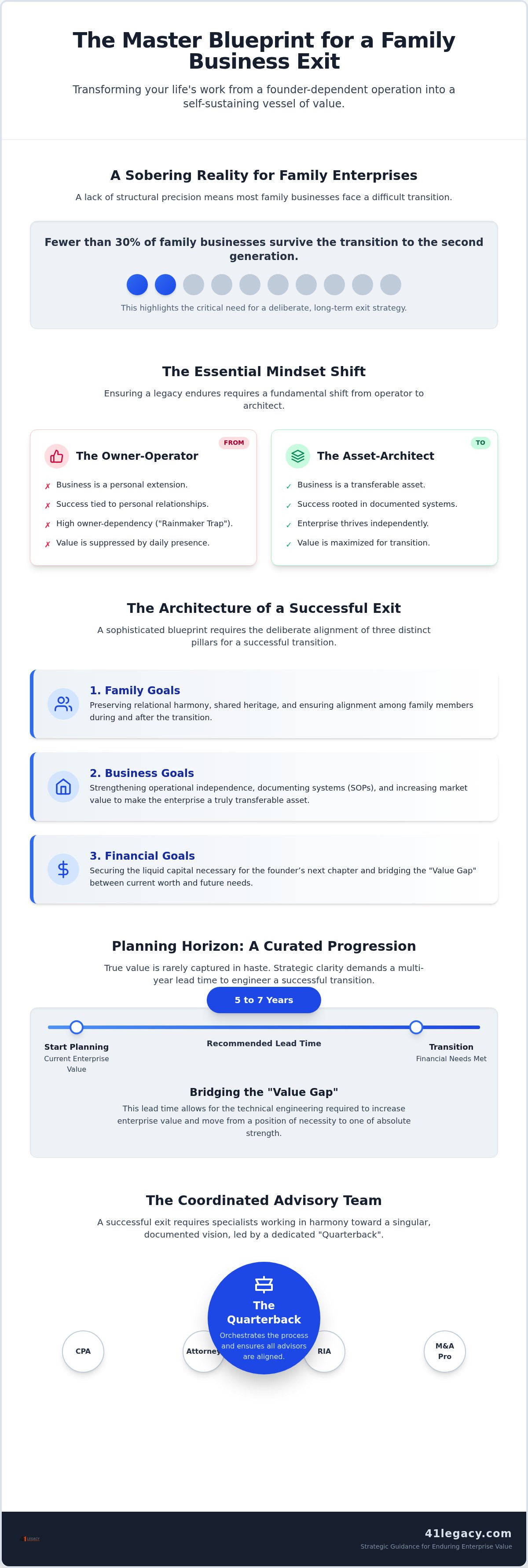
A family business exit strategy is far more than a set of transaction documents; it is a sophisticated blueprint for the preservation of impact. We view the enterprise not as a commodity to be liquidated, but as a masterpiece to be transitioned with reverence. This architecture requires a deliberate alignment of three distinct pillars:
- Family Goals: Preserving relational harmony and shared heritage.
- Business Goals: Strengthening operational independence and market value.
- Financial Goals: Securing the liquid capital necessary for the founder’s next chapter.
While Succession planning often focuses narrowly on leadership roles, a comprehensive family business exit strategy addresses the transfer of both authority and essence. It ensures that the transition is a deliberate choice rather than a reaction to unforeseen circumstances. By treating the exit as a design project rather than a legal obligation, you protect the soul of the organization while maximizing its technical worth.
True value is rarely captured in haste. Strategic clarity demands that planning begins five to seven years before a transition. This lead time allows for the technical engineering required to bridge the "Value Gap" between current worth and retirement needs. It transforms the exit from a singular event into a curated progression, ensuring the business remains a transferable asset rather than a burden on the next generation. By starting early, you move from a position of necessity to one of absolute strength.
Preserving the Essence of the Enterprise
The business carries a historical weight that transcends the balance sheet. Successful stewardship involves identifying the core values that define the brand and ensuring they remain intact during a transfer. We help owners balance this emotional heritage with the cold realities of market attractiveness. By treating the business as a living entity with its own story, you ensure its soul isn't lost in the transition. This process requires a refined eye for detail and an unwavering commitment to the legacy you've spent decades building.
The 'Rainmaker Trap' and Its Impact on Value
Many founders fall into the "Rainmaker Trap," where the company's success is tied solely to their personal relationships or expertise. This high owner-dependency makes the business essentially unsellable to external buyers and risky for internal successors. To maximize enterprise value, you must undergo a psychological shift from "owner-operator" to "asset-curator." We focus on reducing these invisible risks through systems that allow the business to thrive independently. This precision engineering ensures that the enterprise’s value is rooted in its structure, not just its founder’s presence. It creates a business that doesn't just survive your departure but flourishes because of the foundation you laid.
Engineering Transferability: Reducing Owner Dependency
The most profound obstacle to a successful family business exit strategy is often the founder’s own excellence. While your personal vision built the enterprise, your daily presence can inadvertently suppress its market value. Transferability Engineering is the discipline of detaching the business’s performance from the founder’s personality. It's a meticulous process of refining the organization’s internal architecture so it functions with the same precision whether you are in the boardroom or miles away. We treat this not as a mere operational task, but as an artistic refinement of the business's inner essence.
We utilize a Strategic Capacity Evaluation to meticulously identify the specific bottlenecks that anchor the business to its owner. These dependencies are often invisible to those within the family circle, yet they are glaringly obvious to a sophisticated successor or institutional investor. By isolating these structural risks, we begin the work of transforming the business into a truly transferable asset. This transition ensures that the enterprise’s worth is held within its enduring systems, not merely within the "tribal knowledge" of its current leadership. It's the difference between owning a job and curating a legacy.
The Role of Standard Operating Procedures (SOPs)
Documented systems are the foundational elements of a legacy. They convert the intuitive brilliance of a founder into a repeatable, institutional asset. For an internal or external successor, these documents serve as a bridge of trust, proving that the business’s success is a result of design rather than luck. Standard Operating Procedures are the narrative of precision that ensures continuity. Without this documentation, the risk of a 30% to 40% value loss during transition becomes a stark reality, as the "magic" of the founder cannot be easily replicated by the next generation.
Empowering the Next Generation of Leadership
True stewardship requires a deliberate shift from family-led governance to system-led excellence. This evolution reduces "key person risk" and prepares the next generation to lead with technical clarity rather than emotional guesswork. By focusing on talent development through structured implementation support, we assist you in building a leadership team capable of navigating future market complexities with grace. This ensures the enterprise remains a vibrant, living entity, resilient and ready for the next chapter of its historical narrative. If you are ready to begin this refinement, our Transferability Engineering services provide the technical roadmap for a graceful transition.
Enterprise Diagnostics: Assessing Exit Readiness
Before embarking on a family business exit strategy, one must face the clinical reality of the organization's current state. We utilize Enterprise Diagnostics to look beneath the surface of the balance sheet. It’s a process of uncovering the "Value Gap," the distance between the enterprise's current market worth and the financial requirements of the founder's future aspirations. A business may appear successful on paper, yet remain unattractive to a sophisticated buyer because it lacks the structural integrity to survive a change in leadership. True readiness is a state of being where the business is prepared for scrutiny at any moment.
It's essential to distinguish between value and transferability. Value is a static snapshot of potential; transferability is the kinetic ability of that value to move into new hands without dissipating. A business with high owner-dependency has a low transferability score, regardless of its revenue. Assessing readiness through the lens of a connoisseur investor ensures that every element of the enterprise is polished to a high sheen, ready for the scrutiny of the most discerning successors. We don't just look for what the business does; we look for what it is capable of becoming without you.
The Four Capitals of Business Value
Our diagnostic process evaluates the "Four Capitals" that constitute the true essence of an enterprise: Human, Structural, Customer, and Social capital. While financial statements capture the past, these intangible assets dictate the future. Human capital measures the depth of your leadership team, while structural capital assesses the strength of your internal systems. Customer capital evaluates the diversity and loyalty of your client base, and social capital reflects the brand's reputation and culture. Often, the most significant "hidden" value lies within these intangibles. By measuring these pillars, we prioritize the specific value-growth activities that will have the greatest impact on the eventual transfer.
The Value Growth Roadmap
Once the diagnostics are complete, the findings are translated into a bespoke trajectory. This isn't a generic plan but a custom-engineered path from assessment to implementation. We establish measurable milestones that track the expansion of enterprise value over time. Utilizing 41 Legacy's Value Growth Roadmap, owners can move with strategic clarity, ensuring that every operational decision serves the ultimate goal of a successful and dignified exit. This structured advisory support provides the rhythmic progress necessary for a masterpiece transition, allowing you to build a business that thrives as a standalone asset.
Aligning Family Dynamics with Strategic Goals
The transition of a family enterprise carries an emotional weight that few other business events can match. It represents the intersection of a lifetime of labor and the delicate bonds of kinship. A successful family business exit strategy must harmonize these two forces with surgical precision. Without transparent communication among stakeholders, the enterprise risks becoming a source of friction rather than a lasting legacy. We advocate for a level of strategic clarity that aligns the individual financial goals of each family member with the long-term health and stability of the company.
Managing conflict isn't about suppressing emotion; it’s about establishing formal governance that provides a neutral framework for decision-making. When individual aspirations diverge from the business's reality, value is often the first casualty. By creating a documented roadmap that everyone understands, you remove the ambiguity that often leads to internal strife. This alignment ensures that the business remains a healthy, transferable asset capable of supporting the family for generations to come. It requires a commitment to the truth of the diagnostic findings over the comfort of the status quo.
Succession vs. Transition
Choosing a successor is merely one component of a much larger architectural blueprint. A leadership change without a comprehensive exit plan is often a recipe for operational instability. Internal family transfers require technical precision to navigate complex tax implications and maintain the brand’s essence. Equally vital is preparing the "Second Act" for the outgoing founder. We've observed that founders who lack a clear purpose post-exit often inadvertently sabotage the transition. A refined family business exit strategy requires the founder to step into a new narrative with as much passion as they brought to the original creation.
Mitigating Risk Through Strategic Advisory
Transitions are fragile periods where common risks can quickly erode decades of value. Key person risk, customer attrition, and loss of momentum are constant threats during a leadership shift. Our monthly implementation support is designed to act as a safeguard against these vulnerabilities. We work to ensure the "Value Gap" is closed through disciplined execution before the final exit trigger is pulled. This proactive approach transforms the exit from a moment of uncertainty into a curated demonstration of enterprise strength. If you are ready to align your family’s future with the strategic needs of your business, explore our Strategic Advisory services for guided expertise.
The Coordinated Advisory Team: The 'Quarterback' Model
Traditional professional teams often operate in fragmented silos, a reality that frequently works to the owner’s detriment during a transition. Your CPA views the world through the lens of tax compliance; your attorney focuses on the technicalities of risk mitigation; your wealth manager looks toward the public markets. Without a unifying force, these specialists may inadvertently pull the enterprise in opposing directions. A masterfully executed family business exit strategy requires a single, documented vision that all advisors must serve. We act as the 'Quarterback' for this team, ensuring that every technical decision aligns with the ultimate goal of preserving legacy and maximizing enterprise value. This coordination transforms a collection of specialists into a unified force of stewardship.
When a CPA and an attorney aren't aligned, the resulting friction can create a "Value Gap" that threatens the founder's financial security. By establishing strategic clarity early, we ensure that every legal document and tax election serves the broader narrative of the enterprise's health. This model moves the business owner from the center of every technical conflict to a position of oversight. You become the visionary architect, while we ensure the construction of your exit follows the blueprint with extreme precision. It's a method that values the harmony of the whole over the individual interests of the parts.
The CEPA Difference in Exit Planning
The presence of a Certified Exit Planning Advisor in the professional room changes the altitude of the conversation. Our role is to orchestrate the existing expertise of your trusted advisors into a coherent Strategic Capacity Evaluation. We ensure that the tax strategies, legal structures, and operational refinements are not just technically sound, but harmonious with the founder's long-term aspirations. This level of coordination prevents the loss of value that often occurs when professional silos fail to communicate. It is a commitment to precision where no detail is left to chance, ensuring the intersection of engineering and finance is managed with the care of a master artisan.
Next Steps: Embarking on the Legacy Journey
The first step toward building a transferable asset is a comprehensive Enterprise Diagnostic. This clinical assessment provides the empirical data needed to initiate a meaningful dialogue with your current professional team. It moves the conversation from vague intentions to a structured implementation support plan. By establishing this foundation, you position yourself as a steward of a living entity rather than just an owner-operator. It's time to bring your team together under a singular roadmap for growth. Begin your journey toward a transferable legacy with 41 Legacy and transform your life's work into a masterpiece of enduring impact.
Architecting an Enduring Legacy
Designing a family business exit strategy is the final, most significant act of stewardship. It requires a fundamental shift in perspective, moving from the role of an indispensable operator to that of a visionary curator. By utilizing enterprise diagnostics to identify the Value Gap and applying the principles of transferability engineering, you transform your life's work into a self-sustaining asset. This ensures your impact continues long after your daily involvement ends.
True enterprise value is realized through a Custom Value Growth Roadmap and the disciplined coordination of your professional team. Our specialists provide Certified Exit Planning Advisor (CEPA) leadership to national family businesses, acting as the quarterback for your advisory circle. We align every technical detail with your singular vision to ensure a transition that honors your history. It's time to build a business that flourishes independently of its founder.
Secure your legacy and grow your enterprise value; start with 41 Legacy today. You've spent a lifetime perfecting your craft. Now is the moment to ensure its permanence.
Strategic Guidance: Frequently Asked Questions
What is a family business exit strategy?
A family business exit strategy is a comprehensive blueprint that orchestrates the transition of ownership and leadership while maximizing enterprise value. It's more than a transaction; it's a curated process of preparing the organization to flourish independently of its founder. This strategy harmonizes the emotional heritage of the family with the technical requirements of the market. By aligning these pillars, you ensure the preservation of your legacy and the continued health of the enterprise.
How long does it take to create and implement an exit plan?
A full transition typically requires a timeline of three to seven years to execute with precision. Starting this process five to ten years before your intended departure date is often recommended by professional boards. This duration allows for the implementation of a Value Growth Roadmap and the technical engineering necessary to close any existing value gaps. It ensures that every operational refinement is intentional and that the eventual transfer is a graceful progression.
Why is my business worth less than I think it is?
Discrepancies in valuation often arise from high owner-dependency, which sophisticated buyers view as a significant structural risk. If the business can't function without your daily presence, its transferability is severely compromised. Additionally, businesses without a formal plan can lose 30% to 40% of their value during a transition. Market value is determined by the strength of your systems and leadership team rather than just historical revenue or personal effort.
Can I exit my business if I still want to be involved?
You can certainly transition out of daily operations while maintaining a meaningful connection to the enterprise. A well-designed family business exit strategy may include a "Second Act" where the founder moves into a curatorial or board-level role. This allows the next generation to lead while you provide high-level strategic clarity and preserve the brand’s essence. The key is ensuring the business no longer relies on your tactical involvement to generate its primary value.
What is the difference between exit planning and succession planning?
Succession planning focuses specifically on the transition of leadership roles and management authority within the organization. Exit planning is a more expansive discipline that integrates the business’s value growth, the founder’s financial needs, and the family’s long-term legacy goals. While succession is a vital component, exit planning serves as the overarching architecture that ensures the entire enterprise is prepared for a successful internal or external transfer. It treats the business as a transferable asset.
How do I reduce my business's dependency on me?
Reducing dependency requires the application of Transferability Engineering to institutionalize your tribal knowledge. You must document every critical process through Standard Operating Procedures, transforming your intuitive brilliance into a repeatable system. Empowering a leadership team to handle strategic capacity is equally vital. When the enterprise’s success is rooted in its internal architecture rather than your personal relationships, its market attractiveness and overall value increase significantly. This shift allows you to become an asset-curator.
When should I involve my CPA and attorney in the exit process?
You should involve your professional advisors as soon as you begin the diagnostic phase, ideally several years before the transition. However, these specialists often work in silos, which can lead to fragmented results. We utilize a "Quarterback" model to coordinate your CPA, attorney, and other advisors under a singular, documented vision. This ensures that tax planning, legal structures, and strategic goals are harmonized. Early involvement prevents costly technical errors and ensures no detail is lost.
What is an Exit Readiness Assessment?
An Exit Readiness Assessment is a clinical diagnostic process that evaluates the current state of your enterprise through the lens of a sophisticated buyer. It identifies the "Value Gap" between your current worth and your future financial requirements. This assessment measures the Four Capitals: Human, Structural, Customer, and Social capital. By uncovering these hidden risks and opportunities, the assessment provides the empirical data needed to build a custom Value Growth Roadmap for your legacy.

Article by
Mike Laskowski
Mike Laskowski is a Business Value Growth Strategist who helps business owners uncover the truths that drive their performance, risk, and readiness. Blending forensic interviewing from a 26‑year federal career with Strategic Capacity analysis and CEPA methodology, he works upstream to reduce owner dependency, increase transferability, and strengthen enterprise value. Mike guides founders through clarity, operational evolution, and transition readiness so their companies become transferable, owner‑independent assets that endure beyond the founder.
Disclaimer
This article is for educational and informational purposes only and does not provide legal, tax, investment, or business brokerage advice. 41 Legacy does not offer M&A brokerage services, legal document drafting, tax preparation, or investment advisory services. Business owners should consult licensed professionals in those disciplines before making decisions related to business transactions, legal matters, tax strategy, or financial planning. All examples are illustrative and may not apply to your specific situation.