
Exit Planning vs. Retirement Planning: Securing Your Business and Your Future
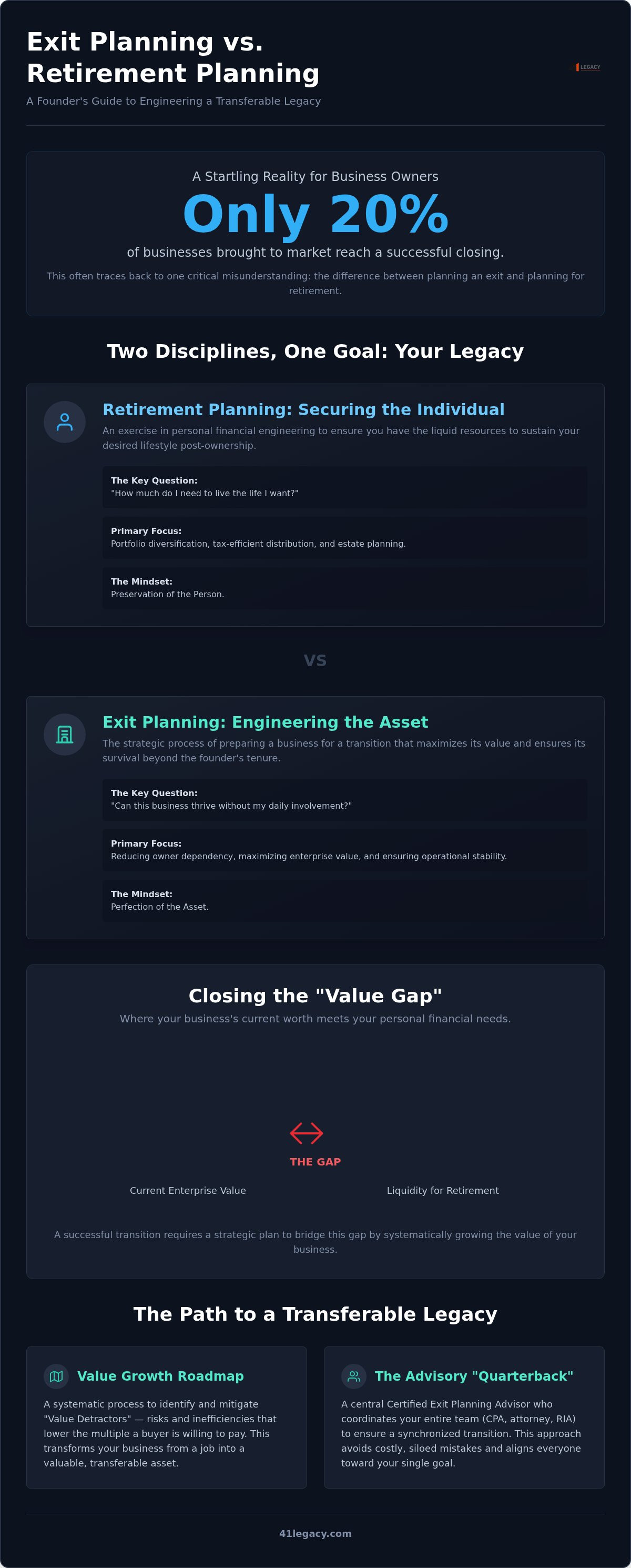
Did you know that only 20 percent of businesses brought to market actually reach a successful closing? This startling reality often traces back to a profound confusion regarding exit planning vs retirement planning. You've likely spent a lifetime as the guardian of your enterprise, weaving your identity into the very fabric of its operations. It's natural to assume that a profitable business is an inherently transferable one, but the two are rarely synonymous. We recognize the silent anxiety that comes from realizing your net worth is locked within an entity that still requires your daily breath to survive.
This guide serves as a bridge between your current stewardship and a future of uncompromised freedom. We'll distinguish the technical precision of personal financial security from the artistry of engineering a transferable asset. You'll learn how to identify the value gap and implement a coordinated strategy that reduces owner dependency. By the end, you'll have a clear framework to ensure your business survives as a masterpiece of independent value, allowing your personal legacy and your professional transition to exist in perfect harmony.
Key Takeaways
- Understand the critical distinction between exit planning vs retirement planning to ensure your personal financial goals align with your business’s structural readiness.
- Identify and mitigate owner dependency to transform your business from a lifestyle operation into a highly transferable, standalone asset.
- Learn how to bridge the "Value Gap" by establishing an accurate baseline of your enterprise's current worth against the liquidity required for your next chapter.
- Discover the role of a Value Growth Roadmap in systematically increasing the multiples buyers or successors are willing to pay for your legacy.
- Learn why coordinating a team of advisors through a central "Quarterback" is essential for a synchronized transition that avoids costly, siloed mistakes.
The Fundamental Divide: Why Exit Planning and Retirement Planning Are Not the Same
To the uninitiated, the transition from active leadership to a life of leisure seems like a singular event. It's often viewed through the lens of a simple departure. However, for the business owner, this transition is actually a delicate synchronization of two distinct disciplines. Understanding the nuanced interplay between exit planning vs retirement planning is the first step toward true stewardship. One focuses on the preservation of the person; the other focuses on the perfection of the asset. They are related, yet their objectives require different tools and different mindsets.
The "Owner vs. Asset" distinction is the most critical concept for any founder to grasp. We often encounter owners who have achieved significant personal wealth through their success, yet they find themselves tethered to a business that is functionally worthless to a third party. This paradox occurs when the business lacks independent value. If the entity requires your specific genius to function, it's not a transferable asset; it's a high-paying job. A master legacy plan ensures that your personal financial health and your business's structural integrity grow in tandem, rather than in competition.
Retirement Planning: Securing the Individual
Retirement planning is an exercise in personal financial engineering. It's the process of ensuring that the individual has the liquid resources necessary to sustain their desired lifestyle once the paycheck stops. This discipline focuses on portfolio diversification, tax-efficient distribution strategies, and comprehensive estate planning. Most owners engage with RIAs or wealth managers to answer a fundamental question: "How much do I need to live the life I want?" While essential, these conversations rarely touch the inner workings of the business itself. They treat the business as a fixed value on a balance sheet rather than a living entity that requires cultivation.
Exit Planning: Engineering the Asset
Exit planning is the strategic process of preparing a business for a transition that maximizes its value and ensures its survival beyond the founder's tenure. It shifts the focus from the owner's bank account to the business's operational stability and enterprise value. We view this as a form of transferability engineering. It addresses the difficult question: "Can this business thrive without my daily involvement?" This requires a Certified Exit Planning Advisor to diagnose weaknesses and build a roadmap that reduces owner dependency. By focusing on the asset's readiness, we ensure that the eventual liquidity event isn't just a transaction, but a successful transfer of a healthy, functioning legacy. When you balance exit planning vs retirement planning, you protect your future and the future of the organization you built.
Exit Planning: The Art of Engineering a Transferable Asset
To build a legacy, one must look beyond the horizon of their own tenure. Exit planning is the meticulous engineering of a transferable asset. It represents a refusal to settle for a business that only works because you do. While the discussion of exit planning vs retirement planning often centers on personal wealth, the true focus of the former should be on structural health. A healthy business is one that can be handed over like a finely crafted timepiece, continuing to tick with the same precision long after the original watchmaker has left the room. We view this transition as the ultimate act of stewardship.
The primary goal of this engineering is to maximize enterprise value and market attractiveness. This requires identifying "Value Detractors," which are specific risks or operational inefficiencies that lower the multiple a buyer is willing to pay. Whether it's a lack of customer diversity or outdated systems, these flaws act as friction in any transition. By addressing them early, you transform your business from a demanding job into a valuable asset that attracts premium interest and ensures a lasting impact.
The Role of SOPs in Transferability
Documented processes ensure the business operates with surgical precision regardless of who sits at the helm. Standard Operating Procedures (SOPs) act as the blueprint for a scalable, sellable entity. They take the unspoken wisdom of your experience and translate it into a repeatable system that others can follow. If you want to understand what is an SOP in business, look at it as the essential DNA of your legacy. It's the difference between a business that relies on the owner's luck and one that relies on intentional design.
Reducing the 'Rainmaker Trap'
The "Rainmaker Trap" is a common vulnerability where the founder remains the primary driver of technical expertise or client relationships. This dependency is a significant risk for any successor. Effective Succession planning requires building strategic capacity within your leadership team. It's about empowering others to handle growth so the business doesn't falter in your absence. A "quarterback" advisor identifies these dependency risks through deep enterprise diagnostics, ensuring the transition is seamless. We often help owners start this journey with a focused Exit Readiness Assessment to reveal where the business is most vulnerable and where value can be most effectively grown.
Retirement Planning: Managing the Personal Side of the Legacy
Transitioning from the boardroom to the next phase of life is a profound shift in identity. While we spend years perfecting the mechanics of the enterprise, we must also prepare the individual for the quiet that follows the final departure. This is where the distinction in exit planning vs retirement planning becomes deeply personal. Retirement planning is the architecture of your post-career life. It ensures the "Liquidity Event" — the moment your business equity transforms into personal capital — provides enough fuel for your future ambitions without compromising your security.
Aligning your personal risk tolerance with the timing of a transition is vital. According to the 2026 Retirement Confidence Survey, 46 percent of U.S. retirees left the workforce earlier than planned. Unforeseen circumstances can accelerate a timeline, making a lack of preparation a significant liability. If your transition isn't coordinated, you might find yourself exiting under duress. We work alongside your wealth managers to ensure that the proceeds from your business sale aren't just a random figure, but a calculated foundation for a life of continued purpose.
The Wealth Gap Analysis
The "Wealth Gap" represents the distance between your current liquid assets and the total capital required to sustain your lifestyle after your tenure. For approximately 80 percent of owners, their net worth is concentrated heavily within the business itself, according to data from the Exit Planning Institute. Relying solely on the business for retirement is a high-risk strategy that leaves your future vulnerable to market fluctuations. We help you quantify this gap through Enterprise Diagnostics, ensuring you don't discover a financial shortfall only after the keys have been handed over.
Tax Efficiency and Estate Preservation
A successful legacy requires more than just a high sale price; it requires the preservation of that value through efficient tax and estate strategies. The 2026 capital gains tax rates, which reach 20 percent for income over $545,500 for single filers, can significantly erode your net proceeds if the timing of the transfer isn't managed with precision. We coordinate with your tax professionals to navigate these complexities, ensuring your vision for heirs or philanthropic goals remains intact. By synchronizing the business transition with your estate plan, you protect the essence of what you've built for the generations that follow.
Closing the Value Gap: Where Business Performance Meets Personal Need
The intersection of personal aspiration and corporate reality is where the "Value Gap" resides. It is the silent chasm between what your business is worth today and the capital required to fund your next chapter. Addressing this gap is the essence of why exit planning vs retirement planning must be viewed as a synchronized endeavor. Only 20 to 30 percent of businesses that go to market actually sell, according to the Exit Planning Institute. This failure often stems from a lack of preparation. To ignore the gap is to risk a future of compromise. To bridge it is to secure a legacy of abundance.
Establishing an honest baseline is the first act of courage for any steward. Without a clinical understanding of your starting point, growth is merely a hope rather than a strategy. We utilize a rigorous process for determining enterprise value, stripping away the emotional attachment of the founder to reveal the asset's true market standing. This clarity allows us to map the precise distance you must travel to reach your financial destination.
Realizing a premium exit requires time. While retirement planning can often be adjusted through portfolio shifts, increasing the multiple of a business requires years of intentional engineering. We recommend starting this process at least three to five years before your anticipated departure. This duration allows for the implementation of a Value Growth Roadmap. It's a structured journey designed to polish every facet of the organization until it gleams for a successor, ensuring the business thrives beyond your tenure.
Enterprise Diagnostics: The First Step to Clarity
A diagnostic assessment examines the business through multiple lenses: financial health, operational efficiency, and human capital. This process identifies "low-hanging fruit," which are immediate improvements that can bolster value without significant capital investment. An objective third-party assessment is vital here. It removes the natural bias of the founder, providing a clear-eyed view of the risks that a sophisticated buyer would certainly scrutinize. By identifying these vulnerabilities early, we can begin the work of strengthening the enterprise's foundation.
Strategic Implementation and Accountability
Theory alone doesn't build value. The transition from diagnostic clarity to tangible growth requires monthly implementation support. We focus on how to increase enterprise value by systematically de-risking the entity. This creates a "Value Growth" mindset where the business is always prepared for a transition. It ensures that when the time comes to exit, you aren't scrambling to fix flaws but are instead presenting a refined, transferable asset. To begin your journey toward clarity, consider starting with our Exit Readiness Assessment.
The Advisory Quarterback: Aligning Your Team for a Seamless Transition
A masterpiece requires a conductor. When your CPA, attorney, and wealth manager operate in isolation, the resulting friction often compromises the very value you've spent decades building. This fragmentation is where many owners lose the thread of their legacy. It's not enough to have brilliant specialists; those specialists must be synchronized to a singular vision. Data from the Exit Planning Institute’s 2023 National State of Owner Readiness Report indicates that 78 percent of business owners lack a formal transition team. This often leaves them to navigate the complexities of exit planning vs retirement planning alone, leading to siloed decisions that might save taxes today but destroy enterprise value tomorrow.
We act as the "Quarterback" of your advisory team. Our role is to coordinate the technical brilliance of your existing professionals, ensuring every decision, from tax structure to SOP documentation, aligns with your ultimate exit goal. By maintaining a high "professional-room altitude," we allow you to focus on high-level strategic outcomes while we manage the granular details of the transition. A Certified Exit Planning Advisor bridges the gap between today’s operational demands and the future legacy you wish to leave behind.
The Coordinated Advisory Process
Strategic clarity is maintained through regular alignment meetings. We ensure the Value Growth Roadmap is followed with surgical precision, preventing the drift that occurs when advisors aren't talking. This process reduces the mental burden on you, the owner. You don't need to be the expert in every technical discipline; you simply need a team that operates with the same dedication to excellence that you brought to your business. We provide the structure that allows your professionals to work in harmony, protecting both your personal wealth and the enterprise's health.
Your Legacy, Engineered with Precision
True stewardship is about building an asset that reflects your life's work. It's the peace of mind that comes from knowing your personal future and your business's transition are perfectly synchronized. This isn't a transactional exercise; it's a philosophical endeavor to preserve the essence of your impact. By aligning your team today, you ensure that your departure is a moment of triumph rather than a period of chaos. We invite you to Secure your business legacy with an Exit Readiness Assessment from 41 Legacy. Let us help you engineer a future that honors your past.
Engineering Your Lasting Impact
The journey from founder to steward is a transformation that requires both technical precision and philosophical clarity. Navigating exit planning vs retirement planning is not merely a financial exercise; it's the deliberate engineering of a legacy that thrives beyond your tenure. By distinguishing your personal financial needs from the structural readiness of your business, you ensure that your eventual transition is a moment of strength rather than one of uncertainty. This balance allows you to protect your future while honoring the essence of what you've built.
Success requires a synchronized approach. Led by a Certified Exit Planning Advisor (CEPA), 41 Legacy provides the strategic coordination needed to align your CPA, attorney, and wealth manager under a singular vision. Through our structured Value Growth Roadmap, we help you close the value gap and reduce owner dependency, transforming your life's work into a transferable asset of enduring value. We act as the guardian of your transition, ensuring every technical detail serves your long-term impact.
The time to begin your transition is while the horizon is still clear. We invite you to Request Your Exit Readiness Assessment at 41 Legacy to establish an honest baseline for your future. Your business is a masterpiece; let us help you ensure its story continues with the same excellence you brought to its creation.
Frequently Asked Questions
Is exit planning the same as selling my business?
No, exit planning is not a transaction but a strategy to ensure your life’s work is a transferable asset. While selling is the eventual moment of exchange, exit planning is the meticulous engineering required to make that moment successful. It focuses on maximizing enterprise value and reducing operational risks. This ensures that when you decide to transition, the business is prepared to thrive under new stewardship. We don't act as brokers; we act as architects of your readiness.
When is the best time to start exit planning if I don't want to retire for 10 years?
The ideal time to begin is immediately, even if your departure is a decade away. A ten-year horizon provides the luxury of time to implement a comprehensive Value Growth Roadmap. This runway allows for deep operational refinements and the systematic reduction of owner dependency. Starting early transforms the discussion of exit planning vs retirement planning from a reactive necessity into a proactive strategy for legacy preservation and wealth maximization.
Can my current wealth manager handle my exit planning?
Most wealth managers specialize in retirement planning by managing liquid portfolios and personal distributions. Exit planning requires a different set of tools, such as enterprise diagnostics and transferability engineering. We don't replace your wealth manager; we act as the "Quarterback" who coordinates their work with your business goals. This ensures your personal financial needs are perfectly synchronized with the growth and eventual transition of your corporate asset.
What is the biggest mistake owners make when separating exit and retirement plans?
The most significant error is assuming that personal financial security automatically translates to business readiness. Many owners have a robust retirement plan but own a business that is difficult to sell due to high owner dependency. This misalignment creates a "Value Gap" that only becomes apparent during a transition. Successful stewards recognize that these are distinct disciplines requiring a coordinated advisory team to ensure the business can survive the founder’s departure.
How does reducing owner dependency actually increase the value of my business?
Reducing owner dependency increases value by lowering the perceived risk for a successor. Buyers pay a premium for businesses that function with surgical precision without the founder’s daily involvement. When you document processes and build strategic capacity within your team, you're essentially selling a turnkey system rather than a job. This operational maturity directly leads to a higher valuation multiple and a more attractive asset in the eyes of sophisticated investors.
What is a 'Value Gap' and how do I know if I have one?
A "Value Gap" is the financial distance between what your business is worth today and what you need it to be worth to fund your future. You'll know if you have one by undergoing a formal Exit Readiness Assessment. This diagnostic establishes an honest baseline of your enterprise value. Identifying this gap early allows us to build a roadmap to close it, ensuring your business proceeds meet your long-term retirement requirements.
Do I need an exit plan if I intend to pass the business to my children?
Internal transitions require just as much precision as external sales to ensure the business remains viable for the next generation. Passing a business to children without a formal plan often leads to operational collapse or family discord. A structured exit plan focuses on leadership development and strategic capacity evaluation. This ensures your heirs inherit a healthy, transferable asset that is capable of sustaining the family legacy for decades to come.
What is the role of a Certified Exit Planning Advisor (CEPA) compared to a CPA?
A CPA focuses on historical financial reporting and tax compliance, while a CEPA acts as the "Quarterback" of your strategic transition. We look forward, using enterprise diagnostics to identify levers for value growth and transferability. While your CPA ensures the numbers are accurate, we ensure the business is structured as a valuable asset. Both roles are essential, but the CEPA provides the high-level coordination needed to align every advisor toward your ultimate legacy goals.

Article by
Mike Laskowski
Mike Laskowski is a Business Value Growth Strategist who helps business owners uncover the truths that drive their performance, risk, and readiness. Blending forensic interviewing from a 26‑year federal career with Strategic Capacity analysis and CEPA methodology, he works upstream to reduce owner dependency, increase transferability, and strengthen enterprise value. Mike guides founders through clarity, operational evolution, and transition readiness so their companies become transferable, owner‑independent assets that endure beyond the founder.
Disclaimer
This article is for educational and informational purposes only and does not provide legal, tax, investment, or business brokerage advice. 41 Legacy does not offer M&A brokerage services, legal document drafting, tax preparation, or investment advisory services. Business owners should consult licensed professionals in those disciplines before making decisions related to business transactions, legal matters, tax strategy, or financial planning. All examples are illustrative and may not apply to your specific situation.