
Engineering Transferability: Building a Management Team to Sell a Business
What if the very brilliance that built your company is the one factor standing in the way of its future? Most founders take pride in being the heartbeat of their enterprise, yet this dependency often creates a silent ceiling on the company's true worth. You've likely felt the exhaustion of a business that can't breathe without your constant presence, realizing that building a management team to sell a business is far more than a simple hiring initiative; it's a precise act of transferability engineering. It's the transition from being the master artisan to becoming the steward of a self-sustaining legacy that can endure through time.
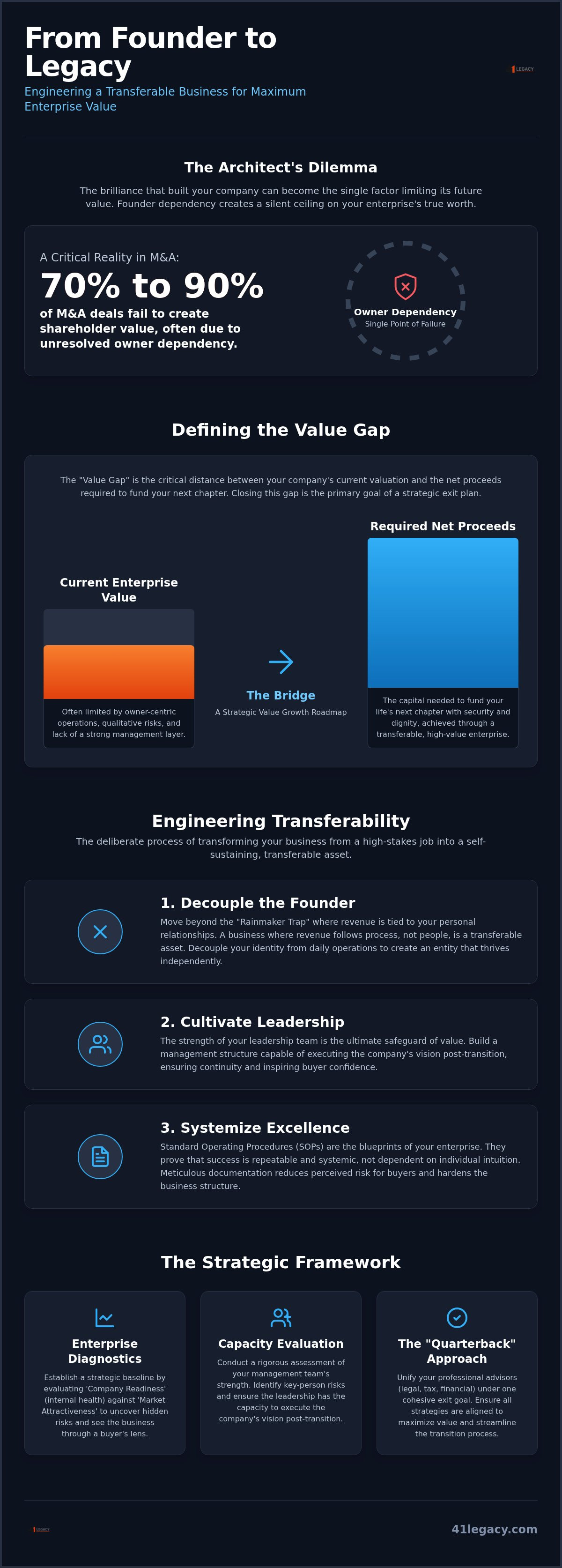
Given that 70% to 90% of M&A deals fail to create shareholder value, the strength of your leadership becomes your most vital safeguard. Enterprise value is engineered, not found. This article reveals how to transform your organization into a high-performance asset that thrives with professional autonomy. We'll examine the strategic steps to cultivate a leadership team capable of driving value while reducing the risks inherent in owner dependency. You'll discover a clear roadmap for leadership transition and the specific insights needed to command a higher valuation multiple by refining the human architecture of your business through a strategic value growth roadmap.
Key Takeaways
- Define the Value Gap to bridge the distance between your current enterprise worth and the capital required to fund your life’s next chapter.
- Master the art of building a management team to sell a business, transforming your company from a founder-dependent operation into a transferable asset.
- Conduct a Strategic Capacity Evaluation to identify key person risks and ensure your leadership team can execute the company’s vision post-transition.
- Implement a "Quarterback" approach to unify your professional advisors, aligning legal, tax, and financial strategies under one cohesive exit goal.
- Transition from transactional thinking to a multi-year Value Growth Roadmap that focuses on engineering long-term transferability and legacy.
The Architecture of Continuity: Defining the Value Gap
Enterprise value represents the price a sophisticated buyer is willing to pay for the future cash flows of a transferable asset. It's the ultimate measure of your stewardship. For many founders, a profound realization occurs during the initial stages of transition planning: the 'Value Gap.' This gap is the distance between the current valuation of your firm and the net proceeds required to fund your next chapter with dignity and security. While revenue may appear robust, it's often a deceptive indicator of exit readiness if the founder remains the primary driver of every critical decision. Building a management team to sell a business is the essential bridge across this divide. Enterprise Value is the definitive intersection of an organization’s future growth potential and the structural risks that define its current state.
Enterprise Diagnostics: The Strategic Baseline
Our proprietary Enterprise Diagnostics process serves as the foundational strategic baseline for any successful transition. It moves beyond superficial financial metrics to identify the hidden risks that quietly devalue a firm in the eyes of a professional buyer. We evaluate 'Company Readiness,' which measures the internal health and structural integrity of the business, against 'Market Attractiveness.' This objective data allows an owner to see the business through the lens of a Certified Exit Planning Advisor (CEPA), uncovering where the essence of the company is too closely tied to the individual. Effective succession planning serves as the foundational layer of this diagnostic process, ensuring that talent is not just present, but prepared to carry the legacy forward. An Exit Readiness Assessment provides the clarity needed to stop guessing and start engineering value.
Moving Beyond EBITDA: The Multiple Factor
Sophisticated buyers look past the bottom line to assess the sustainability and quality of those earnings. Qualitative vulnerabilities, particularly owner-centric operations, act as a heavy weight that compresses your valuation multiple. If the business relies on your personal relationships, technical expertise, or daily oversight to function, the risk to a buyer is extreme. Simply 'cleaning the books' is insufficient to secure a premium exit in a competitive market. You must harden the business structure by delegating authority and building a management team to sell a business that operates with surgical precision. This shift from a job you own to a transferable asset is what ultimately dictates the deal structure and the final price. By focusing on a Value Growth Roadmap, we help you transition from a central operator to a visionary leader who has built a self-sustaining enterprise.
Engineering Transferability: Reducing Owner Dependency
A business that demands the founder’s daily breath is not an enduring asset; it's a high-stakes job. True enterprise value exists only when the organization functions as a self-sustaining entity, independent of the hands that first shaped it. We call this rigorous process transferability engineering. It's the deliberate, often difficult act of decoupling your identity from the company’s daily operations. Building a management team to sell a business ensures that the legacy you’ve meticulously crafted can endure through time. Without this separation, the enterprise remains a reflection of a person rather than a standalone machine of commerce.
One of the most dangerous patterns we encounter is the 'Rainmaker Trap.' When the owner is the primary driver of sales or the sole keeper of client relationships, the business carries a single point of failure that professional buyers find intolerable. If the revenue follows the person rather than the process, the company’s worth evaporates the moment you step away from the desk. To a connoisseur of fine enterprises, a business without a delegated sales engine is a significant risk. It's a collection of past successes rather than a guarantee of future performance.
The Role of SOPs in Value Growth
Precision in documentation is the hallmark of a truly transferable business. Standard Operating Procedures (SOPs) act as the essential blueprints of your enterprise, providing a clear, evocative narrative of how excellence is achieved at every level. These documents reduce the perceived risk for potential acquirers by proving that success is repeatable, systemic, and independent of any single individual’s intuition. This meticulous documentation is a prerequisite when building a management team to sell a business, as it provides the new leadership with a reliable map for success. Creating a turnkey operation through these refined processes allows you to command a premium multiple during negotiations. You can learn more about engineering transferability through SOPs as a foundational cornerstone of your long-term transition strategy.
Building the 'Owner-Independent' Culture
Transitioning from a 'command and control' model to a delegated leadership structure requires a profound psychological shift in the founder. You must move from being the central operator to becoming a strategic steward of the company's future. This evolution is the core of our approach to Owner Dependency Reduction. The most resilient and valuable businesses are those intentionally designed to thrive in the founder's absence. By fostering a culture of autonomy and accountability, you ensure the transition is a seamless progression of history rather than a disruptive break in the lineage. If you're ready to evaluate your current leadership strength, our Strategic Capacity Evaluation offers the clarity needed to begin this transformation.
Strategic Capacity Evaluation: Assessing Management Strength
Strategic Capacity is the silent pulse of a truly transferable asset. It represents the collective ability of your leadership team to execute the company’s vision long after you have relinquished the helm. While the previous stages of our process focused on the architecture of systems and the reduction of owner dependency, this evaluation examines the human soul of the organization. Building a management team to sell a business requires a profound and honest assessment of whether the current leadership possesses the technical precision and emotional weight to lead independently. It's the difference between a group that follows instructions and a team that stewards a legacy.
Identifying 'key person' risks is a critical component of our proprietary Strategic Capacity Evaluation. These risks act as single points of failure that can jeopardize years of meticulous cultivation. If the departure of one individual causes the structural integrity of the firm to waver, the enterprise is not yet ready for a successful transition. Sophisticated buyers look for a stable, high-performing middle management layer that ensures operational continuity. They're seeking the assurance that the company's excellence is a systemic reality rather than an individual fluke. This qualitative depth is what allows a business to survive the intense scrutiny of the due diligence process.
Human capital serves as a vital value driver that often dictates the final terms of a deal. During negotiations, a buyer isn't merely analyzing spreadsheets; they're evaluating the depth of your bench. A company with a robust, empowered leadership layer commands a significantly higher valuation multiple because it represents a lower risk profile. It proves that the essence of the business is distributed throughout the team. By focusing on building a management team to sell a business, you're not just preparing for an exit; you're hardening the enterprise for a future of sustained growth. You can explore how we identify these qualitative drivers through our Enterprise Diagnostics phase.
Talent Development and Retention Strategies
Securing your legacy requires more than just identifying talent; it demands a sophisticated strategy for retention. Incentivizing key employees to remain through the transition period is essential for maintaining buyer confidence and operational stability. This involves creating a culture of accountability that functions flawlessly without the owner's constant oversight. We help you implement structures that align the team's professional aspirations with the long-term health of the enterprise. When your leaders feel like guardians of the company’s history, their dedication becomes a powerful asset that transcends the transaction itself.
Empowering the Leadership Team
There is a fundamental distinction between 'management' and 'strategic leadership.' Management focuses on the execution of existing tasks, while strategic leadership involves the ability to navigate future challenges and seize new opportunities. Our approach involves creating redundancy in critical roles to ensure that no single person holds the keys to the company’s survival. This redundancy creates a sense of harmony and resilience within the organization. By investing in the professional growth of your team, you're building a legacy that will thrive for generations. This empowerment is the final stage in transforming a founder-led company into a world-class, transferable asset.
The Advisory Quarterback: Aligning Your Professional Team
Excellence in the transition of a legacy is never a solitary achievement. It demands a sophisticated orchestration of various professional disciplines, each contributing to a singular vision. Too often, business owners find themselves at the center of a fragmented planning process where CPAs, attorneys, and wealth managers operate in silos, rarely communicating with one another. This lack of coordination creates structural risks that can devalue the enterprise and complicate the delicate act of building a management team to sell a business. A Certified Exit Planning Advisor (CEPA) acts as the strategic architect, ensuring that every legal structure, tax strategy, and value growth initiative is perfectly aligned with your ultimate exit goal. The quarterback doesn't replace your trusted advisors; instead, we elevate their work by providing the strategic context they often lack.
By coordinating the timing of tax elections with the development of leadership incentives, we ensure that every strategic move increases the company's transferability. This holistic view is the only way to protect the essence of what you've built. When your professional team is aligned, the process of building a management team to sell a business becomes a focused effort rather than a series of disconnected tasks. We provide the leadership needed to ensure that your advisors are working toward a unified outcome, protecting your wealth and your legacy simultaneously.
Coordinated Advisory vs. Fragmented Planning
Receiving conflicting guidance on valuation or tax implications is a primary driver of deal fatigue and failed transitions. When advisors don't communicate, the owner is forced to translate complex technical jargon between parties, leading to errors and missed opportunities. Our Value Growth Roadmap serves as the single source of truth for your entire advisory team. It provides a clear, documented blueprint that keeps your existing CPA and legal counsel focused on the same objective. This alignment is critical when you're preparing for a transition, as it ensures the internal leadership development mirrors the external financial planning. Without this coordination, you risk building a structure that is legally sound but operationally hollow.
Monthly Implementation Support
A strategy is only as powerful as its execution. Many owners possess a vision for their transition but lack the capacity to manage the granular details of implementation alongside daily operations. Our Monthly Implementation Support provides the accountability and structured cadence necessary to maintain momentum. We act as your dedicated partners, ensuring that the milestones of your roadmap are met with surgical precision. Transitioning a company is a multi-year journey of refinement that requires a steady, unhurried rhythm. Without a monthly cadence, the urgent demands of the business often crowd out the important work of exit readiness. To ensure your legacy is preserved through a coordinated effort, you can explore our Strategic Advisory services for ongoing support.
The Value Growth Roadmap: Executing Your Exit Strategy
Exit readiness is a deliberate multi-year journey, not a sudden transactional event. It requires the patience of an artisan and the technical precision of a strategist. Viewing your business as a living entity, rather than a simple vehicle for income, shifts your role from a central operator to a dedicated steward. This perspective allows you to cultivate the organization's inner essence, ensuring its vitality remains intact long after your departure. Preparing yourself emotionally for life after the successful transfer of the enterprise is as critical as the financial engineering itself. You aren't just selling a company; you're entrusting a legacy to new hands.
Executing the Roadmap with Precision
Our process follows a disciplined four-step architecture designed to maximize enterprise value and ensure a seamless transition. First, we conduct an Exit Readiness Assessment to establish an objective baseline of your current state. Second, we prioritize the specific value drivers that will have the most profound impact on your valuation multiple. Third, we execute the plan through Monthly Implementation Support, providing the accountability needed to keep the transition on track. Finally, we secure the legacy by building a management team to sell a business that can thrive independently of your presence. This structured approach transforms the abstract goal of an exit into a tangible, high-value reality that protects your future.
Your Next Steps Toward Exit Readiness
The cost of waiting until you feel 'ready to sell' to begin the planning process is often measured in lost enterprise value and limited options. Strategic planning should ideally begin three to five years before a planned transition to allow for proper engineering of the company's systems. By requesting an initial enterprise diagnostic now, you can identify your specific Value Gap and begin the work of closing it with surgical precision. This early intervention allows for the unhurried refinement of your leadership team and internal systems. Don't leave the future of your life's work to the whims of the market or chance circumstances. You can begin your journey toward a transferable legacy with 41 Legacy today.
The Path to a Transferable Enterprise
True enterprise value is a deliberate creation. It requires moving beyond the day-to-day operations to focus on the structural integrity of the firm. By addressing the Value Gap and prioritizing transferability engineering, you transform your company into a self-sustaining asset. Building a management team to sell a business is the cornerstone of this evolution, ensuring the company's excellence is no longer tethered to your personal presence. This process hardens the business against risk while elevating its potential in the eyes of sophisticated buyers who value continuity as much as performance.
Led by a Certified Exit Planning Advisor (CEPA), our team provides the strategic architecture needed for this transition through customized Value Growth Roadmaps. We invite you to move from the role of central operator to that of an intentional steward. Your business is a living entity with a story to tell; let's ensure its next chapter is one of continued strength and independence. Request Your Exit Readiness Assessment to begin defining your legacy with surgical precision. Your commitment to excellence today secures the impact of your enterprise for years to come.
Frequently Asked Questions
What is the difference between business valuation and enterprise value?
Business valuation is a technical calculation often used for compliance or tax purposes, while enterprise value is the definitive price a buyer pays for the future cash flows of a transferable asset. Enterprise value accounts for both growth potential and the structural risks inherent in the organization. It's the ultimate measure of your stewardship, reflecting how well the business can function as a standalone entity without your constant oversight.
How long does it typically take to build a management team capable of running the business?
Building a management team to sell a business is a deliberate multi-year journey that typically requires three to five years of focused cultivation. This timeline allows for the unhurried identification of talent and the rigorous testing of their strategic capacity. It's an act of transferability engineering that ensures leadership is deeply ingrained in the company’s culture before a transition occurs.
Why do buyers consider owner dependency a major risk during due diligence?
Buyers view owner dependency as a single point of failure that jeopardizes the continuity of future earnings. If the essence of the company is tied to your personal relationships or technical expertise, the risk to an acquirer is extreme. During due diligence, they're looking for proof that the business can breathe on its own, ensuring their investment remains secure after you relinquish control.
Can I increase my company's valuation multiple without increasing revenue?
You can certainly increase your valuation multiple by reducing the qualitative risks that compress your company's worth. A business with a high-capacity leadership team and documented systems represents a lower risk profile to a buyer than a larger, more chaotic firm. By hardening the enterprise through owner dependency reduction, you command a premium multiple regardless of your current revenue levels.
What is the role of a Certified Exit Planning Advisor (CEPA) compared to a CPA?
A CPA focuses on historical financial records and tax compliance, while a CEPA acts as the strategic architect for your company’s future transition. The CEPA coordinates the work of all professional advisors, ensuring that tax strategies and legal structures align with a unified Value Growth Roadmap. We provide the strategic altitude needed to view the enterprise as a transferable asset rather than just a set of books.
How do standard operating procedures (SOPs) specifically impact the final sale price?
Standard operating procedures act as the blueprints of your enterprise, proving that your success is systemic and repeatable. They lower the risk for a buyer by providing a turnkey framework for operational continuity, which directly translates into a higher valuation multiple. When excellence is documented, it becomes a tangible asset that commands a significantly higher final sale price.
What is the 'Value Gap' and why is it critical for my retirement planning?
The Value Gap is the distance between your current enterprise worth and the net proceeds required to fund your life’s next chapter with security. Identifying this gap is the first step in any successful retirement strategy, as it defines the specific value growth targets you must achieve. Our Exit Readiness Assessment provides the clarity needed to bridge this divide before you begin a transition.
How does a 'Quarterback' advisor help during the exit planning process?
A Quarterback advisor unifies your professional team, ensuring that your CPA, attorney, and wealth manager are all moving in the same direction. This coordinated approach prevents the fragmented planning that often leads to conflicting advice and missed opportunities. By providing a single source of truth, we ensure that every strategic move strengthens the transferability of your legacy.

Article by
Mike Laskowski
Mike Laskowski is a Business Value Growth Strategist who helps business owners uncover the truths that drive their performance, risk, and readiness. Blending forensic interviewing from a 26‑year federal career with Strategic Capacity analysis and CEPA methodology, he works upstream to reduce owner dependency, increase transferability, and strengthen enterprise value. Mike guides founders through clarity, operational evolution, and transition readiness so their companies become transferable, owner‑independent assets that endure beyond the founder.
Disclaimer
This article is for educational and informational purposes only and does not provide legal, tax, investment, or business brokerage advice. 41 Legacy does not offer M&A brokerage services, legal document drafting, tax preparation, or investment advisory services. Business owners should consult licensed professionals in those disciplines before making decisions related to business transactions, legal matters, tax strategy, or financial planning. All examples are illustrative and may not apply to your specific situation.