
Diversifying Customer Base to Increase Value: The Architecture of a Transferable Legacy
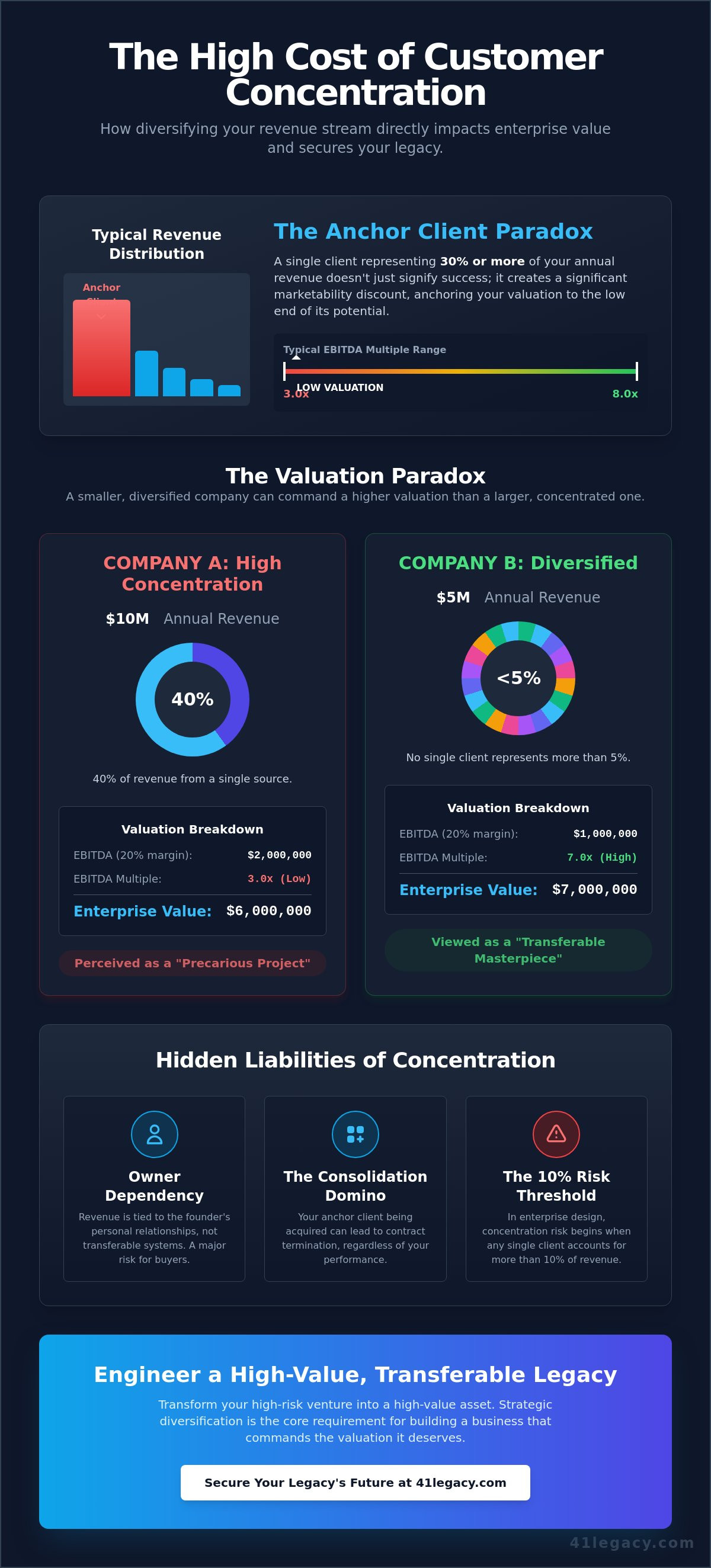
As of May 2026, a single client representing 30% or more of your annual revenue doesn't just signify success; it triggers a significant marketability discount that can anchor your enterprise value to the lower end of the 3.0x to 8.0x EBITDA multiple range. For the business owner acting as a dedicated steward of their company's history, the process of diversifying customer base to increase value is more than a defensive maneuver. It's the deliberate engineering of an asset designed to endure. You likely feel the weight of this concentration, sensing an invisible ceiling on your valuation or the quiet anxiety of being held hostage by a primary revenue stream.
We understand that true excellence requires a foundation that is both stable and expansive. This article reveals how strategic diversification transforms your operation from a high-risk venture into a high-value, transferable legacy. We will explore the technical mechanics of de-risking your revenue model and building an enterprise that thrives independently of your personal client relationships, ensuring your life's work commands the respect and valuation it deserves.
Key Takeaways
- Recognize how revenue concentration creates a marketability discount that erodes your enterprise multiple during a transition.
- Learn why diversifying customer base to increase value is a core requirement for engineering a business that thrives independently of its founder.
- Identify the threshold where an anchor client becomes a risk to your legacy and how to rebalance your portfolio for structural stability.
- Discover the diagnostic process for identifying high-value client segments that strengthen your strategic capacity and overall transferability.
- Understand how structured advisory and monthly implementation turn a risk-mitigation strategy into a lasting, high-value asset.
The Perils of Concentration: Why a Single Anchor Can Sink Your Legacy
In the discipline of enterprise design, we define customer concentration as any single relationship accounting for more than 10% of annual revenue. While a massive contract often feels like a crowning achievement, it frequently acts as a gilded cage for the unwary owner. This is the Anchor Client paradox. Rapid growth fueled by one or two primary sources provides immediate scale, yet it simultaneously narrows the foundation of the business. For a steward focused on building a lasting impact, the intentional act of diversifying customer base to increase value becomes a necessity for long-term preservation. Without this balance, you aren't leading an independent entity; you're managing a high-stakes department for another company.
This concentration creates a hidden value gap. During preliminary assessments, sophisticated buyers look past top-line revenue to find the structural integrity of the cash flow. If a significant portion of your income is siloed within a few accounts, the perceived risk increases exponentially. This risk isn't just theoretical. It manifests as a lower enterprise multiple, effectively erasing years of hard work. The emotional toll is equally heavy. Stewardship shouldn't feel like being held hostage by the whims of a single procurement officer or a sudden shift in a client's corporate strategy.
The Rainmaker Trap and Owner Dependency
A common oversight in many firms is how major accounts often mask deep-seated owner dependency. These high-value relationships usually rely on the founder's personal charisma and decades of history. While this speaks to your character, it's a liability for transferability. Buyers distinguish between relationship-based revenue and system-based revenue. If the revenue walks out the door when you do, the asset isn't truly transferable. We find that professional investors heavily discount businesses where the owner remains the primary account manager for the largest revenue streams. True value lies in the systems, not the individual.
The Vulnerability of the Unprotected Enterprise
Your enterprise exists within a volatile ecosystem where external shifts are inevitable. Even if your relationship with an anchor client is flawless, you're vulnerable to the Consolidation Domino. If your primary client is acquired by a competitor, your contract might be terminated regardless of your performance. This vulnerability aligns with the broader principles of Diversification (marketing strategy), which seeks to mitigate risk by spreading exposure across varied segments. Relying on a single industry or client means you've inherited their specific economic risks, from bankruptcy to market pivots, without having any control over their internal decisions. Protecting your legacy requires a more resilient architecture.
The Mathematics of Value: How Diversification Impacts Enterprise Multiples
In the quiet rooms where enterprise value is determined, risk is the primary architect of the final number. Sophisticated buyers don't merely purchase your past profits; they invest in the probability that those profits will continue into an uncertain future. When a business lacks a broad foundation, the buyer must apply a steeper "Discount Rate" to account for the fragility of the cash flow. The intentional act of diversifying customer base to increase value is the most effective way to lower this rate. It moves the conversation from the volatility of a single relationship to the enduring strength of a market-proven asset.
During the due diligence phase, customer concentration often acts as a deal killer. A buyer might see a company generating $10 million in revenue but, upon discovering that 40% comes from one source, they may walk away entirely or demand a significant "Risk Premium." This creates a striking valuation paradox. A $5 million company with no client representing more than 5% of its revenue often commands a higher total valuation than a $10 million company tethered to a single anchor. The smaller firm is viewed as a transferable masterpiece, while the larger one is seen as a precarious project. A comprehensive Enterprise Diagnostic can illuminate where your current concentration risks reside before they impact your valuation.
De-Risking the Revenue Stream
Institutional buyers utilize a Quality of Earnings (QofE) analysis to scrutinize the source of every dollar. They are searching for "Stickiness." If your revenue is concentrated, the buyer assumes a higher likelihood of churn. By broadening your portfolio, you shift the narrative from volatile income to predictable enterprise value. Sophisticated buyers recognize the benefits of a diverse customer base, viewing it as a shield against the volatility of any single industry pivot or corporate restructuring.
Comparing Concentrated vs. Diversified Portfolios
The impact on your EBITDA multiple is quantifiable and direct. In the current 2026 market, the difference in multiples can be the difference between a comfortable transition and a compromised legacy.
- High Concentration (>30%): Typical multiples range from 3.0x to 4.5x EBITDA.
- Low Concentration (<10%): Typical multiples range from 5.0x to 8.0x EBITDA.
Strategic Capacity is the ability of your organization to absorb the sudden loss of a major client without compromising its core mission or financial viability. When your business possesses this capacity, you aren't just selling a job; you're transferring a resilient, high-performance engine. This structural excellence is what defines a legacy asset.
Strategic Capacity: Diversification as a Pillar of Transferability
Strategic capacity is the hallmark of a legacy built to endure. While we've examined the mathematical erosion caused by concentration, we must now address the structural integrity required for a business to exist as a standalone entity. A business isn't truly an asset until it possesses the ability to thrive without its creator's constant intervention. This is why diversifying customer base to increase value serves as a foundational pillar of transferability. It proves your value proposition isn't a fluke of a few personal relationships; it's a refined solution that the broader market actively seeks. When your revenue is spread across varied segments, you demonstrate that your enterprise has the "musculature" to support itself in any economic climate.
At 41 Legacy, our philosophy centers on preserving the essence of what you've built through structural excellence. We view the business as a masterpiece that requires a balanced frame to be displayed in any gallery. By decentralizing client management, you strip away the "Key Man" risk that keeps many owners tethered to their desks. When a diverse array of clients relies on your systems rather than your personality, the business gains the freedom to be transferred with its soul intact. This decentralized approach is the only way to ensure that your life's work isn't just a job you've created for yourself, but a valuable, transferable asset.
Engineering a Standalone Entity
Building systems that serve a broad demographic requires a deliberate shift in perspective. It's about curating a client list that reflects market attractiveness rather than just convenience. Through Enterprise Diagnostics, we identify where the founder's influence is too deeply embedded. This diagnostic process ensures that the brand's legacy survives the inevitable transition of ownership. It isn't enough to have a high-performing company today. You must engineer a business that can speak for itself in the marketplace, commanding the respect of future stewards who value heritage as much as performance.
The Role of Strategic Advisory in Value Growth
True value growth is a disciplined pursuit. It's easy to fall into the trap of "growth for growth's sake," but unfocused expansion often dilutes enterprise value by increasing operational complexity without reducing risk. We align every sales effort with a long-term Value Growth Roadmap. This ensures that every new client adds to the architectural strength of the firm. As your strategic advisors, we act as the "Quarterback" for your professional team. We ensure that your CPA, attorney, and wealth manager are all moving in harmony toward a singular, uncompromising vision of perfection. This coordination is what turns a risky operation into a high-value legacy.
Engineering the Shift: A Strategic Roadmap to Customer Expansion
Transitioning from a concentrated revenue model to a diversified portfolio requires the precision of a master restorer. It isn't a chaotic sprint toward any available lead, but a disciplined sequence of strategic movements. The process of diversifying customer base to increase value must be handled with care to preserve the operational excellence you've already established. We approach this shift through five distinct phases, ensuring each step strengthens the underlying architecture of your legacy.
- Phase 1: The Diagnostic. We begin by illuminating the true depth of your concentration risk, looking beyond simple percentages to find the hidden dependencies.
- Phase 2: The Ideal Client Profile (ICP). We identify high-value, low-risk segments that mirror the quality of your best clients without the inherent fragility of your current silos.
- Phase 3: The Value Proposition. Your message is refined to resonate with a broader audience while maintaining the sophisticated essence of your brand.
- Phase 4: Implementation. We execute the pivot strategically, expanding your reach without alienating the anchor clients who currently support your operations.
- Phase 5: Monitoring. Through monthly implementation support, we ensure the transition remains on track, turning strategic intent into measurable enterprise value.
The Diagnostic: Measuring the Value Gap
The first step toward a transferable asset is knowing exactly where you stand. Utilizing Exit Readiness Assessments allows us to identify the specific concentration traps that would give a sophisticated buyer pause. We analyze the Cost of Acquisition (CAC) across different segments to ensure your expansion is efficient and sustainable. In this context, we define the Value Gap as the delta between your business's current worth and its potential value once the risks of concentration and owner-dependency are removed. Research suggests that for owners planning to sell, this mitigation plan should begin 24 to 36 months in advance to maximize the impact on your multiple.
Refining the Value Proposition for Market Breadth
Scaling a legacy requires moving from bespoke services, which often rely on your personal intervention, to scalable solutions that the organization can deliver with artisan-level precision. This shift doesn't mean compromising on quality. Instead, it means documenting your excellence so it can be replicated across multiple industry verticals. By crafting a narrative that speaks to the universal needs of your ICP, you ensure your brand's reputation precedes you in new markets. If you're ready to begin this transition, you can request a strategic capacity evaluation to determine your current readiness for expansion.
Securing the Future: The 41 Legacy Approach to Value Growth
The work of building a transferable asset reaches its zenith when the owner transitions from a daily operator to a visionary steward. This evolution requires more than just a shift in mindset; it demands a rigorous, coordinated approach to the business's structural health. At 41 Legacy, we serve as the Quarterback for your professional advisory team, ensuring that every specialist moves in harmony toward a singular goal. The discipline of diversifying customer base to increase value isn't a project with a finish line. It's an ongoing commitment to excellence that transforms a life's work into an enduring masterpiece.
We provide the monthly implementation support necessary to turn high-level strategy into tangible enterprise value. Without consistent execution, even the most brilliant roadmap remains a static document. In the current 2026 economic environment, where commercial lenders maintain disciplined underwriting standards and the Prime Rate sits at 6.75%, the clarity of your diversification plan is vital. We bridge the gap between your current operations and the high-value, de-risked model that sophisticated buyers and internal successors demand. This ensures your legacy isn't left to chance.
A Coordinated Advisory Strategy
Most business owners work with talented CPAs and attorneys, yet these professionals often operate in silos. We bring these voices together, aligning your tax and legal structures with your ultimate Exit Readiness goals. It's essential that your corporate architecture supports a diversified revenue model. We ensure that your advisory team is focused on the same uncompromising vision, protecting the essence of your business while engineering it for maximum transferability. This holistic oversight is the only way to ensure that no detail is overlooked in the pursuit of perfection.
The Path to a Successful Transition
Preparation is the ultimate form of respect for your legacy. By building a business that thrives independently of your personal relationships, you're honoring the work you've done and the people who've supported you. A truly transferable asset is one that can be handed to a new steward with the confidence that its core will remain intact. This level of readiness doesn't happen by accident. It's the result of meticulous planning and the courage to de-risk your revenue streams long before a transition occurs. If you're ready to secure the future of your enterprise, embark on your Value Growth journey today and begin building a legacy that endures.
The Blueprint for an Enduring Asset
Building a transferable legacy requires a departure from the fragile safety of a few anchor clients. We've established that revenue concentration functions as a persistent anchor on your enterprise multiple, while a broad foundation signals structural excellence to future stewards. By diversifying customer base to increase value, you effectively de-risk your life's work and prove that your company's essence is market-wide. This transformation turns a risky operation into a resilient engine that thrives independently of your personal charisma.
Our team provides the technical precision and national strategic advisory needed to guide high-net-worth owners through this complex evolution. Led by Certified Exit Planning Advisor (CEPA) leadership, we utilize a proprietary Value Growth Roadmap process to ensure every strategic move is intentional and polished. This coordinated approach protects the heritage you've built while preparing it for a seamless transition. Begin your journey toward a transferable legacy with a 41 Legacy Exit Readiness Assessment. You've spent years building something extraordinary; now is the time to ensure it endures for generations to come.
Frequently Asked Questions
What is considered a dangerous level of customer concentration?
Any single client representing more than 10% of your annual revenue is generally considered a concentration risk. In the current market, if one account exceeds 30%, sophisticated buyers will likely apply a significant marketability discount to your valuation. This level of exposure creates a precarious foundation that threatens the long-term transferability and resilience of the enterprise.
How does customer diversification affect my business valuation multiple?
Diversification directly increases your EBITDA multiple by lowering the perceived risk of your future cash flows. While concentrated firms often trade at multiples between 3.0x and 4.5x, companies with a broad base can command 5.0x to 8.0x. By diversifying customer base to increase value, you shift from a risk-heavy operation to a premium, transferable asset that appeals to a wider range of buyers.
Can I diversify my customer base without losing my biggest client?
Yes, diversification is about expanding your portfolio rather than terminating existing high-value relationships. The goal is to grow other segments so that the relative percentage of your anchor client decreases over time. This approach preserves your current revenue while building the structural integrity needed for a successful transition. It turns a potential liability into a balanced component of a larger, more stable engine.
How long does it typically take to see an increase in value from diversification?
Strategic diversification typically requires a timeline of 24 to 36 months to produce measurable impacts on enterprise value. This duration allows you to document consistent revenue from new segments and prove that the growth is sustainable. Institutional buyers look for multi-year trends that demonstrate the company's ability to thrive without relying on a single source or the founder's personal charisma.
What role does my CPA play in customer diversification strategies?
Your CPA provides the granular data necessary to analyze the quality of your earnings and the profitability of different customer segments. We coordinate with your financial advisors to ensure your reporting accurately reflects the reduced risk profile of your diversified base. This alignment is crucial for presenting a clear, authoritative case to potential buyers during the due diligence process, ensuring your legacy is valued correctly.
Is it better to have many small customers or a few medium-sized ones?
A balanced mix of medium-sized clients is often ideal for maintaining operational efficiency while minimizing risk. Too many small customers can increase administrative complexity and strain your strategic capacity. The objective is to cultivate a portfolio where no single entity holds enough leverage to compromise the business's financial stability. We focus on identifying the right client size that supports both growth and transferability.
How do I explain my diversification strategy to a potential buyer?
Present your strategy as a deliberate engineering effort to build a standalone entity with market-wide appeal. Show the buyer your Value Growth Roadmap and the systems you've implemented to manage a broad portfolio without founder intervention. Explaining the logic of diversifying customer base to increase value demonstrates that you are a steward of a resilient asset rather than an owner of a job.
What are the first steps in an Exit Readiness Assessment for my firm?
The assessment begins with an Enterprise Diagnostic to uncover hidden dependencies and measure your current value gap. We analyze your client mix, owner involvement, and structural systems to identify specific obstacles to transferability. This provides the strategic clarity required to begin engineering a business that commands a premium multiple. It's the foundational step in turning your life's work into a high-value, transferable legacy.

Article by
Mike Laskowski
Mike Laskowski is a Business Value Growth Strategist who helps business owners uncover the truths that drive their performance, risk, and readiness. Blending forensic interviewing from a 26‑year federal career with Strategic Capacity analysis and CEPA methodology, he works upstream to reduce owner dependency, increase transferability, and strengthen enterprise value. Mike guides founders through clarity, operational evolution, and transition readiness so their companies become transferable, owner‑independent assets that endure beyond the founder.
Disclaimer
This article is for educational and informational purposes only and does not provide legal, tax, investment, or business brokerage advice. 41 Legacy does not offer M&A brokerage services, legal document drafting, tax preparation, or investment advisory services. Business owners should consult licensed professionals in those disciplines before making decisions related to business transactions, legal matters, tax strategy, or financial planning. All examples are illustrative and may not apply to your specific situation.