Developing a Successor for Your Business: The Art of Engineering a Transferable Legacy
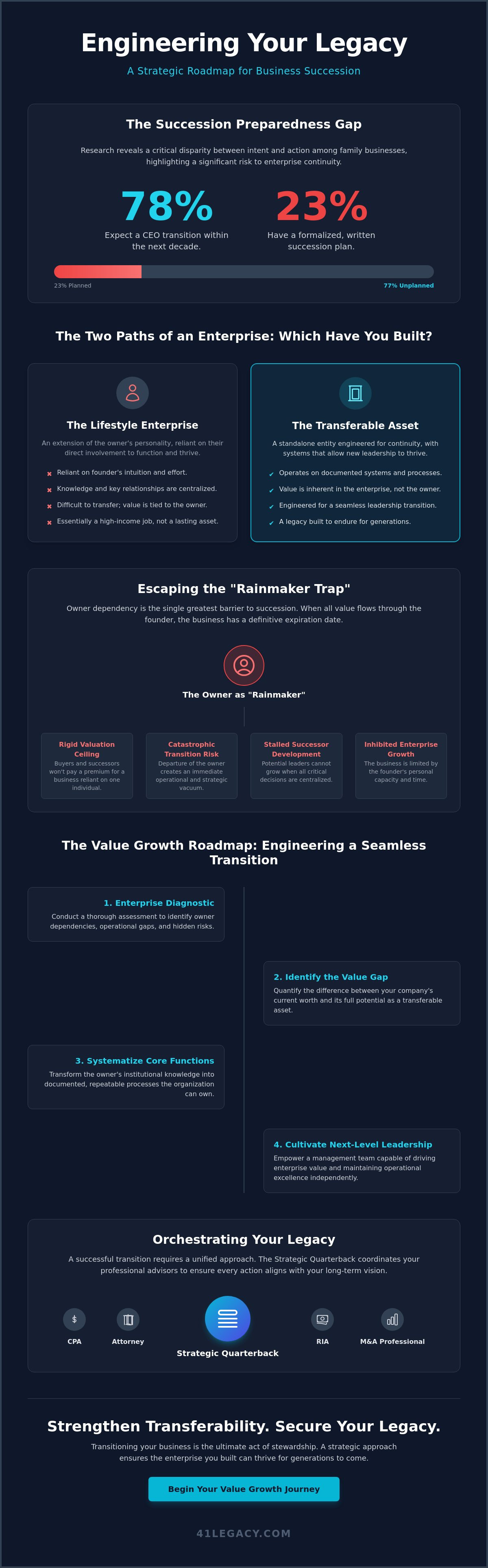
Research indicates that 78 percent of family businesses expect a CEO transition within the next decade, yet only 23 percent are actively implementing a plan to manage it. This disparity highlights a significant risk to the enduring essence of many enterprises. We believe that developing a successor for your business is the ultimate act of stewardship, requiring a blend of technical precision and a deep respect for the history you've created. It's common to feel the weight of uncertainty regarding the market value of your life's work or the fear that the business might stumble without your direct guidance.
You'll learn how to transform your company from a founder-dependent operation into a high-value, transferable asset that thrives under new leadership. We'll examine the strategic roadmaps and diagnostics necessary to reduce owner-dependency, maximize your financial return, and secure a lasting legacy for your employees and customers. By treating succession as an art of engineering rather than a simple exit, you ensure the impact of your work continues for generations.
Key Takeaways
- Learn to distinguish between a lifestyle enterprise and a transferable asset, positioning your company for a transition that preserves its historical essence.
- Discover why developing a successor for your business depends on dismantling the "Rainmaker Trap" to remove the valuation ceilings caused by owner dependency.
- Assess potential leadership candidates based on their ability to drive enterprise value and maintain operational excellence under new stewardship.
- Utilize enterprise diagnostics and a Value Growth Roadmap to identify and close the gap between your current and potential market value.
- Understand the importance of a strategic quarterback to coordinate your professional advisors and ensure a unified approach to your legacy.
The Philosophy of Succession: From Founder-Led to Transferable Asset
Succession is the ultimate test of an enterprise's structural integrity. It's the moment when the strength of the foundation is finally measured against the weight of the future. Many owners view this process as a distant administrative task, yet it's actually a profound act of stewardship. To succeed in developing a successor for your business, you must first acknowledge a difficult truth: a business that relies on your daily presence is a job you own, not a legacy you've built. True impact requires a transition from a founder-led culture to a system of transferable excellence.
The distinction between a lifestyle business and a transferable asset is often found in the details of daily operations. A lifestyle business is an extension of the owner’s personality, thriving only through their personal intuition and effort. In contrast, a transferable asset functions as a standalone entity with its own internal logic and momentum. When a system is designed solely around a founder, any successor is likely to fail. They cannot replicate your decades of instinct. They need a framework that allows them to lead without needing to be you. This requires shifting your role from the primary operator to a strategic steward, focusing on the long-term health of the organization rather than the immediate demands of the day.
The Essence of Transferability
Transferability is the primary driver of enterprise value. It represents the ease with which a new leader can take the helm without disrupting the rhythm of the business. Succession planning is the discipline of identifying and bridging the "Value Gap," which is the difference between your current worth and your company's full potential. Successors and external buyers pay a premium for turnkey operations. They seek the peace of mind that comes with a business that has been engineered for continuity. At 41 Legacy, we help owners refine these internal structures to ensure the essence of the company remains intact long after the transition.
Succession as a Value Growth Strategy
Preparing for a successor is not merely an exit strategy; it's a growth strategy. The very actions required to make a business transferable also make it more profitable today. By viewing your business as a product for sale, you begin to see inefficiencies that were previously hidden by your own hard work. This mindset creates a "perpetual state of readiness." It encourages the development of robust systems and high-performing teams, which naturally reduces risk and increases the enterprise's appeal. When you focus on developing a successor for your business, you aren't just planning for the end. You're building a more resilient and valuable organization for the present.
Identifying the Rainmaker Trap: Why Owner Dependency Stalls Succession
In many enterprises, the founder acts as the primary architect of growth, serving as the lead salesperson and the ultimate technical authority. While this drive is essential during the early stages, it eventually matures into what we call the "Rainmaker Trap." This phenomenon occurs when the business’s success is inextricably linked to the owner’s personal involvement. If the company’s "magic" resides only in your intuition, developing a successor for your business becomes an impossible task. No candidate can inherit your instincts, and no buyer will pay a premium for a system that collapses the moment you step away.
Owner dependency creates a rigid valuation ceiling. Professional advisors and potential successors look for structural stability, not individual heroics. When institutional knowledge is locked in a single mind, it represents a catastrophic risk rather than an asset. Transitioning away from this model requires a meticulous deconstruction of your daily roles. You must transform personal expertise into documented processes that the organization can own. This shift is the core of Owner Dependency Reduction, a process that prepares the enterprise to breathe on its own.
The Owner Dependency Audit
To understand the depth of this trap, one must conduct a candid audit of the company’s daily survival. Consider these questions:
- How many days could the business operate at peak efficiency without your direct input?
- Which "critical path" decisions are currently reserved solely for your approval?
- Do your most valuable customer relationships belong to the brand or to you personally?
If customer retention is tied to your personal charisma, the business lacks transferability. A successor needs a clear runway, not a shadow they can never escape. Utilizing resources like a Succession Planning Toolkit can help identify these critical positions and the gaps in your current team’s readiness.
Strategic Capacity Evaluation
Building a legacy requires a team capable of high-level execution without constant oversight. This is where strategic capacity evaluation becomes vital. It involves identifying the "Value Drivers" that exist independently of your presence. By decentralizing decision-making, you empower your leadership team to protect the company's essence. This isn't just about delegation. It's about engineering a culture of autonomy. When developing a successor for your business, your goal is to ensure the enterprise is a living entity, capable of thriving long after its founder has departed.
Evaluating Potential Successors Through the Lens of Enterprise Value
The selection of a successor is less of a human resources task and more of a curatorial decision. When you're developing a successor for your business, you're choosing the next steward of a complex, living asset. This decision must move beyond mere likability or personal loyalty. Instead, focus on strategic fit and operational competence. An internal successor often excels at preserving the company’s cultural essence, while an external hire might bring the systems needed to scale. Both paths are valid, provided the individual can protect and execute the Value Growth Roadmap you've established.
Family transitions require an even higher level of professional rigor. Heritage is a powerful motivator, but it isn't a substitute for technical skill. The right successor, whether family or not, must be evaluated on their ability to maintain the enterprise's health independently of your presence. They are the guardians of the legacy you've meticulously built. Their primary responsibility is to ensure that the structural integrity of the business remains uncompromised during the transition and beyond.
The Competency Framework
A candidate’s potential is best measured through their ability to scale the results of your Enterprise Diagnostics. Don't rely on interviews alone. Test their strategic capacity by assigning project-based implementation tasks. This allows you to observe their decision-making and technical precision in real-time. Cultural alignment is equally vital. The successor must respect the firm's long-term essence while possessing the drive to improve its mechanical performance. This balance ensures the business remains both a tribute to its past and a leader in its future.
Preparing the Successor for Stewardship
The transition should move deliberately from a shadowing phase to an empowerment phase. Early in the process, involve the successor in the broader strategic vision. When developing a successor for your business, establish clear KPIs that focus on transferability and owner-dependency reduction. By the time you step away, the successor shouldn't just be "ready" to lead. They should already be leading the systems that make the business thrive. This structured approach ensures the transfer of leadership is a seamless extension of the company's history, not a disruption of it.
The Value Growth Roadmap: Engineering a Seamless Transition
A successful transition is rarely the result of chance. It's the product of a deliberate, phased approach designed to protect the integrity of the enterprise. The Value Growth Roadmap serves as the master blueprint for this evolution, moving the company from a founder-centric model to a standalone asset. When you are developing a successor for your business, this roadmap ensures that every structural adjustment is made with precision and foresight. It's a journey from identifying the current state to realizing the full potential of the legacy you've built.
Phase 1 begins with Enterprise Diagnostics. This process establishes a baseline valuation by examining the internal mechanics of the organization. Once the baseline is set, Phase 2 focuses on identifying and closing the Value Gap, which is the difference between what the business is worth today and its potential value if all risks were mitigated. Phase 3 involves the formalization of Standard Operating Procedures (SOPs) to ensure operational consistency. Finally, Phase 4 provides Monthly Implementation Support, ensuring that the momentum of the transition is maintained through consistent, strategic action.
The Power of Documented Systems
Standard Operating Procedures act as the instruction manual for your successor. Without these documented systems, a new leader is forced to rely on guesswork or constant consultation with the founder. This creates friction and slows the transition of operational control. When developing a successor for your business, formalizing every critical process ensures that the company’s "magic" is no longer an intangible quality held only by you. Instead, it becomes a repeatable, scalable asset. This level of standardization is a tool for extreme precision, allowing the successor to maintain the high standards of quality and service that define your brand’s history.
Closing the Value Gap
The distance between your current valuation and your company's peak potential is often defined by risk. In the diagnostic phase, we identify these risks, such as high owner-dependency or a weak balance sheet. Closing the Value Gap requires a systematic approach to strengthening the enterprise’s foundation. This might include diversifying your customer base or improving financial reporting. The goal is to create a "built-to-sell" asset. Even if you intend to transition the business to a family member or a long-term employee, the enterprise must be healthy enough to stand on its own in the open market. This level of preparation ensures the business is ready for internal or external financing, securing the financial return you deserve for your years of dedication.
To ensure your enterprise is prepared for its next chapter, we invite you to explore our Value Growth Roadmap and begin the process of engineering a truly transferable legacy.
Orchestrating the Legacy: The Role of the Strategic Quarterback
Succession planning frequently falters not for lack of effort, but for lack of coordination. When experts work in silos, the enterprise suffers from fragmented guidance. A CPA may focus exclusively on tax mitigation, while an attorney prioritizes legal protection. Without a unified vision, these individual strategies can conflict, creating "Advisor Friction" that stalls the transition. Developing a successor for your business requires a "Quarterback" model. This is a strategic leader who aligns every professional advisor toward a single, cohesive vision of the future. It ensures that the technical excellence of each specialist contributes to the overall health and transferability of the asset.
At 41 Legacy, we provide the strategic clarity necessary to harmonize these moving parts. We believe there's a profound difference between a transactional exit and a legacy transition. A transaction is merely a change of hands; a legacy transition is the preservation of an essence. By coordinating your advisory team, we ensure that the structural integrity of the business is maintained. This allows the founder to transition with the confidence that their life's work is secure and capable of thriving independently.
Aligning the Professional Advisory Team
The role of a Certified Exit Planning Advisor (CEPA) is to serve as this central point of alignment. Their task is to ensure that tax, legal, and operational strategies aren't just technically sound, but that they actively support the Value Growth Roadmap. When developing a successor for your business, this holistic approach reduces the friction that occurs when advisors operate without a shared map. By integrating these disciplines, we create a seamless environment where technical precision meets the artistic vision of the founder.
Securing Your Life’s Work
The final stage of this journey is a rigorous diagnostic to determine if the business is truly ready for transfer. This isn't a surface-level review. It's an in-depth evaluation of the company’s strategic capacity and its ability to function without founder intervention. Achieving a "professional-room altitude" plan provides the peace of mind that comes from knowing every detail has been polished to a high sheen. Your legacy isn't just a collection of assets; it's a living story that deserves to be told with excellence. We invite you to Contact 41 Legacy to begin your Exit Readiness Assessment and take the first step toward securing your company's future.
Securing the Future of Your Masterpiece
The journey from a founder-dependent operation to a high-value, transferable asset is a meticulous process of refinement. It requires moving beyond the "Rainmaker Trap" and embracing a structured Value Growth Roadmap that prioritizes long-term enterprise health. By developing a successor for your business through this lens, you ensure that the company’s essence remains intact while its operational capacity expands. This isn't merely about a transaction. It's about the deliberate preservation of your life's work.
Your enterprise is more than a series of numbers on a balance sheet. It's a living record of your dedication and vision. True success lies in the ability of the organization to thrive independently of its creator. We focus on long-term Value Growth, utilizing a proprietary Enterprise Diagnostics process to reveal the structural integrity of your firm. Led by a Certified Exit Planning Advisor (CEPA), our approach ensures that every strategic decision serves the ultimate goal of transferability. You've spent years building your legacy. Now's the time to ensure it endures.
Begin your journey toward a transferable legacy with an Exit Readiness Assessment.
Frequently Asked Questions
What is the first step in developing a successor for my business?
The first step is conducting a comprehensive Enterprise Diagnostic to establish a baseline of current transferability. This assessment identifies the "Value Gap" and highlights critical risks that must be addressed before leadership transition begins. By understanding where the business stands today, you can engineer a precise roadmap for its future independence and long-term health.
How long does the business succession planning process typically take?
A thorough succession process typically requires three to five years to execute with the necessary precision. This timeline allows for the gradual reduction of owner dependency and the validation of a successor’s strategic capacity. Research shows that 42 percent of family businesses anticipate a CEO transition within this window, highlighting the urgency of starting early to ensure structural integrity.
Can I develop a successor if my children are not interested in the business?
Yes, you can successfully transition your legacy to key employees or external leadership if family members choose a different path. Developing a successor for your business is about identifying the individual with the highest strategic fit, regardless of their lineage. This approach often leads to a more professionalized environment where competence and cultural alignment drive the company’s continued evolution.
What is the difference between a business exit plan and a succession plan?
An exit plan focuses on the owner’s departure and financial goals, while a succession plan addresses the continuity of leadership and operational excellence. While they're related, succession is the internal engineering required to ensure the business thrives after you step away. A strong succession plan is a vital component of any broader strategy to maximize the asset’s final market value.
How does owner dependency affect the valuation of my company?
High owner dependency significantly depresses valuation by introducing a "valuation ceiling" that deters sophisticated buyers. If the business relies on your personal intuition to function, it represents a risk rather than a transferable asset. Reducing this dependency through documented systems and decentralized decision-making is the most effective way to protect the enterprise’s financial worth during a transition.
What role does a Certified Exit Planning Advisor (CEPA) play in succession?
A Certified Exit Planning Advisor acts as a strategic quarterback, coordinating your professional advisory team toward a singular vision. They ensure that tax, legal, and operational strategies are harmonized, preventing the advisor friction that often stalls complex transitions. This role is essential for maintaining a professional-room altitude and ensuring every technical detail aligns with your long-term legacy goals.
How do I choose between an internal successor and an external buyer?
The choice depends on your priorities for the company’s essence and your desired financial return. Internal successors often preserve the existing culture more effectively, while external buyers may offer higher initial liquidity but demand more rigorous transferability engineering. Both paths require developing a successor for your business who can demonstrate the strategic capacity to lead the enterprise into its next chapter.
What happens to my business value if I don’t have a succession plan?
Without a formal plan, your business value is at risk of significant erosion, as only 20 to 30 percent of businesses put on the market actually sell. Lack of preparation creates uncertainty that drives away potential successors and lenders alike. Proactive planning secures the structural foundation of the company, ensuring it remains a high-value asset capable of delivering a lasting impact for stakeholders.
Article by
Mike Laskowski
Mike Laskowski is a Business Value Growth Strategist who helps business owners uncover the truths that drive their performance, risk, and readiness. Blending forensic interviewing from a 26‑year federal career with Strategic Capacity analysis and CEPA methodology, he works upstream to reduce owner dependency, increase transferability, and strengthen enterprise value. Mike guides founders through clarity, operational evolution, and transition readiness so their companies become transferable, owner‑independent assets that endure beyond the founder.
Disclaimer
This article is for educational and informational purposes only and does not provide legal, tax, investment, or business brokerage advice. 41 Legacy does not offer M&A brokerage services, legal document drafting, tax preparation, or investment advisory services. Business owners should consult licensed professionals in those disciplines before making decisions related to business transactions, legal matters, tax strategy, or financial planning. All examples are illustrative and may not apply to your specific situation.