
Developing a Strong Management Team: The Architect’s Guide to Enterprise Value
What if the most valuable component of your business isn't your personal expertise, but your absence? For many founders, the weight of daily operations feels like a badge of honor, yet this constant involvement often acts as a silent anchor on enterprise value. According to the Exit Planning Institute’s 2023 State of Owner Readiness Report, 80% of small to mid-sized businesses fail to sell. The primary reason is often a lack of structural integrity that allows the company to function without its creator. You likely agree that your business deserves to outlast your daily presence, yet the path to true autonomy requires a meticulous shift in focus. By developing a strong management team, you transition from the sole engine of the company to the architect of a self-sustaining asset.
This guide provides the blueprint to transform your leadership group into a sophisticated vehicle of transferable value. You'll learn how to build a team that operates with the precision of a master craftsman, ensuring your legacy remains intact long after you step away. We'll explore the strategic diagnostics and value growth roadmaps necessary to move from owner-dependency to a business that thrives as a standalone masterpiece.
Key Takeaways
- Shift your perspective from managing individual hires to cultivating a collective leadership asset that functions independently of the founder’s daily involvement.
- Master the meticulous process of developing a strong management team by prioritizing strategic alignment and a legacy mindset over technical skills alone.
- Utilize precise diagnostic assessments to identify leadership gaps and orchestrate a team capable of preserving the organization’s soul through every transition.
- Implement a structured "Quarterback" model of leadership to reduce owner-dependency and ensure the organization is prepared for a seamless, high-value transition.
From Owner-Centricity to Enterprise Value: The Management Mandate
A business is more than a collection of mechanical assets; it's a living entity whose soul is preserved through its leadership. In the pursuit of developing a strong management team, an owner must stop viewing employees as mere assistants and start seeing them as a collective asset. This shift is the cornerstone of enterprise value. While a founder’s vision ignites the spark, the team’s collective execution sustains the flame. True transferability exists only when the business can breathe, grow, and thrive without the founder’s constant intervention.
The "Rainmaker Trap" represents the single greatest threat to a company’s legacy. When an owner remains the primary decision-maker, revenue generator, and problem solver, the business is essentially a high-paying job rather than a transferable asset. Buyers view owner-dependency with profound skepticism. According to data from the Exit Planning Institute, businesses with high owner-dependency often face valuation discounts ranging from 20% to 50%. A company that relies on a single person’s intuition is a fragile machine; it lacks the structural integrity required for a successful transition.
Human capital is the invisible pillar of business transferability. It requires a deliberate management development process to ensure that knowledge is decentralized. By investing in the growth of others, a steward transforms individual talent into institutional wisdom. This evolution moves the business from a state of owner-centricity to a state of enterprise value, where the strength of the collective outweighs the brilliance of the individual.
The Philosophical Shift: Guardian vs. Operator
The transition from Master Operator to Master Architect is a profound evolution. An operator focuses on the daily mechanics, while an architect designs the systems that allow the mechanics to function autonomously. This shift ensures the business’s soul is preserved through decentralized leadership. Transferable management is a team that functions with precision and purpose in the owner’s absence.
The Financial Impact of a Strong Team
Management depth directly influences the EBITDA multiple during a sale. A second-tier management layer reduces Key Person Risk, making the business far more attractive to sophisticated acquirers. Without this layer, a Value Gap emerges, where the potential worth of the company is stifled by its reliance on the founder. Strengthening this tier can increase a company's market multiple by 1.5x to 2.0x, based on 2023 M&A market trends. It's the difference between selling a job and transferring a legacy.
Curating the Leadership Collective: Identifying Potential and Fit
Developing a strong management team requires a fundamental shift in perspective. We must move away from the transactional nature of filling roles and embrace the curatorial act of selecting stewards. A business is a living entity; its enterprise value depends entirely on those who protect its core philosophy while driving its performance. We don't hire for mere skills. We hire for strategic alignment and a legacy mindset. This approach ensures the business remains a transferable asset, capable of flourishing long after the founder steps away. The transition begins by establishing a C-Suite mindset throughout the organization, regardless of its current scale. This philosophy demands that every leader views their department through the lens of a shareholder. They must prioritize risk reduction and long-term sustainability over short-term gains. This level of dedication transforms a group of managers into a cohesive leadership collective.Beyond Technical Proficiency
Technical skill is the entry fee, not the finish line. True leadership demands the "Virtues of Excellence," a set of traits that include intellectual humility and a commitment to the craft of management. We prioritize emotional intelligence (EQ) as a prerequisite for team harmony. A leader's ability to remain composed under pressure is vital for maintaining stability during market shifts. According to the steps to building an effective team provided by UC Berkeley, clarity of purpose and collaborative commitment are essential for high-level performance. We utilize behavioral assessments to predict how a potential leader will react when the stakes are highest. These diagnostics move beyond resumes to reveal the underlying character of the individual.The Diagnostic Approach to Talent
A meticulous human capital audit uncovers hidden leaders within the existing structure. This diagnostic process differentiates between high-performing individual contributors and those with the capacity to inspire others. Promoting the most successful individual contributor to a management role is a strategic error that frequently destroys sales momentum while simultaneously installing an unequipped leader. * Internal audits identify employees who demonstrate natural ownership of outcomes. * External benchmarking provides context by comparing your team's capabilities against national standards. * Succession planning relies on identifying those who can operate independently of the founder. This rigorous selection process reduces owner-dependency and builds a legacy that thrives on its own merits. For those ready to begin this evolution, a diagnostic value growth roadmap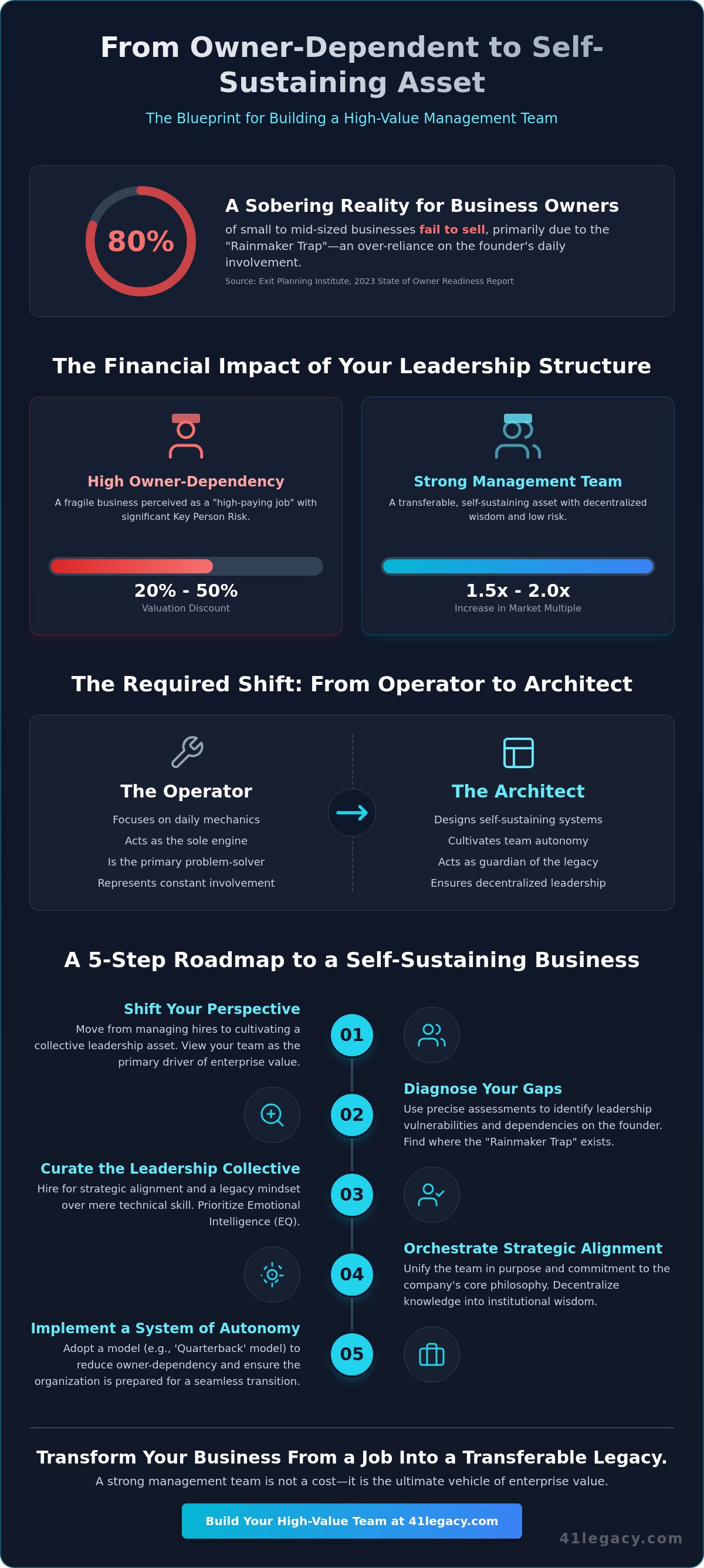
Orchestrating Strategic Alignment: The Framework of Excellence
Strategic alignment transforms a group of talented individuals into a cohesive unit capable of sustaining a founder's legacy. Developing a strong management team requires a shift from tactical management training to strategic leadership development. While training focuses on the mechanics of daily tasks, leadership development cultivates the ability to steer the organization toward long-term objectives. It's the difference between knowing how to operate a machine and understanding how to design the workflow that makes the machine valuable.
The Value Growth Roadmap serves as the primary instrument for this alignment. It provides a clear trajectory for the team, ensuring every decision supports the ultimate goal of increasing enterprise value. Data from the Exit Planning Institute indicates that roughly 80% of businesses lack a formal, written transition plan. By integrating the team into this roadmap early, you reduce owner-dependency and create a self-sustaining asset. This process requires a cadence of accountability that mirrors the precision of high-end engineering. Regular, structured reviews ensure the team remains focused on the metrics that drive value, rather than getting lost in the noise of daily operations.
Vision vs. Execution: Bridging the Gap
Translating an owner's vision into reality requires more than inspiration; it demands documented precision. You must convert high-level goals into specific Key Performance Indicators (KPIs) that the management team can own. Documented Standard Operating Procedures (SOPs) are essential for team autonomy. They serve as the technical manuals for your business, ensuring craftsmanship remains consistent regardless of who is at the helm. This level of documentation ensures the company is "Exit Ready" at all times. A business prepared for a transition is inherently more efficient and carries significantly less risk for the buyer and the steward alike.
Incentive Alignment and Retention
Protecting the soul of the organization means keeping your best talent committed to the long-term evolution of the brand. Bespoke compensation plans should reward the growth of enterprise value rather than just annual profits. Tools like "Phantom Stock" or "Stay Bonuses" provide the team with a financial stake in a successful transition. These structures ensure the managers responsible for the company's success are rewarded for their stewardship. When developing a strong management team, financial alignment ensures they become true guardians of the enterprise value you've built over decades.
A 5-Step Roadmap for Developing a Strong Management Team
Building a legacy requires a shift from individual performance to collective mastery. It's the difference between a solo craftsman and a world-class atelier. Developing a strong management team ensures the business functions as a precision instrument, even when the founder isn't present. This transition is not merely a change in personnel; it's a meticulous re-engineering of the firm's engine to ensure long-term transferability and resilience.
- Step 1: Conduct an Enterprise Diagnostic. This structural survey identifies leadership gaps. We find the cracks in the management foundation before they become structural failures that diminish enterprise value.
- Step 2: Define Specific Roles via the Quarterback Model. Every high-performance machine needs a driver for each system. We replace owner-dependency with specialized roles where leaders own specific outcomes rather than just performing tasks.
- Step 3: Implement Strategic Mentorship. We don't just hire; we curate talent through advisory programs. This fosters a bespoke culture of excellence where the "soul" of the business is preserved through professional development.
- Step 4: Establish a Value Growth Meeting Rhythm. Regularity creates discipline. A structured cadence of weekly and monthly meetings drives accountability and ensures the team remains aligned with the long-term vision.
- Step 5: Delegate Uncompromising Authority. The final hand-off involves giving the team the power to make high-level decisions. This step transforms the owner from a technician into a true steward of the legacy.
Phase 1: Assessment and Gap Analysis
Objectively measuring a team's ability to execute requires a cold, clinical look at current operations. According to the Exit Planning Institute, high owner-dependency can lead to a 20% to 30% discount on business value during a transition. We identify "Value Killers" within the organizational chart, such as single points of failure or lack of documented processes. This assessment sets the baseline for your bespoke Value Growth Roadmap, ensuring every structural adjustment serves the ultimate goal of transferability.
Phase 2: Empowered Implementation
The transition from telling to coaching is where the master craftsman truly emerges. As an owner, your role evolves into a mentor who empowers the team to solve high-level problems independently. Monitoring progress through monthly implementation support ensures the team doesn't revert to old habits. By developing a strong management team, you create a culture of uncompromising quality where the staff is responsible for the evolution of the brand, allowing the business to thrive as a living entity independent of its founder.
Protecting the Legacy: The 41 Legacy Approach to Leadership
41 Legacy serves as the quarterback for your leadership evolution. Developing a strong management team is not a secondary objective; it's the core engineering required to sustain a high-value enterprise. We approach this transition with the same reverence a curator shows a priceless collection. Our process balances the art of leadership with the uncompromising precision of business engineering. By positioning your leaders as the guardians of the company’s future soul, we ensure the brand’s heritage remains intact long after the founder steps away.
This structured advisory process focuses on closing the Value Gap. This gap represents the difference between your company’s current worth and its potential value if it operated with zero owner-dependency. We use a meticulous roadmap to identify where the business is stalled. We then install the systems and leadership behaviors necessary to bridge that divide. The result is a business that functions with the harmony of a finely tuned engine, where every component contributes to a singular, powerful output.
The Role of the Strategic Advisor
An outside perspective is essential to break the cycle of owner-dependency. Founders are often too close to the daily operations to see the structural fractures that limit growth. We act as the objective lens, coordinating directly with your CPAs and attorneys. This ensures your management team is legally protected and that all incentive structures align with long-term enterprise value. It’s about creating a transferable asset that provides genuine peace of mind. When your professional advisors work in concert, the risk of a failed transition decreases, and the clarity of your strategic path increases.
Building for the Future
The ultimate goal of our partnership is to create a business that is built to sell but ready to scale. This dual-track approach ensures you never feel backed into a corner. When you focus on developing a strong management team, you reclaim your most valuable resource: time. This freedom allows you to choose your exit on your own terms, whether that involves an internal succession or a third-party acquisition. You are no longer just an operator; you are the architect of a lasting legacy that thrives independently of your daily presence.
Take the first step toward securing your company's future. Begin your Enterprise Diagnostic with 41 Legacy to identify the growth levers in your organization.
Architecting the Future of Your Enterprise
Transitioning from a founder-led model to a collective leadership structure isn't just a tactical shift; it's a commitment to the enduring soul of your business. By developing a strong management team, you transform your company from a personal endeavor into a transferable asset that commands premium value. This evolution reduces owner-dependency and ensures the engine of your organization continues to run with surgical precision long after your direct involvement ends. It's about shifting from the role of the primary operator to that of a visionary steward who values heritage as much as performance.
Our team provides national strategic advisory expertise led by Certified Exit Planning Advisors (CEPA). We utilize a Structured Value Growth Roadmap to guide this transition, ensuring every leadership appointment aligns with your long-term goals. This meticulous approach to curation protects the heritage you've built while preparing the company for its next chapter. You've spent years perfecting your craft, and now it's time to ensure that excellence remains uninterrupted through a disciplined framework of excellence.
Take the first step toward a resilient and valuable future. Secure Your Business Legacy with an Exit Readiness Assessment. Your vision deserves a future that's as enduring and uncompromising as the work itself.
Frequently Asked Questions
How long does it typically take to develop a strong management team?
Developing a strong management team typically requires 18 to 36 months of intentional cultivation. This duration allows for the transition from tactical execution to strategic stewardship, ensuring every internal process is polished to a high sheen. It's a meticulous journey that transforms individual contributors into a cohesive unit capable of sustaining the brand's legacy.
Can I build a management team without hiring expensive outside executives?
You can certainly build from within by identifying the latent potential in your current staff. This bespoke approach to developing a strong management team relies on structured mentorship and clear value growth roadmaps. It prioritizes the preservation of institutional knowledge while elevating internal talent to a level of uncompromising excellence.
Is a management team necessary if I don’t plan on selling my business for 10 years?
A robust management structure is essential today because it immediately improves your quality of life and reduces operational risk. Building this foundation 10 years in advance ensures the business functions as a transferable asset rather than a personal job. It transforms the company into a self sustaining legacy that doesn't depend on your daily presence to maintain its performance.
What is the biggest mistake owners make when trying to delegate to their team?
The most frequent error is confusing delegation with total abdication of responsibility. Owners often hand over tasks without providing the necessary diagnostic tools or a structured framework for success. This creates a vacuum where precision is lost; true delegation requires a meticulous balance of autonomy and accountability to maintain the company's standards.
How do I know if my current employees have the potential to be a management team?
Potential is revealed through a consistent commitment to the organization's core philosophy and an aptitude for strategic thinking. Use objective assessments to measure their ability to drive enterprise value independently. You're looking for individuals who view their work as a craft and demonstrate a deep reverence for the company's long term evolution.
What is the difference between a management team and a leadership team in exit planning?
Management focuses on the meticulous execution of daily operations and technical precision. Leadership is concerned with the strategic vision and the ultimate preservation of the brand's soul during a transition. In exit planning, a management team keeps the machine running, while a leadership team ensures the legacy continues to thrive after the founder departs.
How much does it cost to implement a management development program?
According to the 2023 Training Industry report, organizations spend an average of $1,200 to $1,500 per employee on professional development annually. While these figures provide a baseline, the true investment lies in the time dedicated to mentorship and the implementation of structured growth roadmaps. This commitment is the cornerstone of developing a strong management team that commands respect in any market.