
Transferability & Owner Dependency
Creating Recurring Revenue Streams: The Engine of Enterprise Value and Exit Readiness
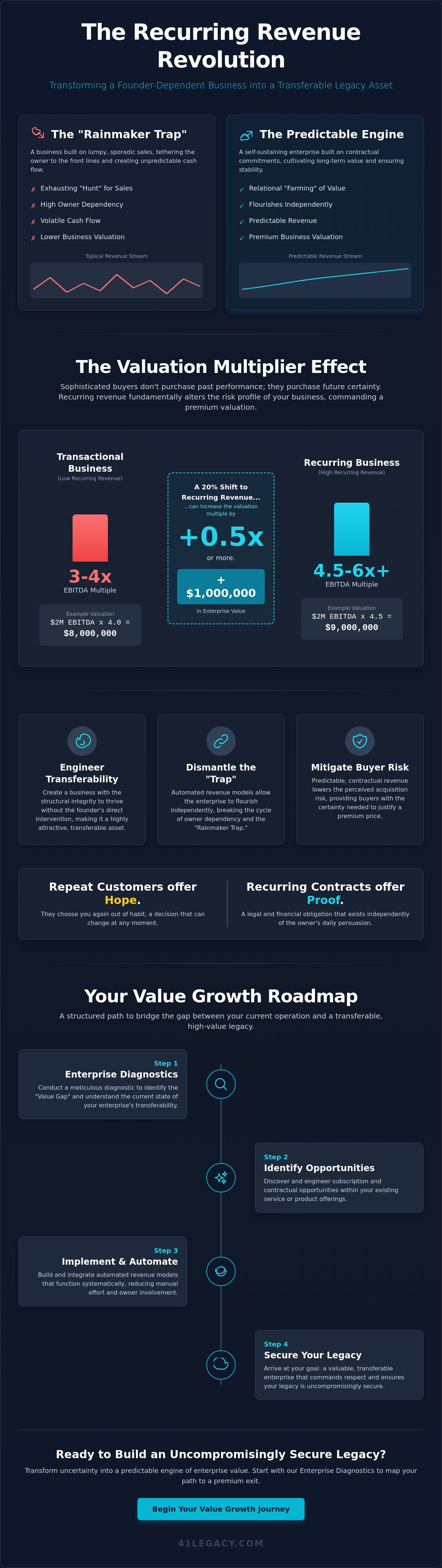
The true measure of an enterprise's soul isn't found in the frantic energy of a single transaction, but in the steady, rhythmic pulse of enduring value. For many owners, the stress of unpredictable cash flow and the exhaustion of the "Rainmaker Trap" suggest a business that is too dependent on its founder to ever truly be free. Transitioning from lumpy, sporadic sales to a model focused on creating recurring revenue streams is more than a financial adjustment; it's a fundamental act of stewardship. Research indicates that a 20-percentage-point shift in the proportion of recurring revenue can move a business's valuation multiple by half a turn or more, turning a volatile operation into a sophisticated asset.
You likely recognize that your current growth feels precarious, especially when interest rates for SBA 7(a) fixed loans remain as high as 14.75 percent in 2026. We'll show you how to transform that uncertainty into a predictable engine of enterprise value that commands respect from the most discerning buyers. This article explores the strategic framework for reducing owner dependency and engineering transferability through meticulous enterprise diagnostics. By the end, you'll understand how a structured value growth roadmap can simplify your eventual exit and ensure your legacy remains uncompromisingly secure.
Key Takeaways
- Understand why shifting from transactional sales to contractual commitments creates a predictable engine of long-term value.
- See how creating recurring revenue streams directly increases your valuation multiple by attracting sophisticated buyers through predictability.
- Discover practical methods to engineer transferability by identifying subscription opportunities within your existing service offerings.
- Learn how automated revenue models dismantle the "Rainmaker Trap" and allow your enterprise to flourish independently of your daily involvement.
- Explore how a structured Value Growth Roadmap can bridge the gap between your current operation and a transferable legacy.
The Strategic Imperative: Why Recurring Revenue Defines Enterprise Value
The true vitality of an enterprise isn't measured by the intensity of its last sale, but by the quiet certainty of its next. Many founders spend decades "hunting," chasing the next contract with an urgency that leaves the business exhausted and the owner tethered to the front lines. Shifting this paradigm toward creating recurring revenue streams transforms the business from a series of exhausting events into a self-sustaining engine. This transition marks the move from transactional hunting to relational farming, where value is cultivated through enduring commitments rather than captured in fleeting moments.
A contractual commitment to future value serves as the bedrock of a sophisticated firm. Unlike a "repeat" customer who chooses you again out of habit, a recurring contract represents a legal and financial obligation that exists independently of the owner's daily persuasion. This distinction is vital for those seeking to bridge the "Value Gap" often identified during our initial Enterprise Diagnostics. When revenue is predictable, the business ceases to be a job and begins to function as a true legacy, capable of sustaining its own momentum.
The Concept of the 'Transferable Asset'
A transferable asset is a business that possesses the structural integrity to thrive and generate profit without the direct intervention of its founder. For a successor, the subscription business model acts as a financial guarantee, providing a clear window into the firm’s future performance. While repeat customers offer hope, recurring contracts offer proof. This distinction is the primary driver of enterprise health, ensuring that the soul of the company remains intact even as the leadership evolves.
Predictability as a Risk Mitigation Strategy
Sophisticated buyers don't purchase past success; they purchase future certainty. Risk demands a discount. In a volatile economic environment, consistent income streams protect the enterprise from market fluctuations and the rising cost of capital. When cash flow is erratic, risk is high, and the valuation multiple suffers accordingly. By creating recurring revenue streams, you effectively lower the perceived risk of the acquisition, allowing buyers to justify a premium price. This predictability provides the peace of mind necessary for a graceful transition, ensuring the enterprise remains attractive to those who value stability as much as performance.
The Valuation Multiplier: How Recurring Streams Impact Your Exit Price
Valuation is the bridge between a founder's past sacrifice and their future freedom. While many owners focus on the total revenue figure at the bottom of the ledger, sophisticated buyers look at the architecture of that income. They use a multiple of EBITDA to determine the purchase price, a calculation that essentially measures the probability of the business continuing to thrive under new stewardship. When you focus on creating recurring revenue streams, you aren't just increasing cash flow; you're fundamentally altering the risk profile of the entire enterprise. Valuation is a reflection of future risk, not just past performance.
The impact on your exit price is quantifiable and profound. Data from May 2026 indicates that a 20-percentage-point shift in the proportion of recurring revenue can move a business's valuation multiple by half a turn or more. For a company generating $2 million in EBITDA, moving from a 4x multiple to a 4.5x multiple adds $1 million in enterprise value without requiring a single dollar of additional profit. This is the precision of value growth in action. It transforms the business into a bespoke asset that commands a premium because it offers what every institutional buyer craves: certainty.
The EBITDA Multiple Framework
Buyers view uncontracted revenue as a high-risk gamble. A firm built on transactional sales might command a 3x multiple, as the buyer must effectively "re-buy" the customer base every morning. In contrast, businesses with contractual recurring models often see multiples of 6x or higher. This discrepancy exists because a contract is a promise of future performance that remains intact after the founder departs. To understand where your firm sits on this spectrum, a thorough Enterprise Diagnostic can reveal the specific levers needed to elevate your multiple.
Market Attractiveness and Competitive Advantage
A business defined by "sticky" revenue becomes the prestige choice for M&A activity. Institutional investors and private equity groups prioritize firms where the cost of customer acquisition is offset by a long-term lifetime value. This stickiness serves as an uncompromising defense against market volatility, ensuring the business survives the transition of ownership. By creating recurring revenue streams, you move your company out of the crowded marketplace of individual buyers and into the exclusive sightlines of sophisticated investors who value heritage and structural integrity. This strategic shift ensures that the soul of the enterprise is preserved, allowing your legacy to endure long after the final documents are signed.
Engineering Transferability: Identifying Recurring Opportunities in Your Industry
The architecture of a legacy business requires more than just high-quality work; it requires a structural design that ensures continuity. Many owners in traditional sectors believe that recurring revenue is reserved for software firms, yet the most resilient enterprises in manufacturing and professional services utilize specific engineering techniques to build predictable value. One such method is the "Salami Technique," where a complex, bespoke service is meticulously sliced into smaller, subscription-based components. By isolating a specific outcome, such as compliance monitoring or preventative maintenance, and offering it as a standalone contract, you begin creating recurring revenue streams that don't require your constant oversight.
This approach extends to the "Razor/Blade" model, adapted for modern distribution. Here, the primary equipment or service is the "razor," while the essential, recurring consumables or support services are the "blades." This creates a natural dependency that benefits both the client through consistency and the owner through stability. Whether it's through Service Level Agreements (SLAs) or ancillary memberships that provide exclusive access to data, these models shift the business's focus from a single point of sale to a lifetime of service.
Models for Professional and Technical Services
Transitioning from project-based fees to Monthly Implementation Support is a hallmark of Transferability Engineering. Instead of a one-time advisory engagement, you provide ongoing stewardship that ensures the client's long-term success. This model shifts the focus from the event of a project to the evolution of the client’s business. Maintenance and monitoring contracts serve as a value-add, providing the client with peace of mind while reinforcing the firm's role as a dedicated guardian of their interests. In some cases, white-labeling your expertise into a proprietary tool can further decouple revenue from your personal hours.
Models for Product-Based and Industrial Businesses
Industrial firms can achieve significant growth by implementing consumable replenishment programs. These automated systems remove the friction of reordering, ensuring that the client never faces downtime. According to the research brief from May 2026, subscription-based businesses have grown 3.4 times faster than S&P 500 companies over the last 12 years, a testament to the power of this model. Additionally, leasing equipment with "guaranteed uptime" SLAs transforms a physical product into a reliable service. This creates a deeper, more sophisticated relationship with the market and generates data-as-a-service opportunities that sophisticated buyers find irresistible when evaluating an enterprise’s health.
Beyond Cash Flow: Reducing Owner Dependency Through Automated Revenue
The "Rainmaker Trap" is a heavy burden for many founders. When the owner is the primary salesperson, the business's value is capped because the enterprise cannot exist without their personal charisma and constant intervention. A business that relies on a single individual for its survival is not an asset; it's a job with high overhead. By creating recurring revenue streams, you shift the firm's focus from the exhausting pursuit of the next sale to the meticulous stewardship of existing relationships. This transition is essential for any owner who wishes to build a transferable asset that thrives independently of their daily presence.
In a recurring model, the firm prioritizes "serving" over "selling." This requires a level of consistency and quality that transactional businesses often lack. When revenue is automated, the pressure to constantly close new deals diminishes. This breathing room allows leadership to focus on refining the internal mechanics of the enterprise. The result is a business that's not only more profitable but also significantly more attractive to successors who want a machine that runs, not a role that requires their constant oversight. This shift offers the owner a profound psychological freedom, knowing the legacy they've built is structurally sound.
Systematization and SOPs
Predictable revenue necessitates predictable delivery. You can't scale a subscription model if every client requires a bespoke, founder-led solution. Standard Operating Procedures (SOPs) become the engineering blueprints of the firm, ensuring that quality remains uncompromising without your constant intervention. Essentially, automation in revenue leads to automation in operations. This structural clarity reduces the risk of human error and ensures that the enterprise maintains its soul through every transition. To begin the process of detaching your personal identity from the firm’s performance, consider a structured approach to Owner Dependency Reduction.
Empowering the Advisory Team
Predictable income provides the clarity your advisory team needs to function at their highest level. When your CPA and Attorney have access to consistent data, they can move beyond reactive problem-solving and focus on long-term strategy. This data allows for more informed capital allocation decisions, especially when the current prime rate of 6.75 percent as of May 2026 makes borrowing costs a critical consideration for any growth initiative. A "Quarterback" advisor can then integrate these insights into a cohesive plan, ensuring every financial and legal move strengthens the firm's transferability. This collaborative approach reinforces the business as a sophisticated entity capable of thriving in any economic climate.
Building Your Legacy: Integrating Recurring Revenue into Your Roadmap
A legacy is not merely what remains after you depart; it is the structural integrity you build while you are still present. Transitioning from a business owner to a steward of a transferable asset requires a profound shift in perspective, moving from the daily grind of survival to the meticulous refinement of an enduring machine. By creating recurring revenue streams, you establish a foundation that allows the enterprise to flourish independently of your direct involvement. This evolution ensures that the soul of your company is preserved, much like a masterfully restored vehicle that continues to perform long after the artisan has finished their work.
The art of creating recurring revenue streams is the ultimate act of stewardship. Our process begins with comprehensive Enterprise Diagnostics. This stage is designed to identify the Value Gap, which is the discrepancy between your current valuation and the potential value achievable through structural improvements. We look deep into your existing P&L to uncover hidden recurring opportunities that may have been overlooked in the pursuit of transactional growth. Coordinating with your existing advisors, including CPAs and attorneys, is vital. We don't replace these professionals; we empower them with a clear vision of value growth, ensuring every strategic decision moves you closer to exit readiness.
The 41 Legacy Process: Diagnostics to Implementation
Once the diagnostic phase is complete, we craft a bespoke Value Growth Roadmap. This document serves as your strategic guide, prioritizing the engineering of transferability over simple revenue increases. Executing this pivot requires uncompromising discipline, which is why Monthly Implementation Support is a core component of our advisory. We provide the steady, unhurried guidance necessary to integrate these changes into your daily operations without compromising the quality of your service. Research into the subscription economy projects a compound annual growth rate of 18.2 percent through 2030, suggesting that those who adapt now are positioning themselves for a significant future advantage.
Your Next Step Toward Strategic Clarity
The journey toward strategic clarity and exit readiness is a multi-year endeavor. Ideally, this process should begin three to five years before your planned transition. This timeframe allows for the full realization of the value growth strategy, ensuring the business is a curatorial masterpiece when it finally reaches the market. Your role is to build a business that is attractive to sophisticated buyers, one that stands as a testament to your craftsmanship and vision. To understand where your enterprise stands today, we invite you to Discover your current exit readiness with a 41 Legacy Assessment.
Securing Your Enterprise's Enduring Legacy
Building a firm that thrives beyond your tenure requires the meticulous discipline of creating recurring revenue streams. We've explored how this strategic shift fundamentally alters your risk profile, turning unpredictable sales into a sophisticated valuation multiplier. By standardizing operations and decoupling your personal identity from daily revenue, you ensure the soul of your business remains intact during any transition. This isn't merely about cash flow; it's about the structural integrity of your life's work.
Led by a Certified Exit Planning Advisor (CEPA), our team employs a structured "Quarterback" approach to coordinate with your existing advisors. This collaborative focus on enterprise value ensures that your firm is prepared for its next chapter without the need for transactional brokerage. To begin the process of engineering your firm's transferability, Secure your business's future with an Exit Readiness Assessment from 41 Legacy. The path to a successful exit is a deliberate journey of craftsmanship. With the right roadmap, your business can become a self-sustaining masterpiece that preserves your legacy for generations.
Frequently Asked Questions
Can any business create a recurring revenue stream, even in traditional industries?
Yes, almost any enterprise can transition by identifying essential, repeatable components of their work. Traditional industries often find success by creating recurring revenue streams through preventative maintenance or compliance monitoring. This shifts the focus from a single project to the lifelong stewardship of the client's assets, ensuring that the firm's value is built on a foundation of enduring service rather than sporadic, founder-led transactions.
How does recurring revenue specifically increase my business's valuation multiple?
Recurring revenue increases valuation by lowering the risk profile of future cash flows. Sophisticated buyers pay a premium for certainty; uncontracted revenue is often viewed as a high-risk gamble. As noted earlier, research from May 2026 shows that a 20-percentage-point shift toward recurring income can move a valuation multiple by half a turn or more. This structural change turns a volatile operation into a sophisticated, transferable asset.
What is the difference between repeat customers and a recurring revenue model?
The distinction lies in the nature of the legal and financial commitment. A repeat customer chooses to return based on habit or past satisfaction, which offers hope but no guarantee for a future owner. A recurring model is built on a contractual obligation. This ensures future value remains within the firm regardless of the founder's daily presence, providing a window into performance that repeat business simply cannot offer.
Will moving to a recurring model alienate my current transactional customers?
Transitioning to a subscription model shouldn't alienate your core base if handled with meticulous care. Many firms successfully maintain a hybrid approach, offering transactional services for one-off needs while reserving premium, high-touch support for recurring members. This creates an atmosphere of exclusivity and rewards your most loyal clients with prioritized attention. It positions the recurring option as the "prestige" choice for those who value long-term results over quick fixes.
How much of my revenue needs to be recurring to impact my exit readiness?
Any amount of predictable revenue improves your position, but significant impact usually begins around the 20 percent mark. At this level, the business starts to decouple from founder-led sales. This shift proves to a successor that the enterprise possesses the structural integrity to thrive independently of the original artisan. It marks the transition from a firm that is "hunted" to one that is systematically "farmed" for consistent value.
Do I need new software or technology to implement a recurring revenue stream?
Technology is a tool, not a prerequisite for success. While billing automation through platforms like Stripe can reduce administrative friction, the essence of creating recurring revenue streams is the strategic agreement with the client. You should focus first on the value proposition and the contractual framework before investing in complex digital infrastructure. Strategic clarity regarding the service delivery is far more important than the software used to process the payments.
How does reducing owner dependency through recurring revenue help my employees?
Reducing owner dependency provides your team with a more stable and predictable work environment. When revenue is automated, the firm relies on Standard Operating Procedures rather than founder-driven whims or the stress of sales slumps. This clarity empowers employees to master their craft and ensures the business's soul is preserved through operational excellence. It creates a culture of stewardship where every team member understands their role in maintaining the legacy.
What happens to my enterprise value if I don't have recurring revenue when I'm ready to sell?
Without predictable income, your business faces a significant "risk discount" during a transition. Buyers often demand lower multiples or complex earn-out structures to offset the uncertainty of future sales. Lacking recurring revenue means you're effectively selling a job that requires a new "Rainmaker." This significantly devalues the transferable asset you've spent years building, as the buyer must assume the risk of re-acquiring every customer after you depart.
Disclaimer
This article is for educational and informational purposes only and does not provide legal, tax, investment, or business brokerage advice. 41 Legacy does not offer M&A brokerage services, legal document drafting, tax preparation, or investment advisory services. Business owners should consult licensed professionals in those disciplines before making decisions related to business transactions, legal matters, tax strategy, or financial planning. All examples are illustrative and may not apply to your specific situation.