
Transferability & Owner Dependency
Coordinating Your CPA and Attorney for a Business Sale: The Strategic Quarterback Approach
What if the greatest threat to your legacy isn't market volatility, but the silence between your most trusted advisors? Many owners believe that hiring a premier CPA and a seasoned attorney is sufficient to protect their life's work. However, when these experts operate in silos, the resulting friction often creates a value gap that no amount of legal drafting can repair. Effectively coordinating your CPA and attorney for a business sale is the vital orchestration required to transform a complex transaction into a seamless transition of stewardship.
At 41 Legacy, we believe that a business sale should be a symphony of precision, not a collection of discordant notes. You've spent years refining your craft, and you deserve a transition that reflects that same level of excellence. This guide explores how a strategic quarterback approach harmonizes your advisors to leverage the permanent tax benefits of the One Big Beautiful Bill Act. By bridging the distance between financial strategy and legal protection, we help you realize the full enterprise value of your asset while preserving the essence of your professional heritage.
Key Takeaways
- Recognize how advisor silos create deal fatigue and why a unified strategic roadmap is essential to prevent the collapse of a potential transition.
- Understand the strategic necessity of coordinating your CPA and attorney for a business sale through a neutral lead who aligns financial accuracy with legal protection.
- Identify the divergent priorities of your professional team, bridging the gap between tax efficiency and the mitigation of long-term contractual liability.
- Learn how the diagnostic phase establishes a shared foundation of facts, allowing your team to evaluate deal structures with absolute clarity.
- Discover how monthly implementation support ensures your value growth roadmap is executed, transforming the business into a transferable asset that thrives independently of the founder.
The Silent Cost of Advisor Silos in a Business Sale
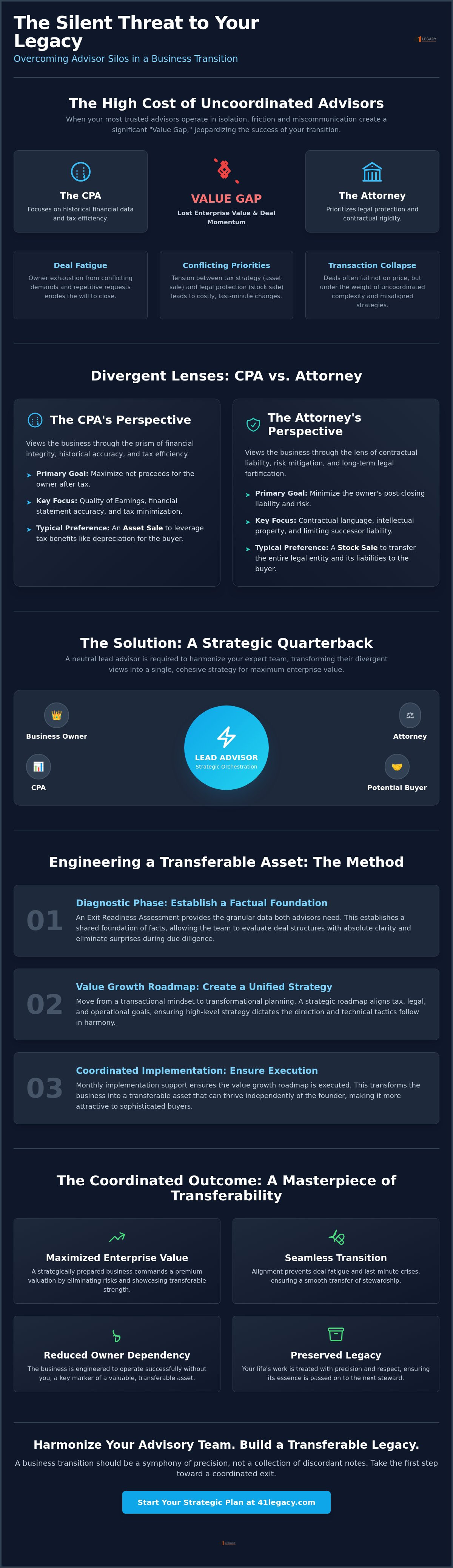
The silent cost of advisor silos is not merely a line item on a financial ledger; it is the gradual erosion of a life's work. Advisor silos occur when professionals operate within the narrow confines of their specific discipline, neglecting the broader strategic horizon. A Certified Public Accountant might focus intensely on the precision of historical financial statements, while an attorney prioritizes the rigidity of contractual language. Without a unified roadmap, these efforts remain disconnected, creating a "Value Gap" where the financial potential of the business is stifled by uncoordinated legal or tax structures.
This lack of alignment often leads to "Deal Fatigue." This is a state of psychological and operational exhaustion where the owner, overwhelmed by conflicting demands and repetitive data requests, loses the momentum necessary to close. Transactions don't just fail because of price. They often collapse under the weight of uncoordinated complexity. This failure frequently begins as early as the NDA stage. When advisors haven't aligned on the desired outcome, even simple confidentiality agreements can become battlegrounds for control rather than tools for progress.
The Friction Between Tax Strategy and Legal Protection
The tension between tax strategy and legal protection is a hallmark of the siloed approach. Your CPA may advocate for an asset sale to maximize tax benefits, while your attorney may insist on a stock sale to limit successor liability. Without coordinating your CPA and attorney for a business sale early in the process, these "entrenched positions" often surface during the heat of final negotiations. This leads to expensive, last-minute structural changes that can significantly dilute the net proceeds realized at closing.
Moving from Transactional to Transformational Planning
True stewardship involves preparing for an exit two to three years before the intended date. Moving from a transactional mindset to transformational planning requires a shift in how the advisory team functions. Early Exit Readiness Assessments provide the granular data both advisors need to function at their highest capacity. This approach establishes a "Professional Room Altitude" where high-level strategy dictates the direction, and technical tactics follow in harmonious alignment. Coordinating your CPA and attorney for a business sale in this manner ensures that the business is treated as a masterpiece of transferability engineering rather than a mere commodity to be traded.
The Divergent Lenses: What Your CPA and Attorney See Differently
A business is a complex organism. When viewed through the specialized lenses of your professional team, it often appears as two distinct entities. Your CPA views the enterprise through the prism of historical accuracy and tax efficiency. They focus on the net proceeds that will remain after the final signature is dry. Conversely, your attorney views the business through the lens of contractual liability and the fortification of intellectual property. Both perspectives are vital, yet they often overlook the "essence" of the heritage you've built. Coordinating your CPA and attorney for a business sale ensures these divergent views converge into a singular, cohesive strategy.
Standard documents and boilerplate agreements often fail to capture the unique craftsmanship of a legacy business. They treat your life's work as a generic commodity. This creates a dangerous blind spot regarding enterprise value growth and market attractiveness. While your advisors protect the perimeter, they may not be engineering the asset for maximum transferability. A masterfully built business requires more than just standard legal protection; it requires a narrative of excellence that resonates with sophisticated buyers. This is where strategic alignment becomes the differentiator between a simple transaction and a true legacy.
The CPA’s Role in Financial Integrity
Financial integrity extends far beyond annual tax preparation. In a sophisticated sale, your CPA must transition from compliance to quality of earnings reporting. This process ensures your financial statements reflect a "transferable asset" rather than a vehicle for tax minimization. When coordinating your CPA and attorney for a business sale, it's essential they align on the structural implications of an asset versus a stock sale. This collaboration ensures the permanent tax benefits of the One Big Beautiful Bill Act are fully realized without compromising the legal integrity of the deal.
The Attorney’s Role in Transferability Engineering
Your attorney acts as the guardian of the company's "Secret Sauce." Their role in transferability engineering involves scrubbing contracts and supplier agreements of owner dependency. If the business cannot breathe without your daily presence, its value is diminished. By preparing a legal due diligence vault and securing robust intellectual property filings, they prevent surprises that could derail a closing. Engaging in Transferability Engineering early ensures that the legal structure supports the financial promise of the enterprise. This meticulous preparation transforms the business into a turnkey masterpiece, ready for its next steward.
The Strategic Quarterback: Why Coordination Requires a Lead Advisor
In the intricate choreography of a business transition, the owner often finds themselves trapped in an exhausting role: the translator. When professionals speak in the disparate dialects of tax code and case law, the owner bears the heavy "Advisory Burden" of reconciling conflicting directives. Coordinating your CPA and attorney for a business sale shouldn't be the responsibility of the principal. It requires a strategic lead. This "Quarterback" serves as a neutral axis, ensuring that every technical maneuver serves the overarching vision of the enterprise. This role is about orchestration, moving the process from a series of disconnected events to a unified movement of stewardship.
A Certified Exit Planning Advisor (CEPA) often fulfills this function, acting as the curator of the transition process. By facilitating direct, structured communication between the financial and legal teams, the lead advisor ensures that the Value Growth Roadmap remains the primary document of record. This approach shifts the focus from defensive posturing to the proactive engineering of a transferable asset. It allows the owner to remain in a "Professional Room Altitude," focusing on the health of the business while the specialists align their technical skills with the owner's ultimate objectives.
Aligning the Team Toward Enterprise Value
The strategic agenda must be established before the technical specialists begin their granular work. The Quarterback ensures the owner's financial goal remains the "North Star" for every legal and tax decision. This manages the rhythmic variation between high-level vision and technical excellence. It ensures that the inner essence of the business is not lost in the mechanics of the transaction. When the team is aligned, the focus remains on building a transferable asset that can thrive independently of the founder, rather than simply checking boxes on a closing list.
Reducing Friction and Advisory Costs
Friction is the silent enemy of enterprise value. When advisors work in isolation, redundant efforts lead to billable hour bloat and strategic confusion. A lead advisor filters complex jargon, translating technical terms into strategic clarity so the owner doesn't get lost in the details. This coordinated effort maintains a steady, unhurried pace that respects the craftsmanship of the business. By preventing "deal fatigue" and redundant work, the Quarterback protects both the owner's capital and their peace of mind throughout the transition process.
Critical Coordination Points in the Exit Process
The journey from a successful enterprise to a realized legacy is punctuated by moments of intense technical demand. These coordination points are where the strategic vision is either solidified or compromised. By coordinating your CPA and attorney for a business sale at these specific junctures, you transform a chaotic transaction into a deliberate act of stewardship. This alignment ensures that every financial disclosure and legal covenant serves the long-term health of the asset you've meticulously crafted. Precision is paramount; even a minor misalignment in the due diligence vault can lead to significant erosion of value during the final hours of a deal.
The transition process moves through distinct phases that require a synchronized effort. In the due diligence phase, the financial data room must be perfectly mirrored by legal disclosures. Any discrepancy between what the CPA reports and what the attorney discloses can trigger red flags for a sophisticated buyer. As you approach the closing phase, the team must ensure post-sale obligations, such as consulting agreements or lease-backs, are both tax-efficient under the permanent provisions of the One Big Beautiful Bill Act and legally sound. This level of coordination prevents the Value Gap from widening at the very moment you intend to bridge it.
Phase 1: Enterprise Diagnostics and Goal Alignment
The diagnostic phase establishes the factual foundation for the entire transition. Sharing the results of your Enterprise Diagnostics with the full advisory team allows the CPA to model net proceeds based on actual market readiness rather than optimistic projections. Simultaneously, the attorney reviews the owner dependency report to prioritize contract remediation. Establishing a rhythm of monthly implementation support ensures these advisors move in lockstep, addressing transferability issues long before they become deal-killing obstacles. This proactive stance protects the essence of the business while engineering it for a seamless transfer.
Phase 2: Negotiation and Deal Structuring
During negotiations, the divergent lenses of your advisors must be focused on a single outcome: maximum realized value. Coordinating your CPA and attorney for a business sale is critical when evaluating complex maneuvers like an F-reorganization. This is a specialized corporate restructuring for S-corporations that allows an owner to sell the company's stock for legal simplicity while providing the buyer with the tax benefits typically found in an asset purchase. It's a hybrid approach that requires surgical precision from both teams to execute correctly.
The CPA validates the buyer's earn-out calculations to ensure they're achievable and tax-advantaged, while the attorney drafts the representations and warranties that protect those future earnings. The strategic quarterback oversees this exchange, ensuring that neither the tax strategy nor the legal risk mitigation compromises the overall enterprise value. This balanced approach allows you to exit with confidence, knowing the integrity of your legacy is preserved.
Engineering a Transferable Asset: The 41 Legacy Method
At 41 Legacy, we view a business as a masterpiece of human effort and precision. It's an entity that deserves to endure far beyond the tenure of its creator. Engineering a transferable asset requires moving past the chaotic, founder-led models of the past toward a system-driven architecture that functions with surgical precision. This transformation is achieved through the meticulous process of coordinating your CPA and attorney for a business sale, ensuring that every financial and legal structure supports the business's ability to thrive independently. When the technical details are polished to a high sheen, the business ceases to be a daily obligation and becomes a lasting legacy.
The final result of this method is a business built as a transferable asset; one that commands respect in the market and provides the owner with ultimate optionality. We don't view a sale as a mere transaction, but as the culmination of an artistic calling. By aligning the technical engineering of your CPA with the protective craftsmanship of your attorney, we ensure the inner essence of the company remains intact. This creates an atmosphere of exclusivity and value that appeals directly to the most sophisticated buyers in the marketplace.
The Value Growth Roadmap in Action
A Monthly Strategic Advisory engagement ensures the roadmap isn't merely a document on a shelf but a living guide to execution. We utilize strategic capacity evaluations to identify the specific growth levers that increase enterprise value without increasing owner dependency. This coordinated advice protects the company during a transition, ensuring that the very qualities that made it successful are preserved. It's about preparing the owner for a legacy that persists long after the final signatures are dry, maintaining a steady and unhurried pace that respects the work's historical significance.
Your Next Steps Toward Exit Readiness
The first step toward this vision is the Enterprise Diagnostic. It provides the clarity needed to align your professional team and identify the "Value Gap" before it impacts your net proceeds. When you introduce the quarterback concept, you aren't replacing your trusted advisors; you're directing them toward a singular, uncompromising vision of perfection. Successfully coordinating your CPA and attorney for a business sale starts with a commitment to excellence. It's an invitation to treat your exit not as an end, but as the ultimate expression of the asset's health and transferability. By bridging the gap between current operations and future potential, we help you build something that truly lasts.
Orchestrating a Masterful Transition
A business sale represents the ultimate evaluation of a steward’s work. By moving beyond advisor silos and coordinating your CPA and attorney for a business sale, you ensure that the financial and legal foundations of your enterprise are perfectly aligned. This strategic harmony bridges the value gap, transforming your company from a founder-dependent operation into a transferable asset of exceptional quality. Our process, led by a Certified Exit Planning Advisor (CEPA), specializes in transferability engineering and owner dependency reduction to protect the essence of what you've built.
Strategic clarity is the differentiator between a mere transaction and a lasting legacy. Every decision made today should serve the long-term health and transferability of your enterprise. We invite you to begin your journey toward exit readiness with a comprehensive Enterprise Diagnostic. By identifying growth levers and aligning your professional team, you can approach your transition with the confidence of a true connoisseur. Your life's work deserves a transition as meticulous and refined as the business itself. The path to a successful legacy is built on precision, and that work begins now.
Frequently Asked Questions
Why won't my CPA and attorney talk to each other automatically?
Most professionals operate within the narrow confines of their technical niche and lack a unified strategic roadmap to follow. Without a lead advisor to facilitate communication, they work in silos, often unaware of how their individual decisions might conflict with the other's objectives. They are trained to protect their specific domain, not necessarily to orchestrate a cross-disciplinary masterpiece.
What is the "Value Gap" and how does coordination help close it?
The Value Gap is the disparity between what an owner requires from a sale to meet their personal goals and what the market actually offers for the business. Coordination closes this gap by aligning tax efficiency with legal risk mitigation. This ensures that the final net proceeds reflect the full enterprise value of the asset you have built over a lifetime of dedicated craftsmanship.
Should I hire a business broker or a strategic advisor first?
A strategic advisor should be engaged first to engineer the business into a transferable asset before it is ever presented to a potential buyer. This preparation reduces owner dependency and clarifies the roadmap for transition. Engaging an advisor early ensures that the business is at its peak attractiveness and value, allowing you to act as a steward of a truly independent entity.
How does an Asset Sale vs. Stock Sale affect my net proceeds?
An asset sale often provides tax advantages for the buyer but can lead to higher taxes for the seller, while a stock sale generally offers lower capital gains rates. Coordinating your CPA and attorney for a business sale allows you to evaluate structures like an F-Reorganization. This coordination leverages the permanent tax benefits of the One Big Beautiful Bill Act to maximize your net proceeds without compromising legal integrity.
What is the role of a Certified Exit Planning Advisor (CEPA) in this process?
A CEPA acts as the strategic quarterback, orchestrating the efforts of technical specialists toward the owner's ultimate vision of perfection. They translate complex technical jargon into strategic clarity and ensure that every maneuver by the CPA and attorney increases the transferability of the legacy. This role is about maintaining a professional-room altitude where strategy always dictates the technical tactics.
How early should I start coordinating my advisory team before a sale?
Coordination should ideally begin two to three years before your intended transition to allow sufficient time for transferability engineering. This lead time is essential for conducting diagnostics and implementing value growth roadmaps that address owner dependency. Early preparation ensures that financial integrity and legal protections are polished to a high sheen long before any negotiations begin.
Can coordination actually reduce my total advisory fees?
Yes, proactive coordination prevents redundant work and the billable hour bloat caused by conflicting advice or last-minute structural changes. By establishing a clear strategic agenda early, the quarterback ensures that specialists focus their efforts with extreme precision. This efficiency respects the owner's capital and ensures that every professional engagement adds measurable value to the enterprise.
What happens if my advisors disagree on the deal structure?
When disagreements arise, the strategic lead reconciles these technical perspectives against the owner's primary financial and personal goals. Coordinating your CPA and attorney for a business sale through a neutral lead prevents entrenched positions from stalling a deal. This approach ensures that the inner essence of the business is protected while the technical specialists find a harmonious path forward.
Disclaimer
This article is for educational and informational purposes only and does not provide legal, tax, investment, or business brokerage advice. 41 Legacy does not offer M&A brokerage services, legal document drafting, tax preparation, or investment advisory services. Business owners should consult licensed professionals in those disciplines before making decisions related to business transactions, legal matters, tax strategy, or financial planning. All examples are illustrative and may not apply to your specific situation.