
Convincing Your Partner to Sell: Strategic Alignment Guide
The ultimate act of leadership isn't merely the creation of a company; it's the meticulous refinement of an asset that can endure beyond its founders. For many owners, the challenge of convincing your business partner it's time to sell feels less like a strategic move and more like an emotional crossroads. You likely fear that raising the subject will spark friction or imply that the work you've built together is nearing its end. It's natural to feel protective of a legacy that represents a lifetime of dedication and precision engineering.
We'll show you how to shift this dialogue from a point of contention to a shared pursuit of enterprise value and legacy preservation. By focusing on objective diagnostics and the reduction of owner dependency, you can move toward a harmonious agreement that honors your past while securing your future. This guide provides a roadmap to understanding your company's true transferability. It ensures that when the time comes to step away, you leave behind a masterpiece that is prepared to thrive under new stewardship.
Key Takeaways
- Reframe the exit as the final act of stewardship, transitioning the company into a self-sustaining asset that thrives independently.
- Use Enterprise Diagnostics to provide an objective, third-party perspective that neutralizes emotional friction between partners.
- Understand how transferability engineering increases enterprise value while improving your current quality of life and operational freedom.
- Learn a structured roadmap for convincing your business partner it's time to sell, beginning with a legacy visioning session away from the office.
- Discover how a strategic advisor acts as a quarterback for your CPA and attorney to maximize the harvest of your life's work.
The Philosophy of Stewardship: Why Exit Planning is a Shared Responsibility
Building a company is an act of profound creation. Maintaining it is an act of discipline. However, the ultimate expression of stewardship is preparing that creation to live without its creators. We view the business not as a mere source of income, but as a transferable asset that must eventually stand on its own. When you begin the delicate process of convincing your business partner it's time to sell, you aren't suggesting an end. You're initiating the final act of craftsmanship: the transition of the work to its next guardian.
This shift in narrative is vital. It moves the conversation from the idea of "quitting" to the sophisticated reality of harvesting a legacy built over decades. A master craftsman understands that every masterpiece reaches a point of completion where further interference only serves to devalue the work. In the world of enterprise, waiting for a trigger event such as sudden illness or burnout is the greatest risk to your life's work. True value is preserved through intentionality, not reaction.
The Risk of the 'Status Quo' Bias
Complacency is a silent thief of enterprise value. While you and your partner may find comfort in the familiar rhythms of the office, the market remains indifferent to your history. Competitors innovate while owner-dependency quietly erodes the transferability of your firm. If the business requires your constant intervention to function, you haven't built an asset; you've built a high-stakes job. Stewardship is the duty to ensure the company survives its founders. An effective exit strategy must be engineered during a season of strength to ensure the essence of the brand remains intact.
Aligning on the 'Why' Before the 'When'
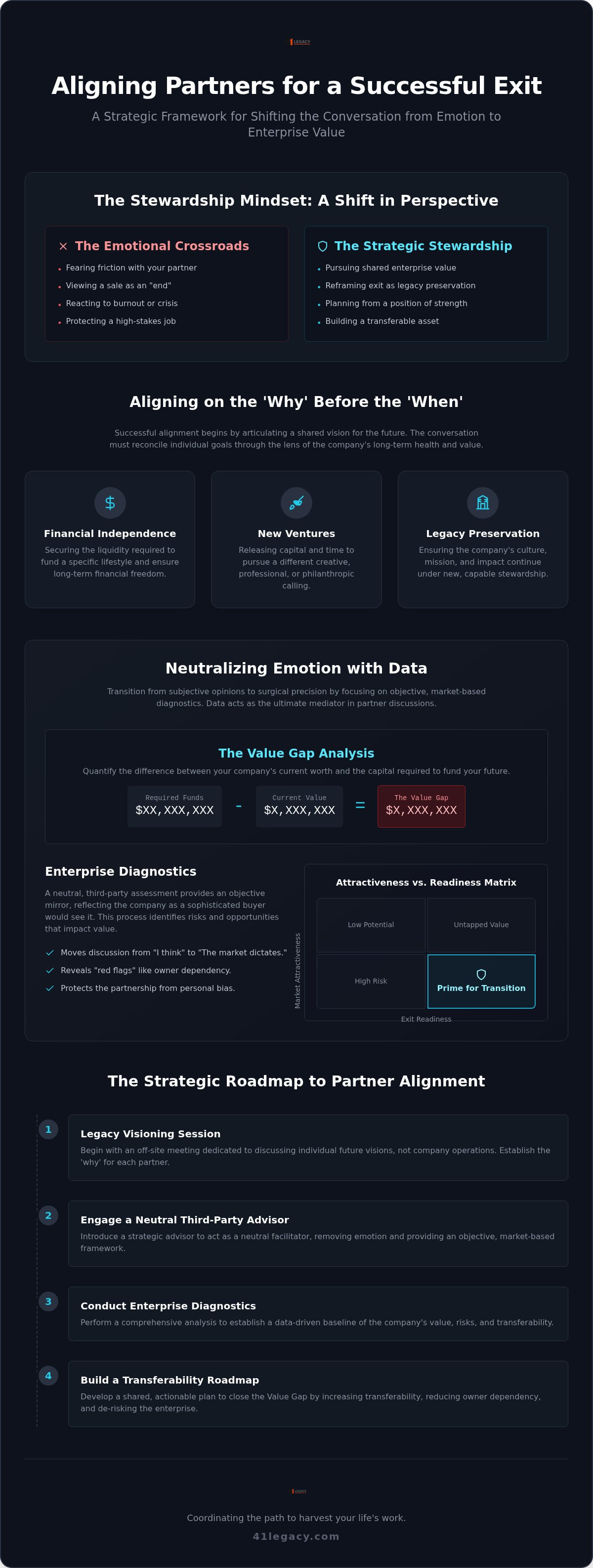
Alignment begins with purpose rather than dates. Before discussing the mechanics of a transition, partners must articulate their individual visions for the future. These often include:
- Financial Independence: Securing the liquidity required to sustain a specific lifestyle.
- New Ventures: Releasing capital to pursue a different creative or professional calling.
- Legacy Preservation: Ensuring the brand's culture and impact continue for decades.
These goals must be reconciled through the lens of the company's health. By utilizing the exit planning for business owners framework, you can begin a dialogue focused on precision. This structured approach ensures that convincing your business partner it's time to sell becomes a shared pursuit of excellence rather than a point of friction.
Identifying the Value Gap: Using Data to Neutralize Emotion
The process of convincing your business partner it's time to sell often stalls at the intersection of sentiment and speculation. One partner may see a lifetime of effort that is "priceless," while the other sees a window of market opportunity. To resolve this, we must transition from subjective opinions to surgical precision. This is where the Value Gap becomes the central pillar of your strategy. It represents the difference between the company's current worth and the amount required to fund the partners' future legacies.
Understanding this gap requires an objective baseline. By determining enterprise value through a structured lens, you transform a potentially divisive debate into a technical evaluation of an asset. This data-driven approach removes the weight of personal expectation and replaces it with the cold reality of market dynamics.
The Power of Objective Enterprise Diagnostics
Diagnostics serve as a neutral mirror, reflecting the company as a sophisticated buyer would see it. It moves the partnership away from "I think the business is worth X" toward "The market dictates the value is Y." This process utilizes a 'Market Attractiveness' vs. 'Exit Readiness' matrix to identify exactly where the enterprise stands in the eyes of an acquirer.
When you encounter resistance when a business partner won't sell, data acts as the ultimate mediator. A diagnostic reveals "red flags," such as high owner-dependency or concentrated customer bases, that a buyer would use to devalue your work. These insights protect the partnership from personal bias, ensuring that both parties view the enterprise with the clarity of a curator rather than the attachment of a founder.
The 'Wealth Gap' Analysis
A successful transition is only possible if the net proceeds align with the partners' financial needs. A 'Wealth Gap' analysis calculates exactly what is required for both individuals to pursue their next chapters. If the current value falls short, the diagnostic serves as a roadmap for growth rather than a signal to exit immediately. It identifies the specific levers you must pull to increase the quality of the asset before a sale.
Conversely, if the gap is closed, it highlights the risk of holding an asset that has already reached its peak utility for its current stewards. This financial modeling provides the strategic clarity needed for convincing your business partner it's time to sell by proving that the timing is mathematically sound. To begin establishing this baseline for your own firm, you can explore our structured Enterprise Diagnostics process.
Building Transferability: A Goal Both Partners Can Support
The dialogue surrounding a potential exit often becomes strained because one partner views the company as an inseparable extension of their identity. However, the path to a successful transition is built upon a foundation that benefits both parties immediately. We believe that a business "Ready to Sell" is, by definition, the "Best to Run." When you focus on building transferability, you aren't just convincing your business partner it's time to sell; you're inviting them to co-author a more efficient and profitable chapter of the firm's history.
This process, which we define as Transferability Engineering, is the deliberate act of detaching the brand's success from the individual brilliance of its owners. It transforms the enterprise from a founder-led project into a high-performance asset. For partners who disagree on the timing of a sale, this focus provides a middle ground. It increases the quality of life today while simultaneously closing the Value Gap we identified in the previous section.
Reducing Owner Dependency
Many founders fall into the "Rainmaker Trap," where their personal involvement is the primary catalyst for revenue and strategic execution. While this provides a sense of control, it devalues the company in the eyes of a sophisticated acquirer. A buyer seeks a self-sustaining engine, not a job that requires their constant intervention. By empowering the next level of management to handle daily operations, you increase the company's strategic capacity. This shift allows the business to thrive even when the partners are absent, creating a sense of operational freedom that makes the business more attractive to own and easier to transition.
The Blueprint of Standard Operating Procedures
The institutionalization of your collective wisdom is the final requirement for a turnkey asset. This is achieved through the implementation of SOPs in business. These documents serve as the blueprint for excellence, ensuring every outcome is predictable and every standard is met without your direct supervision. For a partner who fears the business will collapse without them, these processes provide profound psychological relief. They prove the legacy is secure because the essence of the work has been captured in a transferable system. Buyers pay a premium for this certainty, valuing the harmony of a well-oiled machine over the erratic spark of founder brilliance. Ultimately, engineering a business that can stand alone is the highest form of stewardship. It ensures that when you are successful in convincing your business partner it's time to sell, you're presenting an asset that is polished, predictable, and profoundly valuable.
The Strategic Roadmap to Partner Alignment
Alignment is not a single event; it's a structured progression that honors the complexity of the partnership while prioritizing the health of the enterprise. When you approach the task of convincing your business partner it's time to sell, the atmosphere must be one of mutual stewardship rather than individual exit. By following a technical roadmap, you replace the anxiety of the unknown with the precision of a well-executed plan.
Initiating the Conversation with Grace
The initial dialogue should be framed around "What if" scenarios rather than "I want" ultimatums. This reframe allows both partners to explore the future of the company without feeling pressured by immediate demands. Focus on the enterprise as a living entity that requires a transition plan to ensure its long-term survival. Maintaining a professional-room altitude ensures that the focus remains on the asset's future rather than personal friction.
To move from conceptual discussion to strategic action, we recommend a five-step progression:
- Step 1: Schedule a "Legacy Visioning" session away from the office to discuss long-term goals without daily operational distractions.
- Step 2: Commit to a formal Enterprise Diagnostic to establish a neutral baseline of the company's current health and transferability.
- Step 3: Identify the specific Value Drivers, such as management depth or systems efficiency, that will maximize the eventual exit for both parties.
- Step 4: Create a 12 to 36 month Value Growth Roadmap to systematically address weaknesses and enhance the asset's worth.
- Step 5: Engage a certified exit planning advisor to act as a quarterback, coordinating with your CPAs and attorneys to ensure every detail is polished.
The Role of the Value Growth Roadmap
A Value Growth Roadmap serves as the bridge between your current operations and a successful transition. It sets specific, measurable milestones that both partners can support, such as hitting a predetermined EBITDA target or successfully delegating key client relationships to a management team. This roadmap provides a clear finish line, which significantly reduces the emotional weight of the transition. By assigning accountability for these strategic changes, the process of convincing your business partner it's time to sell becomes a shared project focused on excellence. To begin drafting your own path to a successful transition, we invite you to explore our Value Growth Roadmap advisory services.
The 41 Legacy Approach: Coordinating Your Path to Exit
Successfully convincing your business partner it's time to sell is only the initial hurdle in a much larger narrative of stewardship. Once alignment is achieved, the focus must shift to the technical execution of the Value Growth Roadmap. At 41 Legacy, we don't operate as transaction-focused brokers who merely seek a signature on a listing agreement. Instead, we serve as value-focused advisors, positioning ourselves as the strategic lead for your entire professional circle. We believe that the final chapter of your ownership should be as meticulously crafted as the day you opened your doors.
We act as the quarterback for your team of CPAs, attorneys, and financial advisors. This role is essential because, while these professionals are experts in their respective silos, they often lack a unified strategic vision for the enterprise's transferability. By providing monthly implementation support, we ensure that the complex work of reducing owner-dependency and engineering transferability actually happens, rather than remaining a theoretical goal on a forgotten document. This dedicated oversight ensures that when the time comes to transition, the business is a polished, high-value asset that commands respect in the marketplace.
The Coordinated Advisory Team
Your CPA and attorney are vital to a successful transition, yet they often provide conflicting advice based on their specific disciplines. An attorney might focus on risk mitigation while a CPA focuses on tax efficiency. Without a strategic lead to align these efforts, the resulting "noise" can erode enterprise value and create unnecessary friction between partners. Our approach provides a singular point of strategic clarity, ensuring every professional is moving in harmony toward the same objective. We protect the essence of the work by managing the intricacies of the preparation phase, allowing you to focus on leading the company through its most important evolution.
Preparing for the Final Transfer
The ultimate goal of our partnership is to ensure the business is built to thrive independently of its founders. This level of operational excellence provides a peace of mind that cannot be found in a rushed or uncoordinated exit. By treating the transition as a philosophical and technical endeavor, we help you secure the legacy you've spent decades building. A meticulously engineered exit is the final gift a steward gives to their creation, ensuring it remains a vibrant, living entity for the next generation of leadership. It's time to move beyond the anxiety of the unknown and into the confidence of a structured plan. Begin your journey toward a transferable legacy with 41 Legacy.
Engineering Your Shared Legacy
The transition of a business is the ultimate expression of stewardship. It's the moment when your collective creation is polished to its highest luster and prepared for its next guardian. By shifting the dialogue from a personal exit to the objective growth of enterprise value, the challenge of convincing your business partner it's time to sell becomes a coordinated pursuit of excellence. You've built an asset with the precision of a master craftsman; it deserves a transition that reflects that same dedication.
Through our CEPA-led strategic advisory and proven Value Growth Roadmap process, we act as the quarterback for your existing professional team. We ensure your CPA and attorney work in harmony to protect the essence of your brand while maximizing its transferability. This structured approach replaces uncertainty with strategic clarity, allowing both partners to move forward with confidence. Secure your business legacy with a comprehensive Exit Readiness Assessment. The work you've built is a masterpiece, and we're here to ensure its story continues with strength and sophistication.
Frequently Asked Questions
What if my partner refuses to even discuss selling the business?
Resistance often stems from an emotional attachment to the work or a fear of the unknown. You can lower the tension by shifting the dialogue from an immediate exit to a focus on enterprise health. Suggesting a neutral Enterprise Diagnostic allows both parties to view the company as an asset rather than a job. This objective data often serves as the most persuasive tool for convincing your business partner it's time to sell by highlighting the risks of the status quo.
How long does it typically take to prepare a business for a high-value exit?
A sophisticated transition generally requires a timeline of 12 to 36 months. This period is essential for implementing a Value Growth Roadmap that addresses owner dependency and strengthens operational systems. Rushing the process often leaves significant money on the table. By taking a deliberate and unhurried approach, you ensure the enterprise is polished to its highest luster, making it a masterpiece that is truly ready for its next guardian.
Does an Exit Readiness Assessment mean we have to sell immediately?
An Exit Readiness Assessment is a diagnostic tool designed to provide strategic clarity, not a commitment to a transaction. It identifies the current transferability of your firm and uncovers the specific levers that can increase its value. Many owners use this assessment to make the business "best to run" today. The insights gained allow you to lead with precision, whether you choose to transition in two years or ten.
How do we handle a situation where one partner wants to stay and the other wants to leave?
This scenario requires a high level of strategic alignment and a focus on the company's long-term sustainability. The conversation should center on the enterprise's ability to thrive independently of any single individual. By engineering transferability, you create options for internal transitions or restructured roles that honor the goals of both partners. A structured advisory process helps navigate these delicate waters without eroding the foundation of the partnership or the business.
What are the most common factors that devalue a business during a sale?
The most significant value destroyers include high owner dependency, customer concentration, and a lack of documented processes. If the business relies on the founders' daily intervention to function, a buyer views it as a high-risk acquisition. Messy financial records and a weak middle management layer also serve as red flags. Addressing these issues through transferability engineering is the most effective way to protect the legacy and the final harvest of your work.
How does reducing owner dependency actually increase the final sale price?
Reducing owner dependency transforms a founder-led project into a self-sustaining asset. Buyers pay a premium for "predictable outcomes" and a turnkey operation that doesn't require the original creator's presence. When the business can thrive without your constant supervision, it significantly lowers the risk for the next steward. This increased strategic capacity directly correlates to a higher valuation because the company's success is institutionalized within its systems and management team.
Why is a Certified Exit Planning Advisor (CEPA) different from a traditional business consultant?
A CEPA utilizes a holistic framework that aligns the business, personal, and financial goals of the owners. While traditional consultants may focus on a single operational silo, a CEPA acts as a quarterback for your entire professional team. This specialized leadership ensures that your CPA and attorney are moving in harmony toward a unified strategic vision. This coordinated approach is vital when convincing your business partner it's time to sell because it provides a comprehensive roadmap for success.
What is the 'Value Gap' and how do we calculate it for our specific company?
The Value Gap is the difference between the current enterprise value of your company and the net proceeds required to fund your future goals. We calculate this through a structured Enterprise Diagnostic that evaluates your firm's market attractiveness and exit readiness. Understanding this gap is essential for strategic planning. It tells you exactly how much growth or refinement is needed to ensure that your life's work provides the liquidity required for your next chapter.

Article by
Mike Laskowski
Mike Laskowski is a Business Value Growth Strategist who helps business owners uncover the truths that drive their performance, risk, and readiness. Blending forensic interviewing from a 26‑year federal career with Strategic Capacity analysis and CEPA methodology, he works upstream to reduce owner dependency, increase transferability, and strengthen enterprise value. Mike guides founders through clarity, operational evolution, and transition readiness so their companies become transferable, owner‑independent assets that endure beyond the founder.
Disclaimer
This article is for educational and informational purposes only and does not provide legal, tax, investment, or business brokerage advice. 41 Legacy does not offer M&A brokerage services, legal document drafting, tax preparation, or investment advisory services. Business owners should consult licensed professionals in those disciplines before making decisions related to business transactions, legal matters, tax strategy, or financial planning. All examples are illustrative and may not apply to your specific situation.

