
Communicating Business Sale to Customers: Legacy Guide
Did you know that customers are three times more likely to depart following the news of a merger, with attrition rates climbing as high as 30% in certain sectors? This staggering reality, documented by the Phoenix Strategy Group on March 19, 2026, highlights the fragile nature of enterprise value during a transition. When the time comes for communicating a business sale to key customers, the stakes are far higher than a simple change of letterhead. It's the ultimate test of whether you've built a masterpiece that can endure beyond your own tenure or a delicate structure dependent entirely on your personal touch.
You've likely spent decades as a dedicated steward of your firm's reputation, and the anxiety that your departure might trigger an exodus of vital accounts is deeply felt. We're here to offer a more confident path. You'll learn how to orchestrate a seamless transition that protects your enterprise value and ensures your most vital customer relationships remain steadfast. This guide explores the technical precision required for disclosure, including compliance with 2026 data privacy updates, and the structured plan needed to prove your business is a truly transferable asset. We'll examine how to transform a moment of uncertainty into a powerful declaration of lasting continuity.
Key Takeaways
- Treat customer trust as a vital, invisible asset that must be meticulously transitioned to ensure long-term enterprise value.
- Identify and dismantle the "Rainmaker Trap" to ensure the business remains a stable, transferable entity that doesn't rely on your personal touch.
- Master the strategic timing for communicating a business sale to key customers by evaluating your firm’s unique relationship architecture.
- Orchestrate a seamless handover using a joint introduction that emphasizes continuity and reinforces the strength of the incoming leadership.
- Utilize structured enterprise diagnostics to transform your business into a resilient asset capable of thriving well beyond your tenure.
The Weight of Stewardship: Why Customer Communication Defines Your Legacy
A business transition is far more than a legal exchange of equity. It is the passing of a torch, a deliberate act of stewardship that ensures the fire you've tended continues to burn with brilliance. For the master artisan of an enterprise, the announcement of a sale represents the final, most delicate stroke on a life's work. It's a moment where technical precision meets emotional resonance. You aren't just transferring a ledger; you're transitioning a legacy. This metamorphosis requires a deep reverence for the history of the brand and the individuals who've sustained it.
When the time comes for communicating a business sale to key customers, you're managing an invisible asset of immense value: trust. While it doesn't appear in a standard audit, its presence or absence dictates the success of your exit. Long-term clients don't just buy your products; they buy the certainty and the essence you've cultivated. When they hear news of a transition, their primary need is for stability. Without it, the psychological impact can lead to immediate attrition, threatening the very foundations of the deal you've worked so hard to secure.
The Interplay Between Trust and Enterprise Value
The risk of customer flight is perhaps the most significant detractor from a successful transition. Research from the Phoenix Strategy Group indicates that customer attrition can reach 20% to 30% in some industries following news of a merger or sale. This volatility directly impacts the process of determining enterprise value. If your value is heavily weighted toward personal goodwill or a high concentration of specific clients, the announcement must be handled with surgical care. We must frame the sale not as a departure, but as an evolution. It's a progression that secures the business's essence while introducing the resources required for its next chapter.
The Role of the Guardian in Transition
As a guardian of your brand, your role shifts from daily operations to ensuring the future. Communicating a business sale to key customers requires a narrative of continuity that prioritizes their peace of mind. You aren't leaving them behind; you're placing them in capable hands. This conversation demands a professional-room altitude that remains calm and authoritative even when emotions run high. By applying the foundational principles of business communication, you can craft a message that resonates with clarity and respect. A coordinated advisory team acts as the quarterback in this process, helping synchronize the message across legal and financial channels to reinforce the strength and transferability of the asset you've built.
Reducing Owner Dependency: The Prerequisite for a Seamless Announcement
If an enterprise cannot breathe without its founder, the news of a transition acts as a signal of decline rather than a promise of growth. When the owner is the sole repository of institutional knowledge and the primary contact for every major account, the act of communicating a business sale to key customers will inevitably trigger panic. The client's loyalty is often tied to a person, not a process. If that person is departing, the perceived value of the service departs with them. This vulnerability is costly. According to OutboundEngine (July 20, 2026), acquiring a new customer can cost five times more than retaining an existing one. Losing your foundation during a sale is a luxury your enterprise value cannot afford.
We often see owners fall into the "Rainmaker Trap." While being your company’s most effective salesperson feels like a strength, it's a significant liability that devalues the asset. A business that relies on a single individual's charisma isn't a transferable enterprise; it's a high-paying job. To secure a successful exit, we must shift the focus from personal goodwill to institutional goodwill. By the time a buyer enters the frame, the business should already be functioning as a self-sustaining entity, with relationships anchored in the brand's reputation rather than the founder's identity.
Engineering Transferability Before the Sale
Transferability is the ability of a business to thrive independently of its creator. Achieving this requires a rigorous application of enterprise diagnostics to identify where relationship risks are concentrated. We recommend transitioning key accounts to senior management or specialized account teams long before an exit is planned. This deliberate shift ensures that by the time you are communicating a business sale to key customers, your involvement has already become secondary to the systems you've built. This foresight transforms the announcement from a shock into a natural progression of the firm's growth.
The Master Craftsman’s Approach to Systems
A legacy isn't preserved through memory alone, but through the meticulous documentation of excellence. High-value SOPs in business serve as the blueprint for this continuity. These systems demonstrate to your clients that the quality they've come to expect is a result of a refined process, not a singular personality. By institutionalizing these relationships, you reduce the "Value Gap" and present the buyer with a turn-key operation. This level of owner dependency reduction ensures the buyer's introduction is a non-event, viewed by the customer as a seamless continuation of a trusted standard.
Strategic Precision in Timing: Confidentiality vs. Transparency
Timing the disclosure of a transition is a surgical maneuver that requires both technical precision and deep emotional intelligence. There is an inherent tension between the necessity for absolute secrecy during negotiations and the desire for authentic transparency with those who have fueled your success. If you speak too early, you risk destabilizing the deal should the transition falter. If you speak too late, you risk appearing evasive, potentially damaging the very trust that defines your brand. Navigating this delicate balance is why a certified exit planning advisor is essential. They act as the architect of your communication strategy, ensuring every move is calculated to protect enterprise value.
Determining the optimal moment requires a thorough evaluation of your "Relationship Architecture." This involves analyzing how deeply your clients are integrated into your internal processes and how much of their loyalty is tied to you personally versus the institutional brand. When communicating a business sale to key customers, you must decide if the relationship warrants a private, early conversation or if a broader announcement following the close is more prudent. During the due diligence phase, managing the "Cover Story" is vital. Inquiries from inquisitive clients must be handled with a calm, authoritative grace that maintains confidentiality without resorting to falsehoods.
A Framework for Disclosure Timing
There is no universal solution for timing; rather, there is a strategic choice based on your specific industry and competitive landscape. The following framework provides a baseline for this decision:
| Strategy | Early Disclosure (High Trust) | Delayed Disclosure (Transactional) |
|---|---|---|
| Ideal Environment | Low competition; long-term, intimate partnerships. | High competition; price-sensitive or transactional markets. |
| Primary Benefit | Reinforces loyalty and builds a bridge for the successor. | Protects deal integrity and prevents competitor interference. |
| Primary Risk | Potential "deal fatigue" or panic if the sale is delayed. | Risk of the "rumor mill" eroding trust before the close. |
For your "Legacy Clients," those who represent the soul of your enterprise, a private introduction before the general announcement often yields the highest retention. However, if absolute confidentiality is the only path to a successful close, the "Closing Table" announcement remains a valid, albeit high-stakes, strategy.
The Risk of the Information Vacuum
Nature abhors a vacuum, and so does a business ecosystem. If you don't control the narrative, rumors will fill the silence, often with catastrophic results. Rumors can erode enterprise value faster than any poor negotiation point. When communicating a business sale to key customers, you must be the primary source of truth. Senior management plays a critical role here; they must be sworn to a circle of trust, acting as steady hands that maintain operational excellence while you focus on the transition. By being the first to speak, you ensure the story told is one of continuity and strength, not one of departure and decline.
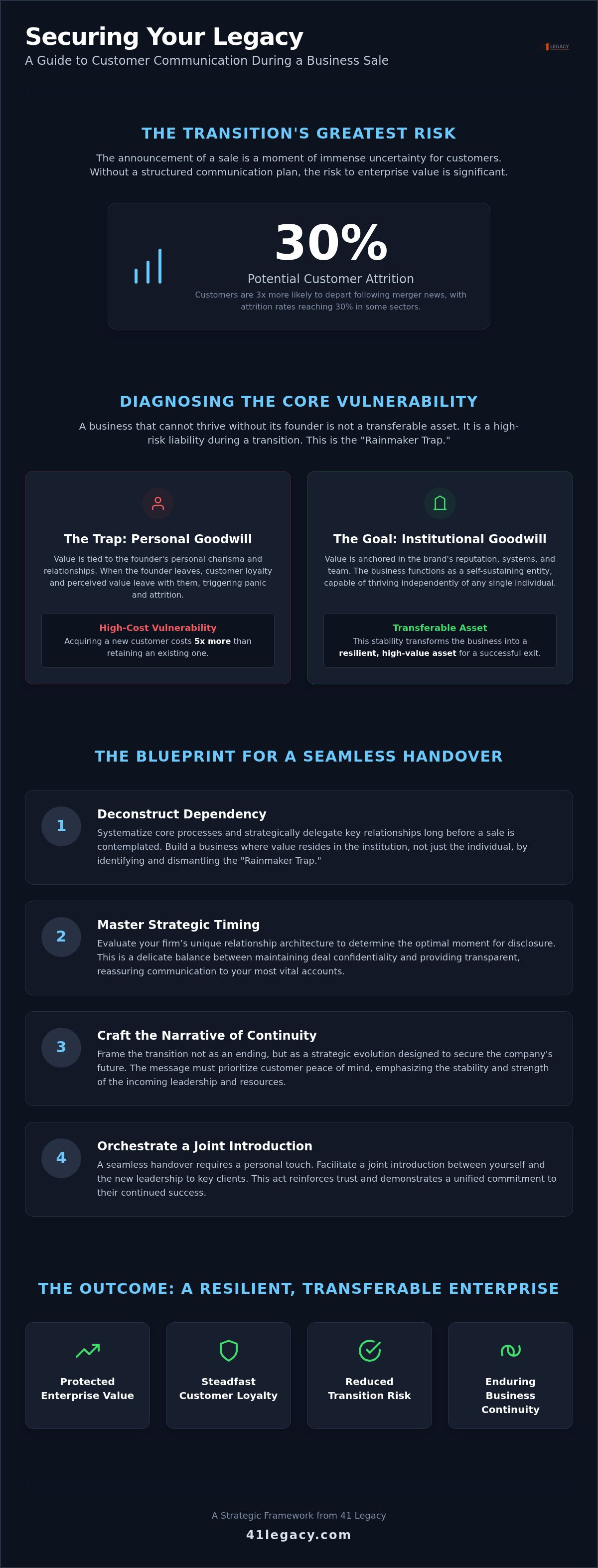
The Narrative of Continuity: Steps for a Seamless Client Transition
Crafting the narrative of a sale requires the same extreme precision one might apply to restoring a masterpiece. It isn't enough to simply inform; you must inspire confidence. The most effective messages emphasize what is staying the same, anchoring the customer in the familiar while introducing the new. By positioning the buyer as the "Next Steward" of the brand's essence, you frame the transition as a commitment to the firm's longevity rather than a liquidation of its assets. When communicating a business sale to key customers, the primary goal is to neutralize the fear of change by highlighting the permanence of the service standards you've established.
The Communication Roadmap
A successful transition follows a steady, unhurried rhythm. This structured approach ensures that the most vital relationships are handled with the reverence they deserve:
- Step 1: Internal Alignment. Before a single word reaches a client, ensure your senior staff and your "Quarterback" advisor are perfectly synchronized. Every team member must understand the narrative of continuity.
- Step 2: Identifying the "Key 20%." Focus your initial energy on the customers who represent the majority of your enterprise value. These legacy relationships require a bespoke approach.
- Step 3: The Personal Outreach. For your most vital accounts, a phone call or a private meeting is the only acceptable medium. It signals respect and provides a space for a two-way conversational experience, which is a growing trend for 2026.
- Step 4: The Formal Announcement. Once the inner circle is informed, release a coordinated, professional announcement to the broader base. This message should be polished to a high sheen, reflecting the meticulous nature of your work.
Crafting the Message of Excellence
The announcement should detail the exhaustive process you undertook to find a successor who shares your unwavering devotion to quality. Use evocative language to describe this selection as a "refusal to settle for less than perfection." You must directly address the inevitable questions regarding pricing, service levels, and primary points of contact. By providing clear, actionable next steps for customers to meet the new leadership, you transform a moment of potential anxiety into a formal introduction to the next chapter of the brand's history. To ensure your firm is prepared for this level of strategic clarity, consider starting with an Exit Readiness Assessment to evaluate your current transferability.
The "Joint Introduction" is perhaps the most critical tool in your arsenal. When you and the successor appear together, it serves as a visual and verbal endorsement, signaling that the essence of the business is being preserved. This unified front reinforces the idea that the successor isn't just a "new owner," but a hand-selected guardian who will uphold the legacy you've spent a lifetime building.
Building a Transferable Future with 41 Legacy
The journey toward a successful transition isn't a sudden pivot but a deliberate evolution. True exit planning for business owners begins years before a signature is ever required. It starts with a vision of the end, where the enterprise is no longer a reflection of the founder’s daily effort but a self-sustaining masterpiece. At 41 Legacy, we serve as the architects of this transformation, ensuring every component of your business is engineered for transferability. By the time you're communicating a business sale to key customers, the business should already be flourishing as a standalone asset, independent and resilient.
Our process begins with a structured Exit Readiness Assessment. This diagnostic tool provides the technical precision needed to evaluate your current landscape, identifying where owner-dependency might be obscuring the firm's true potential. We act as the "quarterback" for your professional advisory team, coordinating with your CPAs and attorneys to ensure a unified strategy. This collaboration maximizes enterprise value by aligning financial health with operational excellence, allowing you to approach your transition with the calm authority of a true steward.
The Value Growth Roadmap
Closing the "Value Gap" requires more than just strategic intent; it demands a meticulous Value Growth Roadmap. We identify the discrepancies between your current valuation and your enterprise's peak potential, then engineer a path to bridge that distance. Our monthly implementation support ensures this roadmap isn't merely a document on a shelf but a living progression executed with surgical precision. Our mission is clear: we ensure your life’s work survives as a transferable legacy, preserving the essence of what you’ve built for the generations to follow.
Next Steps for the Visionary Owner
In the progression of time, the most opportune moment to plan an exit was years ago. The second best time is today. Waiting until a transition is imminent leaves your most vital relationships vulnerable to the attrition risks we've explored. By requesting an Enterprise Diagnostic now, you gain the strategic clarity required to lead your firm toward a future of independent strength. Communicating a business sale to key customers is a moment that should be met with confidence, not anxiety. We invite you to secure your business legacy with 41 Legacy and begin the work of transforming your enterprise into a lasting, transferable asset.
Securing the Continuity of Your Life’s Work
The transition of your enterprise is the final, most profound act of leadership you'll perform. By dismantling the Rainmaker Trap and institutionalizing your client relationships through documented systems, you transform your business into a truly transferable asset. This preparation ensures that when the time comes for communicating a business sale to key customers, the message is one of strength and enduring quality. You aren't merely stepping away; you're ensuring the essence of your brand thrives in the hands of a hand-selected successor.
At 41 Legacy, we provide the strategic clarity required to navigate these delicate maneuvers. Led by a Certified Exit Planning Advisor (CEPA), our team utilizes a proprietary Enterprise Diagnostics process to identify and close value gaps. We act as the quarterback for your advisory team, coordinating with your legal and financial experts to maximize your firm's potential. It's time to move beyond owner-dependency and build a legacy that remains steadfast through every chapter of growth. Begin your Exit Readiness Assessment today to evaluate your firm’s transferability. Your masterpiece deserves a future as brilliant as its history.
Frequently Asked Questions
When is the best time to tell key customers about a business sale?
The optimal moment is dictated by your relationship architecture and the competitive landscape of your industry. For your most vital partners, the ideal window opens once the definitive agreement is signed but before the wider market receives the news. This allows for a private, dignified conversation that reinforces their importance. Strategic timing protects the deal's integrity while ensuring your legacy clients feel like respected insiders rather than afterthoughts in a transaction.
How do I prevent customer flight after announcing a sale?
Retention is secured by emphasizing continuity and the preservation of the brand's essence. You must demonstrate that the systems and quality standards they rely on are institutionalized rather than personal. When communicating a business sale to key customers, focus the narrative on the resources the new steward brings to the firm. Providing immediate access to the successor through a structured introduction helps bridge the gap and maintains the certainty clients require to remain loyal.
Should I tell my customers before the deal is officially closed?
Disclosing a transition before the deal is officially closed carries significant risk to the enterprise value. If the sale falters, you may find your relationships destabilized by unnecessary uncertainty. Most professional advisors recommend waiting until the deal is certain. However, for a rare few "Legacy Clients" whose departure would devalue the asset, a carefully timed, confidential disclosure under a non-disclosure agreement might be necessary to secure the successor's confidence in future revenue.
What should be included in a business sale announcement to customers?
A polished announcement should blend gratitude for the past with a vision for the future. It must include a clear explanation of why the successor was chosen, highlighting their commitment to your uncompromising standards. Address the practicalities of service, pricing, and contact points immediately to neutralize anxiety. The message should feel like a formal passing of the torch, reassuring clients that the meticulous care they've come to expect will remain unchanged under the new stewardship.
How does owner dependency affect customer reactions to a sale?
High owner dependency is the primary catalyst for customer panic during a sale. If the client believes the value of the business resides solely in your personal touch, they'll perceive your departure as a loss of service quality. Reducing this dependency through transferability engineering long before the announcement is vital. When the business operates as a self-sustaining asset, customers view the sale as a professional evolution rather than a personal abandonment, significantly reducing the risk of attrition.
Can a joint announcement with the buyer help retain key clients?
A joint announcement serves as a powerful verbal and visual endorsement of the successor. It signals that you aren't merely leaving, but are actively entrusting your life’s work to a capable new guardian. This unified front is essential for communicating a business sale to key customers with the required gravity. By appearing together, you transfer your personal goodwill to the new leadership, providing the continuity and professional-room altitude necessary to maintain long-term account stability.
How do I handle a situation where a customer finds out before the announcement?
If a client discovers the news prematurely, you must move swiftly to regain control of the narrative. Arrange a private, authoritative conversation immediately to prevent rumors from eroding trust. Acknowledge the transition with a calm transparency that emphasizes the strategic nature of the move. By addressing the situation directly and reinforcing the continuity of the business's essence, you can transform a potential breach of confidentiality into an opportunity for deeper engagement and reassurance.
Will selling my business to a competitor upset my customers more than a private equity sale?
Selling to a competitor often triggers more immediate anxiety regarding the loss of the brand’s unique identity and personalized service. Customers may fear that the culture they value will be absorbed into a larger, more indifferent entity. A private equity sale, while sometimes viewed as more transactional, can be framed as an injection of capital to enhance the firm's legacy. Regardless of the buyer, the narrative must focus on the preservation of the business's core essence and its commitment to perfection.

Article by
Mike Laskowski
Mike Laskowski is a Business Value Growth Strategist who helps business owners uncover the truths that drive their performance, risk, and readiness. Blending forensic interviewing from a 26‑year federal career with Strategic Capacity analysis and CEPA methodology, he works upstream to reduce owner dependency, increase transferability, and strengthen enterprise value. Mike guides founders through clarity, operational evolution, and transition readiness so their companies become transferable, owner‑independent assets that endure beyond the founder.
Disclaimer
This article is for educational and informational purposes only and does not provide legal, tax, investment, or business brokerage advice. 41 Legacy does not offer M&A brokerage services, legal document drafting, tax preparation, or investment advisory services. Business owners should consult licensed professionals in those disciplines before making decisions related to business transactions, legal matters, tax strategy, or financial planning. All examples are illustrative and may not apply to your specific situation.