
Common Business Valuation Mistakes to Avoid: A Guide for Strategic Growth
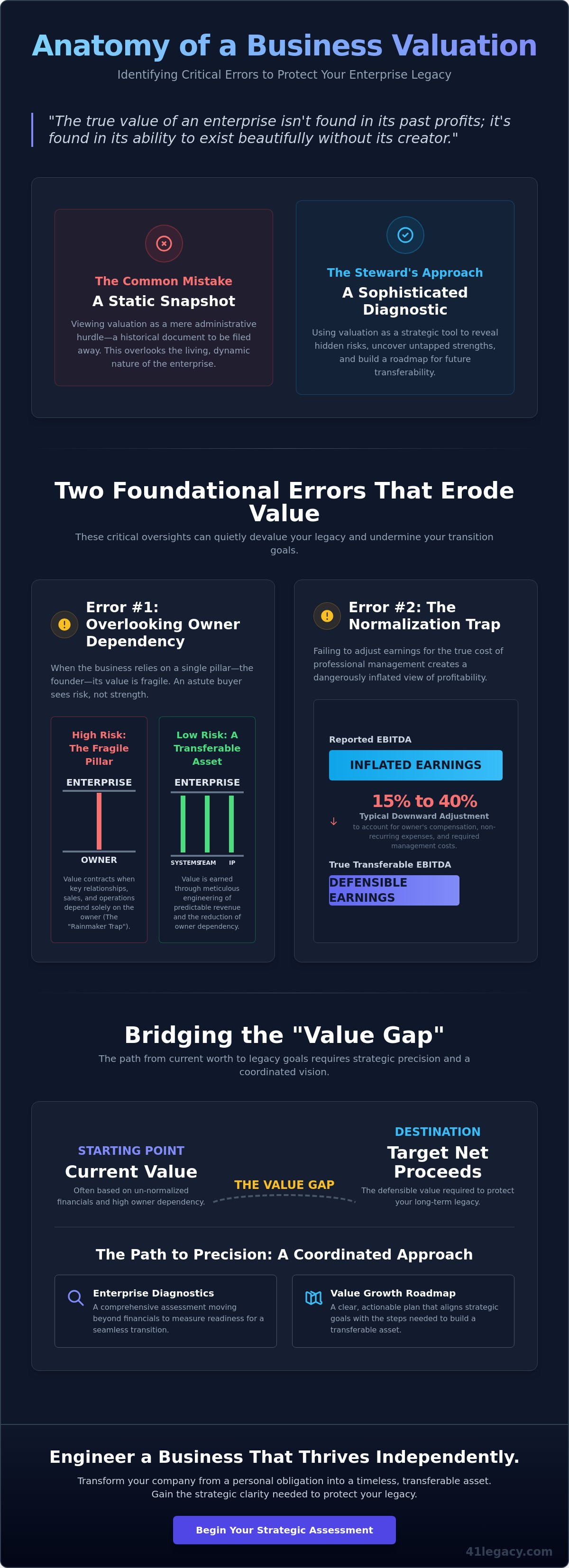
The true value of an enterprise isn't found in its past profits; it's found in its ability to exist beautifully without its creator. For the dedicated steward, your business is a living testament to your vision, yet its future transferability often rests on a surprisingly fragile foundation. Many owners find themselves paralyzed by uncertainty or frustrated by conflicting advice, leading them to overlook common business valuation mistakes to avoid that can quietly devalue their heritage. When normalization adjustments alone can alter reported earnings by 15% to 40%, the margin for error is dangerously thin.
We believe you deserve a defensible, sophisticated understanding of your company's worth that honors your work while preparing for what comes next. This guide will help you identify the critical errors that threaten your company's legacy and provide a clear roadmap to close the gap between your current value and your exit goals. You'll discover how to engineer a business that flourishes independently of your daily involvement, transforming your company from a personal obligation into a timeless, transferable asset.
Key Takeaways
- Move beyond static financial snapshots by prioritizing a comprehensive assessment of your company’s readiness for a seamless transition.
- Recognize the common business valuation mistakes to avoid, specifically the failure to normalize EBITDA for the true costs of professional management.
- Uncover how reducing owner dependency acts as a catalyst for transferability, allowing your enterprise to thrive independently of your daily involvement.
- Bridge the "Value Gap" by aligning your strategic goals with the reality of net proceeds required to protect your long-term legacy.
- Learn to coordinate your advisory team through structured Enterprise Diagnostics and a clear Value Growth Roadmap to ensure strategic precision.
The Illusion of Value: Why Static Snapshots Often Mislead Owners
A business is a living entity, a complex tapestry of relationships, systems, and intellectual capital. Too often, owners view a valuation as a mere administrative hurdle, a static certificate to be shelved once the ink is dry. This perspective is one of the most common business valuation mistakes to avoid. To the dedicated steward, a valuation should function as a sophisticated diagnostic tool, revealing the hidden fractures and untapped strengths within the enterprise. While a formal valuation serves specific technical needs, it's the strategic Exit Readiness Assessment that provides the clarity required for long-term legacy planning. We believe that understanding value is the first step in protecting it.
The business valuation process is an exercise in architectural precision. It requires an understanding that the "Standard of Value" is not a fixed point; it's a variable that shifts based on the intended transition path. An internal transfer to a successor requires a different analytical lens than an external sale to a strategic buyer. We approach this work with the reverence of a curator, ensuring that the valuation reflects the true essence of the business rather than a generic industry average. Relying on "Rule of Thumb" multiples in a sophisticated market is like appraising a masterpiece by the weight of its frame. It misses the artistry of the operation and the specific risks that a buyer will inevitably uncover.
Price vs. Value: The Connoisseur's Distinction
Enterprise Value is the present worth of future cash flows, a testament to the business’s ability to thrive beyond its current leadership. Market multiples are frequently misleading because they lack the necessary context of risk and transferability. A high multiple isn't a gift; it's earned through the meticulous reduction of owner dependency and the engineering of predictable revenue. True value is found at the intersection of market attractiveness and operational excellence. It's here that the business becomes a sought-after asset rather than a personal obligation for the next owner. We look for the harmony between technical engineering and creative vision to define this worth.
The Timing Trap: Why Historical Data Isn't Enough
Relying solely on historical performance is a strategic blind spot. Buyers aren't purchasing the past; they're securing a claim on the future. One of the common business valuation mistakes to avoid is failing to align the valuation with future-focused forecasting that accounts for modern automation and AI integration. In a volatile economic climate, the "Valuation Date" carries immense weight. It's an anchor in time that must account for current market shifts, interest rate fluctuations, and emerging risks. Precision in this area ensures that your legacy is protected by contemporary facts, not by the echoes of former successes that may no longer be repeatable.
Foundational Errors: Owner Dependency and the Normalization Trap
The most exquisite architecture fails if it relies on a single, fragile pillar. In the world of enterprise value, that pillar is often the founder. While a profit and loss statement may reflect a healthy bottom line, an astute buyer sees only the risk of a vacuum if the creator departs. This invisible weight is owner dependency, and it's a primary reason why many companies fail to achieve their true market potential. Overlooking this human element is among the most common business valuation mistakes to avoid, as it directly impacts the risk profile of the entire organization. If your business cannot breathe without your daily presence, it's a personal obligation rather than a transferable asset.
The "Rainmaker Trap" is a particularly poignant example of this dependency. When the founder is the sole driver of sales and high-level relationships, the enterprise possesses no independent momentum. A connoisseur of business value understands that a company’s worth is tied to its systems, not just its current success. When professionals discuss avoiding valuation errors, they often emphasize that a buyer isn't just purchasing cash flow; they're purchasing the certainty that those cash flows will continue under new leadership. Without a robust management tier, that certainty evaporates, and the valuation multiple inevitably contracts.
The Mathematics of Normalization
Precision in financial reporting requires an autopsy of discretionary spending. EBITDA Normalization is the process of stripping away owner-specific anomalies to reveal the core earning power of the entity. This includes adjusting for a fair market replacement of the owner's salary, which is often significantly lower or higher than what a professional manager would command. "Lifestyle" expenses, such as country club memberships or personal travel, must be meticulously identified and removed. Failing to account for these non-recurring items can artificially deflate the perceived value, leaving significant money on the table during a transition.
Transferability Engineering: Beyond the Numbers
True value growth requires a shift from technical execution to strategic stewardship. A business that requires its founder for daily operations is a liability in the eyes of a sophisticated acquirer. To mitigate this risk, we focus on the implementation of rigorous Standard Operating Procedures that codify the "inner essence" of the work. These documents transform individual expertise into institutional knowledge, ensuring that the brand’s standard of excellence remains uncompromised. By fostering a management layer capable of independent decision-making, you enhance the company's transferability and secure a higher premium. We believe that Owner Dependency Reduction is the most effective way to protect your legacy and ensure the business thrives for generations to come.
The Strategic Blind Spot: Miscalculating the Value Gap
The Value Gap is the silent chasm between the current worth of an enterprise and the capital required to sustain a founder’s post-exit legacy. For many, this gap remains unmeasured until the eleventh hour, leading to a profound sense of strategic disorientation. One of the most common valuation mistakes is treating the valuation as an end in itself rather than a baseline for future engineering. Without a clear understanding of this distance, a steward cannot effectively navigate the path toward their ultimate objective. We believe that true strategic clarity begins with identifying these discrepancies before they become insurmountable obstacles.
Miscalculating this gap often stems from failing to account for company-specific risks that inflate the discount rate. When a business lacks structural capital or suffers from high customer concentration, its value is inherently fragile. Addressing these common business valuation mistakes to avoid requires a shift in perspective, moving from historical reporting to future-focused risk mitigation. This is not merely a financial exercise; it's a philosophical commitment to the health of the entity. A business that is not growing in value is, by definition, losing its competitive edge in a sophisticated market.
The Net Proceeds Reality Check
A gross valuation figure is often a vanity metric that obscures the financial reality of a transition. What matters is not the enterprise value on a certificate, but the net proceeds that remain after the friction of taxes, transaction fees, and debt retirement. This "Wealth Gap" occurs when the liquid capital harvested from the business fails to meet the owner's long-term needs. Deal structure plays a decisive role here; a high headline price with unfavorable earnout terms can be far less valuable than a lower, more secure cash offer. We prioritize the engineering of a Value Growth Roadmap that accounts for these realities from the outset.
Mining for Intangible Gold
Intangible assets like brand equity, proprietary culture, and intellectual property are the soul of an enterprise, yet they are frequently undervalued. Buyers pay a premium for "Structural Capital," which represents the systems and knowledge that allow a business to operate in a state of perpetual readiness. Conversely, high customer concentration can swing the valuation pendulum violently in the wrong direction, as the loss of a single relationship could jeopardize the entire entity. A transferable asset is one where the value is embedded in the organization's fabric, not just its ledger. By identifying and strengthening these intangibles, you reduce the perceived risk and command a multiple that reflects the true artistry of your work.
Coordinating the Vision: The 'Quarterback' Model of Advisory
A masterpiece is never the result of uncoordinated hands. In the architectural preservation of a business, the friction between fragmented professional perspectives often creates a strategic paralysis that devalues the entire enterprise. One of the common business valuation mistakes to avoid is allowing your CPA, attorney, and wealth manager to operate in isolation. While each may be a master of their specific discipline, their individual goals frequently contradict the overarching objective of enterprise value growth. True stewardship requires a conductor to harmonize these voices into a singular, uncompromising vision of perfection.
The role of a Certified Exit Planning Advisor (CEPA) is to serve as this essential conductor, or "Quarterback." By aligning strategic planning with valuation diagnostics, we ensure that every tactical maneuver strengthens the company's transferability. Without this coordination, owners often find themselves caught in the "Analysis Paralysis" of conflicting advice, where the fear of making a wrong move prevents any move at all. We believe that a cohesive legacy is built through the deliberate synchronization of technical precision and artistic vision.
The Friction of Siloed Professionalism
The cost of siloed advice is often hidden in the ledger. For instance, a sophisticated tax-minimization strategy may successfully reduce your current liability but inadvertently destroy enterprise value by deflating the EBITDA that a buyer uses to calculate a multiple. Similarly, legal structures that protect an owner today might create significant hurdles for the transferability of business interests tomorrow. A single "Quarterback" ensures that these disciplines work in concert rather than at cross-purposes. This coordination transforms the advisory team from a group of service providers into a unified guardian of your history.
A Roadmap for Implementation
Moving from a diagnostic understanding to tangible results requires more than a dusty report; it requires a disciplined cadence of execution. Our approach transitions from the initial assessment into active Strategic Advisory, where monthly accountability ensures that the Value Growth Roadmap remains the central guiding principle. Every decision, from talent development to capital allocation, must contribute to the long-term health and independence of the entity. To begin aligning your professional team and securing your company's future, we invite you to explore our structured Strategic Advisory support.
The Path to Precision: Leveraging Enterprise Diagnostics
Precision is not a destination; it's a continuous act of stewardship. To move beyond the common business valuation mistakes to avoid, an owner must transition from observing the past to engineering the future. This journey requires a structured methodology that treats the enterprise as a masterpiece in progress. We follow a disciplined five-step process designed to reveal the inner essence of the business while fortifying its market position. It begins with a deep, diagnostic exploration and concludes with the realization of a transferable legacy.
- Step 1: Conduct a comprehensive Exit Readiness Assessment to identify hidden risks and operational fractures.
- Step 2: Perform Enterprise Diagnostics to benchmark your performance against industry peers, ensuring your margins and systems meet the highest standards.
- Step 3: Quantify the Value Gap by measuring the distance between your current enterprise value and your ultimate legacy goals.
- Step 4: Reduce owner dependency through Transferability Engineering, where systems are refined to function independently of your daily involvement.
- Step 5: Execute a Value Growth Roadmap with monthly implementation support to ensure strategic momentum never falters.
The Diagnostic First Step
A static appraisal is a historical relic. In contrast, a diagnostic assessment is a living document that identifies the "Red Flags" likely to halt a buyer during due diligence. These might include unverified financial adjustments or deep-seated owner dependency. By establishing a baseline today, you gain the clarity needed to correct these common business valuation mistakes to avoid before they impact your net proceeds. This initial step is about more than numbers; it's about identifying the structural integrity of your life's work.
Building the Transferable Asset
41 Legacy serves as the guardian of your enterprise’s essence. Our role is to guide you through the profound shift from being an Operator to becoming a Steward of value. This transformation ensures that the business thrives because of your vision, not because of your labor. By crafting a legacy through precision and strategic clarity, you build a transferable asset that remains vibrant and profitable long after your departure. We invite you to begin this process with the reverence it deserves, ensuring your impact is both lasting and profound.
Architecting a Legacy of Transferable Value
The preservation of an enterprise requires more than financial reporting; it demands a philosophical commitment to excellence. Precision is the guardian of value. By moving beyond static appraisals and addressing the common business valuation mistakes to avoid, you transform your company into a resilient, transferable asset. We've explored how reducing owner dependency and harmonizing your advisory team creates the structural integrity necessary for a successful transition. This transition is the ultimate test of a steward's vision, proving that the business's essence can flourish independently of its creator.
Our work is dedicated to this intersection of technical engineering and artistic legacy. Led by a Certified Exit Planning Advisor (CEPA), we utilize a comprehensive Enterprise Diagnostics process to ensure your company is benchmarked against the highest standards. We don't focus on transactional brokerage; we focus on the deliberate building of a legacy that stands the test of time. Your business is a living testament to your vision, and its story deserves to continue with clarity and strength.
Secure your legacy with a professional Exit Readiness Assessment from 41 Legacy. You've spent a lifetime building your business; now is the time to ensure its future is as brilliant as its past.
Strategic Clarity: Frequently Asked Questions
What is the most common mistake business owners make during valuation?
Relying on historical performance as a sole predictor of future worth is the most frequent error. This oversight is central to the common business valuation mistakes to avoid, as sophisticated buyers price the future's potential, not yesterday's successes. A steward must look beyond the ledger to ensure the entity's essence is protected through modern, forward-looking diagnostics that account for market shifts and emerging risks.
How does owner dependency affect the final sale price of a company?
Owner dependency creates a "key-person risk" that directly erodes the valuation multiple. If the business requires your daily presence or personal relationships to function, a buyer will perceive it as a personal obligation rather than a transferable asset. Reducing this dependency is essential to securing a premium price and ensuring the company's long-term health and independence after your departure.
Why is EBITDA normalization so important for a transferable business?
EBITDA normalization is vital because it reveals the true economic earnings of the entity by stripping away owner-specific anomalies. By adjusting for non-market salaries or discretionary spending, you provide a clear view of the business's core earning power. This process can alter reported earnings by 15% to 40%, making it a critical step in defending your company's worth during any transition.
What is the difference between Enterprise Value and Equity Value?
Enterprise Value represents the total worth of the business operations, inclusive of both debt and cash. Equity Value is the portion of that worth attributable to the owners after all liabilities are settled. Understanding this distinction is crucial for calculating the actual net proceeds you'll receive, ensuring your personal financial goals align with the reality of the business's capital structure.
How often should a business owner have their company valued?
A business owner should treat valuation as an annual diagnostic baseline rather than a one-time event. Regular assessments allow you to track the progress of your Value Growth Roadmap and identify emerging risks before they become permanent discounts. This steady cadence ensures you're always operating in a state of perpetual readiness, much like a curator maintaining a private collection.
Can a business be too small for a formal exit readiness assessment?
No business is too small for a strategic assessment of its readiness and transferability. Readiness is a measure of an asset's health and independence, regardless of its current revenue or size. Establishing these sophisticated foundations early allows a smaller entity to grow into a highly valued enterprise that can thrive independently of its founder's daily involvement.
What role does a CEPA play in the valuation process?
A Certified Exit Planning Advisor (CEPA) acts as the strategic "Quarterback" who aligns the valuation with your long-term legacy goals. They ensure that the process isn't just a financial exercise but a catalyst for enterprise value growth. By harmonizing the perspectives of your CPA and attorney, the CEPA protects the integrity of your vision and ensures a cohesive transition.
How do intangible assets like brand reputation impact valuation?
Intangible assets like brand equity and proprietary culture create "Structural Capital" that commands a significant market premium. These elements represent the institutional knowledge and systems that allow a company to maintain its standard of excellence without its creator. When these intangibles are meticulously documented and protected, they transform the business into a sought-after, transferable masterpiece.

Article by
Mike Laskowski
Mike Laskowski is a Business Value Growth Strategist who helps business owners uncover the truths that drive their performance, risk, and readiness. Blending forensic interviewing from a 26‑year federal career with Strategic Capacity analysis and CEPA methodology, he works upstream to reduce owner dependency, increase transferability, and strengthen enterprise value. Mike guides founders through clarity, operational evolution, and transition readiness so their companies become transferable, owner‑independent assets that endure beyond the founder.
Disclaimer
This article is for educational and informational purposes only and does not provide legal, tax, investment, or business brokerage advice. 41 Legacy does not offer M&A brokerage services, legal document drafting, tax preparation, or investment advisory services. Business owners should consult licensed professionals in those disciplines before making decisions related to business transactions, legal matters, tax strategy, or financial planning. All examples are illustrative and may not apply to your specific situation.