
Business Value Growth Advisory: Engineering Your Transferable Legacy
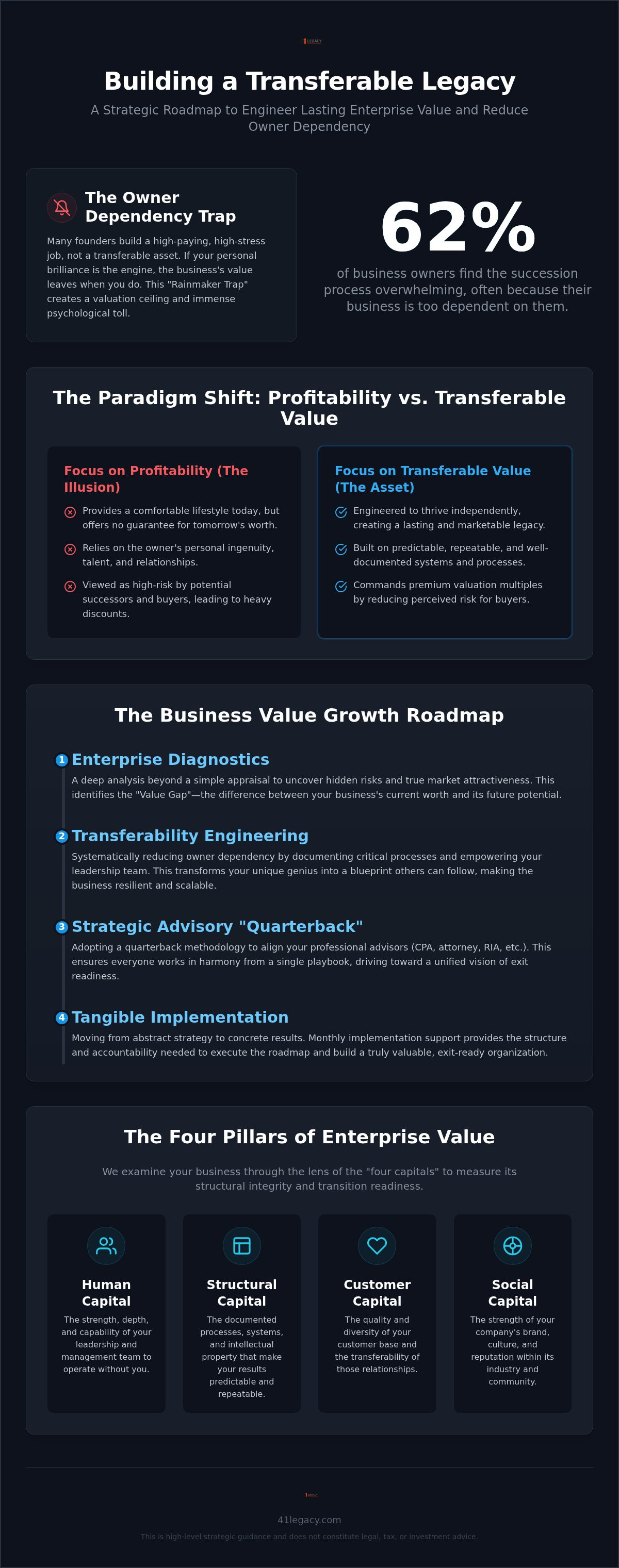
What if the masterpiece you have spent decades crafting remains unfinished because you are the only one who can hold the brush? For many founders, the realization that their life's work is entirely dependent on their daily presence is a heavy burden. You likely feel a profound sense of stewardship for your company, yet you recognize that the ultimate mark of excellence is an entity that thrives without your constant intervention. This transition requires a business value growth roadmap, a strategic framework designed to engineer lasting value and ensure your legacy is preserved through any future transition. It's a vital shift, especially since 62% of business owners find the succession process overwhelming.
You will discover how to transform your business from a self-employment trap into a high-value, transferable asset that operates with surgical precision. We will explore how to reduce the daily stress of owner dependency and coordinate your professional advisors into a unified force. By the end, you will have the strategic clarity needed to build an exit-ready organization that reflects your uncompromising standards and thrives independently of your daily involvement.
Key Takeaways
- Distinguish between mere profitability and transferable enterprise value to ensure your life's work remains attractive to the market.
- Utilize a structured business value growth roadmap to identify your current Value Gap and establish a clear trajectory toward your financial goals.
- Implement transferability engineering and precise documentation to reduce owner dependency, allowing the business to thrive without your constant presence.
- Adopt a quarterback methodology to align your professional advisors, ensuring your CPA and attorney work in harmony toward a singular vision of exit readiness.
- Transition from abstract strategy to tangible results through monthly implementation support that provides the accountability needed to build a lasting legacy.
Beyond the Bottom Line: Why Profit Does Not Equal Transferable Value
We believe a business is more than a source of income; it's a living legacy that requires careful stewardship. Many owners mistake a healthy bottom line for a valuable asset. While high profitability provides for a comfortable lifestyle today, it doesn't guarantee that the business has any worth to a successor tomorrow. Enterprise value is found in the soil, not just the harvest. If the engine of your company relies on your personal ingenuity to remain in motion, you haven't built an asset. You've created a high-paying, high-stress job. Transitioning from an operator to a steward means recognizing that your personal brilliance can actually become a liability during a transition.
This realization is the foundation of a business value growth roadmap. We often see the "Rainmaker Trap," where a founder's unique talent and relationships are the primary drivers of revenue. To a potential successor, this represents extreme risk. They aren't looking to buy your genius because your genius leaves when you do. They're looking for a predictable, repeatable system that produces results regardless of who is at the helm. True value is engineered by detaching the essence of the business from the identity of the owner.
The Illusion of Success in High-Owner-Dependency Firms
Success often masks fragility. If your phone is the only one that rings when a crisis emerges, or if every significant decision requires your signature, your firm is highly owner-dependent. This dependency creates a natural valuation ceiling. Buyers in 2026 are increasingly sensitive to this, often applying heavy discounts to businesses where the founder is the primary point of contact for clients or the sole keeper of vital processes. Beyond the financial impact, the psychological toll is immense. Building a business that cannot thrive without you leads to burnout and a sense of being trapped by your own creation. Strategic clarity begins when you decide to build something that can outlast your daily involvement.
What Buyers Actually Pay For: Transferability and Risk
Value is determined by the balance of risk and reward. According to 2026 market trends, buyers are placing a premium on the predictability and repeatability of cash flow rather than raw profit alone. Transferability is the metric of how easily a new leader can step into your role without the machinery grinding to a halt. This requires a business value growth roadmap that prioritizes the documentation of your unique processes. We view this documentation as both a technical and artistic endeavor. You're not just writing manuals; you're capturing the soul of the enterprise and translating it into a blueprint that others can follow. By reducing perceived risk, you naturally increase the multiples used to determine your company's worth.
The Architecture of Enterprise Diagnostics: Identifying the Value Gap
Engineering a legacy begins with a cold, clear-eyed look at the current state of the machine. We call this Enterprise Diagnostics. It's more than a simple appraisal of assets and liabilities. While a traditional appraisal might tell you what the business is worth in a vacuum, a diagnostic reveals its market attractiveness. This process establishes the baseline for your business value growth roadmap. It uncovers the hidden structural risks that often devalue a company in the eyes of a sophisticated buyer. By examining the business as a living entity, we can identify where the foundation is strong and where it requires restoration.
The architecture of your business value growth roadmap is built upon these diagnostic findings, ensuring every strategic move serves to increase enterprise value. We look past the balance sheet to see the gears of the operation. This depth of analysis is what separates a mere estimate from a strategic blueprint. It allows us to move beyond guesswork and into the precise engineering of transferability.
Measuring Market Attractiveness and Transition Readiness
A curator examines a work of art for its provenance and condition; we examine a business through the lens of the "four capitals." These are Human, Structural, Customer, and Social capital. Each serves as a pillar supporting the total weight of the enterprise. We evaluate your Strategic Capacity, which is the ability of your leadership team to sustain performance without your direct oversight. If the diagnostics reveal high customer concentration or a lack of documented systems, these are significant red flags. They signal to a buyer that the essence of the business is not yet transferable, which naturally depresses the valuation multiple.
Quantifying the Value Gap for Future Planning
The most critical discovery in this phase is the Value Gap. This is the distance between your current valuation and the financial target required to fund your next chapter. To understand this, you must first calculate your Wealth Gap. This is the net amount you need from a transition to maintain your lifestyle and fulfill your philanthropic or family goals. Diagnostics allow us to prioritize which areas of the business need immediate restoration to close this gap. You can learn more about the nuances of Determining Enterprise Value through our detailed guide. By identifying these gaps early, we can move from theory into the deliberate engineering of a transferable asset. If you're ready to see where your business stands today, you can begin with an Enterprise Diagnostics evaluation.
Strategic Value Growth Roadmaps: Navigating from Worth to Potential
A map is only as useful as the traveler’s commitment to the journey. While diagnostics provide the coordinates of your current position, a custom business value growth roadmap defines the path toward your ultimate destination. This is not a static document to be filed away; it's a living strategy that aligns your daily operational decisions with the long-term goal of exit readiness. By de-risking the enterprise through deliberate engineering, you ensure that when the time comes for a transition, the asset is both attractive and resilient. Most strategic plans fail because they remain purely theoretical. We believe true progress requires a structured five-step process that moves from initial assessment and gap analysis to the rigorous implementation of value-driving initiatives.
Our Monthly Implementation Support model provides the necessary cadence to ensure these goals aren't lost in the noise of daily operations. This business value growth roadmap serves as the central nervous system of your transition strategy, providing the accountability needed to transform a self-employment trap into a legacy asset. It's about moving beyond what the business is worth today and engineering what it has the potential to become in the hands of a successor.
The Five Pillars of a Transferable Asset
Building a transferable asset requires a meticulous focus on four specific areas of the enterprise. We view these as the pillars of your legacy:
- Financial Transparency: You must move beyond tax-avoidance accounting. Sophisticated buyers look for growth-focused reporting that clearly demonstrates the health and trajectory of the business.
- Operational Scalability: Your systems must function without your daily input. If a process exists only in your head, it has no value to a buyer.
- Customer Diversification: Relying on a few key accounts is a significant risk. We work to broaden your base, ensuring no single client holds the power to devalue your life's work.
- Team Empowerment: You must transition from a hub-and-spoke management style to one that empowers a leadership team. A business that can run itself is the ultimate mark of a master artisan.
Implementation: Moving from Theory to Tangible Growth
The gap between a vision and a reality is filled by consistent action. Most strategic plans gather dust because they lack a monthly advisory cadence. We utilize Value-Based KPIs that track growth beyond just top-line revenue, focusing instead on the metrics that actually drive valuation multiples. This rigorous approach ensures every team member is aligned with the goal of increasing enterprise value. For those seeking deeper tactical insights, you can explore our guide on How to Increase Enterprise Value. By treating value growth as a continuous process rather than a one-time event, you build a company that is always exit-ready.
The Art of Transferability Engineering: Reducing Owner Dependency
True mastery in business is not found in being indispensable. It's found in the deliberate engineering of your own redundancy. We call this Transferability Engineering. It's the process of extracting the founder’s essence and distilling it into systems that others can execute with precision. When a business relies on the specific brilliance of its creator, it's a fragile entity. By following a business value growth roadmap, you shift from the role of a Master Craftsman to that of a Business Architect. A craftsman is the tool; an architect creates the structure that houses the talent. This shift is what transforms a local enterprise into a globally attractive asset.
Reducing owner dependency does more than just lower your stress. It exponentially increases the pool of potential buyers. Sophisticated investors look for a "turnkey" operation where the engine continues to hum long after the founder has departed. If you can't walk away for a month without the business suffering, you haven't built a transferable asset. You've built a cage. Engineering transferability is the key to unlocking that cage and realizing the full potential of your life's work. It ensures that the value you have created is preserved and can be successfully handed to the next generation of leadership.
SOPs as the Blueprint for a Transferable Legacy
Documented processes are often the most valuable hidden assets on a balance sheet. We view What is an SOP in Business? as the technical manual for your legacy. These are not just dry instructions; they're the blueprint that ensures your "secret sauce" is preserved. You don't have to slow down operations to start this. We recommend a "capture as you go" approach, where your team records their workflows in real-time. This creates a library of institutional knowledge that makes the business independent of any single individual, including yourself. It's the difference between a business that exists in your head and one that exists as a tangible asset.
Developing Strategic Capacity in Your Leadership
A buyer will always pay a premium for a team they don't have to replace. Identifying "Key Player risk" is a vital part of your business value growth roadmap. If all the knowledge sits with one or two veterans, the business is vulnerable. Developing Strategic Capacity means investing in talent development and succession planning at every level. This ensures that the leadership team has the autonomy to make high-level decisions. When your management team can navigate challenges without your guidance, you've achieved the ultimate goal of stewardship. If you're ready to begin this transition, our Transferability Engineering advisory can help you build a more resilient organization that thrives independently of your daily involvement.
The Strategic Advisory Quarterback: Harmonizing Your Professional Team
The symphony of a successful exit is rarely played by a soloist. It requires the precise harmonization of several distinct disciplines, each contributing to the overall resonance of the enterprise. Most business owners already possess a circle of trusted professionals, including a CPA, an attorney, and a financial planner. However, these experts often operate in silos, focusing on their specific niche without a unified vision for the owner's ultimate transition. We act as the strategic quarterback for this collective, ensuring every advisor is aligned with the business value growth roadmap. By providing a single point of accountability, we transform a group of individual specialists into a cohesive force dedicated to the preservation of your legacy.
A Certified Exit Planning Advisor (CEPA) brings a unique methodology to this leadership role. While your CPA manages the historical record and your attorney protects the present structure, the CEPA looks toward the future potential of the asset. This perspective is vital because an uncoordinated team often leads to advisory friction. Decisions made in one silo can inadvertently devalue the business in another. Our role is to ensure that every professional maneuver serves the singular goal of exit readiness, protecting the essence of what you've built while maximizing its market attractiveness.
Ending the Silo Effect: Why Your CPA and Attorney Must Align
Advisory friction often manifests as a conflict between short-term tax mitigation and long-term value growth. A CPA might suggest strategies to reduce taxable income that, while beneficial today, could make the business appear less profitable to a future successor. Similarly, legal structures designed for current liability protection might inadvertently complicate the transferability of the enterprise. The quarterback methodology resolves these contradictions by facilitating direct communication between your professional team. We ensure that legal frameworks and accounting practices are engineered to support the business value growth roadmap, creating a seamless path from operational success to a successful transition.
Your Next Steps: From Readiness to Realization
The journey toward a transferable legacy begins with a commitment to clarity. By initiating the diagnostic process, you gain an objective understanding of your current enterprise value and the specific levers that will drive future growth. This transparency provides a profound sense of peace. You'll no longer wonder about the market's perception of your life's work; you'll have a blueprint to improve it. Whether you're planning a transition in three years or ten, the best time to engineer value is while you're still at the helm. To learn more about how a specialist can guide this process, explore the role of The Certified Exit Planning Advisor. Building a business that's always ready for exit is the ultimate act of stewardship, ensuring your impact continues long after your daily involvement ends.
Securing the Future of Your Life's Work
Transitioning from a business operator to a steward of a legacy is a profound shift. It requires moving beyond the daily harvest of profit to focus on the health of the soil itself. We've explored how a structured business value growth roadmap serves as the essential blueprint for this transformation. By identifying the Value Gap through our Structured Enterprise Diagnostics Framework and engineering transferability into your daily operations, you ensure your life's work remains a resilient and attractive asset. This process doesn't just prepare you for an exit; it builds a stronger organization today.
Realizing this vision requires more than just theory. It demands the precision of our National Strategic Advisory Support and the specialized CEPA expertise to align your professional team into a unified force. You've built something of substance through years of dedication and artistry. Now is the time to ensure it can thrive independently of your daily presence. Begin Your Exit Readiness Assessment with 41 Legacy to gain the clarity and strategic depth your masterpiece deserves. Your legacy is ready to be engineered for its next great chapter.
Frequently Asked Questions
What is the difference between a business valuation and a value growth roadmap?
A business valuation provides a static snapshot of what your enterprise is worth today, often based on historical financial data. In contrast, a business value growth roadmap is a forward-looking strategic blueprint designed to increase that worth over time. While the valuation identifies the starting point, the roadmap outlines the specific engineering steps required to close the Value Gap and prepare the organization for a successful, high-value transition.
How long does it typically take to see a measurable increase in enterprise value?
Tangible increases in enterprise value typically require a commitment of twelve to thirty-six months. While minor operational efficiencies can be realized quickly, the deep structural work of transferability engineering takes time to mature. This duration allows for the documentation of systems and the validation of a management team's autonomy. Consistent monthly implementation support ensures that these strategic improvements are not just temporary shifts but permanent enhancements to the company's market attractiveness.
Why is owner dependency considered such a high risk by potential buyers?
Buyers view owner dependency as a significant risk because it suggests the business cannot function without the founder's personal brilliance. If your unique relationships or technical skills are the primary drivers of revenue, the asset's value is non-transferable. A successor isn't buying your past success; they're buying the predictability of future cash flows. High dependency increases the perceived risk that those flows will cease once you depart, leading to lower valuation multiples.
Can business value growth advisory help if I do not plan on selling for 10 years?
Value growth advisory is arguably most effective when the transition is a decade away. Beginning this process early allows you to build a more resilient, profitable, and less stressful organization today. By following a business value growth roadmap over several years, you have the luxury of time to refine your strategic capacity and diversify your customer base. This long-term stewardship ensures that when you're ready to exit, the business is already a highly optimized asset.
What role does a CEPA play compared to my traditional business accountant?
A traditional accountant focuses on historical financial accuracy and tax mitigation. A Certified Exit Planning Advisor (CEPA) takes a broader, more strategic view of the enterprise as a transferable asset. While the accountant manages the books, the CEPA acts as a quarterback to align your entire professional team toward the goal of exit readiness. This involves looking beyond the numbers to evaluate structural risks and identifying opportunities to enhance the company's overall market appeal.
How do I know if my business is currently exit-ready?
Exit readiness is determined through a structured process of Enterprise Diagnostics rather than a simple feeling of being finished. You're exit-ready when your business can demonstrate repeatable systems, a diversified customer base, and a leadership team that operates independently of your daily oversight. If your presence is required for the company to maintain its momentum, you likely have a significant Value Gap to close before a successful internal or external transition can occur.
What are the Four Capitals and why do they matter for my business value?
The Four Capitals represent the intangible assets that drive a business's total value: Human, Structural, Customer, and Social capital. Human capital focuses on the talent within your team, while Structural capital refers to your documented systems and intellectual property. Customer capital measures the strength and diversity of your client relationships, and Social capital reflects your brand's reputation. Mastering these four areas is essential for creating a company that's attractive to sophisticated buyers.
Is business value growth advisory only for large corporations?
Strategic advisory is particularly vital for mid-market and small business owners who often find themselves trapped in daily operations. While large corporations have built-in management layers, smaller firms frequently suffer from extreme owner dependency. Value growth engineering provides the structure needed to transform these smaller enterprises into professionalized assets. Regardless of your current revenue, the principles of transferability and risk reduction are the universal languages of high-value business transitions and lasting legacy building.

Article by
Mike Laskowski
Mike Laskowski is a Business Value Growth Strategist who helps business owners uncover the truths that drive their performance, risk, and readiness. Blending forensic interviewing from a 26‑year federal career with Strategic Capacity analysis and CEPA methodology, he works upstream to reduce owner dependency, increase transferability, and strengthen enterprise value. Mike guides founders through clarity, operational evolution, and transition readiness so their companies become transferable, owner‑independent assets that endure beyond the founder.
Disclaimer
This article is for educational and informational purposes only and does not provide legal, tax, investment, or business brokerage advice. 41 Legacy does not offer M&A brokerage services, legal document drafting, tax preparation, or investment advisory services. Business owners should consult licensed professionals in those disciplines before making decisions related to business transactions, legal matters, tax strategy, or financial planning. All examples are illustrative and may not apply to your specific situation.