
Business Value Gap Analysis: The Architect’s Blueprint for a Transferable Legacy
Your business is more than a commercial entity; it's a testament to your life's work and a vessel for your enduring legacy. Yet, for many owners, the true worth of this masterpiece remains obscured by the fog of daily operations and a heavy reliance on their personal involvement. A rigorous business value gap analysis serves as the architectural diagnostic that exposes the silent discrepancy between your current enterprise value and the financial summit you must reach to exit on your own terms.
It's natural to feel a sense of unease when your personal wealth is inextricably tied to an asset that cannot yet breathe without you. You deserve a clear, dollar-figure understanding of where you stand and a strategic path forward that aligns your professional reality with your retirement aspirations. This article details the precise methodology to identify and close that value chasm through structured transferability engineering. We'll examine the roadmap required to build an independent, high-value enterprise that honors your history while securing your future.
Key Takeaways
- Perform a rigorous business value gap analysis to quantify the precise financial distance between your current enterprise value and the capital required to fund your ultimate aspirations.
- Learn how enterprise maturity serves as a critical multiplier, elevating your business from a functional operation into a high-value, transferable asset.
- Utilize a structured Enterprise Diagnostic to identify hidden risks and intangible value drivers that traditional financial statements often fail to capture.
- Implement transferability engineering to systematically reduce owner dependency, ensuring the organization maintains its excellence without your constant presence.
- Discover the role of a Value Growth Roadmap in coordinating your advisory team to build a strategic path toward a resilient and lasting legacy.
Understanding the Business Value Gap: Where Ambition Meets Market Reality
The creation of a business is an act of profound craftsmanship. For the dedicated founder, the enterprise represents years of meticulous labor and strategic vision. However, a significant disconnect often exists between the owner's personal aspirations and the cold reality of market valuation. This is where a formal business value gap analysis becomes essential. It identifies the structural chasm between the current value of your enterprise and the financial figure required to secure your desired future.
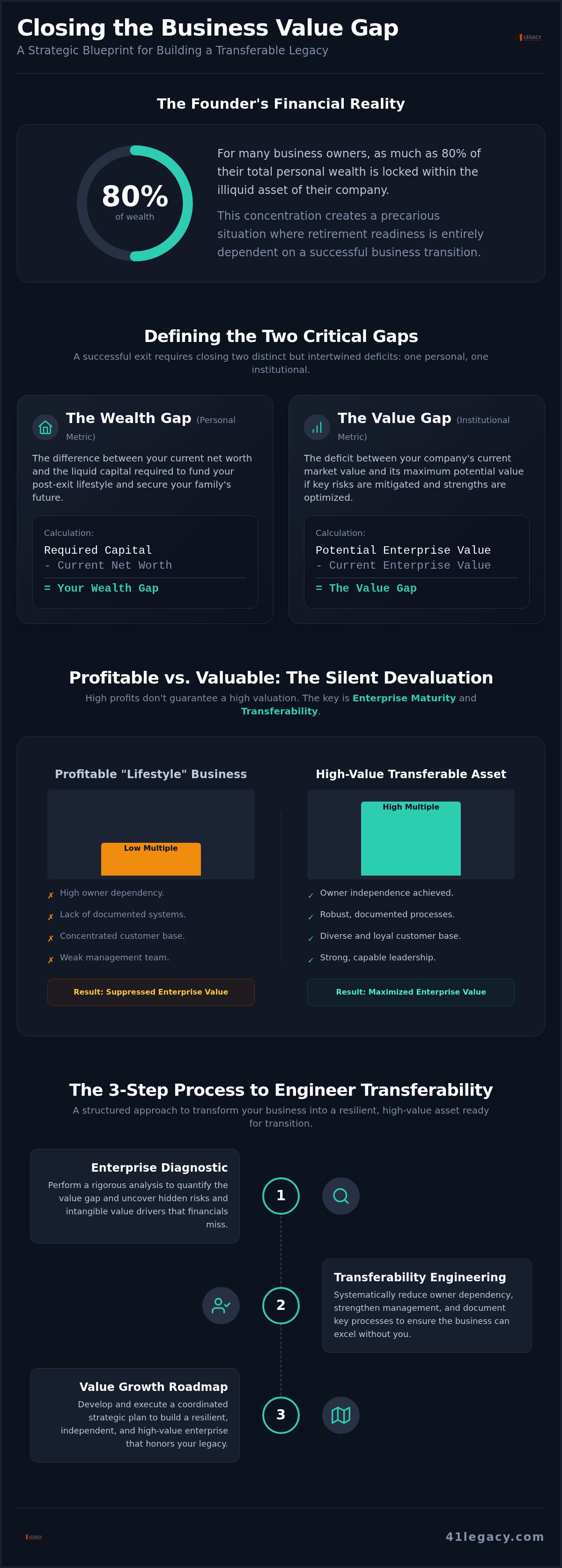
For many business owners, as much as 80% of their total wealth is locked within the illiquid asset of the company. While this concentration reflects a lifetime of devotion, it also creates a precarious situation where retirement readiness is entirely dependent on a successful transition. A Gap analysis in this context isn't just a financial exercise; it's a diagnostic of the business's ability to exist as a masterpiece independent of its creator.
The Financial Chasm: Wealth Gap vs. Value Gap
To understand the full scope of exit readiness, we must look at two distinct but intertwined deficits. The Wealth Gap is a personal metric. It's the difference between your current net worth and the amount needed to maintain your lifestyle after you step away. Conversely, the Value Gap is an institutional metric. It represents the deficit in the company's current market attractiveness compared to its potential. Analyzing these simultaneously is the only way to ensure your ultimate exit isn't just a transaction, but a realization of your legacy. We must distinguish between a lifestyle business, which provides for your present, and a transferable asset, which secures your future.
The Silent Devaluation: Why 'Profitable' Doesn't Always Mean 'Valuable'
A common misconception persists that high revenue or steady profits automatically translate into a high enterprise value. In reality, a business can be highly profitable yet virtually impossible to transfer if it relies too heavily on the founder's presence. Market buyers apply 'multiples' to earnings, but these multiples are often suppressed by underlying risks such as owner dependency or a lack of documented systems. The Value Gap is the unrealized potential of the enterprise's current structure. By performing a business value gap analysis, we identify the specific friction points that keep your company from reaching its peak valuation. We move beyond the balance sheet to evaluate the intangible qualities that make an organization resilient and attractive to a successor.
The Two Dimensions of the Gap: Wealth Goals vs. Enterprise Maturity
A business exists at the intersection of a creator's personal journey and the structural integrity of the organization itself. To achieve a successful transition, one must look at two distinct dimensions of readiness. The first is your personal financial requirement, and the second is the operational maturity of the enterprise. A comprehensive business value gap analysis serves as the bridge between these worlds, ensuring that the asset you've built is capable of supporting the life you've envisioned. Without this alignment, owners often fall into the "Owner’s Trap," overestimating their company’s market value while under-preparing for the realities of a transfer.
Personal Financial Readiness: The Wealth Gap Analysis
Your post-exit life requires a specific volume of liquid capital to sustain your lifestyle and protect your family's future. We often see owners rely on "provisional" plans that lack granular financial grounding. This ambiguity is a risk to your legacy. We act as a coordinator with your wealth managers to define a precise target value, ensuring your exit provides the necessary harvest for your years of labor. A Certified Exit Planning Advisor acts as the architect in this process, translating your personal needs into a structural mandate for the business.
Enterprise Diagnostics: Measuring the Maturity Gap
Enterprise maturity is the silent force that either multiplies or divides your earnings. While your profit loss statement shows what happened yesterday, a diagnostic of your "Four Capitals"—Human, Structural, Customer, and Social—reveals what will happen tomorrow. Understanding how to conduct a gap analysis within these capitals allows us to identify value drivers that attract successors and value detractors that create friction. This evaluation is a surgical health check of the business’s inner essence. It moves the organization from a state of owner-dependency to a state of independent excellence.
According to data from Teamshares, while 54% of small business owners claim to have a formal succession plan, a mere 8% feel fully prepared to transition. This preparation deficit is often rooted in a lack of business value gap analysis. When a business lacks maturity, its EBITDA is discounted by the market to account for risk. Conversely, a mature, transferable asset commands a premium. We help you move beyond mere profitability to build a resilient, plug-and-play asset. You can begin this journey by exploring our enterprise diagnostic services to see where your organization truly stands.
The Enterprise Diagnostic: Uncovering Hidden Risks in Your Life’s Work
The diagnostic process is not a mere financial audit; it's a surgical inquiry into the very soul of your life's work. While the balance sheet provides a historical record of past performance, it frequently fails to capture the future-facing health and resilience of the organization. Determining Enterprise Value requires an exploration of the intangible assets that a sophisticated buyer will actually pay for. We look for the "hidden essence" of the firm, identifying the structural integrity that allows a legacy to endure beyond its founder. It's about shifting the perspective from owner to steward.
The Diagnostic Framework: Beyond the P&L
We begin by examining Structural Capital. Are SOPs documented with the precision of an architect's blueprint, or do they exist only as tribal knowledge? Next, we evaluate Customer Capital. Revenue concentration in too few hands is a fragility that often surfaces during a business value gap analysis. Finally, we assess Human Capital. A business that relies on the founder's daily intervention is a lifestyle business, not a transferable masterpiece. These insights drive strategic change by highlighting exactly where the enterprise is vulnerable to market forces. We look for a leadership team capable of executing the vision without your constant oversight.
Identifying Value Detractors and Risk Multipliers
Legal and financial clutter acts as a risk multiplier that suppresses market interest. This includes unresolved disputes, unstandardized books, or informal contracts that haven't been reviewed in years. We adopt a "Quarterback" approach, coordinating with your CPAs and Attorneys to cleanse the enterprise of these friction points. This meticulous cleanup is essential to mitigate the "Risk Discount." If a buyer perceives instability or lack of coordination, they'll discount the value of your life's work to account for the perceived hazard. We also perform a Strategic Capacity Evaluation to determine if the business can handle significant growth without structural failure. Owner dependency remains the primary risk identified during diagnostics; it's the anchor that prevents a business value gap analysis from reaching its full potential. We focus on transforming the business into a plug-and-play asset that maintains its excellence under any stewardship.
Closing the Chasm: Strategies for Transferability and Owner Independence
Once the diagnostic exposes the silent deficits in your organization, the work of transformation begins. Closing the chasm revealed by a business value gap analysis requires more than just incremental revenue growth. It demands a deliberate process of "Transferability Engineering." This involves refining the organization until it becomes a plug-and-play asset, capable of maintaining its excellence under new stewardship. By focusing on these structural foundations, you ensure that your business value gap analysis leads to a measurable increase in the final harvest of your life's work.
To achieve this, the owner must undergo a personal evolution. You must shift from the role of the "Rainmaker," the primary driver of sales and decisions, to the role of the "Architect." As an architect, your focus is on the design and structural integrity of the system rather than the daily labor within it. This evolution is the cornerstone of effective owner dependency reduction. It allows the business to thrive as a living entity, separate from its creator.
The Blueprint for Transferability
Market attractiveness is built upon the foundation of documented systems. Transferable systems ensure that the "how" of your business is captured in SOPs rather than locked in the minds of a few key individuals. We also focus on the Management Multiplier, which involves cultivating a leadership team that buyers can trust to execute the vision independently. If a buyer feels they're purchasing a job rather than an asset, the value collapses. Ultimately, transferability is the measure of how easily a new owner can step into the founder’s shoes.
Strengthening Intangible Capital
To Increase Enterprise Value, we must look at the "essence" of the firm. This means moving from a person-based brand to a process-based brand. If the brand is the founder, the value disappears when the founder leaves. We also secure Social Capital by formalizing relationships with vendors and key clients, ensuring these bonds are institutional rather than personal. Our Monthly Implementation Support provides the steady, unhurried guidance needed to ensure these changes become permanent fixtures of the organization’s culture. This disciplined approach ensures the gap remains closed, preserving your legacy for the next generation of leadership.
Engineering Your Exit Readiness: The Roadmap to a Lasting Legacy
The journey from diagnostic discovery to the final harvest of your labor requires a master’s touch and architectural precision. It’s not enough to simply identify the distance between your current state and your ultimate goals. You must have a definitive guide to navigate that terrain, translating technical findings into a living strategy. This is the purpose of the Value Growth Roadmap. By viewing Exit Planning for Business Owners as a continuous discipline of value acceleration rather than a one-time event, you ensure the enterprise reaches its highest potential. A thorough business value gap analysis is merely the first step in this sophisticated evolution.
The Value Growth Roadmap: A Living Strategy
The Roadmap prioritizes initiatives by weighing their Value Impact against the Ease of Implementation. We don't believe in overwhelming a founder with a thousand minor tasks that fail to move the needle. Instead, we focus on high-leverage changes that strengthen the structural integrity of the firm. Accountability is the essential ingredient that prevents the pressures of daily operations from stalling progress. Our Monthly Strategic Advisory provides the steady, unhurried rhythm needed to keep the evolution on track, ensuring the business moves toward independence. This transition from the diagnostic phase to implementation is the bridge that leads to a successful and liquid future.
The Coordinated Advisory Team: Aligning for the Exit
A successful transition is rarely the result of a single specialist’s effort; it requires a harmony of disciplines working in concert. We act as the Quarterback for your professional advisory team, ensuring your CPA, Attorney, and RIA are all aligned under a single, uncompromising strategic vision. This coordination reduces the friction and confusion that often derail a transition at the final hour. While some industry voices suggest starting this process only two years before a sale, we know that closing a significant gap takes years of deliberate engineering. It’s a process of refining the inner essence of the organization until it becomes a plug-and-play asset that commands a premium.
We invite you to view your business not merely as a source of income or a daily obligation, but as your most significant piece of transferable art. A legacy isn't just the wealth you accumulate. It's the resilient, independent entity you build to thrive long after your tenure. By committing to a business value gap analysis and the subsequent roadmap, you're not just planning an exit. You're engineering a masterpiece that will maintain its excellence for generations to come.
Securing the Future of Your Life’s Work
Building a successful enterprise is a monumental achievement. Preparing that enterprise to thrive without your daily intervention is an act of profound stewardship. A rigorous business value gap analysis provides the strategic clarity needed to transform a personal lifestyle operation into a high-value, transferable asset. This process ensures that the wealth you've built remains liquid and protected, allowing you to transition on your own terms with absolute confidence.
Success requires a harmony between your personal financial goals and the structural maturity of the organization. We provide CEPA-Certified Strategic Advisory and Comprehensive Value Growth Roadmaps to guide this sophisticated evolution. By acting as the coordinator for your advisory team, we ensure that your CPA, attorney, and wealth managers are all aligned toward a single, uncompromising vision of excellence. This precision engineering reduces risk and maximizes the final harvest of your labor.
Your legacy is the masterpiece you leave behind. It deserves the care of a master artisan. Begin your Enterprise Diagnostic with 41 Legacy. It's time to build a business that reflects your dedication and stands as a testament to your enduring impact.
Frequently Asked Questions
What is the primary difference between a business valuation and a value gap analysis?
A business valuation provides a snapshot of the enterprise’s worth at a specific moment based on historical data. In contrast, a business value gap analysis identifies the discrepancy between that current figure and the financial capital required to fund your ultimate post-exit life. While a valuation is a record of the past, the gap analysis is a forward-looking diagnostic that serves as the foundation for your strategic growth roadmap.
How long does it typically take to perform a comprehensive enterprise diagnostic?
The timeline for a comprehensive enterprise diagnostic varies based on the complexity and scale of the organization, but the process typically spans several weeks. This duration allows for a surgical evaluation of the Four Capitals: human, structural, customer, and social. We move beyond surface-level metrics to uncover the inner essence of the business, ensuring every value driver and detractor is precisely identified before we engineer the roadmap for your legacy.
Can a business be highly profitable but still have a significant value gap?
A company can indeed be highly profitable while suffering from a significant value gap. Profitability measures current performance, but value is determined by the asset’s transferability and independence from the founder. If the earnings are tied to your personal involvement or tribal knowledge, a buyer will perceive high risk and apply a lower multiple. We focus on transforming those profits into enterprise value by building systems that thrive without your daily intervention.
What are the most common 'value detractors' found in mid-market companies?
Mid-market companies frequently struggle with several common value detractors that suppress their market attractiveness. These include high customer concentration, where revenue relies on a handful of clients, and a lack of documented SOPs, which forces the business to rely on tribal knowledge. Additionally, unresolved legal or financial clutter creates a "risk discount." Identifying these during a business value gap analysis allows us to clean up the enterprise and protect its long-term health.
How much does owner dependency actually impact the final sale price of a business?
Owner dependency is often the most significant factor in a reduced final sale price. If the business relies on your personal relationships or technical skill to function, it's a lifestyle business rather than a transferable asset. Buyers view this as a precarious risk, often leading to steep discounts or the requirement of a lengthy earn-out period. Reducing this dependency is essential to ensure the organization maintains its excellence and commands a premium valuation in the market.
Is a business value gap analysis necessary if I plan to pass the company to my children?
A gap analysis is vital even for internal transitions to children or key employees. You must ensure the business can support your retirement while remaining healthy enough for the next generation to lead it. Without this diagnostic, you risk passing on a fragile asset that may fail under new stewardship. A structured transition requires the same level of transferability engineering as an external sale to protect both your legacy and your family’s future.
How often should a value growth roadmap be updated?
A value growth roadmap is a living strategy that should be reviewed monthly and formally updated as major milestones are achieved. Market conditions and internal operational maturity evolve, requiring a steady, unhurried adjustment of priorities. We provide monthly implementation support to ensure the organization stays aligned with the strategic vision. This continuous refinement prevents stagnation and ensures the business remains in a state of constant readiness for a successful and liquid transition.
What role does my CPA play in the value gap analysis process?
Your CPA serves as a critical source of technical financial data and historical performance records. Within our "quarterback" framework, we coordinate with your CPA to ensure the financial books are standardized and transparent for a potential successor. While we don't provide tax or accounting services, we align the CPA’s expertise with the broader strategic vision of the enterprise. This collaboration ensures that the financial foundation of the business supports its ultimate market attractiveness and long-term health.

Article by
Mike Laskowski
Mike Laskowski is a Business Value Growth Strategist who helps business owners uncover the truths that drive their performance, risk, and readiness. Blending forensic interviewing from a 26‑year federal career with Strategic Capacity analysis and CEPA methodology, he works upstream to reduce owner dependency, increase transferability, and strengthen enterprise value. Mike guides founders through clarity, operational evolution, and transition readiness so their companies become transferable, owner‑independent assets that endure beyond the founder.
Disclaimer
This article is for educational and informational purposes only and does not provide legal, tax, investment, or business brokerage advice. 41 Legacy does not offer M&A brokerage services, legal document drafting, tax preparation, or investment advisory services. Business owners should consult licensed professionals in those disciplines before making decisions related to business transactions, legal matters, tax strategy, or financial planning. All examples are illustrative and may not apply to your specific situation.

