
Transferability & Owner Dependency
Business Value Gap Analysis: Bridging the Divide Between Worth and Legacy
A business is more than a sequence of transactions; it's a living legacy that requires careful curation to survive the transition from founder to future. Many owners discover too late that their most significant asset is inextricably tied to their own daily presence, creating a silent risk to their long-term security. This realization often brings a profound sense of uncertainty. We believe that the true measure of your success is the enduring strength of the enterprise you've built. Performing a rigorous business value gap analysis is the essential first step in ensuring that your life's work remains vibrant when you choose to step away.
You've likely sensed a disconnect between the current reality of your balance sheet and the financial aspirations you hold for your next chapter. It's a common tension, but it's one that can be resolved through strategic clarity. In this article, you'll learn how to identify the specific dollar figure that stands between your current valuation and the independent exit you deserve. We'll explore the mechanics of reducing owner dependency and provide a roadmap to increase enterprise value. This process transforms your company into a resilient, transferable asset that honors your heritage while securing your future.
Key Takeaways
- Distinguish between the personal wealth gap and the enterprise value gap to gain absolute clarity on your ultimate financial horizon.
- Identify how owner dependency serves as the primary constraint on your company's marketability and the preservation of its legacy.
- Utilize a rigorous business value gap analysis to quantify the precise distance between your current valuation and the proceeds required for a successful transition.
- Implement Enterprise Diagnostics to establish a technical baseline for your company’s health and its capacity for independent operation.
- Discover how to engineer a transferable asset that thrives without the founder's daily involvement, ensuring the essence of the business endures.
What is a Business Value Gap Analysis?
A business is a tapestry of decisions woven over decades. Too often, owners view their success through the lens of annual revenue, failing to see the structural integrity of the asset itself. A Gap analysis in a general sense identifies where performance falls short of potential; however, a business value gap analysis is far more specific. It identifies the precise chasm between the current market value of your enterprise and the net proceeds required to sustain your lifestyle and secure your legacy after you transition. This is the foundational step of any professional Exit Readiness Assessment, providing the technical precision needed to move from hope to certainty.
There is a vital distinction between a performance gap and a value gap. A performance gap measures how much more profit you could generate today by refining operations. In contrast, a value gap measures the transferability of your business. It asks a deeper question: if you were removed from the equation tomorrow, what would a sophisticated buyer actually pay for the remaining structure? At 41 Legacy, we view this analysis not as a mere financial audit, but as a philosophical shift. You must begin to see your business as a product to be engineered for a buyer, rather than just a vehicle for personal income.
The Silent Threat to Exit Readiness
Most owners only discover their value gap when they are standing at the threshold of retirement, only to realize the market doesn't value their life's work as highly as they do. This realization carries a heavy emotional weight. It's the moment when the dream of a successful, independent exit meets the cold reality of a business that is too dependent on its founder. We act as the guardian of this transition. Through precise Enterprise Diagnostics, we reveal these vulnerabilities early enough to address them, ensuring that your legacy is preserved through a business that can thrive in your absence.
Beyond EBITDA: The Essence of Enterprise Value
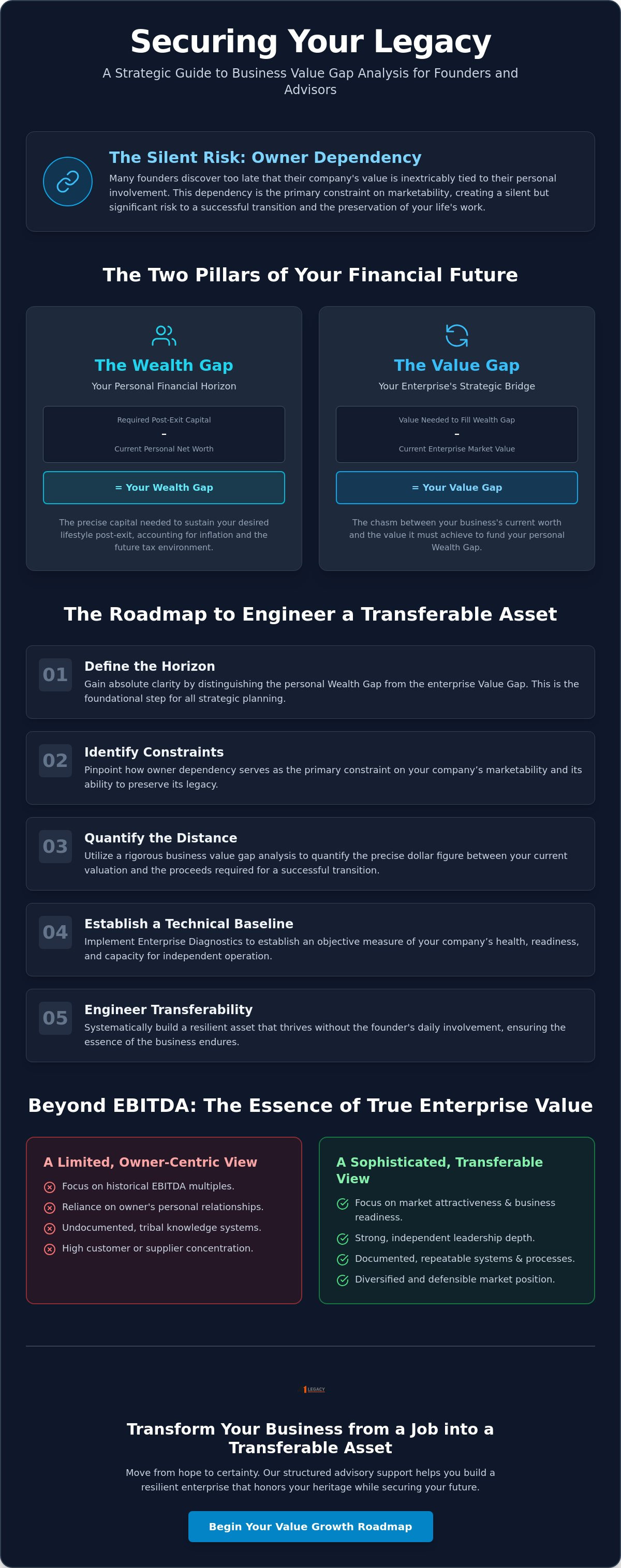
While industry multiples and EBITDA are common benchmarks, they are only half the story in a comprehensive business value gap analysis. True enterprise value is driven by market attractiveness and business readiness. A company might have impressive profits, but if those profits are tied to a single customer or the owner’s personal relationships, the value gap remains wide. We look past the surface numbers to evaluate the inner essence of the organization, focusing on the systems and leadership depth that make the company a durable asset. The Value Gap is the delta between current enterprise reality and future legacy requirements.
The Two Pillars: Distinguishing the Wealth Gap from the Value Gap
A legacy is not merely a destination; it's a structural achievement. To navigate the transition of an enterprise, one must master the relationship between two distinct financial realities. While a business value gap analysis provides the technical blueprint for the company, it must be anchored by an understanding of the owner's personal horizon. These two pillars, the Wealth Gap and the Value Gap, work in a silent, sophisticated harmony to define the success of your stewardship. They aren't just figures on a spreadsheet; they represent the architecture of your future freedom.
Calculating the Wealth Gap
The Wealth Gap is the distance between your current personal net worth and the total capital required to sustain your desired lifestyle after the exit. Defining this finish line requires extreme precision. It's an intimate calculation that accounts for the nuances of your family’s future, including projected inflation and the 2026 federal estate tax environment, where the exemption stands at $15 million per individual. Utilizing enterprise diagnostics allows us to uncover the hidden numbers that often elude a casual glance, ensuring that your post-exit roadmap is built on a foundation of absolute clarity. We coordinate closely with your professional advisors to validate these figures, ensuring your personal financial security is never left to chance.
Identifying the Value Gap
Once the personal requirement is established, we turn our attention to the enterprise itself. The Value Gap is the difference between what your business is worth today and what it must be worth to fill your Wealth Gap. This is where the Valuation Gap often reveals itself, as owners frequently overestimate the market's perception of their company's readiness. A "back of the napkin" estimate is insufficient for a connoisseur of business. Instead, a formal business value gap analysis evaluates the asset through the lens of a sophisticated institutional buyer. By employing Transferability Engineering, we refine the inner essence of the business, making it a more attractive and durable asset. This meticulous process reduces risk and increases the certainty of your legacy. To begin refining your company's trajectory, consider how a Value Growth Roadmap can bring these two pillars into perfect alignment.
Owner Dependency: The Primary Driver of the Value Gap
The founder is often a business’s greatest artisan, yet their very presence can become the enterprise’s most significant vulnerability. While profitability might suggest success, a business that relies on the founder’s daily intuition is inherently fragile. In the context of a business value gap analysis, owner dependency acts as a heavy anchor, dragging down the potential valuation of even the most vibrant companies. A sophisticated buyer isn't just looking for cash flow. They're looking for a machine that runs without the person who built it. When the essence of the business is the owner, the asset lacks the structural integrity required for a high-value transfer.
Many owners unknowingly fall into the 'Rainmaker Trap.' They're the most effective salespeople, the primary problem solvers, and the keepers of the most vital client relationships. While this might drive growth today, it devalues the enterprise for tomorrow. Institutional buyers view this as a 'risk discount.' If the revenue walks out the door with the owner, the business isn't a transferable asset; it’s merely a personal practice. To address this, we conduct a Strategic Capacity Evaluation to determine if your leadership team possesses the depth to thrive independently. This is a study of the inner essence of your organization, revealing whether your team can execute the vision or if they're simply waiting for your next instruction.
The Architecture of Transferability
Moving from owner-centric operations to process-centric excellence is a form of industrial artistry. It requires a fundamental shift in perspective. Documented SOPs aren't just administrative burdens; they're the structural bridge across the value gap. They ensure that the precision of your work is preserved across generations of employees. As the 'Quarterback' for your professional advisory team, we ensure these processes align with your ultimate exit vision, turning individual brilliance into organizational habit. This engineering of transferability is what transforms a company into a legacy.
Reducing Risk to Increase Multiples
A business with 20% annual growth and low owner dependency is often more valuable to a buyer than a company with 40% growth that hinges on the founder’s genius. The former is a durable asset, while the latter is a high-risk gamble. By identifying 'Value Detractors' that standard accounting might overlook, we help you transition from being a central cog to a steward of a lasting legacy. Reducing this dependency is the most effective way to expand your valuation multiples and close the divide revealed in your business value gap analysis. It’s about building something that doesn’t just survive you, but honors you through its continued success.
Conducting the Analysis: 5 Steps to Close the Divide
The execution of a business value gap analysis is not a singular event but a disciplined progression toward enterprise excellence. It requires a curatorial eye to separate the current reality of the business from its ultimate potential. To move from a founder-centric operation to a durable legacy, we follow a rigorous five-step process designed to provide absolute strategic clarity. This methodology ensures that every adjustment to the enterprise is intentional, measured, and aligned with your personal horizon.
- Step 1: Perform an Enterprise Diagnostic. We begin by establishing a technical baseline. This audit evaluates the current market value of the business through a lens of extreme precision, identifying the structural strengths and vulnerabilities that define its worth today.
- Step 2: Define the Legacy Goal. We articulate the total net proceeds required for a successful transition. This figure must account for your post-exit lifestyle, family obligations, and the 2026 federal estate tax environment, where the individual exemption stands at $15 million.
- Step 3: Quantify the Gap. This is the moment of clarity. We identify the specific dollar amount between your baseline value and your legacy goal, revealing the strategic void that must be filled before an exit can be considered successful.
- Step 4: Create a Value Growth Roadmap. We prioritize the 20% of strategic actions that will drive 80% of the increase in enterprise value. This focuses your resources on the most impactful refinements first.
- Step 5: Execute with Accountability. Strategic plans often fail due to a lack of momentum. We provide monthly implementation support to ensure that the roadmap is followed with the meticulous care your legacy deserves.
The Diagnostic Phase
Precision is the hallmark of a master. During the diagnostic phase, we evaluate 11 functional areas of the business, from leadership depth to customer concentration, to determine your true exit readiness. Most owners rely on intuition or outdated multiples to guess their company's worth. We replace "I think" with "I know" by using data-driven insights to establish a definitive valuation. This audit provides the technical precision required to understand exactly where the business stands in the eyes of a sophisticated buyer. To establish your baseline, begin with a comprehensive Enterprise Diagnostics assessment.
The Value Growth Roadmap
A gap is not a failure; it is an engineering challenge. We transform the findings of your business value gap analysis into a sequence of strategic sprints. This roadmap focuses heavily on Transferability Engineering, ensuring that the essence of your business is preserved even as its dependency on you is reduced. By focusing on market attractiveness and operational stability, we provide a clear path forward that moves beyond mere profitability. The Value Growth Roadmap serves as your architectural guide, ensuring that every effort contributes directly to closing the divide and securing your future independence.
The 41 Legacy Approach: Engineering a Transferable Asset
At 41 Legacy, we see ourselves as more than advisors; we are the custodians of your life’s work. Building a company is a creative act of will. Ensuring it survives your departure is a technical feat of engineering. We operate at the rare intersection of these disciplines, where the preservation of a legacy meets the precision of enterprise diagnostics. Our business value gap analysis serves as the blueprint for this transformation. It is more than a calculation of worth; it is a diagnostic that reveals how to evolve from a business owner into a steward of a lasting enterprise. This shift allows the essence of your company to endure long after you have stepped away.
We assume the role of the 'Quarterback' for your professional advisory team to ensure this transition is seamless. High-level strategy requires the same level of coordination as a master artisan’s workshop. Your CPA, attorney, and wealth advisors are essential specialists. Yet, their work must be synchronized to be effective. We provide the authoritative oversight needed to align these professionals toward a single, strategic exit goal. This ensures that every tactical decision, from tax mitigation to legal structure, contributes directly to closing the gap identified in your business value gap analysis.
Coordinating Your Advisory Team
We bring harmony to the complex landscape of professional advice. By aligning your specialists toward a single exit goal, we eliminate the friction that often stalls progress. This unified approach is vital in the July 2026 landscape, where the federal estate tax exemption stands at $15 million and variable SBA 7(a) loan rates hover between 9% and 11.5%. We ensure that your tax planning and legal structures work in concert with your value growth goals. There is a profound peace of mind that comes from knowing your entire team is moving in the same direction, guided by a singular, uncompromising vision of perfection.
Securing Your Legacy
True exit readiness is simply good business strategy applied with extreme precision. It is the process of refining the inner essence of your company until it can thrive independently of its creator. When you prepare for the most important transaction of your life, you should do so with the confidence of a connoisseur who has left nothing to chance. Our approach ensures that your legacy is not just preserved; it is fortified for the future. We invite you to begin your Enterprise Diagnostic with 41 Legacy today to start your journey toward a successful, independent transition.
Refining the Architecture of Your Future Freedom
Your business is a masterpiece that deserves a transition as deliberate as its creation. We’ve explored how a business value gap analysis provides the technical clarity needed to bridge the divide between your current reality and your ultimate legacy. By distinguishing your personal wealth needs from the enterprise’s marketability and systematically reducing owner dependency, you transform a daily operation into a durable, transferable asset. This shift from owner to steward ensures that the essence of your work is preserved for the next generation.
Securing this transition requires a specialized hand. Led by a Certified Exit Planning Advisor (CEPA), our team acts as the strategic quarterback for your professional advisors, ensuring every tactical move aligns with your long-term vision. We focus on engineering transferability to eliminate risk and maximize the proceeds of your life’s work. It’s time to move beyond uncertainty and toward a future defined by precision and peace of mind. Secure your legacy and begin your Exit Readiness Assessment with 41 Legacy. You’ve spent a lifetime building this asset; let’s ensure it’s ready to stand on its own.
Frequently Asked Questions
What is the difference between a business valuation and a value gap analysis?
A business valuation is a technical snapshot of what your enterprise is worth today, while a business value gap analysis is a strategic comparison of that worth against your personal legacy requirements. The valuation tells you where you stand; the gap analysis reveals the distance to your destination. It provides the architectural clarity needed to understand if your life's work can truly sustain your future independence.
How long does it typically take to close a significant value gap?
Closing a significant gap typically requires a horizon of three to five years. This duration allows for the meticulous engineering of transferability and the reduction of owner dependency. It's a time-intensive process of refining the inner essence of the organization. Rushing this craftsmanship often results in a fragile structure that fails to command its full potential value during a transition.
Can a business have a high EBITDA but still have a large value gap?
High profitability doesn't always translate to a transferable asset. A company can boast impressive EBITDA but still face a wide gap if those profits are inextricably tied to the founder’s personal relationships or intuition. Buyers seek a machine that operates with precision in your absence. If the founder is the only source of value, the risk discount applied by institutional buyers will remain high.
Is a value gap analysis only for owners looking to sell to a third party?
This analysis is vital for any transition, whether it's an external sale or an internal transfer to family or employees. Even in a legacy transition, the business must be healthy enough to thrive independently. A business value gap analysis ensures the founder’s financial security is preserved while the successor inherits a robust, well-engineered asset capable of enduring across generations.
What are the most common 'value detractors' found during a diagnostic?
The most frequent detractors are owner dependency, customer concentration, and a lack of documented operational excellence. These factors signal high risk to a potential steward. When a business relies on a single individual or a handful of clients, its structural integrity is compromised. Our diagnostics identify these vulnerabilities early, allowing for the precise adjustments needed to fortify the enterprise and enhance its marketability.
How often should a business owner update their value gap analysis?
We recommend updating the analysis annually to ensure your roadmap remains in harmony with shifting market dynamics. In a world where interest rates and tax exemptions, such as the 2026 federal estate tax limit of $15 million, are in constant flux, your strategy must be agile. Regular audits allow you to refine your trajectory and maintain the momentum required for a successful, independent exit.
Who should be involved in the value gap analysis process?
The process is most effective when coordinated by a Certified Exit Planning Advisor acting as the quarterback for your professional team. This collective should include your CPA, attorney, and wealth advisor. Their specialized knowledge must be synchronized toward a single strategic goal. This unified approach ensures that every financial and legal decision contributes to the health and transferability of the enterprise.
What happens if the value gap is too large to close before my desired exit date?
If the gap remains wide as your exit date approaches, you face a choice between extending your timeline or adjusting your post-exit aspirations. Alternatively, you may choose to focus on aggressive value growth sprints to maximize the asset's worth in the remaining time. Early preparation is the only way to avoid these compromises, ensuring your legacy is preserved without financial sacrifice.
Disclaimer
This article is for educational and informational purposes only and does not provide legal, tax, investment, or business brokerage advice. 41 Legacy does not offer M&A brokerage services, legal document drafting, tax preparation, or investment advisory services. Business owners should consult licensed professionals in those disciplines before making decisions related to business transactions, legal matters, tax strategy, or financial planning. All examples are illustrative and may not apply to your specific situation.