
Business Value Gap Analysis: A Strategic Guide to Building a Transferable Asset
The true measure of your organization isn't found in the net profit on your balance sheet, but in its ability to thrive the moment you walk away. You've spent decades as a meticulous guardian of your firm's heritage, yet you may still feel the quiet weight of uncertainty regarding its actual market attractiveness. It's a common burden for owners who realize that the very success they've built might be too dependent on their personal presence to survive a transition.
By performing a rigorous business value gap analysis, you can uncover the hidden distance between your current valuation and the financial horizon required for a meaningful legacy. We believe your business is a living entity with a story that deserves to continue. This guide provides the strategic clarity needed to bridge that gap, offering a roadmap to reduce owner dependency and harmonize your professional advisory team. You'll learn how to refine your company into a transferable asset that preserves its inner essence while functioning with the technical precision of a masterwork.
Key Takeaways
- Quantify the hidden distance between your current valuation and your ultimate exit goals through a rigorous business value gap analysis.
- Shift from founder dependency to true enterprise value by applying the principles of transferability engineering to your organization.
- Align your disjointed advisory team under a singular Value Growth Roadmap to ensure every specialist serves a unified strategic vision.
- Use enterprise diagnostics to surgically identify the value drivers that enhance market attractiveness and prepare your firm for its next chapter.
- Transition from owner to steward by building a legacy that maintains its essence and flourishes long after your transition.
What is Business Value Gap Analysis?
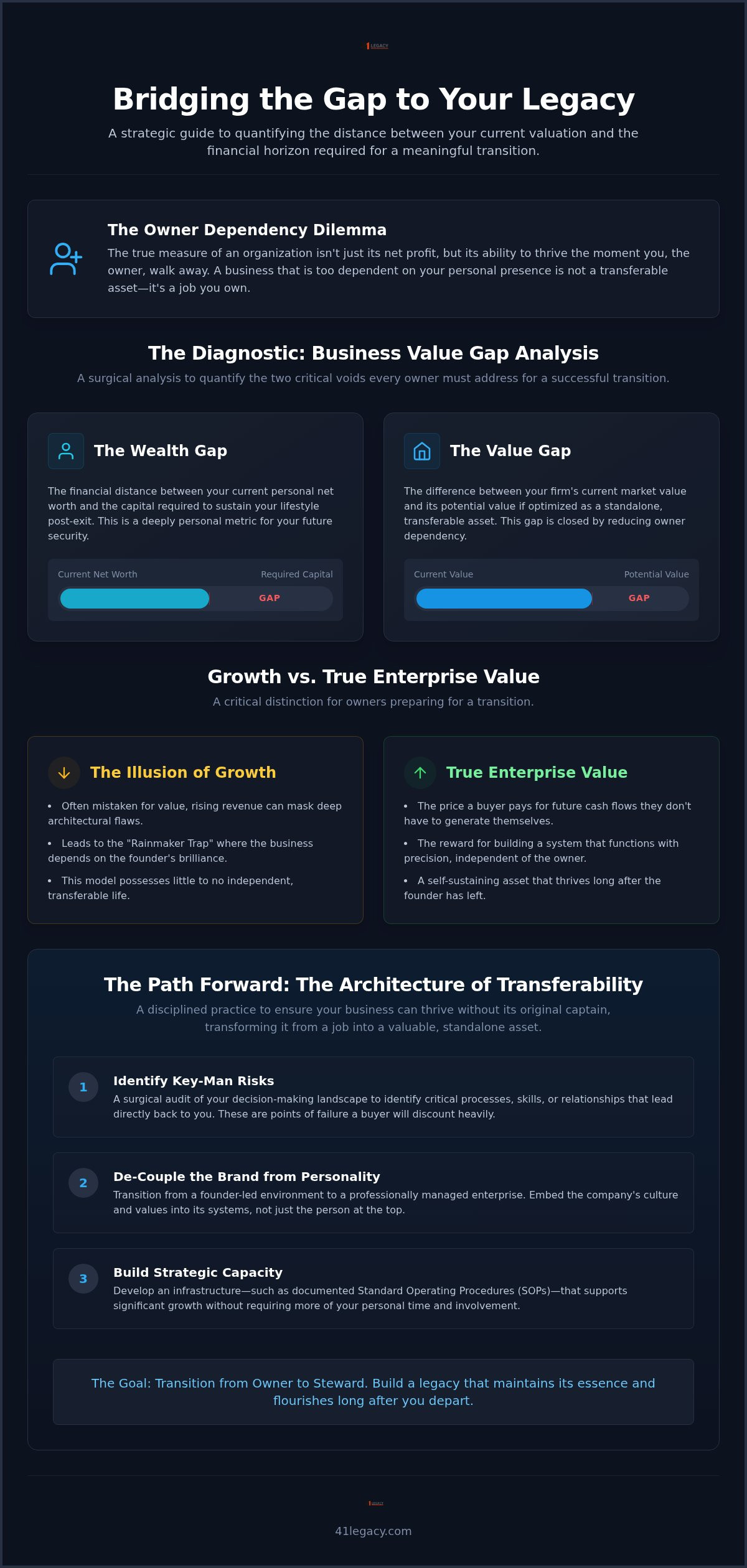
A business is more than a sequence of transactions; it's a living entity with a story to tell. To understand where that story might lead, a steward must perform a rigorous Gap analysis to identify the distance between the present reality and a future of enduring significance. In the context of transition planning, a business value gap analysis serves as a surgical diagnostic. It's designed to quantify the two most critical voids an owner faces: the Wealth Gap and the Value Gap.
The Wealth Gap represents the financial distance between your current net worth and the capital required to sustain your lifestyle after you exit the firm. It's a deeply personal metric that ensures your post-transition life is as refined as the one you've built. Conversely, the Value Gap measures the difference between what your firm is worth today and its potential value if it were optimized as a standalone asset. While traditional coaching often focuses on the behavior of the leader, this advisory focuses on the structural integrity of the enterprise itself. We don't just aim for incremental improvement; we aim for the engineering of a masterpiece.
The Distinction Between Growth and Value
Growth is often mistaken for value. Rising revenue can mask deep architectural flaws that eventually decrease market attractiveness. This often leads to the "Rainmaker Trap," where a business is so dependent on the founder's personal brilliance that it possesses no independent life. True enterprise value is the price a sophisticated buyer pays for future cash flows they don't have to work for. It's the reward for building a system that functions with the precision of a fine timepiece, thriving long after the artisan has left the workshop.
The Role of the CEPA (Certified Exit Planning Advisor)
Navigating these intricacies requires a specific professional altitude. A Certified Exit Planning Advisor (CEPA) brings a holistic perspective that balances business, personal, and financial readiness. This ensures that every decision respects the heritage of the firm while preparing it for a new chapter. At 41 Legacy, we use this expertise to move beyond surface-level consulting. We act as curatorial experts of your vision, utilizing a business value gap analysis to provide the clarity needed for a successful transition. Our strategic advisory services are designed to transform your firm into a transferable asset that preserves its essence while operating with technical excellence.
The Architecture of Transferability: Reducing Owner Dependency
A business is a living entity, a vessel for a specific vision and a repository of a unique heritage. For this entity to endure, it must possess its own systems, culture, and momentum, independent of the hands that first shaped it. We view Transferability Engineering as the disciplined practice of ensuring this vessel can sail without its original captain. It's an architectural endeavor that moves beyond simple operations to create a standalone asset. When we conduct a business value gap analysis, owner dependency frequently emerges as the single greatest risk factor. If the essence of the firm is inextricably tied to your daily presence, the business is a job you own rather than an asset you can transfer.
Many owners hesitate at the thought of making themselves obsolete. They fear that by stepping back, they lose their connection to the work they love. We invite you to reframe this transition. It isn't an act of disappearance; it's an act of stewardship. By detaching the firm's survival from your personal involvement, you're actually honoring the legacy you've built. You're giving the organization the gift of a future that isn't capped by your own capacity. Through Transferability Engineering, we help you transform your role from the primary engine of growth to the guardian of a self-sustaining asset.
Identifying Key-Man Risks
The first step in this evolution is a surgical audit of your decision-making landscape. We examine how many critical threads lead directly back to you. If your personal charisma or technical skill is the only thing holding a client relationship or a production process together, you've created a key-man risk that buyers will discount heavily. The goal is to de-couple the brand's essence from your personality. This requires a transition from a founder-led environment to a professionally managed enterprise where the culture and values are embedded in the systems, not just the person at the top.
Building Strategic Capacity
Strategic capacity is the infrastructure's ability to support significant growth without requiring more of your time. Think of documented Standard Operating Procedures (SOPs) as the blueprints of a masterpiece. They ensure that every task is executed with technical excellence and surgical precision, regardless of who's performing it. This level of clarity attracts premium buyers who seek turnkey operations. They aren't just looking for revenue; they're looking for a proven machine. A business value gap analysis quantifies the lack of this capacity, showing you exactly where the "blueprints" are missing. When these systems are polished to a high sheen, the business gains the freedom to thrive on its own terms.
The Quarterback Advantage: Synchronizing Your Advisory Team
A masterpiece is rarely the result of a single hand working in isolation; it requires the harmonious coordination of various specialists, each a master of their own craft. Too often, business owners find themselves at the center of a discordant symphony. Your CPA focuses on tax mitigation, your attorney on risk insulation, and your wealth manager on portfolio diversification. While each professional is essential, they frequently operate in silos, offering advice that may be technically sound yet strategically conflicting. This fragmentation creates friction that can stall momentum and obscure the clarity provided by your business value gap analysis.
We believe the steward of a great enterprise deserves a unified front. 41 Legacy assumes the role of the Quarterback, a strategic point of contact that synchronizes your existing advisory team toward a singular Value Growth Roadmap. We don't replace your trusted legal or tax professionals. Instead, we amplify their expertise by ensuring their contributions align with the overarching goal of building a transferable asset. This coordination transforms a collection of specialists into a dedicated team, united by an uncompromising vision for your firm's future.
Aligning Decisions Toward Exit Readiness
The tension between short-term tax strategies and long-term valuation is a primary source of strategic discord. A CPA may suggest aggressive deductions to minimize taxable income, yet those same deductions can artificially suppress your EBITDA, negatively impacting the findings of a business value gap analysis. Without a central coordinator, these decisions are made in a vacuum. We ensure that every financial and legal maneuver is weighed against its impact on enterprise value. Learn how 41 Legacy quarterbacks your advisory team to ensure your firm's technical health supports its ultimate market attractiveness.
Monthly Implementation and Accountability
Strategic clarity is a pursuit that requires a steady, unhurried rhythm. Many organizations suffer from the "roadmap on a shelf" syndrome, where brilliant plans are drafted but never executed due to the pressures of daily operations. Our Monthly Implementation Support maintains a professional-room altitude, providing the accountability needed to move the needle on complex transition goals. These sessions aren't hurried transactions; they're thoughtful reviews of your progress. This rhythmic progression ensures that the engineering of your legacy remains a priority, allowing the business to evolve with the meticulous care of a high-end restoration.
From Diagnostics to Execution: The Value Growth Roadmap
Before a masterpiece can be restored, its current state must be documented with absolute fidelity. Enterprise Diagnostics serves as this essential first step, acting as a curatorial review of the firm's structural health. It is a comprehensive evaluation that measures your company’s readiness against the cold reality of market attractiveness. This phase allows us to quantify the Value Gap with surgical precision, revealing the specific structural weaknesses that prevent the firm from reaching its full potential. By conducting a business value gap analysis, we move beyond anecdotal evidence to establish a baseline of truth from which all strategic decisions flow.
An honest assessment is often uncomfortable, yet it's the only path to a lasting legacy. Identifying hidden risks that devalue the asset allows you to address them before they become insurmountable obstacles during a transition. This diagnostic process doesn't merely point out flaws; it provides the strategic clarity required to transform a founder-led company into a high-performance, transferable asset. It's the difference between guessing at your firm's worth and knowing exactly what levers to pull to increase its enterprise value.
The Value Audit: Measuring What Matters
Real value often resides in the intangible essence of the organization, far beneath the surface of traditional financial reporting. While a balance sheet provides a necessary financial snapshot, Enterprise Diagnostics uncovers the "hidden" business that sophisticated buyers actually covet. We evaluate the strength of your brand equity, the depth and autonomy of your human capital, and the security of your customer diversification. Central to this audit is a clear understanding of EBITDA, or Earnings Before Interest, Taxes, Depreciation, and Amortization. In plain terms, this is the core operational profit your business generates before accounting for specific financing choices or tax structures. It's the standard foundation of valuation, and optimizing it is a primary goal of our strategic stewardship.
Executing the Roadmap
Diagnostic findings are only as valuable as the action they inspire. We transform these insights into a prioritized Value Growth Roadmap, a document that serves as the guiding principle for your firm's evolution. This isn't a generic list of improvements; it's a strategic sequence designed to build momentum. We focus on high-impact wins first, establishing a rhythmic progression toward technical excellence. These tasks often involve Transferability Engineering, ensuring that the organization’s systems and culture can thrive without the founder's constant intervention. 41 Legacy provides the structured advisory support needed to maintain the pace of implementation, ensuring your roadmap leads to a tangible result. Begin your Enterprise Diagnostics process to gain the clarity required to bridge the findings of your business value gap analysis.
Stewardship and the Preservation of Legacy
Value growth advisory isn't merely a financial exercise; it's a journey of stewardship. You've spent years breathing life into your organization, and its story deserves a continuation that honors its origin. By viewing the firm as a living entity, you transition from a daily operator to a guardian of history. This perspective ensures the company's essence is preserved, even as its ownership eventually changes hands. It's a commitment to the meticulous preservation of what you've built, ensuring that the technical excellence of the past informs the innovations of the future.
We often remind our clients that a business built to be sold is a significantly better business to own today. When you bridge the distance identified in a business value gap analysis, you create an asset that operates with technical precision and strategic clarity. This isn't just about the final transaction. It's about the daily freedom that comes from knowing your enterprise can flourish without your constant intervention. You're building a legacy that maintains its value regardless of your personal involvement.
The Peace of Mind in Readiness
There's a profound emotional weight lifted when an owner realizes their life's work is a truly transferable asset. Readiness provides options rather than obligations. Whether you eventually pursue an internal transfer to key employees, an ESOP, or an external sale, being prepared allows you to dictate the terms of your departure. You're no longer tethered by the fear that the firm will crumble without you. Instead, you're building a lasting impact that reflects your uncompromising vision of perfection. This readiness is the ultimate expression of respect for the business you've created.
Engaging with 41 Legacy
The ideal time to begin this process isn't when you're ready to leave, but while you still have the energy to lead. Starting an assessment today provides the runway needed to implement a Value Growth Roadmap with the care it requires. High-end craftsmanship can't be rushed, and the engineering of a transferable asset is no exception. We invite the connoisseur of business to move from theoretical understanding to concrete action. By choosing to act now, you ensure that your firm's heritage is protected and its future value is secured. Our team of specialists is ready to provide the professional altitude necessary to navigate these complexities. Begin your Enterprise Diagnostics with 41 Legacy to transform your business value gap analysis into a tangible blueprint for success.
Engineering the Future of Your Enterprise
Building an organization that flourishes independently of its founder is the ultimate expression of stewardship. It's a commitment to the technical precision of the enterprise and the preservation of its unique heritage. By utilizing a business value gap analysis, you gain the strategic clarity required to identify the distance between your current valuation and your ultimate exit goals. This diagnostic process is the first step in transforming your firm into a transferable asset that carries your vision into its next chapter of history.
At 41 Legacy, we provide the professional-room altitude necessary to synchronize your advisory team toward a unified roadmap. Led by a Certified Exit Planning Advisor (CEPA), our national reach ensures that your firm's transferability is engineered with surgical care. We act as the Quarterback for your existing specialists, ensuring that every decision reinforces the long-term health of your legacy. The time to refine your masterpiece is now, ensuring that your firm remains a source of pride and performance for years to come.
Secure your legacy and bridge the Value Gap with 41 Legacy. We're here to help you turn your life's work into a self-sustaining asset that honors its past while securing its future.
Frequently Asked Questions
What is the difference between a business coach and a value growth advisor?
A business coach typically focuses on behavioral performance and leadership mindset, while a value growth advisor focuses on the structural engineering of the enterprise as a transferable asset. We look at the firm as a living entity, ensuring its systems and capacity can thrive without the founder's presence. Our work is rooted in technical diagnostics and strategic clarity rather than general motivation.
How does owner dependency affect the ultimate sale price of my business?
Owner dependency acts as a significant risk multiplier that can drastically reduce the multiple a buyer is willing to pay. If the organization’s essence is tied to your personal charisma or decision-making, the business is perceived as a job rather than a self-sustaining asset. Reducing this dependency is a core objective of Transferability Engineering, turning a founder-led company into a professionally managed enterprise.
What is a Value Gap and how is it calculated in exit planning?
The Value Gap is the difference between the current market value of your firm and its potential value if it were fully optimized for transferability. It's calculated during a business value gap analysis by comparing your existing EBITDA and multiples against industry benchmarks for best-in-class companies. This diagnostic identifies the specific structural improvements needed to reach your ultimate financial goals.
Why do I need a value growth advisor if I already have a CPA and an attorney?
While CPAs and attorneys provide essential technical expertise in their respective silos, they often lack a unified strategic vision for exit readiness. We act as the Quarterback, synchronizing these specialists to ensure their advice aligns with your Value Growth Roadmap. Our role is to maintain a professional-room altitude, coordinating every legal and financial decision toward the common goal of enterprise value growth.
How long does the business value growth process typically take to show results?
Meaningful results in value growth typically emerge within six to twelve months of consistent implementation. This unhurried rhythm reflects the time-intensive nature of high-end business craftsmanship. While some high-impact wins can be addressed quickly, the deeper work of Transferability Engineering requires a steady progression to ensure the new systems are polished to a high sheen and fully integrated into the culture.
What exactly happens during an Exit Readiness Assessment?
An Exit Readiness Assessment is a rigorous diagnostic that evaluates both the attractiveness of the company and your personal financial readiness. We utilize a business value gap analysis to quantify your Wealth Gap and identify hidden risks within the organization’s infrastructure. This process results in a baseline of truth, providing the strategic clarity needed to begin your journey of stewardship.
Can business value growth advisory help me if I don’t plan to sell for 10 years?
A business built to be sold is a significantly better business to own today, regardless of your timeline. Starting the process a decade in advance allows for the unhurried, meticulous engineering of systems that reduce owner dependency and increase profitability. This proactive approach provides you with options and peace of mind, ensuring the firm is always prepared for an unexpected transition or a planned legacy.
How does the Quarterback model improve the performance of my existing advisors?
The Quarterback model eliminates the advisory silo problem by ensuring all professionals are working from the same strategic playbook. By providing a single point of coordination, we reduce conflicting advice and ensure that tax, legal, and financial strategies are harmonized. This alignment amplifies the effectiveness of your existing team, focusing their collective expertise on the preservation of your firm's essence.

Article by
Mike Laskowski
Mike Laskowski is a Business Value Growth Strategist who helps business owners uncover the truths that drive their performance, risk, and readiness. Blending forensic interviewing from a 26‑year federal career with Strategic Capacity analysis and CEPA methodology, he works upstream to reduce owner dependency, increase transferability, and strengthen enterprise value. Mike guides founders through clarity, operational evolution, and transition readiness so their companies become transferable, owner‑independent assets that endure beyond the founder.
Disclaimer
This article is for educational and informational purposes only and does not provide legal, tax, investment, or business brokerage advice. 41 Legacy does not offer M&A brokerage services, legal document drafting, tax preparation, or investment advisory services. Business owners should consult licensed professionals in those disciplines before making decisions related to business transactions, legal matters, tax strategy, or financial planning. All examples are illustrative and may not apply to your specific situation.