
Business Valuation Improvement Strategies: Architecting a Transferable Legacy
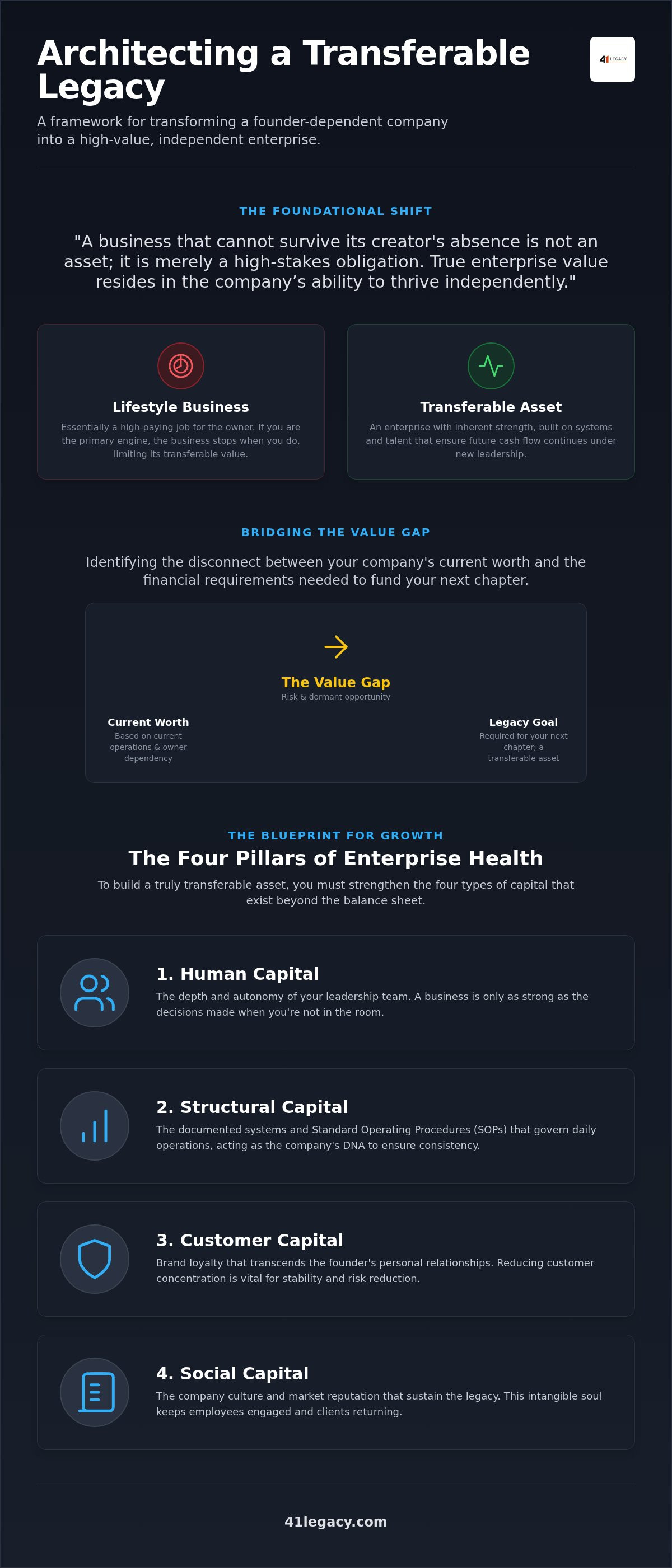
A business that cannot survive its creator's absence is not an asset; it is merely a high-stakes obligation. For many founders, the realization that their life’s work feels fragile to a prospective buyer is a sobering moment. This is why implementing deliberate business valuation improvement strategies is not just a financial exercise but a fundamental act of stewardship. We believe that true enterprise value resides in the company’s ability to thrive independently of its founder. It requires a shift from daily tactical involvement to the meticulous architecture of a transferable legacy.
You've likely felt the weight of the Value Gap between your current worth and the requirements of your next chapter. It's a common anxiety for those who have poured their essence into their work yet lack the documented systems to prove its permanence. This article provides the strategic framework for transforming a founder-dependent company into a high-value enterprise that commands a premium multiple. We'll explore how to reduce owner dependency and utilize structured diagnostics to build a roadmap for sustainable, transferable growth.
Key Takeaways
- Learn to distinguish between a lifestyle business and a transferable asset by viewing your company as a collective strength of systems rather than a source of income.
- Identify the critical "Value Gap" through Enterprise Diagnostics to ensure your business valuation improvement strategies align with the financial requirements of your next act.
- Discover how to escape the "Rainmaker Trap" by institutionalizing your unique knowledge into documented systems that command premium multiples from buyers.
- Understand how a Value Growth Roadmap provides the structured implementation support necessary to transform operational consistency into improved enterprise value.
- Explore the importance of advisory alignment, positioning yourself as a steward who builds an enterprise capable of thriving long after your transition.
Beyond the Balance Sheet: Understanding Enterprise Value as a Living Asset
Enterprise value is not a static figure etched into a cold ledger. It's a living, breathing pulse that reflects the collective strength of your systems, the autonomy of your talent, and the resilience of your market position. While many owners focus solely on the bottom line, true stewardship requires a broader perspective. You aren't just managing cash flow; you're cultivating a legacy that can endure. This perspective shifts the focus from short-term gains to the long-term health of the organization.
Many profitable companies suffer from low market attractiveness because they're built as lifestyle businesses rather than transferable assets. A lifestyle business is essentially a high-paying job for the owner. If you're the primary engine, the business stops when you do. Adopting a Guardian mindset means viewing yourself as a temporary steward of an entity that should eventually thrive without you. This psychological shift is the cornerstone of effective business valuation improvement strategies. It requires a commitment to building something that possesses its own inherent strength.
The Distinction Between Profitability and Transferability
Revenue is often a vanity metric when it comes to the final transition. A buyer doesn't just buy your past profits; they buy your future cash flow and the certainty that it will continue under new leadership. Transferability is the ease with which a new owner can take the helm and maintain the vessel's course without disruption. Understanding business valuation fundamentals reveals that a company with lower revenue but higher transferability often commands a superior multiple compared to a volatile, owner-dependent giant. It's about reducing risk and ensuring the essence of the enterprise remains intact regardless of who sits in the founder's chair.
The Four Pillars of Enterprise Health
To build a truly transferable asset, you must strengthen four distinct types of capital that exist beyond the balance sheet. These pillars represent the structural integrity of the legacy you're architecting.
- Human Capital: This is the depth and autonomy of your leadership team. A business is only as strong as the decisions made when you're not in the room.
- Structural Capital: These are the systems and standard operating procedures (SOPs) that govern daily operations. They act as the company's DNA, ensuring consistency.
- Customer Capital: High value requires reducing customer concentration. Building brand loyalty that transcends the founder's personal relationships is vital for stability.
- Social Capital: This encompasses the culture and reputation that sustain the legacy. It's the intangible soul of the company that keeps employees engaged and clients returning.
Focusing on these pillars ensures that your business valuation improvement strategies result in an enterprise that is both robust and highly desirable to the marketplace. By treating the business as a living asset, you prepare it for a future that extends far beyond your daily involvement.
The Value Gap: Identifying the Disconnect Between Current Worth and Future Legacy
The Value Gap represents the silent distance between the current market worth of an enterprise and the net proceeds required to fund the owner's next chapter. It is a critical metric often overlooked until the moment of transition is imminent. By identifying this gap early, we can implement precise business valuation improvement strategies that bridge the divide with intentionality. Every owner needs a baseline valuation, regardless of their timeline, to act as a north star for strategic decision-making. Without this baseline, you're navigating without a map, unsure if your current growth is actually contributing to your ultimate goal.
Market Attractiveness scores significantly influence the multiple applied to your earnings. A business might be profitable, but if it lacks the structural integrity to attract a sophisticated buyer, the multiple will remain suppressed. We view this diagnostic phase as a curatorial audit, where we examine the inner essence of the organization to uncover hidden risks and dormant opportunities. This evaluation determines whether the market views your company as a fragile collection of assets or a robust, independent entity that is prepared for the future.
The Diagnostic Process: Assessing Exit Readiness
Our diagnostic process evaluates the "Three Circles" of readiness: Business, Personal, and Financial. A company may be prepared for a transition, but if the owner hasn't architected their personal life after exit, the legacy is incomplete. Identifying "Red Flags" like heavy customer concentration or key-man risk early prevents these issues from devaluing the company during due diligence. At 41 Legacy, we use Enterprise Diagnostics to create the strategic clarity necessary for a graceful and profitable transition. This process ensures that every vulnerability is addressed before it becomes a liability.
Quantifying the Intangibles
Intangible assets often hold the greatest weight in a premium valuation. Brand equity and intellectual property aren't just line items; they're the unique fingerprints of your legacy. Buyers are specifically searching for strategies for increasing business value through recurring revenue models that offer predictable future cash flows. While "clean" financial records are often touted as a value-add, we consider them a prerequisite for any serious discussion. Precision in your accounting reflects the meticulous nature of your stewardship. It signals to the market that the enterprise is handled with professional care and is ready for the scrutiny of a sophisticated transition.
Architecting Independence: Reducing Owner Dependency to Command Premium Multiples
A business that relies on the singular brilliance of its founder is inherently fragile. Many owners fall into the "Rainmaker Trap," believing their role as the primary salesperson or visionary is an asset. From the perspective of a sophisticated buyer, this is a profound liability. If you are the sun around which all operations orbit, the enterprise effectively ceases to exist the moment you step away. True business valuation improvement strategies focus on decentralizing this authority, ensuring that the company's essence remains intact without your daily presence.
We view this transition as a deliberate act of design. It's the process of shifting vital knowledge from the founder’s mind into the company’s institutional memory. This is not merely about delegation; it's about building a self-sustaining machine that operates with the precision of a masterwork. When a business can function, grow, and solve problems autonomously, it transforms from a lifestyle asset into a high-value enterprise that commands a premium multiple in the marketplace.
Transferability Engineering: Building a Self-Sustaining Machine
The journey toward independence begins with a rigorous audit of the owner's daily functions. We must identify high-value tasks that have become bottlenecks and systematically move them to capable hands. This requires a profound psychological shift from "Doing" to "Designing." You are no longer the artisan crafting every detail; you are the architect ensuring the structure stands on its own. Understanding the nuances of Determining Enterprise Value reveals that transferability is the ultimate lever for growth. By engineering this independence, you create an asset that is as attractive as it is resilient.
Talent Development as a Value Lever
A buyer doesn't just acquire your customer list; they acquire your team. Empowering a "Second-in-Command" to lead daily operations is one of the most effective business valuation improvement strategies available. This individual must possess the authority to make decisions and the accountability to deliver results. To sustain this value, you must also focus on building a "bench" of talent through cross-training and retention incentives. A business with a deep, autonomous leadership team reduces operational risk and signals to the market that the legacy is built on a foundation of collective excellence rather than individual effort.
The Blueprint for Growth: Implementing Systems and Standard Operating Procedures
Architecture requires more than a vision; it demands a precise blueprint. Documented Standard Operating Procedures (SOPs) serve as the definitive instruction manual for the enterprise, ensuring that every movement is intentional and repeatable. Without these systems, the business remains a collection of individual efforts rather than a singular, high-performance entity. Integrating these systems is a core component of effective business valuation improvement strategies, as they provide the structural integrity required for a seamless transition. By codifying the "how" behind every operation, you preserve the essence of the work while removing the fragility of human error.
Modern stewardship often involves the integration of technology and information systems to automate routine workflows. By utilizing these tools to handle the mundane, you free your human capital to focus on higher-level artistry and strategic growth. This consistency directly impacts profit margins by reducing waste and ensuring that quality never wavers. If you've ever asked what is an SOP in business?, you'll find that it is the bridge between a chaotic, founder-led operation and a disciplined, transferable legacy.
From Chaos to Precision: The SOP Advantage
We don't seek to document every minute detail, but rather to identify the "Critical Few" processes that drive 80% of the value. These are the vital organs of the enterprise. When these processes are documented, training time for new hires decreases and scalability becomes a deliberate choice rather than a struggle. During due diligence, a sophisticated buyer will look for documented, repeatable results. They aren't just buying your past successes; they're buying the system that guarantees future ones. This level of precision is what separates a common business from a rare and valuable asset.
Financial Forecasting and Strategic Capacity
True precision requires moving beyond historical reporting. While past performance is a record, forward-looking financial forecasting is a guide. It allows you to evaluate your "Strategic Capacity," the inherent room your business has to grow without collapsing under its own weight. Learning how to increase enterprise value involves creating a business that isn't just surviving the present but is architected to dominate the future. This foresight signals to the market that your enterprise is a resilient vessel prepared for expansion and long-term sustainability.
Building this blueprint is the first step toward a lasting legacy. To begin your journey toward a more resilient enterprise, consider our Value Growth Roadmap as a guide for your implementation.
Orchestrating the Transition: The Value Growth Roadmap and Advisory Alignment
The final orchestration of a transition is a delicate endeavor that requires more than just technical skill; it demands a unified vision. Many owners surround themselves with talented professionals, yet these experts often operate in isolation. This "Silo Effect" can lead to conflicting advice that hampers the very value you've worked so hard to build. We believe in the "Quarterback" concept, where a single lead advisor aligns your CPA, attorney, and wealth manager under a singular strategic objective. This coordination ensures that every decision serves the long-term health and transferability of the enterprise.
A Value Growth Roadmap is the bridge between theoretical potential and realized value. While many firms provide reports, we focus on the monthly implementation support required to move the needle. Effective business valuation improvement strategies are only as good as their execution. Under the guidance of a Certified Exit Planning Advisor (CEPA), the roadmap becomes a living document that protects the legacy by addressing both business and personal readiness. By establishing a rhythm of structured accountability, we ensure that the architectural changes discussed in previous sections actually take root within the organization.
The Coordinated Advisory Team
Aligning your professional team is essential for protecting the essence of your legacy. When your advisors work in harmony, they can proactively identify risks and opportunities that would otherwise remain hidden. At 41 Legacy, we prioritize implementation rather than just reporting. We act as the guardian of your vision, ensuring that the technical precision of your legal and financial structures mirrors the aesthetic wonder of the business you've built. This unified approach prevents the "Silo Effect" and creates a seamless path toward a successful transition.
Building for the Future: Your Next Steps
The most successful transitions are those planned with a long-term horizon. We recommend starting the value growth process 3-5 years before you intend to step away. This window provides the necessary time to engineer transferability and bridge any identified Value Gap. It allows for the steady, unhurried craftsmanship required to polish every detail of the enterprise. Your first step in this journey is a comprehensive Exit Readiness Assessment, which provides the baseline clarity needed to begin architecting your future.
Begin your journey toward a transferable legacy with 41 Legacy.
Securing the Perpetual Strength of Your Legacy
Transforming a founder-led business into a truly transferable asset is the ultimate act of professional stewardship. It's a journey that moves beyond the cold figures of a ledger and into the deliberate architecture of a living, independent entity. By implementing sophisticated business valuation improvement strategies, you ensure that the essence of your work remains intact while its market value reaches its zenith. This process requires shifting from the tactical demands of the present to the strategic design of the future.
Our approach, guided by Certified Exit Planning Advisor (CEPA) leadership, prioritizes the reduction of owner dependency to bridge the Value Gap with meticulous precision. We don't just provide reports; we deliver Custom Value Growth Roadmaps that serve as a blueprint for long-term resilience. This coordinated effort ensures your enterprise is prepared to command a premium multiple and thrive independently. Take the first step toward securing the future of your life's work. Request Your Exit Readiness Assessment today and begin the refined work of architecting a lasting legacy.
Frequently Asked Questions
What is the most effective strategy for increasing business value?
The most effective strategy is reducing owner dependency by engineering transferability. When a business functions autonomously, it transforms from a lifestyle asset into a high-value enterprise. Buyers pay a premium for systems that guarantee future cash flow without the founder's daily involvement. This shift involves institutionalizing your unique knowledge into the company's institutional memory. It ensures the organization remains a living entity that thrives long after your transition.
How long does it take to see an improvement in enterprise valuation?
Seeing a meaningful impact from business valuation improvement strategies typically requires a horizon of three to five years. While operational efficiencies can yield results in months, the structural work of building transferability takes time to mature. This unhurried pace allows for the meticulous documentation of systems and the development of a leadership bench. Starting early ensures the enterprise is polished and resilient before the moment of transition arrives.
Why is owner dependency considered a major risk by business buyers?
Buyers view owner dependency as a critical risk because it represents a single point of failure for the entire organization. If the business's success is tied to your personal relationships or technical skill, the asset becomes fragile the moment you exit. A sophisticated buyer is searching for a self-sustaining machine, not a high-stakes obligation. Reducing this dependency increases the certainty of future performance and justifies a higher valuation multiple.
What is the difference between a business valuation and an exit readiness assessment?
A business valuation provides a snapshot of current worth, while an Exit Readiness Assessment evaluates the structural integrity and transferability of the enterprise. The assessment identifies the Value Gap and uncovers hidden risks that a standard financial report might miss. It's a diagnostic tool that looks beyond the balance sheet to determine if the company is actually prepared for a successful transition. This clarity is vital for strategic planning.
Can I increase my business value without significantly increasing sales?
You can significantly enhance your enterprise worth without a massive surge in top-line revenue by improving your valuation multiple. Reducing operational risks, diversifying your customer base, and securing recurring revenue streams all make the company more attractive to buyers. Efficiency and predictability are often more valuable than raw growth. By focusing on these internal levers, you build a more robust asset that commands a premium price in the marketplace.
How do Standard Operating Procedures (SOPs) impact my company’s multiple?
Standard Operating Procedures act as the architectural blueprint for your company, signaling to buyers that results are repeatable and scalable. When processes are documented, the business is no longer reliant on individual heroics or tribal knowledge. This reduction in operational risk directly correlates to a higher multiple. SOPs transform a chaotic operation into a disciplined, transferable legacy that a new owner can step into with complete confidence.
What role does a Certified Exit Planning Advisor (CEPA) play in value growth?
A Certified Exit Planning Advisor (CEPA) acts as the strategic quarterback for your entire professional advisory team. They align your CPA, attorney, and wealth manager under a single Value Growth Roadmap to ensure all decisions protect your legacy. This role focuses on moving from theoretical planning to actual implementation support. By coordinating these efforts, a CEPA helps you bridge the Value Gap and successfully navigate the complexities of a business transition.

Article by
Mike Laskowski
Mike Laskowski is a Business Value Growth Strategist who helps business owners uncover the truths that drive their performance, risk, and readiness. Blending forensic interviewing from a 26‑year federal career with Strategic Capacity analysis and CEPA methodology, he works upstream to reduce owner dependency, increase transferability, and strengthen enterprise value. Mike guides founders through clarity, operational evolution, and transition readiness so their companies become transferable, owner‑independent assets that endure beyond the founder.
Disclaimer
This article is for educational and informational purposes only and does not provide legal, tax, investment, or business brokerage advice. 41 Legacy does not offer M&A brokerage services, legal document drafting, tax preparation, or investment advisory services. Business owners should consult licensed professionals in those disciplines before making decisions related to business transactions, legal matters, tax strategy, or financial planning. All examples are illustrative and may not apply to your specific situation.