
Business Exit Strategy Consultant Fees: A Strategic Investment in Enterprise Value
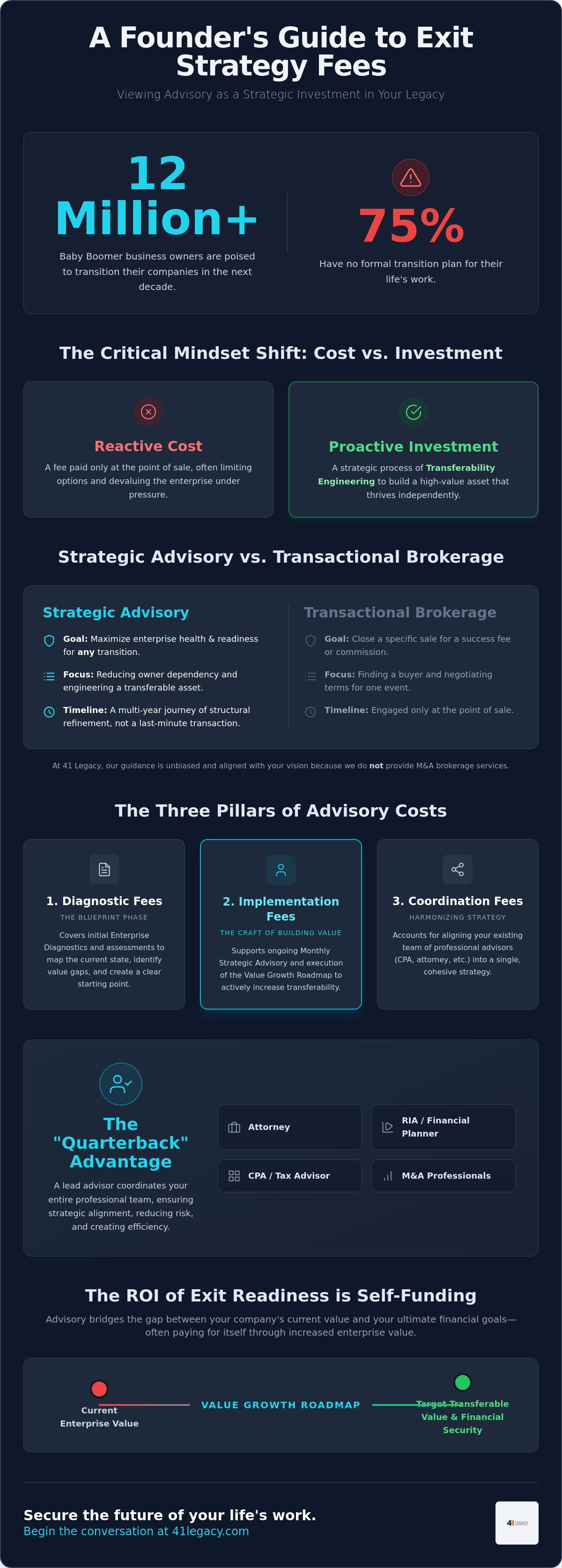
With over 12 million baby boomer business owners poised to transition their companies over the next decade, it's startling that 75 percent of founders have no formal plan for the future of their life's work. This hesitation often arises from uncertainty surrounding business exit strategy consultant fees; many owners fear overpaying for theoretical advice that fails to translate into tangible enterprise value. We understand the weight of this stewardship. It's natural to feel concerned about the gap between your current valuation and your ultimate retirement needs, or to feel confused by the difference between transactional broker fees and the strategic retainers required for true transferability engineering.
This guide will provide you with a clear framework for evaluating advisory costs and how they function as a strategic investment in your legacy. We'll outline a roadmap to reduce owner dependency and ensure your company is a transferable asset that thrives independently of your daily involvement. By the end of this discussion, you'll have the confidence to utilize enterprise diagnostics and value growth roadmaps to protect the essence of your business while securing its financial future.
Key Takeaways
- Understand that exit planning is a proactive investment in enterprise value rather than a reactive cost incurred only at the point of sale.
- Evaluate how different business exit strategy consultant fees, such as Enterprise Diagnostics or Monthly Implementation Support, align with your goals for transferability engineering.
- Learn why structured advisory is often self-funding by identifying and bridging the gap between your current worth and your ultimate financial needs.
- Discover the efficiency of the "Quarterback" model, where a lead advisor coordinates your professional team to reduce risk and ensure your business thrives independently.
- Identify the critical criteria for selecting an advisor who prioritizes the long-term health and legacy of your enterprise over a purely transactional focus.
Understanding the Landscape of Business Exit Strategy Consultant Fees
The transition of a business is not merely a final transaction; it's the culminating chapter of a founder’s creative legacy. Understanding the landscape of business exit strategy consultant fees requires a fundamental shift in perspective. One must view these costs not as a burden on the balance sheet, but as a deliberate investment in the enterprise’s future independence. Unlike reactive events that occur only when a crisis strikes, true Exit planning is a proactive journey of value enhancement. It's the meticulous process of preparing a masterpiece for its next steward, ensuring the essence of the organization remains intact long after the founder has departed.
Advisory fees represent the technical precision required to build this state of readiness. While traditional success fees are often paid to brokers at the moment of closing, advisory fees are focused on the years of growth and structural refinement that must precede any transition. These costs are typically scaled to reflect the complexity of the organization and the depth of its history. The primary driver of these business exit strategy consultant fees is the pursuit of Exit Readiness, a state where the enterprise is prepared for any transition, planned or otherwise. The more intricate the internal systems, the more sophisticated the advisory must be to ensure the business thrives without its creator.
Strategic Advisory vs. Transactional Brokerage
At 41 Legacy, we serve as the guardians of your company's essence. We don't provide M&A brokerage or business sale representation. This distinction is vital. By separating strategic advice from the eventual sale, we ensure our guidance remains entirely unbiased and aligned with your personal vision. You can learn more about our philosophy at 41 Legacy. Our focus is Transferability Engineering. We treat the business as a living asset that must be polished to a high sheen, ensuring it holds its value regardless of who sits in the executive chair. This approach prioritizes the long-term health of the enterprise over the immediate pressure of a transaction.
The Three Pillars of Exit Planning Costs
The financial structure of high-level advisory typically rests on three distinct pillars. First, Diagnostic fees cover the initial Enterprise Diagnostics and assessments required to map the current state of the organization. This is the blueprint phase. Second, Implementation fees support the ongoing Monthly Strategic Advisory and execution of the Value Growth Roadmap. This is the craft of building value. Finally, Coordination fees account for the effort required to align your existing team of professional advisors into a single, harmonious strategy. Each pillar supports the overarching goal of reducing owner dependency and maximizing the transferable value of your life’s work.
Project-Based vs. Retainer Models: Navigating Fee Structures
Selecting the appropriate engagement model is a decision that requires both strategic logic and a clear vision for the future. When evaluating business exit strategy consultant fees, founders often find themselves at a crossroads between the focused intensity of a project and the steady, unhurried rhythm of a monthly retainer. Each path serves a distinct purpose in the lifecycle of an enterprise. A project-based approach offers immediate clarity, serving as a diagnostic lens that reveals the current state of the organization. This model provides an accessible entry point, allowing a founder to witness the depth of the advisory expertise before committing to the multi-year journey of transformation.
While fee structures vary, the principles of these professional engagements often mirror established standards of excellence. The Federal Acquisition Regulation on consultant fees offers a sophisticated framework for understanding how professional services are evaluated for their scope and strategic necessity. In the private sector, these structures ensure that the investment is commensurate with the complexity of the heritage being preserved. Whether through a one-time assessment or recurring support, the goal remains the same: the meticulous engineering of a transferable asset.
Project-Based Enterprise Diagnostics
This initial phase serves as the foundation for all future growth. It involves rigorous Enterprise Diagnostics, market attractiveness studies, and a deep exploration of the "Value Gap." By identifying the distance between your current valuation and your ultimate financial requirements, we establish a baseline of reality. The culminating deliverable of this stage is a Value Growth Roadmap. This document is not a mere report; it's a technical blueprint that outlines the precise adjustments required to enhance the company's inner essence and market appeal. A Strategic Capacity Evaluation can help determine if your organization is ready for this level of detailed scrutiny.
Monthly Advisory and Implementation
Once the blueprint is established, the long-term work of Owner Dependency Reduction begins. Monthly Strategic Advisory retainers provide the steady accountability necessary for complex transitions. This recurring support ensures that the Value Growth Roadmap is actually executed, preventing the vision from being buried by the demands of daily operations. Through Monthly Implementation Support, we focus on strengthening the internal systems that allow the business to thrive independently. This steady progression builds the strategic capacity of the team, ensuring the founder’s impact remains a lasting legacy rather than a temporary presence. It's the difference between a fleeting sale and the building of a permanent institution.
The ROI of Exit Readiness: Bridging the Value Gap
The true measure of a business’s worth is not found in its historical profits alone, but in its capacity to endure without its creator. For many founders, the "Value Gap" remains a hidden reality, representing the silent distance between the current market valuation and the financial harvest required to sustain their next chapter. When viewed through the lens of long-term stewardship, business exit strategy consultant fees reveal themselves as a self-funding mechanism. Strategic value creation over a five to seven-year horizon can increase enterprise value by 30 to 50 percent, a return that significantly outweighs the initial advisory investment. Reducing owner dependency directly increases the marketability and valuation multiple of a firm by proving its operational permanence.
Risk reduction serves as the primary driver of higher valuation multiples. Sophisticated buyers do not pay for past success; they pay for the certainty of future cash flows. By identifying and neutralizing operational risks, advisory services transform a volatile personal practice into a stable, institutional asset. This process ensures that the premium paid for business exit strategy consultant fees is recovered many times over during the final transition. It's the difference between a business that is merely "for sale" and one that is truly "ready for exit."
Closing the Value Gap through Strategic Growth
Enterprise Diagnostics serve as the master artisan’s magnifying glass, identifying hidden risks that quietly devalue a company. These assessments often follow rigorous Certified Business Exit Consultant (CBEC) standards to ensure every structural weakness is documented and addressed. The implementation of documented SOPs and resilient systems has a profound impact on the final sale multiple, as it signals to the market that the business is a self-sustaining entity. In this framework, the owner transitions from a daily operator to a noble steward, presiding over a lasting legacy that possesses its own internal logic and strength.
Quantifying the Cost of Inaction
The cost of neglecting this preparation is often catastrophic. Research indicates that 75 percent of business owners have no formal exit strategy, a lack of foresight that frequently leads to profound regret after a transition. Without Transferability Engineering, many firms fall into the "Rainmaker Trap," where the business’s value is so inextricably linked to the founder that it cannot survive a change in leadership. This fragility results in failed transitions or significantly diminished offers. To begin the process of securing your company’s future, you can engage with an Exit Readiness Assessment to establish a clear baseline for growth.
The "Quarterback" Advantage: Efficiency in Professional Fees
The transition of a historic enterprise is a complex symphony, requiring the harmonic alignment of various professional disciplines. In this context, the role of a lead advisor transcends simple guidance; they become the "Quarterback" of the entire professional team. Many founders find themselves trapped in a cycle of siloed decision-making, where the CPA, the attorney, and the wealth advisor operate in isolation. This fragmentation often results in redundant efforts and conflicting advice, which ultimately inflates the total cost of the transition. By centralizing the strategy, business exit strategy consultant fees serve to streamline the overall professional spend, ensuring that every hour billed by a specialist is directed toward a singular, unified outcome.
This model eliminates the common friction that arises when legal structures aren't aligned with tax strategies or when wealth management goals don't reflect the company's operational reality. The consultant acts as the guardian of the vision, ensuring that the technical excellence of each specialist contributes to the building of a transferable asset. Strategic clarity reduces the total professional service spend over time by preventing expensive course corrections and ensuring that the foundation is laid correctly from the start. It’s about the precise stewardship of resources to protect the value of your life’s work.
Aligning the Professional Advisory Team
The lead advisor manages the delicate communication between the CPA and the Attorney, translating the founder’s legacy goals into actionable technical requirements. This proactive management significantly reduces the "hourly rate drain" that occurs when specialists are left to explore theoretical paths without clear strategic direction. We ensure that the tax and legal frameworks are not just compliant, but are actively supporting the Value Growth Roadmap. Proper coordination ensures that business exit strategy consultant fees are an investment in efficiency, preventing the waste of precious capital on uncoordinated professional efforts.
Protecting the Enterprise Value
A coordinated team is the most effective defense against transaction "deal killers" that often emerge in the eleventh hour. These issues usually stem from unresolved structural flaws or missing documentation that should have been addressed years prior. By overseeing the execution of the Value Growth Roadmap, the consultant ensures that the enterprise remains a polished, market-ready asset. This high-altitude oversight protects the value that has been painstakingly built over decades. To begin aligning your own advisory team, you can explore our Strategic Advisory services.
Selecting an Advisor: Beyond the Fee Schedule
Selecting the right mentor to guide your company’s transition is a decision of profound consequence. While it’s natural to focus on business exit strategy consultant fees, the true value lies in the advisor’s philosophy and their commitment to your legacy. A purely transactional focus seeks a quick exit, often leaving the business’s essence behind. In contrast, a legacy-oriented approach prioritizes the long-term health of the institution. Look for the Certified Exit Planning Advisor (CEPA) designation, as it signals a mastery of the multi-disciplinary skills required to navigate this intricate process with surgical precision.
The ideal consultant doesn't just provide a report; they build the systems that allow your business to thrive as a self-sustaining entity. This involves a deep commitment to owner dependency reduction, ensuring the founder’s presence becomes a choice rather than a requirement. When interviewing potential partners, use this checklist to evaluate their strategic depth:
- Does the advisor utilize a formal Enterprise Diagnostics process?
- Is their methodology focused on building systems or merely facilitating a sale?
- Do they offer Monthly Implementation Support to ensure the roadmap is followed?
- Can they demonstrate a track record in Strategic Capacity Evaluation?
Criteria for Strategic Advisory Excellence
Excellence in this field is defined by a refusal to settle for surface-level solutions. Your advisor should provide a structured diagnostic process that uncovers the inner workings of your organization. Beyond the initial assessment, ensure they offer implementation support. A static report is a dead document; true value is created through the active execution of a Value Growth Roadmap. Verify their technical experience in Transferability Engineering, which is the rare intersection of creative artistry and technical engineering that makes a business truly independent.
Your Next Steps Toward a Transferable Legacy
The journey toward a successful transition is a thoughtful, time-intensive endeavor. We recommend starting this process three to five years before your planned departure. This window allows for the meticulous refinement of operations and the closing of any identified Value Gap. It’s the time required to polish the asset to its highest sheen. The first step is always the most critical. You can Begin your journey with a 41 Legacy Exit Readiness Assessment to gain the strategic clarity your life's work deserves. By investing in professional guidance now, you ensure that business exit strategy consultant fees become the foundation of a lasting, impactful legacy.
Securing the Future of Your Enterprise
The transition of your business is the final act of a long and dedicated stewardship. Viewing business exit strategy consultant fees as a capital investment rather than a transactional expense allows you to focus on the technical precision required to build a truly transferable asset. By bridging the Value Gap and reducing owner dependency, you ensure that the essence of your organization remains intact for the next generation of leadership.
Our approach at 41 Legacy is led by a Certified Exit Planning Advisor (CEPA) who serves as the strategic Quarterback for your entire professional team. This coordination prevents redundant efforts and ensures that every strategic move increases your valuation multiples. We invite you to Secure your business legacy with a 41 Legacy Exit Readiness Assessment. This diagnostic is the first step in engineering a company that thrives independently of its founder. Your life's work deserves a transition that is as meticulous and impactful as the years you spent building it.
Frequently Asked Questions
What is the typical range for exit strategy consultant fees in 2026?
Market data from 2026 indicates that hourly rates for transition strategy often range between $247 and $390, with a reported average of $318.57. Monthly retainers for ongoing strategic advisory typically sit between $3,000 and $8,500. These business exit strategy consultant fees reflect the specialized expertise required to navigate the progression of time and the preservation of an enterprise's essence through technical precision.
Why do consultants charge a retainer instead of just a success fee at the end?
Retainers prioritize the building of a lasting impact over the mere speed of a transaction. While success fees are common in brokerage, they don't fund the multi-year refinement of internal systems or the reduction of owner dependency. A retainer model supports Monthly Implementation Support, ensuring the consultant remains a dedicated guardian of your legacy. This structure allows for the unhurried, thoughtful work that truly increases enterprise value.
Can an exit strategy consultant help if I plan to transition the business to my children?
Transitioning to family members is a philosophical endeavor that requires extreme precision in defining future roles and operational systems. A consultant helps you navigate the emotional weight of this progression, ensuring the business survives the founder's departure. By focusing on Transferability Engineering, you provide your children with a stable asset that possesses its own stories to tell and a clear, independent path forward.
How does an exit readiness assessment differ from a standard business valuation?
A standard valuation is a mechanical calculation of the past, while an exit readiness assessment is an artistic diagnostic of the future. The assessment evaluates the strategic capacity of the organization and identifies the "Value Gap" between current worth and retirement needs. It provides the technical blueprint for your Value Growth Roadmap, ensuring the business is polished to a high sheen for any eventual transition.
Will hiring an exit consultant replace my current CPA or attorney?
The consultant acts as a master coordinator, ensuring your professional team operates with surgical precision. They don't replace your CPA or attorney; they provide the high-level vision that guides their technical work. This "Quarterback" model prevents the uncoordinated efforts that lead to siloed decision-making and redundant professional costs. It's about creating harmony between the creative artistry of your vision and the technical engineering of your advisors.
How long does the value growth process typically take before a business is ready for sale?
Building a masterpiece takes time, and the value growth process usually requires three to five years for full realization. This steady, unhurried rhythm allows for the documentation of SOPs and the strengthening of the management team. While the technical closing of a sale might occur in six to eighteen months, the engineering of a truly transferable asset is a deliberate, long-term commitment to excellence.
What happens during the "Enterprise Diagnostics" phase of the engagement?
During Enterprise Diagnostics, we conduct a deep dive into the inner essence of the organization to identify structural vulnerabilities and hidden risks. This phase involves a Strategic Capacity Evaluation to see if the business can thrive independently of its creator. The result is a clear narrative of the firm’s health, which serves as the foundation for all future Value Growth Roadmap execution and refinement.
Is exit planning worth the cost for a small business with under $5M in revenue?
Smaller organizations often suffer from extreme owner dependency, making exit planning an essential safeguard for the founder's financial future. Investing in business exit strategy consultant fees allows a small business to transition from a personal practice to a transferable asset. This strategic advisory is justified because it protects the heritage of the firm and ensures it can be successfully transitioned to a new steward without losing its value.

Article by
Mike Laskowski
Mike Laskowski is a Business Value Growth Strategist who helps business owners uncover the truths that drive their performance, risk, and readiness. Blending forensic interviewing from a 26‑year federal career with Strategic Capacity analysis and CEPA methodology, he works upstream to reduce owner dependency, increase transferability, and strengthen enterprise value. Mike guides founders through clarity, operational evolution, and transition readiness so their companies become transferable, owner‑independent assets that endure beyond the founder.
Disclaimer
This article is for educational and informational purposes only and does not provide legal, tax, investment, or business brokerage advice. 41 Legacy does not offer M&A brokerage services, legal document drafting, tax preparation, or investment advisory services. Business owners should consult licensed professionals in those disciplines before making decisions related to business transactions, legal matters, tax strategy, or financial planning. All examples are illustrative and may not apply to your specific situation.