
Business Exit as a Wealth Creation Event: Mastering the Final Act
Most business owners view their company as a source of income, yet the most sophisticated stewards recognize it as a masterpiece awaiting its final polish. What if your departure wasn't merely a conclusion, but the ultimate realization of the value you've spent decades cultivating? Viewing your business exit as a wealth creation event requires a deliberate shift from operational management to the meticulous engineering of a transferable asset. It's an act of preservation that ensures the essence of your work continues long after your direct involvement ends.
It's natural to feel a quiet anxiety regarding the true market value of your enterprise or the complexity of the transition. You've likely wondered if the organization can truly flourish without your daily guidance, fearing your legacy is tethered to your presence. We'll show you how to untangle your identity from the business, transforming it into a high-value entity that thrives independently. This is about the precise orchestration of a legacy that secures your financial future while honoring the history you've built.
This guide provides the strategic clarity needed to master this final act. We'll examine how enterprise diagnostics and value growth roadmaps strengthen transferability and reduce risk. You'll discover the path to building a business that stands as a testament to your vision, moving from a lifestyle income source to your most significant financial achievement.
Key Takeaways
- Learn how to treat your business exit as a wealth creation event, shifting from operational management to the strategic realization of your life’s work.
- Identify and dismantle the "Rainmaker Trap" to reduce owner dependency and build a transferable enterprise that thrives independently of your daily involvement.
- Utilize Enterprise Diagnostics and a Value Growth Roadmap to pinpoint specific drivers that elevate market attractiveness and maximize enterprise value.
- Implement Transferability Engineering to transform your company from a personal income source into a durable, standalone asset.
- Understand the "quarterback" philosophy of advisory support, where a Certified Exit Planning Advisor (CEPA) aligns your professional team to protect your legacy.
Redefining the Exit: A Singular Wealth Creation Event
For many founders, the concept of departure feels like a closing door. They often view the conclusion of their tenure as a mere cessation of activity. However, the most successful leaders understand that viewing a business exit as a wealth creation event is the only way to honor the years of sacrifice poured into the foundation. It's the moment where illiquid effort finally transforms into a tangible legacy. For the majority of business owners, this transition represents the single largest financial milestone of their lives, often accounting for the vast majority of their total net worth. This realization demands a level of precision that transcends simple management.
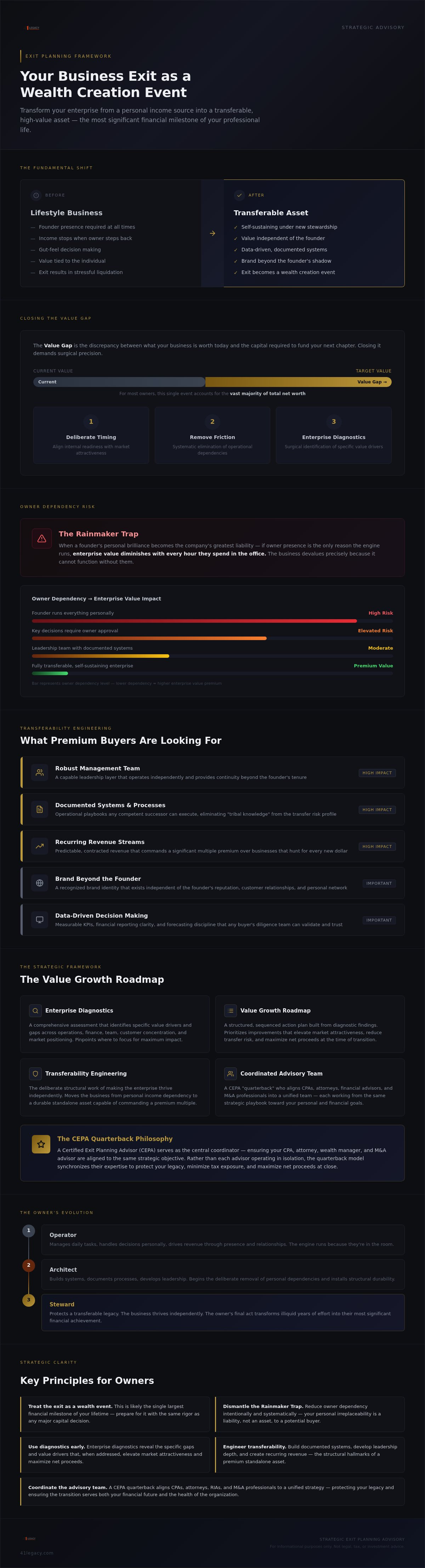
There's a vital distinction between a lifestyle business and a transferable asset. A lifestyle business is a high-performing engine that requires the founder's constant touch to remain in motion. Conversely, a transferable asset is a self-sustaining entity designed to flourish under new stewardship. To bridge this divide, one must identify the "Value Gap." This is the discrepancy between what the business is worth today and the capital required to fund the owner's next chapter. Closing this gap requires surgical diagnostic work and a refusal to settle for mediocrity in operational structures.
The Philosophy of Legacy and Value
We view the enterprise as a living entity with its own story to tell. Building a company that outlasts its founder requires a specific type of reverence; it's the work of a master artisan who knows when to step back so the work can stand on its own. Transitioning from an operator who manages daily tasks to a steward who protects a transferable legacy is a psychological and strategic evolution. It demands that you treat your internal processes with the same care a curator gives to a private collection. This shift ensures that the essence of the business remains intact even as the hands on the wheel change.
Understanding the Wealth Creation Event
A structured exit doesn't happen by chance. It's the result of deliberate timing and the systematic removal of operational friction. When an owner aligns their internal readiness with market attractiveness, they maximize the net proceeds of the transition. A business exit as a wealth creation event is the strategic conversion of enterprise value into personal liquid wealth. By focusing on enterprise diagnostics early, you ensure that the final act of your professional journey is one of triumph rather than uncertainty. This coordination allows for a transfer that secures your financial future and the health of the organization simultaneously.
Shifting from Lifestyle Income to Transferable Enterprise Value
Many owners find themselves ensnared in the "Rainmaker Trap," where their personal brilliance becomes the company's greatest liability. If the founder's presence is the only reason the engine runs, the enterprise devalues with every hour they spend in the office. To truly master a business exit as a wealth creation event, you must shift your focus from generating personal income to engineering a standalone asset. This requires a transition from the frantic pace of an operator to the deliberate precision of a master artisan. You aren't just running a company; you're building a mechanism that produces value independently of your direct involvement.
Engineering an asset requires a clinical look at how the organization functions when you aren't in the room. It means moving away from "gut feel" decision-making toward data-driven systems that any competent successor could manage. This evolution is what transforms a simple business into a premium legacy. By focusing on the structural health of the enterprise today, you ensure that the eventual transition is a moment of profound financial realization rather than a stressful liquidation.
The Mechanics of Enterprise Value
Beyond financial multiples, sophisticated buyers value the qualitative essence of the organization. They're looking for transferability. This means having a robust management team, documented systems, and a brand that exists outside the founder's shadow. A business with a high percentage of recurring revenue will always command a premium over one that must hunt for every new dollar. Determining enterprise value is the first step in this curatorial process. It provides a baseline for the sophisticated improvements required to elevate your company to its highest potential, focusing on diversified customer bases and reliable delivery models.
Bridging the Value Gap
Closing the Value Gap requires more than just increased sales. It demands the systematic removal of owner dependency. Enterprise Diagnostics allow us to peer into the inner workings of the business, identifying "low-hanging fruit" that can be corrected to provide immediate lifts in value. This might include stabilizing a concentrated customer base or refining service delivery to ensure consistency across the board. A Value Growth Roadmap then serves as the blueprint for these enhancements, ensuring every effort contributes to the ultimate goal of a successful transition. This disciplined path ensures your business exit as a wealth creation event is realized with absolute clarity. If you seek to understand the current health of your enterprise, our strategic advisory services can guide your first steps.
Dismantling Owner Dependency: The Architecture of a Standalone Asset
Owner dependency is the primary friction point during any transition. A buyer isn't just acquiring current revenue; they're acquiring the certainty that those earnings will persist under new stewardship. If the founder remains the central hub for sales, problem-solving, and client relationships, the risk profile of the business increases significantly. To ensure a business exit as a wealth creation event, you must systematically remove yourself from the daily gears of the machine. This shift requires the mindset of a master architect, designing a structure that remains stable even after the scaffolding is removed.
Reducing reliance on the founder is the core of transferability engineering. It's about building an organization that stands firm on its own merits, independent of any single individual's charisma. When the business can function at peak performance without your direct intervention, it becomes a premium asset. This transformation doesn't happen by accident; it's the result of deliberate strategic choices that prioritize long-term health over immediate operational convenience.
The Blueprint for Transferability
Precision in documentation is the hallmark of a high-value enterprise. We view Standard Operating Procedures (SOPs) as more than just instructions; they're the recorded history of your expertise. By documenting the "inner essence" of your operations, you create a blueprint that allows others to replicate your success with extreme precision. This reduces the friction of transition, providing a successor with the confidence that the essence of the work will be preserved. Documented expertise transforms tribal knowledge into a durable, transferable asset that commands respect in the marketplace.
Empowering Strategic Capacity
Strategic capacity is the measure of your team's ability to drive performance without your daily oversight. This requires identifying and developing talent that doesn't just follow orders but leads with vision. The intersection of human capital and enterprise value is where the most significant growth occurs. A business is only truly valuable when the owner is the least important person in the room. By building a management layer that commands respect and drives performance, you ensure the organization possesses the internal strength to thrive long after the final act of your tenure.
This structural evolution is essential to realizing a business exit as a wealth creation event. It moves the narrative from what you do to what the company is. When the architecture of the business is sound, the owner becomes a steward rather than a vital component. This shift provides the freedom to focus on high-level strategy while the business continues its steady, unhurried progression toward its ultimate value.
The Value Growth Roadmap: Strategic Preparation for the Ultimate Event
A Value Growth Roadmap isn't a mere document; it's a living instrument of strategic intent. To treat your business exit as a wealth creation event, you must move beyond the abstract and into the granular details of enterprise health. This process begins with an Exit Readiness Assessment, a diagnostic tool that serves as the foundation for all future efforts. We use this initial phase to gain an uncompromising view of the organization's current state, identifying the structural strengths and hidden vulnerabilities that will determine the success of your eventual transition. It's the moment where the master artisan surveys the stone before the first strike of the chisel.
Once the diagnostic is complete, we develop a tailored strategic roadmap for enterprise growth. This is the blueprint for your legacy. It outlines the precise steps required to elevate market attractiveness and solidify enterprise value. This isn't about incremental gains; it's about the fundamental engineering of a transferable asset. By focusing on continuous risk reduction and value protection, we ensure that the business remains a premium entity throughout the duration of your tenure. This steady, unhurried progression ensures that when the time for transition arrives, the organization is at its absolute peak.
The Diagnostic Phase
Strategic clarity is the first requirement of the professional steward. By utilizing Enterprise Diagnostics, we uncover the "red flags" that could derail a future transition, such as concentrated customer bases or undocumented processes. These friction points often remain invisible to those inside the daily operations but are glaring to a sophisticated buyer. Exit planning for business owners is a proactive discipline that transforms these risks into opportunities for growth. It's the difference between reacting to the market and dictating the terms of your own departure with confidence and precision.
Implementation and Accountability
A roadmap holds no value if it's left to gather dust on a shelf. The true realization of a business exit as a wealth creation event occurs during the disciplined work of execution. We provide monthly implementation support to ensure that strategic goals are translated into operational reality. This recurring advisory presence maintains momentum and provides the accountability needed to navigate complex transitions. It ensures that the long-term vision isn't sacrificed for short-term convenience.
Aligning your monthly actions with the long-term goal of a successful exit ensures that every decision serves the health of the enterprise. This coordinated approach allows you to step back from the daily friction, knowing that the team is equipped to execute the plan with precision. If you're ready to begin the diagnostic process, our Value Growth Roadmap provides the strategic clarity necessary to protect your life's work and secure your financial legacy.
Orchestrating Your Legacy: The Coordinated Advisory Approach
Mastering a business exit as a wealth creation event requires more than internal operational excellence; it demands the seamless orchestration of an entire professional ensemble. While you've focused on building a transferable asset, the final realization of that value depends on how well your tax, legal, and financial strategies align. Without a central guiding hand, even the most brilliant individual advisors can inadvertently work at cross-purposes. This creates friction that devalues your life's work at the very moment it should be most polished. True stewardship means ensuring that every technical specialist is reading from the same strategic score.
This is where a Certified Exit Planning Advisor (CEPA) becomes indispensable. Acting as a strategic quarterback, the CEPA ensures that every professional, from your CPA to your estate attorney, moves in harmony toward a singular goal. It's not about replacing your trusted team but rather empowering them through coordinated leadership. This transforms a collection of individual specialists into a unified force dedicated to protecting the essence of your business while maximizing your personal return. It provides the technical precision required for a masterpiece.
The Role of the Strategic Quarterback
Advisors often operate in silos, focusing on their specific discipline without a full view of the broader enterprise. A CPA might prioritize immediate tax mitigation, while an attorney focuses on risk insulation, yet neither may fully grasp how their decisions impact the overall transferability of the asset. We eliminate this "silo effect" by maintaining high-level strategic guidance throughout the process. By coordinating these intricacies, we ensure that tax, legal, and strategic decisions work in concert. This alignment prevents costly delays and ensures that no detail of your legacy is left to chance.
Securing the Final Outcome
The ultimate prize of this coordinated effort is a business built as a transferable asset that thrives independently of your daily presence. There's a profound satisfaction in seeing a life's work successfully transitioned, knowing that the organization’s health and your financial future are both secure. This harmonious approach provides the peace of mind that only comes from absolute clarity and professional alignment. It ensures that the final act of your tenure is one of triumph and lasting impact. Begin your journey toward a transferable legacy with 41 Legacy and ensure your business exit as a wealth creation event is realized with the reverence it deserves.
Securing Your Place in History: The Path to a Transferable Legacy
The transition from daily operator to strategic steward is the most significant evolution a founder will undergo. It's an act of precision that transforms years of dedication into a durable, standalone asset. By dismantling owner dependency and utilizing enterprise diagnostics, you ensure your organization possesses the structural integrity to thrive under new leadership. This shift in perspective is what truly defines a business exit as a wealth creation event, moving beyond a simple departure to the ultimate realization of your life's work.
Success in this final act requires a coordinated effort. 41 Legacy, led by a Certified Exit Planning Advisor (CEPA), serves as the dedicated quarterback for your professional team, ensuring every strategic move aligns with your long-term vision. Through specialized Value Growth Roadmaps, we help you navigate the complexities of transferability engineering with absolute clarity. Your legacy is a masterpiece that deserves a polished conclusion. Discover the true value of your legacy with an Exit Readiness Assessment and begin the process of securing your financial future. You've built something remarkable; it's time to ensure it endures.
Frequently Asked Questions
What exactly is a business exit as a wealth creation event?
It's the strategic conversion of illiquid enterprise value into personal liquid wealth. Instead of seeing an exit as a simple stop, it's the ultimate realization of the value you've built. This process requires meticulous engineering to ensure the business is a transferable asset. By focusing on enterprise diagnostics early, you maximize the net proceeds and secure your financial legacy through a deliberate, well-timed transition that honors your life's work.
How early should I start planning for a business exit?
Ideally, you should begin three to five years before your anticipated departure. This duration allows for the systematic implementation of a Value Growth Roadmap and the thorough reduction of owner dependency. Starting early provides the time-intensive craftsmanship needed to polish internal processes and address the "Value Gap." It transforms the exit from a stressful transaction into a steady, unhurried progression toward your most significant financial achievement and personal peace of mind.
What is the difference between a business broker and an exit planner?
A business broker typically focuses on the transaction itself, acting as an intermediary for a sale. In contrast, an exit planner like 41 Legacy focuses on the years of preparation required to build a transferable asset. We specialize in enterprise diagnostics and transferability engineering to grow the company's value before any transition occurs. We act as a quarterback for your advisory team, aligning strategic growth with your long-term legacy goals.
How can I increase my business value if I am the primary rainmaker?
You must dismantle the "Rainmaker Trap" by institutionalizing your expertise through documented systems and management layers. Buyers devalue companies that rely solely on the founder's personal performance. Increasing value requires a Strategic Capacity Evaluation to ensure your team can lead independently. When you become the least important person in the room, the enterprise becomes a premium asset. This shift from operator to steward is essential for a successful, high-value transition.
What is an Exit Readiness Assessment?
It's a comprehensive diagnostic tool used to gain strategic clarity on your company's current state. This assessment identifies the red flags and friction points that could derail a future transition. By evaluating both market attractiveness and internal readiness, we pinpoint the "Value Gap" between your current valuation and your desired wealth. It serves as the clinical foundation for your Value Growth Roadmap, ensuring every improvement serves the ultimate goal of creating a transferable asset.
How does reducing owner dependency affect my company's valuation?
Reducing owner dependency significantly lowers the risk profile for potential successors, which directly increases valuation multiples. A business that thrives independently of its founder is viewed as a durable, self-sustaining entity rather than a personal job. By engineering a standalone asset, you demonstrate that the company's revenue streams are transferable. This precision in process creates a polished, premium asset that commands a much higher market price during the final act of your tenure.
What role does my CPA play in the exit planning process?
Your CPA is a vital specialist who handles tax mitigation and historical financial reporting. However, they often operate in a silo without a view of the broader strategic legacy. 41 Legacy acts as the quarterback to coordinate with your CPA, ensuring their financial work aligns with your Value Growth Roadmap. This collaboration ensures that tax and legal decisions don't work at cross-purposes, providing you with a harmonious and effective advisory experience throughout the transition.
Can I still grow my business while planning for an exit?
Yes, planning for an exit is fundamentally about growing the business's intrinsic value and transferability. The same strategies used to prepare for a business exit as a wealth creation event are the same ones that drive operational excellence and profitability. By focusing on owner dependency reduction and enterprise diagnostics, you build a healthier organization. This dual focus ensures the company reaches its highest potential while you remain at the helm, preparing it for its ultimate realization.

Article by
Mike Laskowski
Mike Laskowski is a Business Value Growth Strategist who helps business owners uncover the truths that drive their performance, risk, and readiness. Blending forensic interviewing from a 26‑year federal career with Strategic Capacity analysis and CEPA methodology, he works upstream to reduce owner dependency, increase transferability, and strengthen enterprise value. Mike guides founders through clarity, operational evolution, and transition readiness so their companies become transferable, owner‑independent assets that endure beyond the founder.
Disclaimer
This article is for educational and informational purposes only and does not provide legal, tax, investment, or business brokerage advice. 41 Legacy does not offer M&A brokerage services, legal document drafting, tax preparation, or investment advisory services. Business owners should consult licensed professionals in those disciplines before making decisions related to business transactions, legal matters, tax strategy, or financial planning. All examples are illustrative and may not apply to your specific situation.