
Transferability & Owner Dependency
Building Your Business Sale Advisory Team: A Strategic Framework for Legacy
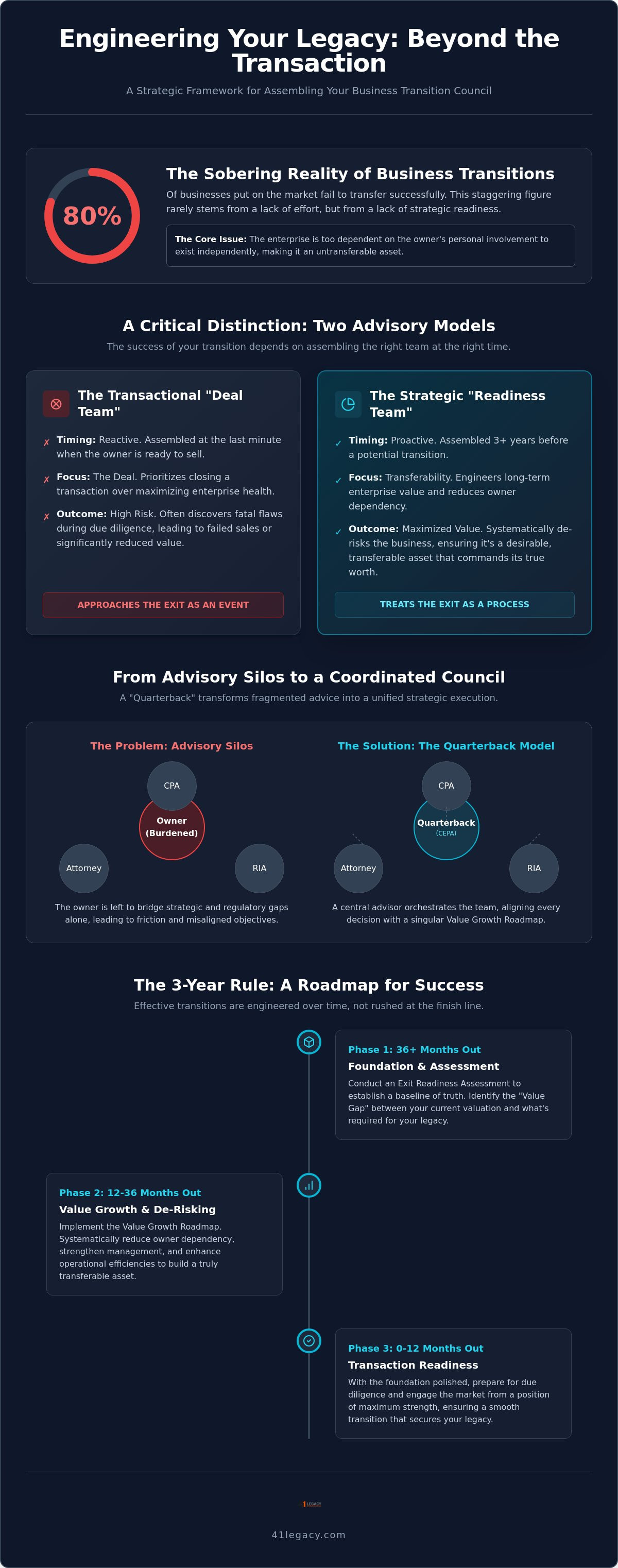
Statistics from the Exit Planning Institute suggest that nearly 80% of businesses fail to successfully transfer to new ownership, often leaving a lifetime of meticulous craftsmanship to fade into obscurity. This failure rarely stems from a lack of effort but rather from a lack of structural harmony. Most owners wait until they are ready to exit before even considering building your business sale advisory team, treating the transition as a mere transaction rather than the preservation of a legacy. When professionals operate in silos, the owner is left to bridge the regulatory and strategic gaps alone, often discovering too late that their enterprise is too dependent on their own presence to be sold.
You've likely felt the weight of being the sole engine of your company, fearing that the value you've cultivated might evaporate without your daily touch. It's a valid concern for any steward who values heritage as much as performance. This article provides a strategic framework to assemble a coordinated council that prioritizes transferability and enterprise value growth. We'll examine how to synchronize your advisors under a unified vision, ensuring your business becomes a sophisticated, transferable asset that commands its true worth when the time comes to step away.
Key Takeaways
- Understand the vital distinction between a transactional "Deal Team" and a "Readiness Team" to avoid the common pitfalls that prevent the majority of business transfers from succeeding.
- Learn the essential criteria for building your business sale advisory team by selecting specialists who prioritize long-term transferability engineering over mere historical reporting.
- Discover how the "Quarterback" model orchestrates professional silos into a single, cohesive unit, allowing you to focus on leadership while your advisors manage the intricacies of strategic readiness.
- Gain specific diagnostic insights to evaluate whether your current CPA and legal counsel possess the forward-looking vision required to support a sophisticated Value Growth Roadmap.
- Identify how an Exit Readiness Assessment serves as the foundation for reducing owner dependency and securing the enduring legacy of your enterprise.
The Shift from Transactional to Strategic: Why Your Team Matters Now
The transition of a business is not merely a financial event. It is the final movement in a decades-long symphony of creation. Too often, owners view the exit as a transaction to be survived rather than a legacy to be engineered. This mindset leads to the assembly of a "Deal Team," a group of professionals, including a Business Broker or investment banker, who arrive only when the ink is ready to flow. While these specialists are necessary for the final exchange, they are fundamentally different from a "Readiness Team." Building your business sale advisory team early ensures that the enterprise is actually transferable before it ever reaches the market. According to research from the Exit Planning Institute, between 70% and 80% of businesses put on the market fail to sell. This silent tragedy usually stems from a lack of strategic readiness, where the business's inner essence is too entwined with the owner to exist independently.
True stewardship requires a shift in perspective. You are not just selling a company; you are transferring a living entity that must thrive without its founder. This requires a deep understanding of the "Value Gap," which is the distance between your current valuation and the net proceeds required to secure your legacy. Closing this gap is a meticulous process of engineering that cannot be rushed in the final months of a sale. It demands a coordinated effort to transform the business into a high-performance asset that stands on its own merits.
The Cost of Advisory Silos
Traditional advisory structures often suffer from strategic drift. Your CPA may focus on immediate tax mitigation, while your attorney focuses on liability, yet neither may be communicating about how these decisions affect long-term enterprise value. Without a "Quarterback" to coordinate these professional perspectives, silos emerge. These silos create friction, where one advisor's success inadvertently complicates another's objective. A unified framework ensures that every tactical decision aligns with a singular Value Growth Roadmap, reducing the "Owner Burden" and allowing you to lead with clarity while your team manages the technical intricacies.
Timing the Assembly
Precision requires time. We advocate for the "Three-Year Rule," suggesting that the most effective teams are assembled at least 36 months before a planned transition. This window allows for Transferability Engineering, the deliberate process of decoupling the business from the founder's daily presence. Moving from a reactive posture to a proactive one transforms the business from a job into a transferable asset. By initiating an Exit Readiness Assessment during this period, you establish a baseline of truth. This foresight ensures that when the transaction finally begins, the foundation is already polished to a high sheen, maximizing the final proceeds and preserving the history you've built.
Core Members of a High-Functioning Exit Advisory Team
A masterpiece is never the result of a single hand. It is the culmination of various disciplines working in absolute harmony. When building your business sale advisory team, you are assembling a council of specialists tasked with preserving the essence of your life's work while maximizing its market value. This team must transcend standard compliance to focus on enterprise value and transferability long before a buyer ever appears. Each member serves a specific function in the orchestration of your legacy, ensuring that the transition is as seamless as the growth that preceded it.
The Role of the Strategic Advisor (CEPA)
The Certified Exit Planning Advisor (CEPA) serves as the architect of your transition. Unlike a broker focused on the eventual close, the strategic advisor utilizes Enterprise Diagnostics to identify hidden vulnerabilities within the organization. They manage the Value Growth Roadmap, ensuring that every operational shift strengthens the company's ability to thrive independently. This role is about stewardship. It's about engineering a business that is a transferable asset, not just a high-paying job for the founder. They provide the high-level vision that keeps the technical specialists aligned with your ultimate legacy goals.
Legal and Financial Specialists
Your current general counsel may be excellent at operational contracts, but a sophisticated exit requires a transactional attorney. This specialist focuses on risk mitigation and the rigorous documentation of Standard Operating Procedures (SOPs), which are essential for proving transferability to a discerning buyer. They ensure that the provenance of your business is well-documented and free from legal entanglements that could derail a deal. Without this precision, even the most profitable companies can appear risky to an outside observer.
Similarly, the forward-looking CPA moves beyond historical tax filing. They engage in Transferability Engineering, ensuring that financial statements are polished to reflect true performance and future potential rather than just past liability. They identify "Value Killers" such as customer concentration or lack of recurring revenue, which can silently erode an EBITDA multiple. A generalist might overlook these nuances, but an exit-focused CPA treats your balance sheet as a narrative of excellence, preparing it for the intense scrutiny of due diligence.
Finally, the financial planner or wealth manager ensures that the business value aligns with your personal liquidity needs. They calculate the distance between your current assets and your post-exit aspirations, ensuring the transaction provides the freedom you've earned. Achieving this level of coordination often begins with a professional Strategic Capacity Evaluation to determine how well your current resources align with your ultimate goals. This structured approach ensures that no detail is left to chance and no value is left on the table.
The "Quarterback" Model: Coordinating Your Professional Silos
The complexity of a business transition demands more than just talented individuals. It requires a master conductor. When building your business sale advisory team, the most critical decision is selecting the lead advisor who will serve as your quarterback. This professional ensures that every decision, from tax structuring to legal risk mitigation, aligns with a singular vision. Without this central figure, the owner is forced to translate complex technical jargon between advisors who rarely speak the same language. This often results in strategic drift, where the pursuit of short-term tax savings inadvertently erodes the enterprise's long-term marketability.
By assuming the role of team coordinator, the quarterback significantly reduces the "Owner Burden." Instead of managing four or five separate professional relationships, you interact with one primary strategist. This allows you to remain focused on the daily operations of the business, ensuring that performance remains high during the critical readiness phase. This coordination is facilitated through a monthly implementation cycle. These regular touchpoints maintain accountability across the advisory board, ensuring that the CPA, attorney, and wealth manager are all working from the same set of enterprise diagnostics.
Breaking Down Professional Silos
Friction is the natural byproduct of uncoordinated expertise. A CPA might suggest an aggressive tax strategy that an attorney finds legally cumbersome, or a wealth manager might require liquidity that conflicts with the business's growth needs. The quarterback’s role is to resolve these conflicting opinions before they reach your desk. By streamlining communication, this model also reduces the inefficiencies of overlapping billable hours. Every advisor operates with surgical precision because they are guided by a unified tactical plan. This prevents the strategic fatigue that often plagues owners who try to manage these silos independently.
The Value Growth Roadmap as the Playbook
A structured process is the antidote to uncertainty. The Value Growth Roadmap serves as the definitive playbook for the entire advisory team, replacing "gut feel" decision-making with data-driven strategy. Every action taken by your advisors is measured against its impact on increasing enterprise value and transferability. You can learn more about how coordinated business advisory transforms a business from a personal job into a transferable asset. This alignment ensures that when you eventually step away, you are leaving behind a legacy that is both durable and distinct, protected by a team that moved in one clear direction.
Evaluating Your Current Advisory Team for Exit Readiness
Building your business sale advisory team starts with assessing whether your current council possesses the strategic depth to handle a legacy-level transition. Most owners rely on advisors who are experts in the maintenance of the present, but a successful exit requires architects of the future. This is the essence of "Professional-Room Altitude." You need specialists who think beyond tactical execution to consider how every decision impacts the ultimate transferability of the asset. If your CPA focuses only on historical tax filing without discussing future tax efficiency, a significant gap exists in your readiness. You must ask them specifically: "How does our current tax structure affect our eventual EBITDA multiple?"
Your legal counsel must also be scrutinized with equal precision. A "Deal Breaker" attorney may protect you from every potential liability, but their defensive posture can inadvertently destroy deal momentum. You require a "Deal Maker" who understands that risk mitigation is a tool for enhancing enterprise value, not a barrier to it. They should be actively identifying "Value Killers" in your contracts and ensuring that your Standard Operating Procedures are documented with the care of a fine art collection. This documentation must be ready for the intense scrutiny of a sophisticated buyer who values order and clarity.
The Exit Readiness Audit
Identifying gaps in your team requires an honest audit of your current professional relationships. Evaluate if your advisors have experience with "Owner Dependency Reduction," the process of ensuring the business thrives without your daily involvement. If your team is focused solely on compliance, they're likely missing the strategic nuances that drive enterprise value. It's often necessary to bring in new specialists to address these deficiencies. This transition doesn't require alienating long-term partners; it simply means elevating the room to meet the complex demands of a transition.
Selecting a Strategic Partner
This lead strategist must be chosen based on their ability to utilize Enterprise Diagnostics to establish a baseline of truth. They should possess a national perspective on mid-market valuations, ensuring your expectations are rooted in current market realities. This partner acts as the guardian of your history, ensuring the work of a lifetime isn't undervalued due to simple tactical oversights. To begin this process of refinement, we recommend you start with a comprehensive Exit Readiness Assessment to identify exactly where your current team stands and what is missing from your table.
The Path Forward: Implementing Your Value Growth Roadmap
The transition from active management to purposeful stewardship is a transformation that requires both philosophical alignment and technical rigor. It begins with establishing a baseline of truth through an Exit Readiness Assessment. This diagnostic is the foundation upon which your future is engineered. Building your business sale advisory team early allows you to move beyond the daily demands of "running a business" and begin the refined work of stewarding a transferable asset. This shift in perspective is what separates those who simply exit from those who successfully preserve a legacy.
Reducing owner dependency is the first and most vital priority of a coordinated team. A company that relies on the founder’s constant presence is an entity with limited internal gravity. To command a premium, the business must demonstrate that its systems, culture, and profitability are independent of any single individual. This is the core of Transferability Engineering. By systematically decoupling your personal identity from the company’s operational success, you create an asset that is attractive to sophisticated buyers who value stability and long-term potential.
41 Legacy provides the structured framework necessary for this long-term evolution. We don't merely offer advice; we provide a disciplined path toward enterprise value growth. Our approach ensures that the strategic clarity established at the beginning of the process is maintained through every stage of the journey. This allows you to focus on your role as the guardian of the company’s essence while our specialists handle the technical complexities of readiness.
Monthly Implementation and Accountability
A roadmap is only as effective as the discipline used to follow it. Recurring strategy sessions are essential to ensure the Value Growth Roadmap stays on track. These sessions provide the space to track progress through enterprise diagnostics and specific value metrics. The quarterback plays a decisive role in maintaining momentum over a 12 to 36 month period, ensuring that tactical drift does not occur. This steady, unhurried rhythm reflects the time-intensive nature of high-end craftsmanship, where every detail is polished to perfection before the final transaction begins.
Securing Your Legacy
Finalizing the team that will eventually manage the M&A process is the final movement in this strategic symphony. When every advisor is synchronized, the result is a profound sense of peace. You can move forward knowing that your history is protected and your financial future is secure. This coordination ensures that when the time comes to step away, you are leaving behind a masterpiece that will thrive for generations. Take the first step toward building a transferable asset by initiating a professional Exit Readiness Assessment today.
Securing the Masterpiece of Your Life's Work
The transition of your company represents the final movement in a narrative of dedication and technical excellence. Successful stewardship requires more than reactive tax planning; it demands the early coordination of a council focused on transferability. By building your business sale advisory team at least 36 months before an exit, you transform daily operations into a high-performance asset that thrives independently of your presence. This deliberate orchestration ensures the "Value Gap" is closed and your legacy is preserved with the same precision you applied to its creation.
At 41 Legacy, our Certified Exit Planning Advisor (CEPA) leadership utilizes a proven "Quarterback" methodology to harmonize your professional silos into a single, cohesive unit. We act as strategic guardians focused on Enterprise Value growth and Owner Dependency Reduction, moving beyond the limitations of standard brokerage. This structured approach provides the clarity necessary to move from the friction of uncoordinated advice to the tranquility of a unified roadmap. Begin your journey toward a transferable legacy with 41 Legacy and ensure your enterprise remains a testament to your vision for generations to come. You've built something extraordinary. It deserves a transition that reflects its true worth.
Frequently Asked Questions
What is the role of a "quarterback" in a business sale advisory team?
The quarterback acts as the central orchestrator, ensuring every professional decision aligns with your Value Growth Roadmap. By managing the technical communication between CPAs and attorneys, this lead advisor prevents strategic drift and reduces the owner's administrative burden. This role is essential for maintaining a unified direction throughout the long-term process of building your business sale advisory team.
When is the best time to start building my exit advisory team?
The ideal time to begin is at least 36 months before your anticipated transition. This three-year window provides the necessary capacity for Transferability Engineering and meaningful enterprise value growth. Starting early allows your team to move from a reactive posture to a proactive strategy, ensuring the business is a polished, transferable asset long before it reaches the market.
Do I need a new attorney and CPA if I plan to sell my business?
You don't necessarily need to replace your current partners, but you must ensure they possess professional-room altitude. Many generalist CPAs focus on historical compliance, while an exit requires a forward-looking specialist focused on future tax efficiency. If your current team lacks experience in Owner Dependency Reduction or enterprise diagnostics, adding a specialized strategic advisor to lead the group is often the most effective path.
What is the difference between a business broker and a strategic exit advisor?
A business broker is primarily transactional, arriving at the end of the journey to manage the sale process. In contrast, a strategic exit advisor focuses on the years of preparation required to maximize the EBITDA multiple and ensure the enterprise is actually ready to be sold. While the broker handles the deal, the strategic advisor handles the engineering of the asset itself.
How does an advisory team help reduce owner dependency?
A coordinated team utilizes Enterprise Diagnostics to identify where the business is most reliant on your personal touch. Through Transferability Engineering, they help you document Standard Operating Procedures and build management capacity that functions independently of your daily presence. This shift transforms the company from a personal job into a durable, transferable asset that retains its essence after you step away.
What qualifications should I look for in an exit planning advisor?
Look for a Certified Exit Planning Advisor (CEPA) who understands the intersection of business, personal, and financial readiness. They should have a proven framework for monthly implementation support and a deep understanding of value metrics. A qualified advisor acts as a guardian of your history, possessing the technical precision to revitalize the business's inner essence for a new owner.
Can my current wealth manager lead my business sale team?
While a wealth manager is a vital member of your council, they often focus on personal liquidity needs rather than business-level operational readiness. Unless they possess specific training in enterprise diagnostics and value growth engineering, they are better suited to align your personal goals with the proceeds the lead strategist helps you generate. The lead role requires a specialist dedicated to the business entity's health.
What are the most common mistakes owners make when choosing an advisory team?
The most frequent error is waiting until a transaction is imminent to begin building your business sale advisory team. Owners also frequently suffer from advisory silos, where their professionals don't communicate, leading to conflicting goals. Choosing generalists over specialists often leaves significant enterprise value on the table because the business wasn't properly engineered for transferability.
Disclaimer
This article is for educational and informational purposes only and does not provide legal, tax, investment, or business brokerage advice. 41 Legacy does not offer M&A brokerage services, legal document drafting, tax preparation, or investment advisory services. Business owners should consult licensed professionals in those disciplines before making decisions related to business transactions, legal matters, tax strategy, or financial planning. All examples are illustrative and may not apply to your specific situation.