
Transferability & Owner Dependency
Building Your Business Exit Team: A Guide to Strategic Stewardship
The most profound tragedy of a founder's career isn't a failed sale; it's the realization that the entity they spent decades perfecting cannot survive their departure. You've likely spent years pouring your essence into your company, only to find yourself anxious about the "Value Gap" between its current worth and your future needs. Building your business exit team is the essential discipline of transforming your daily work into a lasting, transferable asset. It's a process of curation that requires more than a simple broker; it demands a circle of advisors who understand that your legacy is not a commodity.
We understand the quiet fear that your business might collapse once you step away. You deserve a transition that honors your history while maximizing enterprise value through meticulous preparation. This guide will teach you how to assemble a coordinated team of specialists who move in harmony to protect your interests. We'll examine the structured readiness process that reduces owner dependency and provides the strategic clarity you need to exit with confidence and grace. By shifting from a transactional mindset to one of stewardship, you ensure your company thrives long after the transition is complete.
Key Takeaways
- Distinguish between transaction-focused brokers and strategic readiness advisors to ensure your company is engineered for independence rather than just a sale.
- Discover the "Quarterback Philosophy" for building your business exit team to synchronize your CPA, attorney, and wealth manager toward a unified Value Growth Roadmap.
- Identify the "Value Gap" through a rigorous Enterprise Diagnostic to align your current valuation with your ultimate financial and legacy goals.
- Prioritize owner-dependency reduction by evaluating and strengthening the strategic capacity of your internal leadership team.
- Approach the selection of an exit advisor as a final act of stewardship, focusing on the preservation of the company’s essence and long-term health.
The Architecture of Exit Readiness: More Than a Transaction
The transition of a business is the ultimate test of its design. For many founders, the concept of an exit is viewed through the narrow lens of a transaction, a singular moment where a check is exchanged for keys. However, true stewardship requires a more elevated perspective. Building your business exit team is the first step in shifting from a reactive sale to a proactive engineering of value. While a high-volume broker focuses on the immediacy of a commission, a strategic exit readiness advisor functions as an architect, ensuring the structure is sound before the first invitation to bid is ever extended.
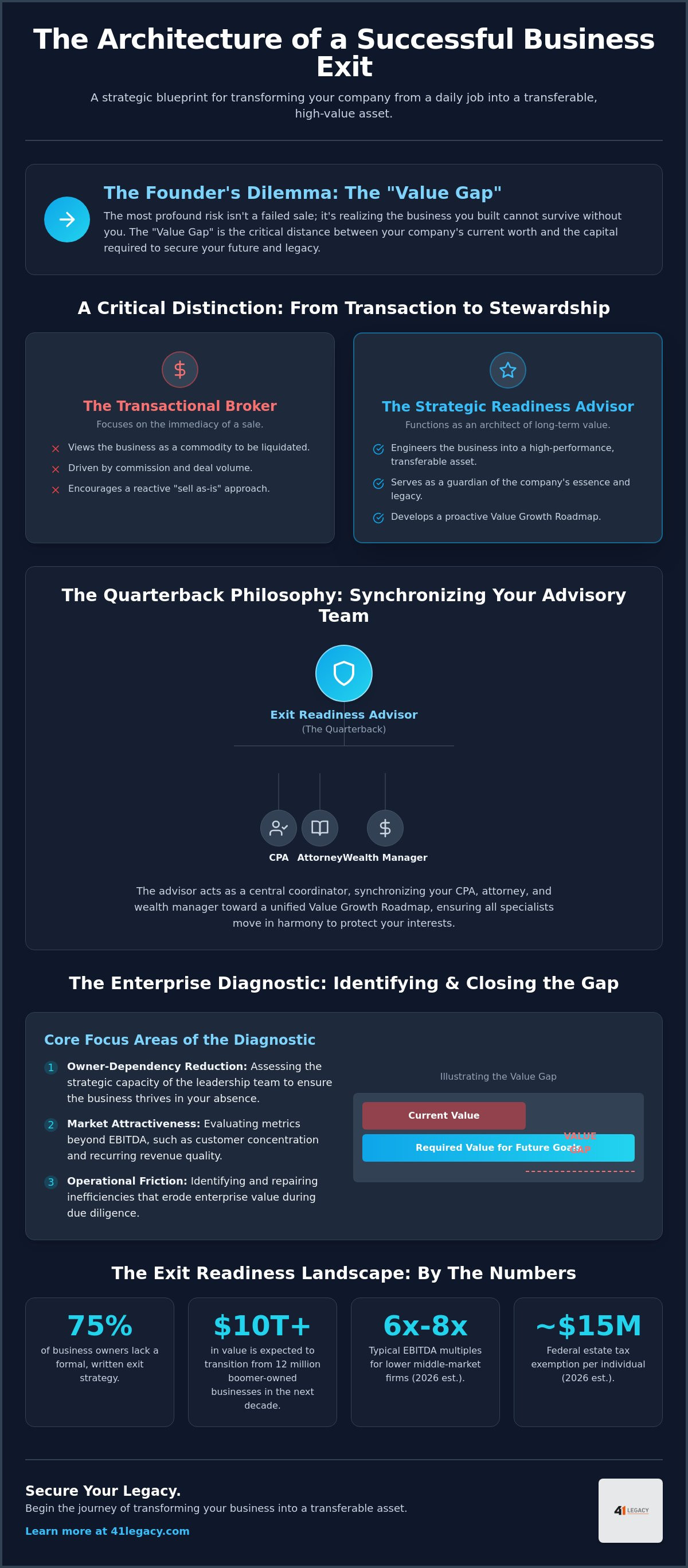
This phase is one of high-altitude strategic engineering. It's the period where we move beyond the surface of daily operations to examine the inner essence of the company. By utilizing an Enterprise Diagnostic, owners can identify the specific levers that drive transferability. This is not about "selling as-is." It is about refining the business until it operates as a high-performance asset that can thrive independently of its creator. Industry research consistently highlights that approximately 75% of business owners lack a formal, written exit strategy. This lack of preparation often leads to deal fatigue or the erosion of enterprise value during the due diligence process.
The Distinction Between a Sale and a Transfer
A sale is an event; transferability is a permanent characteristic. When a business is engineered for transfer, it possesses a clarity and rhythm that appeals to the most sophisticated buyers. Strategic readiness involves creating a Value Growth Roadmap that addresses owner dependency and operational friction. By focusing on transferability, you reduce the inherent risks that cause transactions to fail. You aren't just looking for a buyer; you're ensuring the business is a masterpiece of efficiency that commands the 6x to 8x EBITDA multiples typically seen in the lower middle market in 2026.
The Guardian of the Enterprise Essence
The advisor you select serves as the guardian of your life's work. Over the next decade, an estimated 12 million businesses owned by baby boomers will transition, representing over $10 trillion in value. This massive demographic shift demands a "professional-room altitude" where discussions are handled with technical precision and deep respect for history. Building your business exit team allows you to navigate the emotional weight of this transition with a calm, authoritative partner. We treat the business not as a commodity to be liquidated, but as a legacy to be preserved and passed forward with intentionality.
Critical Questions Regarding Value Enhancement and Diagnostics
A business is more than a balance sheet; it's a living entity with a story that must continue without its author. When you begin building your business exit team, the first inquiry must be directed at the clarity of your diagnostic data. You cannot engineer a legacy on assumptions. A sophisticated advisor doesn't merely look at historical performance; they examine the "Value Gap," which is the distance between your current enterprise value and the capital required to fund your post-exit life and philanthropic goals. With the federal estate tax exemption set to increase to approximately $15 million per individual in 2026, understanding how your valuation aligns with these thresholds is a matter of strategic necessity.
Performing an Enterprise Diagnostic serves as the foundational audit of your company’s inner essence. This process goes beyond standard EBITDA multiples, which typically range between 6x and 8x for lower middle-market firms in 2026. We look at "Market Attractiveness" through a different lens, evaluating metrics such as customer concentration, recurring revenue quality, and the durability of your competitive advantage. These factors determine whether your company is a commodity or a premier asset. High-value advisors provide more than a report; they offer a lens through which the invisible risks of your operation become visible and manageable.
Reducing owner dependency is the most critical technical challenge in this phase. If the business relies on your personal relationships or technical skills to survive, its value is significantly compromised. We measure the "Strategic Capacity" of your leadership team to ensure the business can maintain its rhythm in your absence. This isn't about working less; it's about building a structure where your presence is an asset rather than a requirement. By identifying and repairing these value-leaks early, you ensure the company remains a transferable asset that commands a premium.
Bridging the Value Gap
Closing the Value Gap requires a disciplined Value Growth Roadmap. This plan isn't a static document but a dynamic guide that prioritizes the most impactful improvements to your enterprise value. You should ask your advisor for evidence of implementation support. A true partner doesn't just point out the gap; they provide the monthly advisory required to bridge it systematically, ensuring your financial legacy is secured before you ever reach the negotiation table.
Engineering for Transferability
Transferability is the ultimate measure of a company’s mechanical and aesthetic harmony. To achieve this, your advisor must evaluate management depth and the precision of your documented standard operating procedures. A business that is ready for transfer is one where every process is polished to a high sheen, allowing a new steward to step in without disrupting the company’s soul. This engineering ensures that the history you’ve built is preserved through the transition and beyond.
The Quarterback Philosophy: Synchronizing the Advisory Team
Excellence is rarely achieved in isolation. When building your business exit team, the objective is to move beyond a collection of individual experts toward a synchronized ensemble. A CPA focuses on the precision of the tax code. An attorney prioritizes the rigidity of the legal framework. A wealth manager looks at the horizon of your post-exit life. Without a central coordinator, these disciplines often operate in silos, creating a discordant strategy that can erode enterprise value. We act as the guardian of this harmony, ensuring that every professional voice contributes to a single, elegant masterpiece of transferability.
We serve as the central hub for this transition. This role isn't about replacing your trusted advisors; it's about ensuring their specialized skills are focused on the singular objective of your Value Growth Roadmap. By resolving conflicting advice early, we prevent the deal fatigue that often occurs when professional disciplines clash during the high-pressure environment of due diligence. Proactive alignment ensures that tax and legal strategies are woven into the fabric of the business long before a transition begins. This high-altitude approach allows for surgical precision in navigating complex regulations, such as the 2026 permanent status of the 20% Qualified Business Income deduction.
The Lead Advisor as a Strategic Coordinator
A lack of coordination is often the primary cause of deal failure. If your tax strategy isn't aligned with your legal structure, the resulting friction becomes visible to potential buyers, signaling risk rather than readiness. Learn how we coordinate your advisory team for maximum impact. By establishing a unified vision, we ensure that every professional effort is a building block for transferability. This coordination transforms a group of specialists into a protective barrier around your legacy, ensuring the company’s essence remains intact during the transition.
Aligning Interests for a Seamless Transition
Strategic clarity is maintained through a structured system of Monthly Implementation Support. This cadence ensures that momentum isn't lost to the daily demands of the business. By assuming the administrative burden of advisor coordination, we allow the owner to remain focused on maintaining the company’s operational rhythm. This alignment is especially critical given the regulatory complexities of 2026, such as the mandatory recognition of deferred gains in Qualified Opportunity Funds on December 31, 2026. Proactive coordination ensures these deadlines are met with precision, protecting your hard-earned equity and ensuring the transition is as seamless as the business itself.
Evaluating Methodology and Strategic Depth
A masterpiece is never the result of chance; it is the product of a disciplined methodology and unwavering devotion to detail. When building your business exit team, the framework your advisors employ must be as sophisticated as the enterprise you've spent a lifetime creating. We utilize a process rooted in the Exit Planning Institute (EPI) curriculum, ensuring that every strategic move is backed by technical precision. This universal standard provides a common language for your CPA and attorney, allowing for a level of coordination that "proprietary" or opaque systems simply cannot match. It's a commitment to transparency that honors the provenance of your company.
Strategic Capacity Evaluation is the lens through which we examine the durability of your leadership. It's not enough to have a capable team. They must possess the autonomy to maintain the company’s rhythm without your constant intervention. We look beyond basic management skills to evaluate how your team handles high-altitude decision-making. This diagnostic identifies the specific areas where leadership depth must be engineered to ensure the business remains a transferable asset. By strengthening these internal pillars, we protect your enterprise value during the delicate phase of roadmap implementation, ensuring the company’s essence remains uncompromised.
The Framework of Excellence: CEPA Standards
The Certified Exit Planning Advisor (CEPA) designation represents a pinnacle of professional rigor in the field of transition. By adhering to these standards, we provide an Exit Readiness Assessment that serves as a surgical audit of your company’s market appeal. We don't believe in "black-box" strategies. Instead, we use recognized diagnostic tools to evaluate the intangible assets that sophisticated buyers value most. This clarity allows you to move forward with the confidence that your legacy is being handled with curatorial expertise. Start your Exit Readiness Assessment to begin the process of professional curation.
From Advice to Implementation
Advice without action is merely a concept. While many firms provide a static report and consider their work finished, we focus on the transition from theory to tangible results. Our Monthly Implementation Support ensures that you remain accountable to the milestones defined in your Value Growth Roadmap. This persistent cadence transforms a conceptual plan into a living, transferable asset that thrives independently. We provide the strategic weight required to move through complex improvements, ensuring that every adjustment to your operations is polished to a high sheen and perfectly aligned with your ultimate financial goals.
Stewardship of Legacy: Selecting Your Final Partner
The final act of stewardship for any business owner is the selection of the partner who will guide the enterprise into its next chapter. This choice is more than a logistical necessity; it's a declaration of the value you place on the history and essence of what you've created. Building your business exit team is the process of surrounding yourself with voices that mirror your own dedication to excellence. In a market often cluttered with the noise of high-volume transactions, moving toward the quiet confidence of legacy building requires a calm, authoritative presence. We provide the diagnostic depth and strategic support necessary to ensure your exit is not merely a departure, but a masterful transition.
Stewardship requires a refusal to settle for the common path. While many focus on the mechanics of a transaction, the true guardian focuses on the preservation of impact. By integrating sophisticated diagnostics with a structured Value Growth Roadmap, we ensure that the company’s inner essence remains protected. This approach moves beyond the anxiety of the "Value Gap" and into a space of strategic clarity. You've spent decades building a story; the final chapter deserves the same level of precision and reverence that defined the very first.
The Mindset of a Master Artisan
A true founder is a master artisan, someone who's crafted an entity intended to endure. Your role in this final stage is to ensure the business can function as a lasting, independent entity that honors its own provenance. The Exit Readiness Assessment is the foundational first step in this journey of preservation. It allows us to examine the intricate engineering of your operations and refine them until they reach a state of aesthetic and mechanical harmony. Begin your journey toward a transferable legacy by embracing the discipline of readiness.
The Conclusion of Strategic Growth
A perfectly prepared business doesn't need to shout for attention. Superior outcomes are the natural consequence of quality and transferability. We refuse to settle for transactional mediocrity, believing instead that perfection in preparation is the only path to a successful transition. As you conclude this guide, evaluate your current team’s ability to act as a guardian of your enterprise value. Does your circle of advisors possess the strategic clarity to protect your legacy, or are they merely focused on the event of a sale? Stewardship demands a higher standard, and your life’s work deserves nothing less.
The Culmination of Your Life’s Work
Transitioning from a founder to a steward requires a profound shift in perspective. It's about moving from the immediate pressure of a transaction to the high-altitude engineering of transferability. By building your business exit team with a focus on coordination and strategic clarity, you ensure that your company’s essence is preserved through the transition. A coordinated advisory team, led by a central coordinator, prevents the discord that often devalues an enterprise during due diligence. This structured approach, rooted in the technical precision of the CEPA framework, transforms your business into a high-performance asset that thrives independently.
41 Legacy operates as a national strategic advisory specializing in enterprise diagnostics and the reduction of owner dependency. We bring a master-artisan approach to every engagement, utilizing a structured Value Growth Roadmap to bridge the gap between your current worth and your legacy goals. Protect your life’s work with a comprehensive Exit Readiness Assessment from 41 Legacy. You’ve spent years building something of significance. Now is the time to ensure it endures with the grace and excellence it deserves.
Frequently Asked Questions
What is the difference between an M&A broker and a strategic exit advisor?
The distinction lies in the timing and scope of the engagement. A broker is primarily transaction-focused, entering the narrative to facilitate a sale of the business as it currently exists. A strategic exit advisor serves as an architect who enters years earlier. Their role is to engineer the company for maximum transferability and value, ensuring the structure is optimized before any transaction is ever considered.
Why should I focus on exit readiness if I do not plan to transition for several years?
Sophisticated value growth is a deliberate, time-intensive process that cannot be rushed. Experts generally recommend a five to seven year horizon to successfully bridge the gap between current worth and future needs. Early preparation allows for the meticulous refinement of operations and the reduction of owner dependency, ensuring the business is a masterpiece of efficiency by the time you are ready to depart.
What is a "Value Gap" and how does it affect my business exit team?
The Value Gap is the mathematical distance between your current enterprise valuation and the net proceeds required to fund your post-exit life. When building your business exit team, this gap serves as the primary metric for your advisory circle. Every specialist, from your CPA to your attorney, must align their efforts with a single Value Growth Roadmap designed to close this deficit through strategic engineering.
Can my current CPA or attorney lead my exit planning and readiness process?
Your existing advisors are essential specialists, but they often lack the specific framework required to coordinate a multi-disciplinary transition. Building your business exit team requires a lead advisor who acts as a "Quarterback." This role involves synchronizing the technical precision of your legal and financial counsel toward a unified vision, ensuring that disparate professional efforts don't create friction or devalue the enterprise.
How does reducing owner dependency specifically increase my company’s market value?
Reducing dependency lowers the inherent risk for a successor, which directly correlates to a higher valuation multiple. A business that relies on the founder's personal relationships or technical skill is a liability; a business that thrives independently is a transferable asset. By empowering a management team and documenting precise procedures, you transform the company from a job into a high-performance entity that commands premium market interest.
What is the role of a Certified Exit Planning Advisor (CEPA) on my team?
A CEPA provides the technical framework and strategic depth required for a sophisticated transition. They utilize recognized standards, such as the Exit Planning Institute curriculum, to perform Enterprise Diagnostics and coordinate the advisory team. This designation ensures your advisor possesses the curatorial expertise to handle your legacy with the reverence and technical precision it demands, moving beyond guesswork into a disciplined methodology.
Is an exit readiness advisor the same as an investment banker?
No, these roles serve different stages of the company’s progression. An investment banker or broker focuses on the market event and the negotiation of deal terms. An exit readiness advisor focuses on the foundational engineering required to make the business attractive to those parties in the first place. We prepare the business to be "due diligence ready," ensuring its inner essence is polished before market exposure.
How do I determine if my business is currently a transferable asset?
Transferability is measured through an Enterprise Diagnostic that evaluates the company’s ability to maintain its rhythm without the founder. We examine management depth, the quality of recurring revenue, and the precision of standard operating procedures. If your company can navigate complex challenges and maintain its aesthetic and mechanical harmony in your absence, it has achieved the status of a truly transferable asset.
Disclaimer
This article is for educational and informational purposes only and does not provide legal, tax, investment, or business brokerage advice. 41 Legacy does not offer M&A brokerage services, legal document drafting, tax preparation, or investment advisory services. Business owners should consult licensed professionals in those disciplines before making decisions related to business transactions, legal matters, tax strategy, or financial planning. All examples are illustrative and may not apply to your specific situation.