
Building a Transferable Asset: A Guide for Owners
What would happen if your company had to operate for a month without you? If customers, key decisions, or essential processes depend on your personal knowledge, the business may be harder to transfer than its ownership paperwork suggests. Learning how to build a transferable asset starts with a broader question: can the company continue to perform, make sound decisions, and show what drives its results without relying on you at every turn?
Owners know that a strong business takes years to build. Yet day-to-day demands can leave little room to document how work gets done or make financial information useful for timely decisions. Transferability is not a last-minute project. It develops through deliberate changes that make the enterprise more resilient and its performance easier to understand.
This guide explains what makes an operating business transferable, how to identify owner-dependent risks and financial blind spots, and what to address first. The practical sequence is to clarify the financial picture, strengthen repeatable operations, distribute critical knowledge, and build a company that can carry its value through an internal or external transition.
Key Takeaways
- A transferable business can sustain its operations, decisions, and value beyond the owner’s daily involvement.
- Map the decisions, relationships, and knowledge that depend on you, then separate essential judgment from work that can be documented and assigned.
- Use clear financial information and consistent review to make decisions with a stronger view of cash, profit, and enterprise value.
- To understand how to build a transferable asset, establish a baseline, identify dependencies, prioritize value levers, assign actions, and review progress.
- Strengthen transferability before choosing a transition path, using structured financial insight to guide the work.
What Does It Mean to Build a Transferable Business Asset?
The phrase “asset transfer” can mean a change in legal ownership of a particular asset. Building a transferable business is a different undertaking. It means preparing the whole enterprise to keep serving customers, making sound decisions, and sustaining its performance beyond the owner’s daily involvement.
Business transferability is an enterprise’s ability to sustain its operations, decisions, and value beyond its owner’s daily involvement, not simply a change in legal ownership. Readiness takes shape through the company’s operating and financial condition: how work is carried out, where important knowledge resides, and whether leaders can understand and act on the business’s performance. It isn’t created by a last-minute document.
How Is a Transferable Business Different From a Transferred Asset?
Changing title to a piece of equipment, property, or another individual asset addresses who owns that item. Preparing a business for transfer addresses whether the enterprise can function as a whole when the owner steps back. For example, customer relationships may be attached to a company, yet remain vulnerable if only the owner knows the history, expectations, and next steps for key accounts.
This distinction matters when thinking several years ahead. The question isn’t only whether ownership could change; it’s whether people, processes, and financial information are clear enough for the business to continue operating through that change. This guide focuses on business capability and readiness, not on drafting transfer documents. Understanding how to build a transferable asset begins with examining how the company works, rather than treating transferability as a paperwork task.
Why Begin Building Transferability Before a Transition?
Starting early gives an owner time to see where the company relies on personal involvement and address those dependencies in a deliberate order. Begin by noting which decisions, customer conversations, approvals, and operating routines still require the owner. Then identify what needs to be documented, assigned, or supported by better information. These steps can strengthen the business regardless of when, or whether, a transition occurs.
The stakes are personal as well as operational: 80 to 90 % of an owner’s net worth sits inside the business. That concentration makes it valuable to understand the enterprise’s strengths and vulnerabilities before a transition is pressing. Preparation doesn’t guarantee a transaction, a particular valuation, or a specific outcome. It creates more time to improve clarity and reduce avoidable reliance on one person.
This article provides general business information, not advice for a specific company or transaction. It isn’t legal, tax, or investment advice. The focus is the enterprise itself: building the operating capacity and financial understanding that can support continuity beyond its founder.
Build Transferability by Reducing Owner Dependency
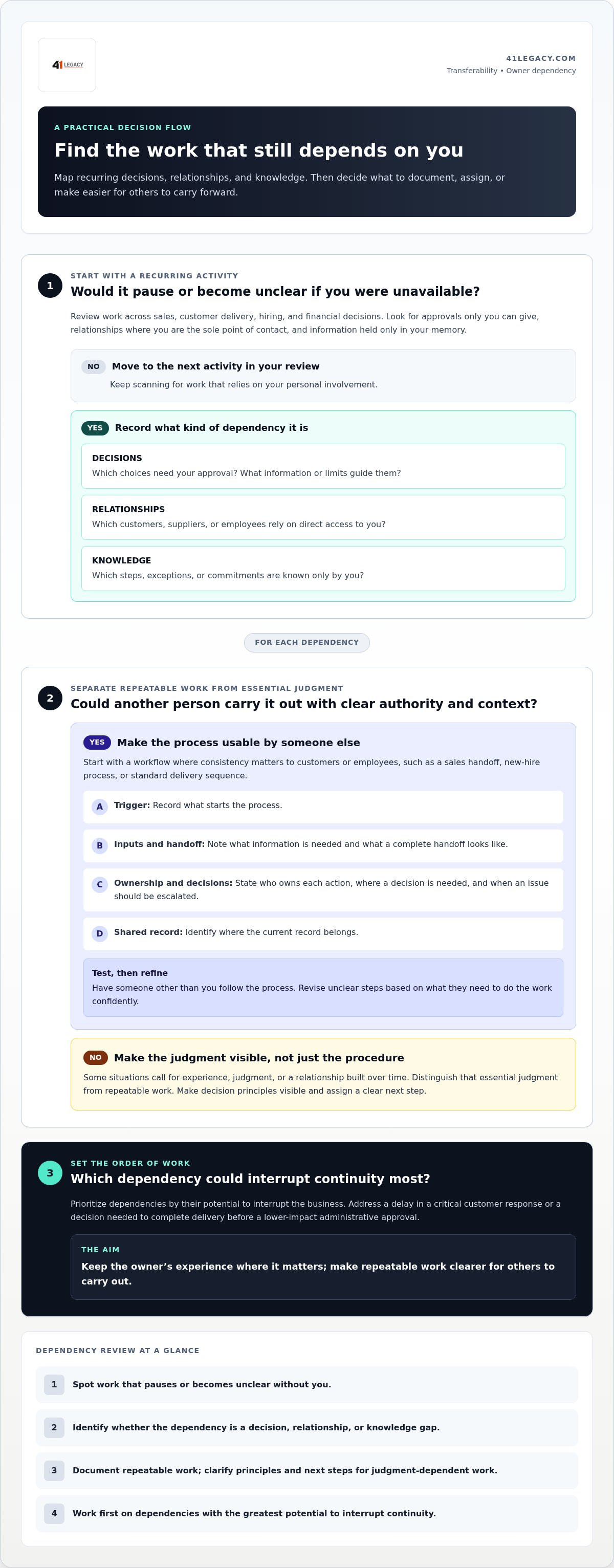
A business may have capable people and sound processes yet still rely on its owner to connect every part of the operation. Make that reliance visible. Track the recurring decisions, relationships, and knowledge that pass through you, then ask what would pause or become unclear if you were unavailable.
Which Owner-Dependent Activities Should You Identify First?
Review the work across sales, customer delivery, hiring, and financial decisions. Look for approvals only you can give, customer relationships where you’re the sole point of contact, and information that exists in your memory rather than in a shared record. A simple inventory can reveal where a routine question becomes a bottleneck.
- Decisions: Which choices require your approval, and what information or limits guide them?
- Relationships: Which customers, suppliers, or employees rely on direct access to you?
- Knowledge: Which steps, exceptions, or commitments are known only by you?
Prioritize dependencies by their potential to interrupt continuity. A delay in a critical customer response or a decision needed to complete delivery may warrant attention before a lower-impact administrative approval. This isn’t about removing the owner’s judgment from the company. It’s about distinguishing judgment that genuinely requires your experience from repeatable work that others can carry out with clear authority and context.
How Can Repeatable Processes Support Continuity?
Choose a few recurring workflows whose consistency matters to customers and employees. A sales handoff, a new-hire process, or a standard delivery sequence can be a useful place to begin. Document the steps in language the person doing the work can use, including who owns each action, where a decision is needed, and when an issue should be escalated.
Keep the instructions practical. Record what triggers the process, what information is needed, what a complete handoff looks like, and where the current record belongs. Then have someone other than the owner follow the process and identify unclear steps. Revise the documentation based on what they need to do the work confidently.
Well-made procedures can support continuity, but documentation alone doesn’t make every decision transferable. Some situations call for experience, judgment, or a relationship built over time. In those cases, make the decision principles visible, assign a clear next step, and build another person’s involvement gradually.
Reducing owner dependency is a practical part of how to build a transferable asset: identify the bottleneck, clarify responsibility, and test whether the work can proceed without your intervention. 41 Legacy’s financial clarity and enterprise-value services support owners working to strengthen transferability. The scope of each engagement is defined in the client’s written agreement.
Use Financial Visibility to Strengthen Transferability
A company can’t make sound, independent decisions if its financial picture arrives too late or lacks measures leaders can use. Timely financial visibility helps the owner and team understand what is happening, what may lie ahead, and which choices deserve attention. It also makes performance easier to explain beyond the founder’s personal view of the business.
“Three weeks late is how old the average owner’s financial picture is when the decision has to be made”. Historical results matter, but they describe what has already happened. Forward-looking decisions require a current view of cash needs, expected activity, and the measures that signal whether the plan is working.
What Financial Information Helps an Owner Make Better Decisions?
Different financial tools answer different questions. A budget sets out planned income and spending. A forecast updates expectations as circumstances change. Key performance indicators, or KPIs, track measures relevant to the company’s priorities. Working-capital visibility helps leaders understand how cash moves through day-to-day operations, while enterprise-value tracking keeps attention on the qualities that support durable performance.
These inputs are most useful when reviewed consistently and connected to decisions. A forecast can help frame upcoming cash needs; a KPI can show whether a key part of the operating plan is on track. Neither should be treated as a guarantee. Their purpose is to give decision-makers a clearer basis for discussion and action. Strategic financial work looks ahead, helping leaders consider decisions rather than relying only on historical reporting.
How Does a Dual-Lens Decision Process Work?
Evaluate each significant financial choice through two lenses. First, assess its expected effect on profit and cash: what costs, income, and timing may be involved? Then consider its potential effect on enterprise value: could the decision strengthen consistency, reduce reliance on the owner, or support the company’s ability to perform over time? The questions don’t produce a guaranteed answer. They make trade-offs explicit.
For example, a company might consider investing in a system to improve a recurring workflow. The profit-and-cash lens examines the expected expense and timing of cash outflows, alongside the costs or capacity the change may affect. The enterprise-value lens asks whether the workflow could become more consistent, easier to oversee, or less dependent on one person. The owner can then weigh the available information, assumptions, and priorities without treating a possible long-term benefit as certain.
This discipline helps distinguish short-term results from lasting business strength. A decision that improves one period’s results may not address the underlying factors that support continuity; a longer-term investment still needs a clear financial rationale. Owners can consider how durable performance and reduced dependency contribute to a stronger enterprise. Used together, financial visibility and a dual-lens review help leaders make choices that are clearer to the team and more understandable through a future transition.
Follow a Practical Sequence to Build a Transferable Asset
Transferability improves through deliberate actions, not a single project completed at the end. A clear sequence helps turn broad concerns into observable progress: defined responsibilities, usable processes, and financial information leaders can apply. You can begin this work before choosing an internal or external transition path. The findings will help shape priorities, while implementation may reveal new gaps to address.
How Do You Establish a Starting Point?
Begin with a practical baseline: review the current financial picture, identify key owner dependencies, and note which measures inform decisions today. Separate established facts from assumptions that need better information. A baseline is a tool for prioritizing work, not a certified valuation or a prediction of future results. It makes the starting conditions visible so progress can be assessed with greater discipline.
Use the baseline to decide which changes deserve attention first. It can help distinguish an immediate operating concern from a longer-term opportunity, then connect each priority to observable evidence of progress. The sequence below turns that initial picture into an ongoing plan:
- Establish a baseline. Gather the financial measures and operating information currently used to guide decisions. Record where information is incomplete, delayed, or based on assumption.
- Identify dependencies. Map decisions, customer relationships, approvals, and operating knowledge that rely heavily on the owner. Note what could stall if that person were unavailable.
- Prioritize value levers. Select opportunities tied to continuity, financial clarity, or enterprise value. Focus on the issues with meaningful implications for how the company operates and makes decisions.
- Assign actions. Give each agreed priority an accountable owner, a defined next step, and a way to recognize completion. Responsibilities should be clear enough that progress doesn’t depend on repeated prompting from the founder.
- Review progress. Set a regular review rhythm. Compare current evidence with the baseline, note what has changed, and adjust priorities as new information emerges.
How Do You Turn Findings Into Consistent Progress?
Choose a manageable set of priorities rather than treating every gap as urgent. For each action, specify who is responsible, what evidence will show that the work is complete, and when the team will review it. Evidence might include a process another employee can follow, a decision with clear accountability, or financial information available in time to inform a choice.
Then repeat the cycle. A new process may surface a decision that still rests with the owner; a financial review may change which improvement deserves attention next. This iterative approach makes transferability part of ongoing business management, not a task that begins only when a transition is imminent. The right priorities depend on each company’s circumstances. This section offers general information, not advice for a specific business. The scope of each 41 Legacy engagement is defined in the client’s written agreement.
For a structured starting point, learn about 41 Legacy’s fixed, six-week financial clarity intensive.
How 41 Legacy Supports the Work of Building a Transferable Asset
The steps in this guide help owners see where the enterprise can become less dependent on them and better prepared to sustain value through change. 41 Legacy provides fractional CFO and enterprise-value advisory services that connect financial insight with practical priorities. The focus is strategic clarity, transferability, and enterprise-value growth, so owners can build a more durable company without treating readiness as a last-minute exercise.
What Happens During the Fixed, Six-Week Financial Clarity Intensive?
The fixed, six-week financial clarity intensive includes one working session per week and a custom KPI tracking sheet. Weeks 1 and 6 are identical for every client. Weeks 2-5 are customized after week 1. The week 3 deliverable is a 13-week cash-flow forecast. This defined structure provides a focused way to examine financial visibility and progress while tailoring the middle weeks to the business.
The KPI tracking sheet supports attention to measures relevant to the business and its decisions. The intensive establishes a clearer financial picture and identifies top profit levers before any ongoing work begins. It’s designed for owner-operated companies with $1 M to $30 M in annual revenue.
What Can Ongoing Strategic Finance Support Address?
After the intensive, the ongoing CFO Seat provides a monthly strategic finance rhythm through budgeting, forecasting, KPI review, decision support, working-capital discipline, and enterprise-value tracking. These activities help owners review what may lie ahead, assess decisions through both profit and cash impact and enterprise-value impact, and maintain a clearer view of progress. The CFO Seat focuses on forward-looking financial decisions.
41 Legacy can coordinate with an owner’s existing professional advisors while keeping each advisor’s role distinct. That coordination can help financial priorities stay connected to the wider transition process, while legal, tax, and investment matters remain with the appropriate professionals. The scope of each engagement is defined in the client’s written agreement.
For owners considering how to build a transferable asset, structured financial support can help translate findings into focused priorities. A first conversation is “No pitch. No pressure.” Explore 41 Legacy’s financial clarity intensive and ongoing CFO Seat.
This article provides general information, not advice for a specific business. Each company’s circumstances and priorities are different, and the ideas here are intended to support informed consideration rather than prescribe a particular course of action.
Make Transferability a Continuing Priority
The next step doesn’t need to be a major restructuring. Choose one business dependency or financial blind spot that could limit continuity, then define what progress would look like in observable terms. A responsibility is clear when someone knows who owns it. A process is useful when another person can follow it. A financial measure is decision-ready when it informs action, not just records the past.
That is the practical work behind how to build a transferable asset: steadily increasing the company’s ability to perform without requiring the owner to carry every decision, relationship, or piece of knowledge. The result is not a promise of a particular transition or outcome. It is a more deliberate way to steward the enterprise and prepare it for what comes next.
41 Legacy helps owners connect financial clarity with enterprise-value priorities through its fixed, six-week financial clarity intensive and ongoing CFO Seat. Start with a 30-minute conversation, No pitch. No pressure.
Frequently Asked Questions
What is a transferable asset in a business?
A transferable business asset is an operating company whose performance doesn’t rest entirely on its owner’s presence. A practical test is whether a capable team member can handle a customer issue, make a routine decision, or explain a key operating measure without waiting for the founder. The more consistently the company can do this, the better prepared it is to continue through a change in ownership or leadership.
How do you make a business less dependent on its owner?
Start by selecting one routine decision or customer handoff that currently waits for your input. Identify who could take responsibility, what information they need, and which unusual situations should still come to you. Then test the arrangement during an ordinary work period and adjust any unclear boundaries. This turns delegation into a defined operating practice, rather than simply asking someone to “take more off your plate.”
Can a small business become transferable if the owner is still involved?
Yes. Transferability doesn’t require an owner to leave or stop contributing. The distinction is whether the company can continue key work without the owner resolving every routine issue. An owner might remain responsible for setting direction, for example, while a team member manages standard customer follow-up. Clear authority and a reliable way to raise exceptions help preserve the owner’s judgment without making daily execution depend on it.
How long does it take to build a transferable business?
There isn’t a single timeline that applies to every company. The work depends on what currently relies on the owner, how readily the team can assume responsibility, and how much financial information needs improvement. Begin with a manageable priority, then review what changed and what still needs attention. Progress can build over time; it shouldn’t be treated as a deadline-driven project that begins only when a transition is imminent.
What financial information helps make a business more transferable?
Useful information is timely, understandable, and connected to decisions. For example, leaders may compare actual results with a budget, use a forecast to consider upcoming cash needs, and track a small set of KPIs tied to company priorities. A useful test is whether someone other than the owner can explain what changed, what the figures may mean for the next decision, and what information is still missing.
Does building a transferable asset mean I need to sell my business?
No. Transferability can support continuity whether you plan to keep ownership, prepare a family or internal transition, or consider another path later. Strengthening decision-making and reducing reliance on one person can make the company more resilient during ordinary changes, such as the owner stepping away from a responsibility. Building readiness preserves options; it doesn’t commit you to a sale or guarantee a particular outcome.
What is the difference between a financial clarity intensive and ongoing CFO support?
The fixed, six-week financial clarity intensive is a defined diagnostic process, with one working session per week and a custom KPI tracking sheet. The CFO Seat is ongoing strategic finance support that can address budgeting, forecasting, KPI review, decision support, working-capital discipline, and enterprise-value tracking. In brief, the intensive establishes financial clarity; ongoing support provides a continuing rhythm for financial decisions and review.
Does 41 Legacy provide advice for my specific business?
41 Legacy provides fractional CFO, financial advisory, and enterprise-value services for owner-operated companies, with engagement scope defined in the client’s written agreement. The information in this article is general and isn’t advice for a specific business. An engagement can focus on a company’s financial priorities while keeping professional roles distinct. 41 Legacy does not provide legal, tax, or investment advice; those matters remain outside its scope.

Article by
Mike Laskowski
Mike Laskowski is a Business Value Growth Strategist who helps business owners uncover the truths that drive their performance, risk, and readiness. Blending forensic interviewing from a 26‑year federal career with Strategic Capacity analysis and CEPA methodology, he works upstream to reduce owner dependency, increase transferability, and strengthen enterprise value. Mike guides founders through clarity, operational evolution, and transition readiness so their companies become transferable, owner‑independent assets that endure beyond the founder.
Disclaimer
This article is for educational and informational purposes only and does not provide legal, tax, investment, or business brokerage advice. 41 Legacy does not offer M&A brokerage services, legal document drafting, tax preparation, or investment advisory services. Business owners should consult licensed professionals in those disciplines before making decisions related to business transactions, legal matters, tax strategy, or financial planning. All examples are illustrative and may not apply to your specific situation.

