
Building a Business Exit Team: The Architecture of a Transferable Legacy
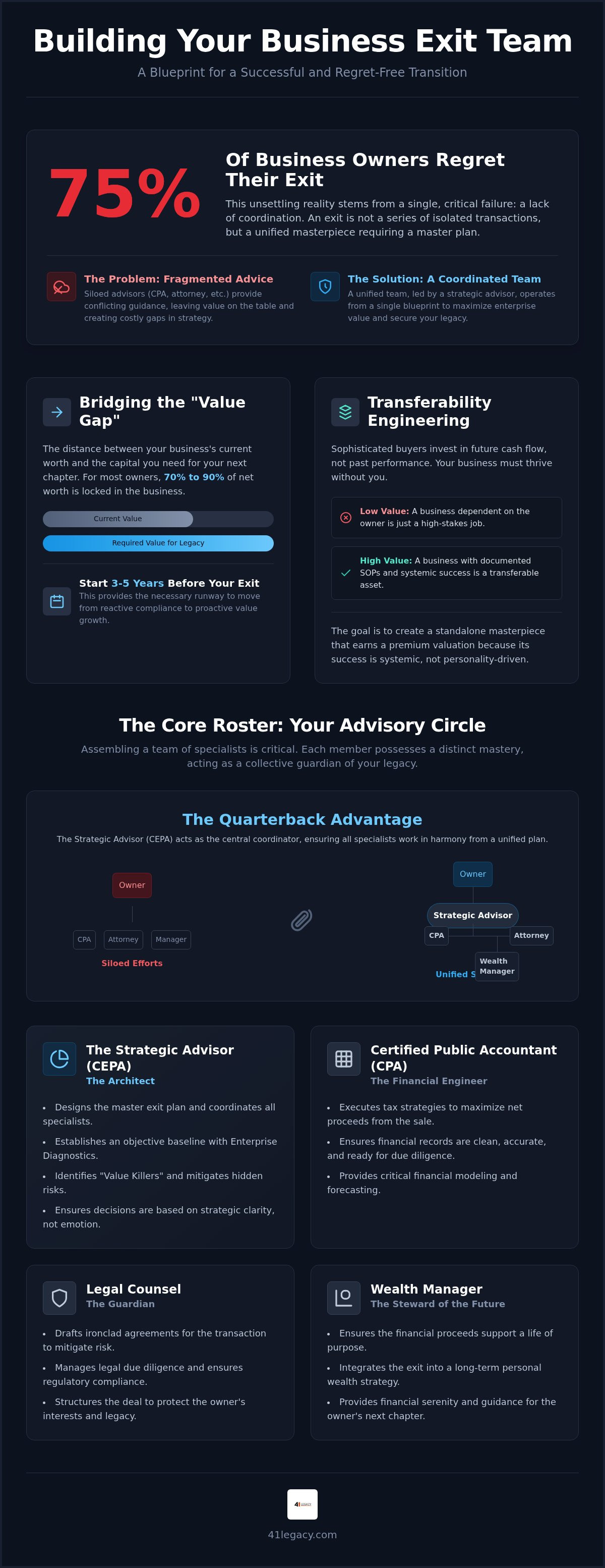
Approximately 75% of business owners profoundly regret their exit within a year of the transaction. This unsettling reality stems not from a lack of effort, but from a failure of coordination. Your enterprise is the culmination of years of meticulous craftsmanship; however, many owners approach the transition as a series of isolated transactions rather than a unified masterpiece. Building a business exit team is the essential first step to ensure your legacy isn't left to chance. Without a central architecture, even the most brilliant CPAs and attorneys can become siloed, inadvertently leaving value on the table through fragmented advice.
It's natural to feel protective of the essence you've built. You understand that your company represents the vast majority of your net worth, yet the fear of owner-dependency often devalues what should be your greatest asset. We believe your exit should be a crowning achievement, not a source of remorse. By reading on, you'll discover how to assemble a high-performance advisory team that operates with the precision of a master artisan. We'll explore how a coordinated strategy, anchored by Enterprise Diagnostics and a Value Growth Roadmap, transforms your business into a transferable legacy that thrives long after your final day at the helm.
Key Takeaways
- Understand why a specialized ensemble is necessary to bridge the gap between fragmented professional advice and true enterprise value.
- Learn the critical roles within your circle, as building a business exit team requires an architect to design the strategy and specialists to engineer the financial details.
- Discover the "Quarterback" advantage in aligning siloed advisors to prevent conflicting guidance and ensure a unified path toward transition.
- Use the Enterprise Diagnostic as a foundational tool to identify "Value Killers" and mitigate risks before they impact your transferability.
- Shift your focus from a mere transaction to the stewardship of a legacy by prioritizing owner-dependency reduction and strategic clarity.
The Architecture of Exit: Why a Specialized Team is Essential
A business is more than a balance sheet; it's a living history of your dedication and expertise. Transitioning away from this life's work requires a profound shift from mere ownership to intentional stewardship. While many view the end of their tenure as a simple transaction, a successful transition is a deliberate orchestration of many moving parts. It's the difference between selling a physical object and ensuring the survival of a unique essence. Without a coordinated effort, enterprise value often dissipates in the silence between siloed advisors who don't communicate. Building a business exit team ensures that your CPA, attorney, and wealth manager aren't just performing isolated tasks, but are acting as collective guardians of your history and its future potential.
Understanding the Value Gap
The "Value Gap" is the silent, often unacknowledged distance between what your business is worth today and what you actually need to fund your next chapter. For many owners, 70% to 90% of their net worth is locked within the company's walls. Closing this gap isn't an overnight task. It requires a diagnostic approach to identifying hidden risks, often called "value killers," that a sophisticated buyer will use to discount your life's work. To mitigate these risks effectively, you should begin the team-building process three to five years before your anticipated exit strategy takes flight. This runway allows your advisors to move beyond reactive compliance and into proactive value growth, ensuring that no money is left on the table due to poor planning.
The Concept of Transferability Engineering
Sophisticated buyers don't purchase your past performance; they invest in your company's future cash flows. If the business cannot breathe or function without your daily presence, it isn't a transferable asset; it's a high-stakes job. Transferability engineering is the process of removing the founder as the central hub of all operations. This involves the meticulous creation and implementation of SOPs in business to establish a culture of precision and reliability. When you document the "how" of your success, you provide a blueprint that a new owner can follow with absolute confidence. Building a business exit team allows you to step back and view your enterprise as a standalone masterpiece. It's about creating a business that functions with surgical precision and earns a premium valuation because its success is systemic rather than personality-driven.
The Core Roster: Identifying Key Specialists for Your Exit Team
Building a business exit team is akin to selecting the finest artisans for a restoration project; each must understand the historical weight of the subject while possessing the technical skill to secure its future. Each specialist must possess a distinct mastery. This ensemble acts as a protective circle around your legacy, ensuring that the essence of what you've built remains intact through the transition. The Certified Exit Planning Advisor (CEPA) serves as the primary architect, drafting the master plan that ensures every other specialist moves in harmony. While your CPA focuses on the surgical precision of tax strategies to maximize net proceeds, your legal counsel drafts the ironclad agreements that mitigate risk. Finally, a wealth manager ensures that your transition leads to a life of continued purpose and financial serenity.
The Role of the Strategic Advisor
A strategic advisor provides the high-level vision that prevents individual professional efforts from becoming siloed. We utilize Enterprise Diagnostics to establish an objective baseline, stripping away the emotional fog that often clouds a founder's perspective. This diagnostic phase is the first step for any high-performing advisory team, as it reveals the true health of the asset before any structural changes begin. By acting as an objective voice, the advisor ensures that decisions are made based on strategic clarity rather than the heat of the moment. This role is about more than just numbers; it is about the preservation of a life's work.
Transactional vs. Readiness Professionals
There is a critical distinction between professionals who facilitate a sale and those who prepare a business for transition. When building a business exit team, the timing of these hires is just as important as the individuals themselves. Hiring an M&A broker before your enterprise is truly "ready" is a common error that often leaves significant value on the table. Readiness advisors focus on the "building" phase, ensuring the business can thrive independently of its founder long before a marketplace is even considered. As you focus on increasing enterprise value, the team's focus shifts from mere maintenance to the engineering of a transferable asset. This proactive approach transforms the business into a masterpiece of reliability, making it far more attractive to sophisticated buyers who value stability over historical vanity. If you are seeking to move beyond maintenance, our Strategic Advisory services can provide the clarity you need to begin this transformation.
The Quarterback Advantage: Coordinating Siloed Advisors
An elite roster is only as effective as the coordination behind it. When you are building a business exit team, the most common failure point isn't a lack of expertise, but a lack of integration. Professionals often retreat into their respective silos, focusing on their specific domain without considering the broader strategic arc. A CPA might suggest an aggressive tax structure that, while efficient, creates a legal liability that your attorney would find unacceptable. This fragmented approach forces you, the owner, to act as a mediator between opposing viewpoints, which is a poor use of your limited time and strategic capacity. The Quarterback serves as the central point of accountability, ensuring every professional is working toward the same Value Growth Roadmap and eliminating the friction of conflicting advice.
Aligning Incentives and Communication
Effective orchestration requires consistent, rhythmic communication. Our approach includes monthly implementation support and structured team meetings where all advisors are brought into the same professional space. The Quarterback translates technical jargon into strategic clarity, distilling complex legal or financial maneuvers into actionable insights for the owner. This unified front is essential when presenting the business to potential successors. A "clean" business isn't just one with tidy books; it's one where the advisory team speaks with a single, harmonious voice, signaling to the market that the enterprise is a masterpiece of precision and reliability.
Reducing Owner Dependency Through Team Leadership
The presence of a strategic Quarterback does more than manage advisors; it transforms the internal culture of the company. During the process of building a business exit team, the Quarterback empowers your internal management team to take on higher levels of responsibility. This shift is vital for reducing owner dependency, as it allows you to move from the role of 'Rainmaker' to that of 'Visionary Leader.' By delegating the administrative burden of the exit process to a trusted coordinator, you can focus on the high-level stewardship that further increases transferability. The Quarterback acts as the ultimate guardian of the owner's time and legacy, ensuring that every strategic decision serves the long-term health of the enterprise.
From Diagnostic to Execution: How Your Team Drives Value
The shift from assembly to action marks the true beginning of the work. When building a business exit team, the first collaborative effort is the Enterprise Diagnostic. Such an evaluation serves as a rigorous examination of the company's structural integrity, allowing the team to identify "Value Killers," those hidden risks that would otherwise allow a buyer to discount your life's work. By addressing these early, the team moves from reactive defense to proactive value engineering. Here, the abstract vision of a legacy meets the technical precision of a high-performance asset. It is a rhythmic variation between high-level vision and granular technical improvement that ensures the business remains a living entity, capable of thriving long after your stewardship concludes.
The Diagnostic Phase
Measuring market attractiveness against internal readiness provides the clarity needed for a successful transition. It isn't a mere spreadsheet exercise; it's a search for the "hidden gems" within the business that drive premium multiples and define your company's unique essence. Establishing a baseline valuation that all advisors agree upon creates a unified starting point for the journey ahead. Strategic clarity prevents the advice conflict mentioned earlier, as every specialist now operates from the same set of facts. The diagnostic reveals exactly where the business stands today and what must change to reach its ultimate potential.
The Implementation Support Model
Vision alone cannot sustain a transition. Most exit plans fail because they lack the discipline of daily application. Our Strategic Advisory services bridge this gap through Monthly Implementation Support, providing the rhythmic accountability required to maintain momentum. We ensure that transferability engineering becomes part of the company's daily operations rather than a theoretical goal. When building a business exit team, the focus must eventually shift from planning to the relentless execution of the roadmap. Maintaining momentum over a multi-year timeline requires a steady hand to keep the team aligned. By balancing high-level vision with granular technical improvement, such disciplined support transforms your enterprise into a masterpiece of reliability, ready for its next chapter.
Securing Your Legacy: Building Your Advisory Circle
Building a business exit team is not merely a logistical necessity; it's a profound act of stewardship. The choice of a strategic partner to anchor this circle is the most consequential decision a founder will make. You aren't simply looking for a service provider. You're seeking a guardian who understands that your company is a masterpiece of your own creation, one that deserves to endure beyond your direct influence. This requires evaluating advisors not by their ability to facilitate a quick transaction, but by their unwavering commitment to the growth of enterprise value and the preservation of your company's unique essence. A true connoisseur of business knows that the transition is as important as the creation itself.
We invite you to slow down and appreciate the intricate craftsmanship that has brought your enterprise to this stage. Transitioning requires a psychological shift from being the central owner to becoming the steward of a transferable asset. This perspective allows you to view the business with the objective eye of a curator, ensuring that every gear and process is polished to a high sheen for the next generation of leadership. It's a refusal to settle for less than perfection, signaling that your work exists at the rare intersection of creative artistry and technical engineering.
The First Meeting: What to Ask Potential Advisors
When vetting candidates for your circle, clarity is paramount. A true strategic partner must demonstrate technical precision and a collaborative spirit. While you're building a business exit team, consider these inquiries during your initial consultation:
- "How do you coordinate with my existing CPA and Attorney?" A partner who cannot function as a quarterback will only add to the siloed noise that devalues an enterprise.
- "What is your process for reducing my personal dependency on the business?" Transferability engineering should be a core pillar of their methodology, not a secondary consideration.
Beyond these technical markers, look for a partner who values the essence of the history you've built. They should speak the language of heritage as fluently as the language of finance, ensuring they're driven by more than just a transactional calling.
Begin Your Readiness Assessment
The time for theoretical discussion must eventually give way to the disciplined execution of a Value Growth Roadmap. Moving from high-level vision to granular improvement provides the strategic clarity necessary for a successful transition. This process offers a professional-room altitude where risk is mitigated and the path forward is illuminated with surgical precision. The peace of mind that comes from a coordinated strategy is the ultimate reward for your years of uncompromising dedication. We invite you to secure your legacy with a professional Exit Readiness Assessment and begin the work of transforming your business into a timeless, transferable asset.
Orchestrating Your Final Masterpiece
The transition of a life's work is a delicate orchestration that demands technical precision and a deep respect for history. You've seen how building a business exit team serves as the essential framework for this endeavor, ensuring that your legacy isn't lost in the silence between siloed advisors. By prioritizing strategic coordination and utilizing rigorous Enterprise Diagnostics, you transform your company from an owner-dependent operation into a transferable asset of enduring value. This process isn't merely about a transaction; it's about the intentional stewardship of an essence you've spent years perfecting.
At 41 Legacy, we act as the strategic quarterback for national business owners, guided by a Certified Exit Planning Advisor (CEPA) who understands the weight of your heritage. Our Value Growth Roadmaps provide the rhythmic accountability needed to bridge the value gap and secure your financial future. We invite you to step into a professional-room altitude where your vision is met with surgical execution. Begin your journey toward a transferable legacy with 41 Legacy and ensure that your masterpiece thrives for generations to come. Your dedication deserves nothing less than a perfectly engineered exit.
Frequently Asked Questions
What is the role of a Certified Exit Planning Advisor (CEPA) on an exit team?
A CEPA serves as the master architect of the transition process, aligning the owner's personal aspirations with the company's financial and structural readiness. They operate at a high strategic level, ensuring that every specialist in the circle moves in harmony. By focusing on the "Value Acceleration Methodology," they help transform a business from a mere operation into a transferable masterpiece of enduring legacy.
When is the best time to start building a business exit team?
The ideal time to begin building a business exit team is three to five years before your anticipated transition date. This generous runway allows for the meticulous engineering required to reduce owner dependency and maximize enterprise value. Starting early ensures that value growth is a deliberate process of refinement rather than a hurried response to an unforeseen marketplace opportunity.
How does a 'quarterback' advisor differ from a business broker?
A quarterback advisor focuses on the strategic readiness and structural integrity of the asset long before it enters the market. Unlike a broker, who primarily facilitates a transaction, the quarterback coordinates siloed advisors to ensure the business is optimized for transferability. They are guardians of the owner's time, managing the complex interplay of legal, tax, and operational improvements to secure a superior outcome.
Can my current CPA lead my business exit team?
While a trusted CPA is essential for tax precision, they are often focused on historical compliance rather than forward-looking strategic engineering. Leading an exit team requires a specialized skillset in transferability and value growth that extends beyond traditional accounting. A dedicated strategic advisor complements your CPA's work by integrating their technical data into a broader, cohesive roadmap for the entire enterprise.
What are the common 'value killers' that an exit team identifies?
Value killers are structural risks that allow buyers to discount the worth of your life's work. Common examples include extreme owner dependency, high customer concentration, and a lack of documented processes. A high-performing team identifies these vulnerabilities early, using diagnostics to reveal where the business's essence is too closely tied to the founder's daily presence. Addressing these risks is a core component of building a business exit team.
How much does it cost to build a professional exit advisory team?
The investment in an advisory team varies based on the complexity of the enterprise and the depth of support required. Most strategic advisors utilize a combination of initial diagnostic fees and monthly implementation support to ensure the roadmap is followed with precision. It's best to view these costs as an investment in the asset's health, as professional coordination often yields a significant premium in final enterprise value.
What is an Enterprise Diagnostic and why is it the first step?
An Enterprise Diagnostic is a comprehensive assessment of a company's internal readiness and market attractiveness. It serves as the essential first step because it establishes an objective baseline for all strategic decisions. Without this granular data, the transition process lacks a stable foundation. The diagnostic reveals the "hidden gems" and "value killers" that dictate the company's true potential and future transferability.
How do I reduce owner-dependency so my business is more attractive to buyers?
Reducing owner dependency is achieved through the deliberate engineering of systems and the empowerment of a capable management team. By documenting your unique processes, you transform your personal expertise into a transferable asset that thrives independently of your daily presence. This shift from rainmaker to visionary leader signals to buyers that the company's success is systemic and sustainable, significantly increasing its market appeal and valuation.

Article by
Mike Laskowski
Mike Laskowski is a Business Value Growth Strategist who helps business owners uncover the truths that drive their performance, risk, and readiness. Blending forensic interviewing from a 26‑year federal career with Strategic Capacity analysis and CEPA methodology, he works upstream to reduce owner dependency, increase transferability, and strengthen enterprise value. Mike guides founders through clarity, operational evolution, and transition readiness so their companies become transferable, owner‑independent assets that endure beyond the founder.
Disclaimer
This article is for educational and informational purposes only and does not provide legal, tax, investment, or business brokerage advice. 41 Legacy does not offer M&A brokerage services, legal document drafting, tax preparation, or investment advisory services. Business owners should consult licensed professionals in those disciplines before making decisions related to business transactions, legal matters, tax strategy, or financial planning. All examples are illustrative and may not apply to your specific situation.