
Transferability & Owner Dependency
Building a Business Exit Advisory Team: The Architecture of a Transferable Legacy
What if the ultimate testament to your leadership isn't your daily presence, but how effortlessly your enterprise breathes without you? For many founders, the reality is far noisier. You likely feel the strain of a business still tethered to your personal involvement, or perhaps you're weary of receiving fragmented, conflicting counsel from professionals who rarely speak the same language. It's a common struggle to find clarity regarding the true value of what you've spent a lifetime creating.
Building a business exit advisory team is not merely a tactical necessity; it's an act of curatorial stewardship. We believe your legacy deserves more than a disjointed exit. It requires the deliberate orchestration of specialists aligned toward a singular vision of excellence. This guide reveals how to assemble a high-performance team that functions as a cohesive unit, ensuring your business matures into a transferable asset that thrives independently. You'll discover how a structured strategy, led by a strategic quarterback, can harmonize your advisors to maximize enterprise value and secure the impact of your life’s work.
Key Takeaways
- Discover why uncoordinated, siloed advice creates a "Value Gap" and how a synchronized ensemble of specialists preserves your enterprise's essence.
- Identify the core architectural roles, including the CPA, attorney, and wealth manager, essential for building a business exit advisory team that functions with surgical precision.
- Understand the vital role of the Strategic Advisor as a "Quarterback" who orchestrates the implementation of a Value Growth Roadmap to ensure seamless transferability.
- Learn to evaluate your current advisors' strategic capacity through Enterprise Diagnostics, revealing the gaps between your current state and a perfected legacy.
- Establish an Exit Readiness Assessment as the foundational blueprint that aligns every professional toward the singular goal of maximizing your life’s work.
The Philosophy of the Coordinated Exit Advisory Team
The creation of a legacy isn't an isolated event. It's an architectural feat. When you begin building a business exit advisory team, you're not just hiring service providers; you're assembling a specialized ensemble dedicated to the preservation and growth of your life’s work. Most owners view their professionals as separate tools in a chest. This fragmented approach fails to capture the intricate harmony required to maximize enterprise value. True stewardship requires a shift in perspective. You aren't merely preparing for a sale; you're engineering a transferable asset that possesses its own independent pulse and vitality.
Why Siloed Advice Devalues Your Legacy
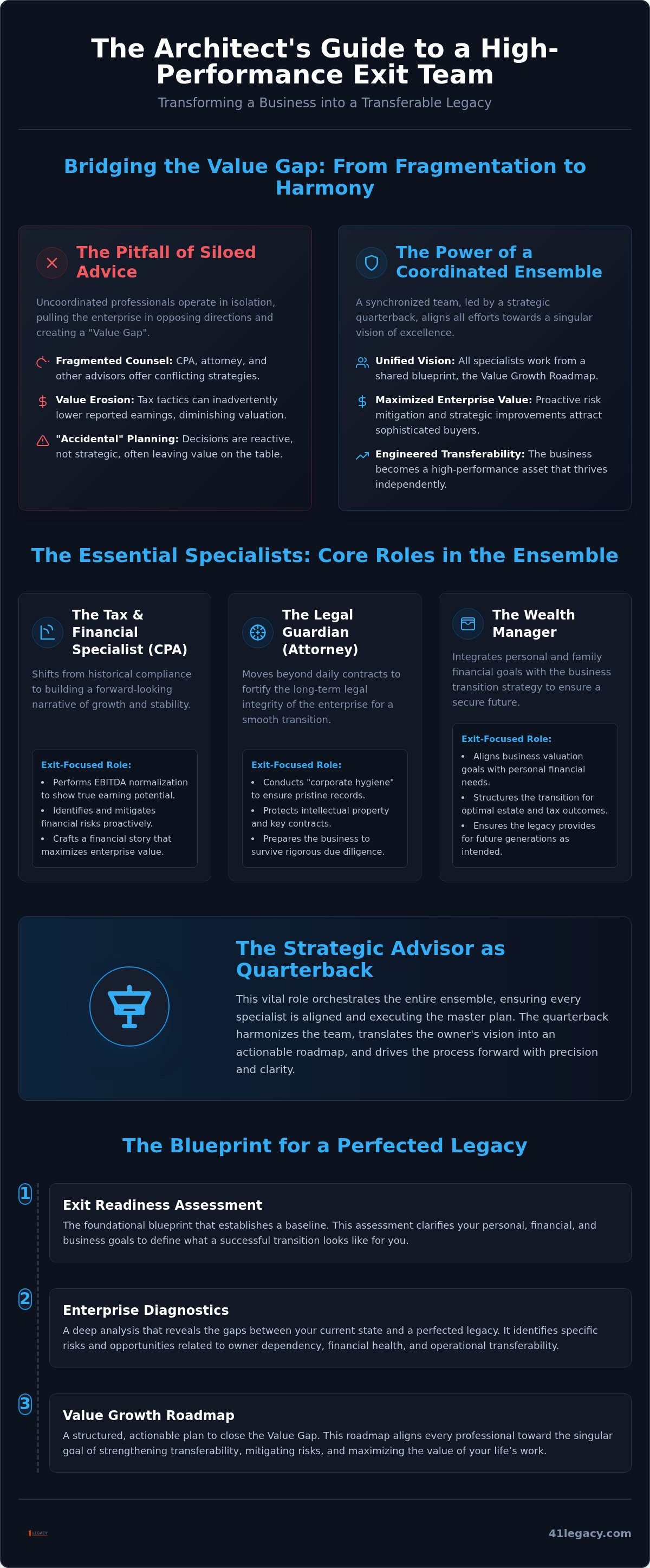
Siloed advice is the enemy of precision. A CPA might focus exclusively on tax-minimization strategies that inadvertently lower the company’s reported earnings, while an M&A attorney prioritizes extreme risk-mitigation goals that could stifle a smooth transition. Without a unified vision, these efforts pull the enterprise in opposing directions. This lack of coordination often leads to "accidental" Exit planning, where decisions are made in reaction to circumstances rather than by design. The Value Gap is the distance between your current valuation and the financial goals required to secure your future. When advisors work in isolation, this gap often widens, leaving the owner with a diminished legacy and unmet expectations.
The Shift from Transactional to Strategic Planning
Waiting until you feel "ready to sell" is a tactical error that often results in leaving significant value on the table. Strategic planning begins years before a transition, focusing on identifying and mitigating enterprise risks that could deter a sophisticated buyer or successor. This proactive approach transforms the business from a personal job into a high-performance asset. By building a business exit advisory team early, you position yourself as the visionary steward rather than the daily technician. You're no longer the engine of the company; you're the architect of a system designed to thrive without your constant intervention. This shift ensures that the business’s essence is preserved through the transition, maintaining its integrity and impact long after your departure.
The Essential Specialists: Roles Within the Ensemble
Building a business exit advisory team requires the same discernment a curator uses when selecting pieces for a permanent collection. It's not enough to have capable professionals; you need an ensemble of specialists who operate with an "exit-minded" focus. While many advisors excel at compliance and historical reporting, the architecture of a transferable legacy demands a forward-looking perspective. Each specialist brings a unique lens to the Certified Exit Planning Advisor framework, ensuring that every facet of the enterprise is polished for its eventual transition. Without this alignment, the essence of your life's work risks being lost in a fragmented process.
The Tax and Financial Specialist (CPA)
A traditional accountant focuses on the rear-view mirror, ensuring tax returns are filed and regulations are met. In contrast, an exit-focused CPA looks through the windshield. Their role is to transform raw financial data into a narrative of growth and stability. This involves EBITDA normalization, where personal expenses or non-recurring costs are meticulously adjusted to reveal the company's true earning potential. This level of financial clarity is foundational for determining enterprise value accurately. If your current professional is solely focused on tax-minimization, they may inadvertently hide the very value you've worked so hard to build. Refining these numbers early allows you to identify the Value Gap and address it with strategic precision.
The Legal Guardian (Attorneys)
The legal structure of your enterprise is the bedrock upon which your legacy rests. While a general corporate attorney handles daily contracts, a specialized M&A or estate attorney focuses on the long-term integrity of the asset. They perform the vital work of corporate hygiene, ensuring that ownership records are pristine, intellectual property is protected, and contracts are assignable. This preparation is essential for surviving the rigors of due diligence. A legacy that is legally tangled is a legacy that is difficult to transfer. By addressing these structural details now, you ensure that the transition of your life's work isn't stalled by avoidable legal friction. To begin assessing the strength of your current legal and financial foundations, consider an Exit Readiness Assessment as your first step toward clarity.
Finally, the Wealth Manager completes the core ensemble. They serve as the bridge between the business's value and your personal future. Their lens is focused on the Wealth Gap, the difference between your current net worth and the amount needed to sustain your lifestyle post-transition. By aligning the business's growth with your personal financial requirements, they provide the confidence needed to step into your next chapter with grace. This coordination ensures that the owner remains the steward of a transferable asset, not just a technician trapped in a transaction.
The Quarterback: Orchestrating the Advisory Ensemble
Assembling a collection of master artisans is a noble beginning, but without a conductor, their individual brilliance often results in a fractured performance. When building a business exit advisory team, the most critical appointment is the Strategic Advisor. We serve as the "Quarterback," the central figure who harmonizes the efforts of your CPA, attorney, and wealth manager. In the traditional Silo Model, the owner is burdened with the exhausting task of translating technical advice between uncoordinated professionals. This often leads to advisor drift, where specialists prioritize narrow compliance over the holistic health of the enterprise. The Quarterback Model restores order, ensuring every professional works in concert toward a singular, uncompromising vision of perfection.
The Quarterback’s primary responsibility is the meticulous implementation of the Value Growth Roadmap. Rather than allowing strategic documents to gather dust, we ensure that every recommendation is executed with surgical precision. This process significantly reduces owner dependency on the planning itself. By managing the administrative and technical coordination of the team, the Quarterback allows you to remain the visionary steward of your legacy, rather than becoming the project manager of your own exit. It's a shift from transactional chaos to curated excellence.
Aligning Decisions Toward Enterprise Value
Precision requires constant calibration. We provide monthly implementation support to maintain momentum and prevent the team from retreating into their respective silos. The Quarterback serves as the linguistic bridge between disciplines. We translate the strategic objectives of the Value Growth Roadmap into actionable, technical tasks for the CPA to normalize earnings and for the Attorney to refine corporate governance. This alignment ensures that every hour billed by your specialists directly contributes to the growth of enterprise value. It transforms a group of independent contractors into a high-performance ensemble dedicated to the preservation of your life's work.
Managing the Human Element of the Exit
A transition is as much a psychological journey as it is a financial one. The Quarterback acts as the objective voice in a room often filled with competing specialized interests. We are uniquely positioned to address your emotional and psychological readiness, ensuring you don't just exit the business, but move toward a meaningful next chapter. This involves integrating the "Third Leg" of the stool, personal financial planning, with the growth of the business asset. By balancing these three pillars, business value, personal finance, and psychological readiness, the Quarterback ensures your legacy is not only maximized but also protected for the generations to follow.
Assessing Your Current Team for Exit Readiness
Loyalty is a foundational virtue in business, yet when building a business exit advisory team, it must be weighed against strategic capacity. Your long-term CPA or attorney may have served you faithfully for decades, but an exit is a specialized architectural shift that requires a different set of tools. We utilize Enterprise Diagnostics to illuminate the hidden gaps in your current advisory circle. This diagnostic process ensures that the professionals you trust possess the specific expertise required to maximize enterprise value and protect the essence of your life's work.
Introducing a Strategic Advisor to your established team isn't a gesture of replacement. It's an act of elevation. By positioning the Quarterback as a resource that streamlines communication and provides strategic clarity, you allow your existing advisors to focus on their core technical strengths. This coordination prevents the friction that often arises when specialists feel their roles are being encroached upon. It transforms a group of individual practitioners into a synchronized ensemble focused on a singular goal.
The Exit Readiness Audit for Advisors
To determine if your current ensemble is prepared for a transition, you must move beyond general professional qualifications. You need to identify if your advisors are maintenance-ready or transaction-ready. Maintenance advisors are excellent at keeping the lights on, filing returns, and drafting standard contracts. Transaction-ready advisors, however, understand the nuances of building a transferable asset. Consider these direct inquiries for your team:
- For your CPA: "Have you ever normalized EBITDA for a sale, and can you prepare a Quality of Earnings report that will withstand professional scrutiny?"
- For your Attorney: "How many business transfers have you structured in the past twelve months, and do you specialize in M&A or estate planning?"
Reducing Owner Dependency Within the Team
A team that requires the owner to bridge every communication gap is a team that lacks transferability. If you're the only person who knows how your CPA and Attorney interact, the planning process itself is owner-dependent. We believe in building a team that operates with the same precision as the business itself, utilizing Standard Operating Procedures (SOPs) to define how advice is shared and implemented. This structure ensures that the advisory ensemble can execute the transition strategy even if you choose to take a step back. To begin evaluating the strategic capacity of your current professionals, we invite you to engage in our Strategic Capacity Evaluation.
Securing Your Legacy with 41 Legacy
The preservation of a life’s work is a pursuit that demands both technical surgical precision and a deep reverence for history. At 41 Legacy, we don't view your business as a mere collection of assets. Instead, we see a living entity that requires a deliberate architecture to survive and thrive beyond your direct involvement. When you are building a business exit advisory team, you are establishing the guardrails for your future. Our structured process, involving Diagnostics, Roadmap creation, and Implementation, is designed to transform your enterprise into a masterpiece of transferability.
The 41 Legacy Quarterback Approach
We operate as the strategic Quarterback, working in seamless harmony with your trusted CPA and Attorney. Our role isn't to replace the advisors who have stood by you for years. Rather, we provide the leadership required to increase enterprise value through a coordinated effort. This approach replaces the exhaustion of siloed advice with the clarity of a unified front. Through monthly implementation support, we provide the accountability needed to ensure that strategic goals don't remain theoretical. We are driven by a singular mission: to ensure that no life’s work is left behind or diminished due to a lack of structured planning.
Your First Step Toward a Transferable Asset
The journey toward a perfected legacy begins with an initial Enterprise Diagnostic. This foundational step reveals the Value Gap and identifies the specific risks that may hinder a successful transition. From this data, we craft the Value Growth Roadmap. This document serves as the definitive blueprint for your entire advisory ensemble, aligning every professional toward the same objective. The Exit Readiness Assessment is more than a report; it's the first brick in the architecture of your transferable legacy.
Preserving a business legacy requires a level of precision that leaves no room for compromise. It's an invitation to slow down and appreciate the intricate details that make your enterprise unique. By focusing on transferability and owner-dependency reduction today, you're securing a future where your business can flourish independently. We invite you to take the first step in protecting your life’s work. Let's begin the work of engineering a legacy that stands the test of time.
The Architecture of Your Final Act
Building a business exit advisory team is the definitive act of a steward who values legacy as much as daily performance. We've explored how transitioning from fragmented, siloed advice to a synchronized ensemble preserves the essence of your life's work. By appointing a strategic quarterback to lead the implementation of a Value Growth Roadmap, you ensure that every decision made by your CPA and attorney serves the singular goal of maximizing enterprise value. This structured approach, guided by our Certified Exit Planning Advisor (CEPA) leadership, transforms your business from an owner-dependent operation into a resilient, transferable asset that thrives independently.
It's time to move beyond the friction of conflicting counsel and toward the clarity of a coordinated strategy. We provide the meticulous, strategic implementation support necessary to bridge the gap between your current state and a perfected legacy. Your life's work deserves an exit as intentional and precise as its creation. Don't leave the culmination of your career to chance. We are here to ensure your impact is both protected and enduring. Begin Your Exit Readiness Assessment Today to secure the future you have spent a lifetime building.
Frequently Asked Questions
What is a business exit advisory team?
A business exit advisory team is a synchronized ensemble of specialists dedicated to the preservation of your life’s work. This multi-disciplinary group typically includes a strategic advisor, a CPA, an attorney, and a wealth manager. Their collective purpose is to transition the enterprise from an owner-dependent operation into a high-performance, transferable asset. By aligning their unique technical lenses, they ensure that the business’s essence is protected while maximizing its ultimate enterprise value.
Who should be on my business exit planning team?
The core of your ensemble should feature a Strategic Advisor acting as the Quarterback, complemented by a transaction-ready CPA, a specialized M&A or estate attorney, and a wealth manager. Building a business exit advisory team requires professionals who move beyond simple maintenance and compliance. You need specialists who understand the architecture of a legacy and possess the strategic capacity to engineer a business that thrives independently of its founder’s daily involvement.
Why do I need an exit advisor if I already have a CPA?
While your CPA is essential for historical financial integrity, an exit advisor focuses on the forward-looking growth of enterprise value. Most tax professionals prioritize minimization of liabilities, which can occasionally conflict with the goal of showing high earnings for a transition. An exit advisor coordinates these efforts, ensuring that tax strategies don't inadvertently widen the Value Gap. They serve as the conductor, harmonizing the CPA’s technical precision with the broader strategic vision.
How much does it cost to build an exit advisory team?
The investment required depends on the complexity of your enterprise and the specific specialists needed for your roadmap. Industry data for businesses valued between $3 million and $15 million indicates that total advisor costs can range from $80,000 to $250,000. However, view this not as a transaction cost but as an investment in transferability. A coordinated team often uncovers value that far exceeds their professional fees by identifying and mitigating enterprise risks early.
When is the best time to start building my exit team?
The most effective time to begin is three to ten years before you intend to step away. This duration provides the necessary runway to implement a Value Growth Roadmap and reduce owner dependency. Starting early allows your team to address corporate hygiene and financial normalization with unhurried precision. It ensures that when the time for transition arrives, the business is a perfected asset ready for its next chapter of stewardship.
What is the role of a "Quarterback" in exit planning?
The Quarterback is the Strategic Advisor who orchestrates the entire ensemble to prevent advisor drift. They translate your high-level vision into actionable technical tasks for the other professionals, ensuring that your goals remain the central focus. By managing the administrative coordination and implementation of the roadmap, the Quarterback reduces the owner’s burden. This allows you to remain the visionary leader while the team executes the technical engineering of the exit.
Can my current attorney handle my business exit?
Your current attorney is a vital guardian of your daily operations, but they must have the strategic capacity for a complex transition. General corporate law differs significantly from the specialized rigors of M&A or estate structuring. When building a business exit advisory team, it’s often necessary to add a specialist who understands how to clean up corporate records and contracts for due diligence. This ensures the legal bedrock of your legacy is pristine and transferable.
How does a coordinated team increase the value of my business?
Coordination eliminates the friction and conflicting counsel that often devalues an enterprise. When your advisors work in a siloed model, their individual goals can pull the business in opposing directions. A synchronized team works in concert to strengthen transferability and mitigate risks that deter buyers or successors. This alignment ensures that every facet of the business is polished, which directly improves the enterprise’s desirability and its ultimate valuation in the marketplace.
Disclaimer
This article is for educational and informational purposes only and does not provide legal, tax, investment, or business brokerage advice. 41 Legacy does not offer M&A brokerage services, legal document drafting, tax preparation, or investment advisory services. Business owners should consult licensed professionals in those disciplines before making decisions related to business transactions, legal matters, tax strategy, or financial planning. All examples are illustrative and may not apply to your specific situation.