
Build a Sellable Business: Steps to Maximize Exit Value
If you walked away from your desk today for six months, would you return to a thriving enterprise or a collection of silent phones and mounting liabilities? For many founders, the realization that their company is an extension of their own shadow rather than a distinct, functional entity is a sobering moment of clarity. You've poured years into perfecting your craft and serving your clients, yet the very dedication that built the brand now threatens its longevity. Creating a truly sellable business requires a shift in perspective from that of a tireless operator to that of a deliberate steward of a transferable asset.
We understand the quiet weight of knowing your legacy rests entirely on your shoulders. It's a common burden, but it's one that limits your enterprise value and prevents the freedom you've earned. In a market where sophisticated buyers scrutinize earnings quality with surgical precision, your company must stand on its own merits. This article provides the strategic framework needed to detach your personal identity from daily operations and engineer a company that thrives independently. We'll explore the critical steps to strengthen transferability, reduce owner dependency, and ensure your life's work commands the premium it deserves.
Key Takeaways
- Learn to distinguish between a lifestyle enterprise and a transferable asset by intentionally detaching the company’s daily performance from the founder's presence.
- Identify the "Value Gap" through a formal assessment to ensure your current enterprise value aligns with your long-term financial and legacy objectives.
- Discover how to transform your operations into a sellable business by establishing robust Standard Operating Procedures that serve as the company's permanent DNA.
- Understand the importance of a Strategic Quarterback to harmonize the efforts of your CPAs, attorneys, and advisors toward a unified transition goal.
Defining the Sellable Business as a Transferable Asset
The creation of a sellable business is an act of intentional architecture. It requires the founder to step back from the role of the primary engine and assume the posture of a steward. This transition is not merely operational; it is philosophical. A business that relies on the singular brilliance or constant presence of its owner is a fragile entity. True enterprise health is measured by the degree to which value is detached from the individual and embedded into the structure of the organization itself.
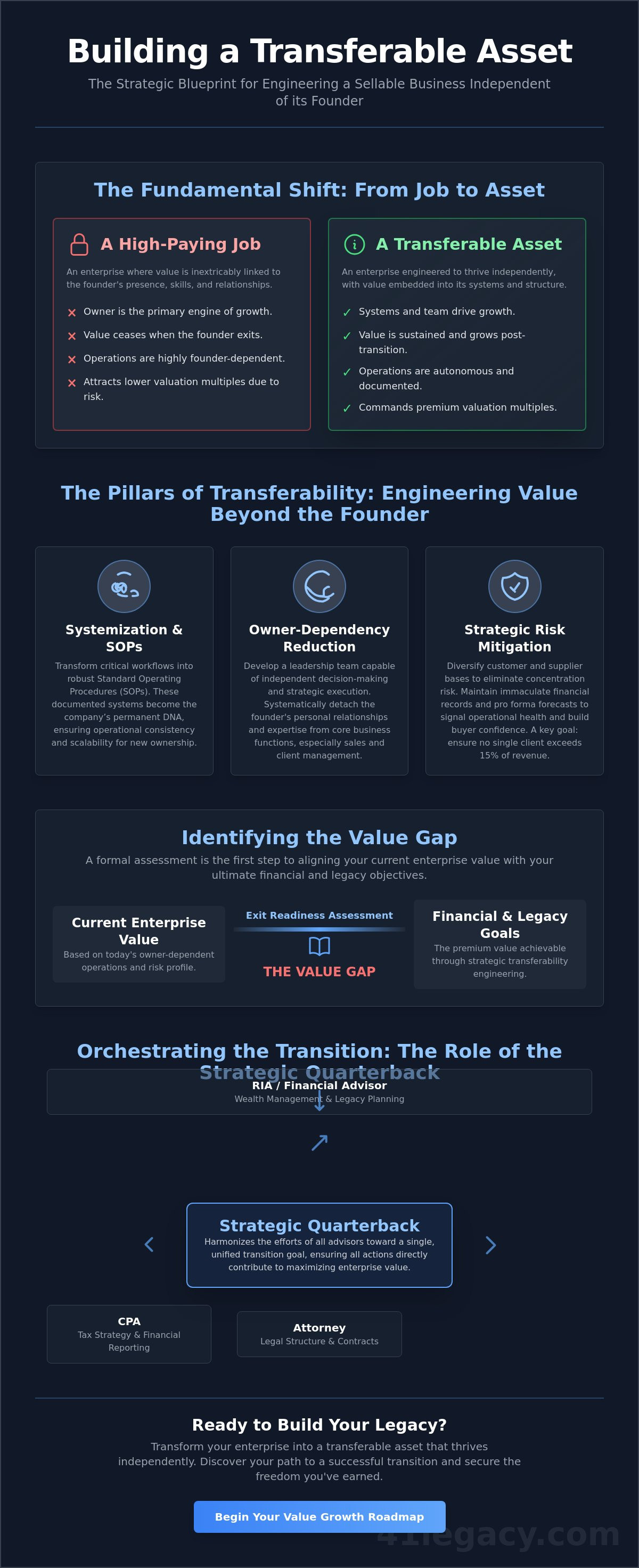
When we evaluate a company's readiness for transition, we look for the presence of a "transferable asset." This is a company whose value remains constant, or even grows, when the founder exits the building. For many owners, the business is a reflection of their personal identity. However, to maximize exit value, one must view the enterprise as a distinct entity with its own story to tell. This shift allows the owner to focus on building a legacy that survives their tenure, rather than a lifestyle that ends with it.
Asset vs. Job: The Core Distinction
Many owners inadvertently build a high-paying job rather than a transferable asset. A job requires your presence to generate revenue; an asset generates value through its own internal momentum. When a founder stops working, a job ceases to exist. In contrast, an asset possesses the systems, recurring revenue streams, and autonomous leadership necessary to thrive under new ownership. Buyers don't pay a premium for a founder’s personal charisma. They invest in the certainty that the company’s inner essence will remain intact long after the transition. A business that passes the "bus test" because it can run without the owner is the only kind that truly commands a high multiple.
The Concept of Enterprise Value
Enterprise value is the ultimate diagnostic of a company's health. While many look at simple EBITDA multiples, sophisticated investors scrutinize the quality of those earnings. This involves analyzing standard business valuation methods to determine if the cash flow is sustainable, predictable, and transferable. Through transferability engineering, we can systematically reduce risk and increase the multiple applied to a company’s earnings. This process involves several critical factors:
- Mapping critical workflows into robust Standard Operating Procedures that serve as the company's DNA.
- Developing a leadership team capable of independent decision-making and strategic execution.
- Diversifying customer bases to eliminate concentration risk and ensure revenue stability.
By viewing your company through this curatorial lens, you prepare it for a successful transition. You can learn more about our approach to building lasting value at 41 Legacy. We believe that a business should be a masterpiece of precision, capable of outlasting its creator while maintaining its standard of excellence.
The Pillars of Transferability: Engineering Value Beyond the Founder
Engineering a sellable business is akin to restoring a classic timepiece; every gear must function with silent, independent precision. While profitability provides the fuel, transferability is the engine that allows the enterprise to move forward without its creator. To maximize exit value, a founder must move beyond the role of a master technician and become a deliberate architect of systems. This process involves stripping away personal reliance and replacing it with a framework of institutional excellence that a buyer can trust and scale.
A high-value enterprise is defined by its resilience against internal and external shocks. This resilience is built through the diversification of customer bases and supply chains. If a single client represents more than 15% of your revenue, your business carries a structural vulnerability that sophisticated buyers will discount. True operational health requires clean, pro forma forecasting and a level of financial transparency that reflects a deep respect for the future steward of the brand. When your books are impeccable, you signal that the company’s essence is grounded in reality rather than founder-led optimism.
Owner-Dependency Reduction
Many founders find themselves caught in the "Rainmaker Trap," where their personal relationships and sales prowess are the primary drivers of growth. While this individual brilliance is impressive, it is also a liability. Building a management team capable of executing a Value Growth Roadmap is essential for detaching the company’s success from your daily involvement. Owner-dependency is the primary value killer in mid-market transitions, acting as a structural flaw that sophisticated buyers will always discount. By investing in talent development and conducting a Strategic Capacity Evaluation, you ensure the organization possesses the intellectual capital to thrive in your absence.
Documented Precision: The Role of SOPs
Documentation is the process of transforming tribal knowledge into transferable intellectual property. Without robust Standard Operating Procedures (SOPs), a business is merely a collection of habits; with them, it becomes a scalable asset. These procedures serve as the company's DNA, ensuring that quality and performance remain consistent regardless of who is at the helm. This level of documented precision builds immense buyer confidence, as it removes the mystery from daily operations. You can learn more about the role of SOPs in business and how they serve as the foundation of a high-value exit. When the intricacies of your process are articulated with clarity, you've created a legacy that is truly transferable.
If you're ready to identify the hidden risks in your current structure, our Transferability Engineering support can help you begin the journey toward a more resilient enterprise.
The Exit Readiness Assessment: Identifying the Value Gap
A business valuation provides a snapshot of a moment in time, but an assessment reveals the strength of the foundation. Many owners mistake a high revenue figure for a sellable business, only to discover during due diligence that their enterprise is unmarketable. The "Value Gap" is the silent distance between what your company is worth today and the financial harvest you require for your next chapter. Identifying this gap is the first step in moving from a state of hopeful operation to one of strategic certainty.
Industry data suggests that approximately 80% of businesses that go to market fail to sell. This staggering failure rate isn't usually due to a lack of profit; it's due to a lack of readiness. A formal assessment serves as a master diagnostic, uncovering hidden risks that would otherwise derail a transition. It allows you to see your company through the eyes of a sophisticated buyer, transforming vulnerabilities into opportunities for structural reinforcement.
Enterprise Diagnostics and Market Attractiveness
There is a critical distinction between "Market Attractiveness" and "Exit Readiness." Your industry may be in high demand, but if your specific company lacks the internal infrastructure to support a transition, its value remains trapped. Our approach to Enterprise Diagnostics involves a meticulous review of your operational structure to identify "red flags" before they reach a potential buyer's desk. We look beyond the balance sheet to quantify intangibles such as brand reputation, employee culture, and the "inner essence" of your client relationships. These elements are often the true drivers of a premium multiple, yet they're the most frequently overlooked in standard accounting.
Closing the Value Gap
Once the Value Gap is identified, we use the diagnostic data to prioritize your Value Growth Roadmap. This isn't about rapid, unsustainable expansion. It's about aligning your personal financial goals with the business's actual exit potential. Closing this gap requires a steady, unhurried pace. We recommend starting this process three to five years before your planned departure. This timeline provides the necessary room to engineer transferability and ensure the business can thrive independently. By addressing these factors early, you're not just preparing for an exit; you're building a more resilient, high-performing enterprise that serves you better in the present.
If you're unsure where your company stands, an Exit Readiness Assessment provides the clarity needed to begin your transition with confidence.
Strategic Capacity and Risk Mitigation
Building a sellable business requires more than current stability; it demands a clear runway for future growth. Sophisticated buyers aren't just looking for a snapshot of your past success. They're searching for "Strategic Capacity," which is the internal space available for the organization to expand under new stewardship. If your enterprise is currently operating at 100% capacity with no room for additional scale, a buyer sees a ceiling rather than a canvas. True enterprise value is found in the balance between a proven track record and the documented potential for what comes next.
Risk mitigation is the process of identifying and neutralizing the "value killers" that linger beneath the surface of daily operations. This involves more than just checking boxes on a compliance list. It requires a deep dive into the company's "inner essence" to ensure that the brand’s soul is not lost during a period of rapid growth or transition. We must address the emotional weight of this progression through structured planning. A transition is a significant life event for a founder, and without a clear framework, the uncertainty can lead to hesitation that erodes the very value you've worked so hard to build.
Protecting the Legacy
Your business is a testament to years of dedication, and ensuring it thrives after your departure is a matter of profound respect for that history. Culture is the invisible thread that holds an organization together when the leadership changes. When a company's values are deeply embedded in its staff and systems, the brand’s identity remains resilient. The owner acts as a guardian of history who prepares the entity for its next chapter. By fostering a culture of autonomous excellence, you create a lasting monument that can survive a change in ownership while maintaining its standard of perfection.
Ongoing Implementation Support
A roadmap for growth is merely a document until it is brought to life through consistent action. Many owners possess the vision but lack the bandwidth to manage the granular details of transferability engineering while running their company. This is why we emphasize the role of monthly implementation support to maintain accountability and momentum. Without a steady rhythm of advisory, the complexities of daily operations often pull a founder back into the "technician" role, stalling the growth of enterprise value. You can explore our strategic advisory services to see how we help owners bridge the gap between high-level vision and tactical execution.
If you're ready to move beyond theoretical plans and begin the work of fortifying your company's future, our Strategic Capacity Evaluation offers the clarity needed to identify your next steps.
Orchestrating the Transition: The Role of the Strategic Quarterback
The final evolution of a sellable business occurs not in the ledger, but in the seamless coordination of the professionals who surround it. While previous stages of this journey focus on internal engineering and operational precision, the transition itself is a complex symphony that requires a central conductor. Most founders possess a talented circle of advisors, yet these specialists often operate in isolation. Without a unified vision, the individual brilliance of a CPA, an attorney, or a wealth manager can lead to discordant strategies that erode the very value you've spent decades building.
At 41 Legacy, we embrace the "Quarterback" philosophy. Our role is to harmonize these diverse disciplines toward a single, uncompromising goal: maximizing your net proceeds and preserving your legacy. We maintain a strict focus on "readiness" rather than "brokerage." This distinction is vital. By remaining detached from the transaction itself, we provide an objective perspective that prioritizes the long-term health of the enterprise over the speed of a sale. We don't just prepare a company for a moment in time; we engineer it to be a masterpiece of transferability.
Aligning the Professional Advisory Team
Siloed advice is one of the most significant risks to a successful transition. An attorney may draft a structure that mitigates risk but inadvertently creates a massive tax liability. Similarly, a tax professional might optimize for the current year without considering how those choices impact future enterprise growth. A Certified Exit Planning Advisor (CEPA) bridges these gaps. We ensure that every decision is filtered through the lens of exit readiness, aligning tax strategy, legal structure, and growth roadmaps into a single, coherent narrative. This orchestration ensures that when the time comes to step away, the transition is as precise as the business you've built.
The Path Forward with 41 Legacy
The journey from an owner-dependent operation to a transferable asset is a deliberate progression. It begins with a project-based diagnostic to establish a baseline of your current standing. This initial clarity allows us to identify the "Value Gap" and prioritize the most impactful improvements. Following this assessment, we transition to a monthly strategic retainer. This Monthly Implementation Support provides the steady rhythm of accountability needed to execute your Value Growth Roadmap. It's a commitment to excellence that ensures your company's inner essence is protected while its market value is maximized.
If you're ready to move from the role of the primary operator to the steward of a lasting enterprise, the first step is clarity. You can Begin your Exit Readiness Assessment with 41 Legacy to discover the true potential of your life's work.
The Art of a Timeless Transition
The transformation of your company from a founder-led operation into a transferable asset is the ultimate act of stewardship. It's a process that moves beyond mere profitability, focusing instead on the preservation of an essence that can thrive independently of your daily presence. By reducing owner dependency and establishing robust systems, you ensure that the masterpiece you've built remains resilient through the progression of time. Constructing a truly sellable business is not a transaction; it's the culmination of a disciplined, strategic vision.
Our team, led by Certified Exit Planning Advisors (CEPA), provides the national strategic advisory needed to navigate this complex evolution. Through our structured Value Growth Roadmap process, we help you bridge the gap between your current standing and your ultimate financial and legacy goals. We invite you to slow down and consider the intricate details of your next chapter. Your life's work deserves a transition that's as meticulous and polished as the enterprise itself.
Secure your legacy with an Exit Readiness Assessment from 41 Legacy. It's time to build a future that honors your past while ensuring a lasting impact.
Frequently Asked Questions
What is the difference between a business valuation and an exit readiness assessment?
A business valuation calculates the current economic worth based on historical data, while an exit readiness assessment determines if the company can actually be transferred to a new steward. Valuation looks at the balance sheet; readiness looks at the structural integrity of your systems. An assessment identifies the specific operational risks that might prevent a sale from ever reaching the closing table.
How long does it typically take to build a truly sellable business?
Creating a sellable business typically requires a horizon of three to five years to achieve peak transferability. This timeline allows for the meticulous documentation of processes and the development of an autonomous leadership team. It ensures that the company's performance is a result of its internal architecture rather than the founder's personal momentum or daily intervention.
Can I build a sellable business if I am the primary face of the brand?
You can certainly build a transferable asset even if you're currently the primary face of the brand, provided you begin detaching your identity from daily operations. This involves institutionalizing your unique expertise into Standard Operating Procedures and elevating your team's visibility. The goal is to transition the brand's soul from an individual's charisma to the organization's collective standard of excellence.
What are the most common risks that devalue a business during a sale?
The most pervasive risks include high owner dependency, significant customer concentration, and a lack of documented operational precision. Buyers often discount the value of a company if more than 15% of revenue comes from a single client. Messy financial records and tribal knowledge that isn't codified into SOPs also serve as major value killers during the scrutiny of due diligence.
Do I need to hire a business broker before I am ready to sell?
You don't need to engage a broker until you've successfully completed the readiness and value growth phases of your journey. Engaging a broker too early can lead to a premature market entry before the company's transferability is fully engineered. Focusing on readiness first ensures you maintain objectivity and maximize the enterprise value before the formal transaction process begins.
How does reducing owner dependency actually increase the company's value?
Reducing owner dependency increases value by lowering the perceived risk for the buyer and expanding the pool of potential successors. When a business functions independently, the quality of its earnings improves, allowing for a higher valuation multiple. A company that doesn't require its founder's daily presence is viewed as a durable asset rather than a personal job.
What is the role of a Certified Exit Planning Advisor (CEPA) in the process?
A Certified Exit Planning Advisor acts as the strategic quarterback who aligns your personal, financial, and business objectives. We coordinate the efforts of your CPAs, attorneys, and other advisors to ensure every decision strengthens the company's transferability. This holistic approach ensures your life's work is prepared for a transition that honors its historical significance and maximizes your net proceeds.
Is it possible to sell a business that has high customer concentration?
It's possible to sell a company with high customer concentration, though it often results in a lower multiple or complex earnout provisions. To mitigate this risk, you must demonstrate the longevity of those relationships and the systems that protect them. Engineering a more diversified revenue stream before the transition is the most effective way to preserve the integrity of your exit value.

Article by
Mike Laskowski
Mike Laskowski is a Business Value Growth Strategist who helps business owners uncover the truths that drive their performance, risk, and readiness. Blending forensic interviewing from a 26‑year federal career with Strategic Capacity analysis and CEPA methodology, he works upstream to reduce owner dependency, increase transferability, and strengthen enterprise value. Mike guides founders through clarity, operational evolution, and transition readiness so their companies become transferable, owner‑independent assets that endure beyond the founder.
Disclaimer
This article is for educational and informational purposes only and does not provide legal, tax, investment, or business brokerage advice. 41 Legacy does not offer M&A brokerage services, legal document drafting, tax preparation, or investment advisory services. Business owners should consult licensed professionals in those disciplines before making decisions related to business transactions, legal matters, tax strategy, or financial planning. All examples are illustrative and may not apply to your specific situation.