
Beyond the Owner’s Trap: Why Your Business Feels Like a Cage and How to Build a Legacy
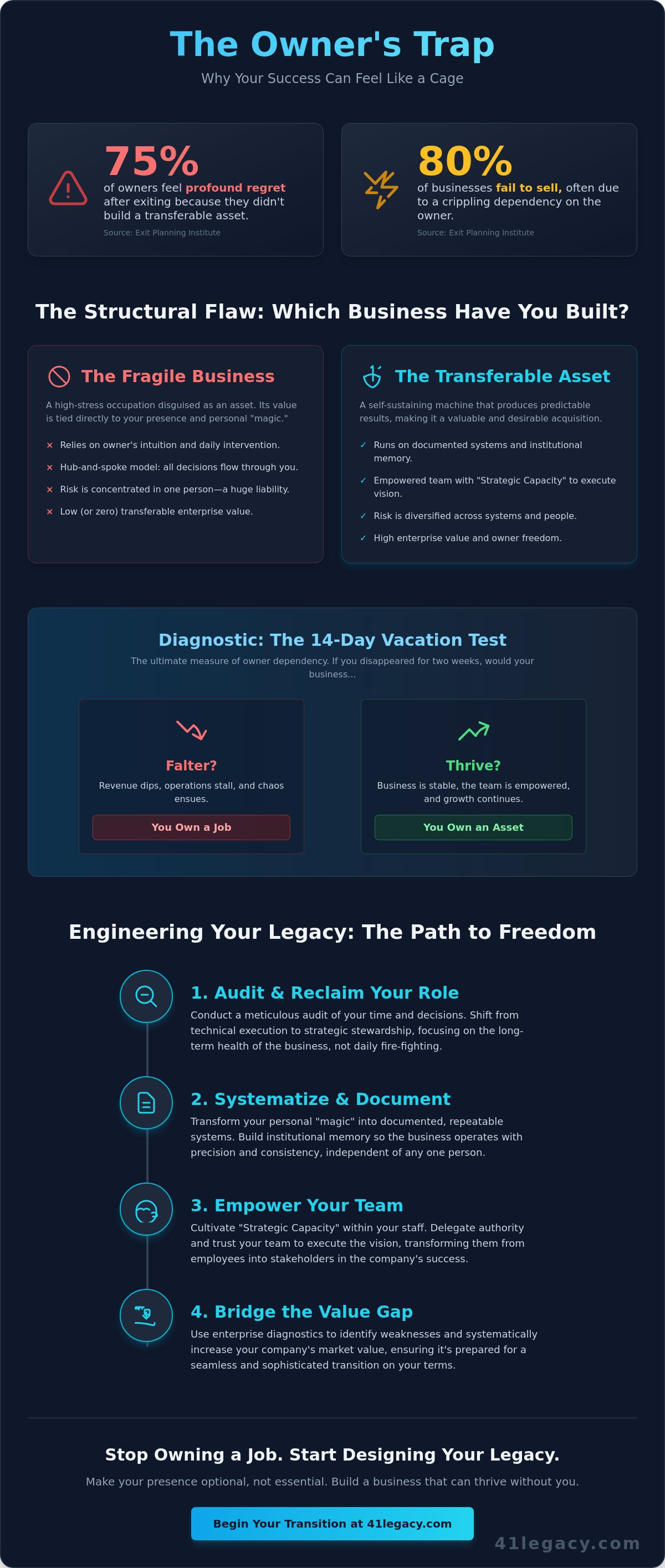
If you were to step away from your desk for ninety days, would your company continue to breathe, or would the silence be deafening? It's a sobering question for any founder who has spent decades pouring their soul into a craft. You likely recognize the weight of decision fatigue and the unsettling realization that you've become the primary bottleneck. You're certainly not alone in the sentiment of feeling trapped by my business; research from the Exit Planning Institute shows that 75 percent of owners experience profound regret after exiting because they didn't build a truly transferable asset.
We believe a business should be a masterpiece of strategic engineering, designed to operate with the same harmony and precision as a restored vintage engine. This article will show you how to transform your daily operations into a valuable, independent entity that thrives without your constant presence. We'll examine the specific diagnostics and value growth roadmaps required to transition from an exhausted operator to a visionary steward. You'll learn the essential steps to cultivate a legacy that preserves your impact while finally regaining the personal freedom you've earned.
Key Takeaways
- Identify the structural flaws that transform success into a cage and learn how to evolve beyond the "Rainmaker" paradox to build a truly transferable asset.
- Shift your perspective from managing a daily job to engineering a legacy by reducing owner dependency and increasing enterprise value through documented systems.
- Address the emotional and strategic weight of feeling trapped by my business by implementing a systematic plan to make your presence optional rather than essential.
- Conduct a meticulous audit of your time and decision-making to reclaim your role as a strategic steward focused on long-term health rather than technical execution.
- Utilize enterprise diagnostics to identify and bridge the value gap, ensuring your business is prepared for a seamless, sophisticated transition on your own terms.
The Anatomy of the Owner’s Trap: Why Success Feels Like a Cage
Success often arrives with an unintended consequence: the loss of personal agency. For many founders, the realization of feeling trapped by my business doesn't happen during a crisis, but during a period of growth. This phenomenon, known as the Owner's Trap, occurs when the enterprise relies entirely on the founder’s daily intervention to function. While your expertise built the company, that same expertise now prevents it from evolving into a transferable asset. Growth, in this state, only increases your personal burden.
This state is often a byproduct of Founder's Syndrome, where a leader’s initial strengths become the very barriers that stifle organizational maturity. When you are the primary Rainmaker, the business possesses a soul but lacks a skeleton. Without your presence, the sales pipeline withers. This makes the entity virtually unsellable to a sophisticated acquirer who seeks a self-sustaining machine rather than a job. You've created a paradox where being the best at what you do makes the company less valuable to everyone else.
The tactical burden of working in the business consumes the bandwidth required for strategic working on the business. This creates a Value Gap. According to data from the Exit Planning Institute, nearly 80% of small to mid-sized businesses never sell. This failure often stems from a disconnect between the owner’s financial needs for retirement and the actual market value of a company that cannot breathe without them. Bridging this gap requires a shift from artisan to architect.
The Symptoms of Invisible Dependency
Dependency manifests in the quiet moments. If every decision, from procurement to client disputes, requires your final approval, you've built a hub-and-spoke model that collapses under pressure. The Vacation Test is the ultimate diagnostic tool. If revenue or operations dip when you are offline for 14 days, you don't own an asset; you own a high-stress occupation. Hustle culture suggests this grind is a badge of honor, but in the world of enterprise value, it's a structural defect that must be repaired.
The Emotional Toll of a Non-Transferable Business
Isolation is the constant companion of the stuck founder. You carry the weight of payroll and performance alone, leading to a slow transition from passion to resentment. Your soul feels disconnected from the machine you created. Owner Dependency is the primary anchor dragging down enterprise value, turning a potential legacy into a weight. At 41 Legacy, we believe true stewardship requires building a business that can eventually thrive without its steward. It's about moving from being the engine to being the curator of a lasting legacy.
The Structural Flaw: Owner Dependency vs. Enterprise Value
A business built on the founder’s personal "magic" is often a masterpiece of individual effort, but it remains a fragile one. When an external investor evaluates a company, they aren't looking for a charismatic leader; they're looking for a machine that produces predictable results. If the gears only turn because you are there to push them, the enterprise value drops. This reality is the core reason many founders end up feeling trapped by my business. They've created a high-performing job rather than a transferable asset.
True enterprise value is found in institutional memory. A lifestyle business relies on the owner's intuition, while a transferable asset relies on documented systems and a team with Strategic Capacity. This capacity is the collective ability of your staff to execute the vision without your daily intervention. When risk is concentrated in one person, it becomes a liability that professional buyers discount heavily. Investors seek the soul of the business, but they require the body to function on its own.
Why Your CPA and Attorney Aren’t Solving This
Compliance is not the same as strategy. Your CPA ensures the books are accurate; your attorney ensures your contracts are valid. These are defensive measures designed to protect what exists. Building a roadmap for value growth is an offensive move. Most professional advisors operate in silos, focusing on their specific discipline without a unified vision for the eventual transition. You need a strategic quarterback to align these experts toward a single objective: making the business run independently of its creator.
The Math of Misalignment
The financial impact of owner dependency is measurable. In middle-market transactions, businesses with high key-man risk often see valuation multiples compressed by 20% to 30%. Beyond the balance sheet, invisible risks like customer concentration further erode value. If a single client accounts for more than 15% of your total revenue, a buyer sees a precarious foundation rather than a solid legacy.
- Key-Man Risk: The loss of value if the founder exits unexpectedly.
- Customer Concentration: Over-reliance on a small group of clients for the majority of income.
- Operational Maturity: The degree to which processes are documented and repeatable.
Enterprise value is a reflection of how well the company breathes in your absence. Reducing these risks requires a deliberate shift from being the primary producer to being the steward of the asset. To begin identifying these structural gaps, it's helpful to utilize a structured diagnostic approach that highlights where your presence is currently a bottleneck. By refining these internal systems, you transform a personal burden into a lasting legacy that commands respect in the marketplace.
Engineering Transferability: The Path to Strategic Freedom
True freedom isn't found in an exit; it's found in the architecture of the enterprise. Transferability Engineering is the meticulous process of making yourself optional within your own creation. Many owners find themselves feeling trapped by my business, a sentiment that stems from being the sole repository of essential knowledge. To break this cycle, we must facilitate a shift from Foundational Knowledge, stored in the founder's mind, to Documented Systems, which reside within the company's infrastructure. While intuition serves the individual, systems serve the legacy.
Standard Operating Procedures (SOPs) act as the blueprints for a masterpiece. They ensure that excellence is repeatable and precision is permanent. According to data from the Value Builder System, companies that score high on systemization receive acquisition offers 71% higher than the industry average. This isn't just about a future sale. Reducing dependency improves current profitability by an average of 20% to 30% through the elimination of owner-related bottlenecks. When the engine runs without the constant intervention of the master craftsman, the business gains the stability required for true evolution.
The Transferability Framework
Transforming a business into a self-sustaining entity requires a structured approach. At 41 Legacy, we guide owners through a three-stage evolution to ensure strategic clarity.
- Step 1: Identifying the Critical Few. We isolate the specific 5% of tasks that currently require the owner's unique touch. These are usually the primary drivers of the "trap."
- Step 2: Designing the Value Growth Roadmap. This bespoke plan redistributes those responsibilities to specialized roles, ensuring no single point of failure exists within the organization.
- Step 3: Implementing Enterprise Diagnostics. We use real-time metrics to track the transition, measuring the company's health and its decreasing reliance on the founder.
Building the Management Layer
The transition from directing to stewardship is a psychological shift for the owner. It requires a move from managing tasks to empowering a team to own outcomes. Talent development is the cornerstone of market attractiveness; investors look for a team that can sustain excellence without a central figurehead. This investment in human capital ensures the business retains its uncompromising standards. A transferable asset is a company that possesses its own independent soul. By cultivating this independence, you ensure the brand’s heritage continues to flourish, regardless of your daily involvement.
Practical Steps to Reclaim Your Time and Value
The sensation of feeling trapped by my business often stems from a lack of structural distance. To evolve from an operator to a steward, you must first conduct a meticulous Time Audit. This diagnostic reveals where you're functioning as an expensive technician instead of a CEO. Data from the Exit Planning Institute suggests that nearly 80% of a business owner's wealth is locked in their company, yet many owners spend 40 hours a week on tasks that do not drive enterprise value. By tracking your time for 14 days, you can identify the low-leverage activities that tether you to the shop floor and prevent strategic growth.
You can begin the process of Owner Dependency Reduction by delegating one high-level decision every seven days. This practice builds the muscle of autonomy within your leadership team, ensuring the business can breathe without your constant input. To understand the true health of your enterprise, engage in an Exit Readiness Assessment. This allows you to view the organization through the lens of a sophisticated buyer, highlighting risks that remain invisible from the inside. When a business can operate for 30 days without the founder's intervention, its marketability and internal stability increase significantly.
Finally, establish a Strategic Rhythm. This involves a monthly implementation meeting dedicated solely to your long-term roadmap. Without this cadence, the gravity of daily operations will pull you back into the cage. Consistency in these meetings ensures that the evolution of the business remains a priority, rather than a secondary thought lost to the noise of the day.
The Power of Documentation
Standard Operating Procedures (SOPs) are more than manuals; they're the intellectual property of your firm. They transform tribal knowledge into a transferable asset. To avoid getting bogged down in minutiae, use a Video First approach. Record a screen share or a physical task as it happens. This captures institutional knowledge in minutes, creating a library of craftsmanship that survives your eventual departure. Research indicates that companies with highly documented processes can command valuations 20% to 25% higher than their peers because they represent a lower risk to a successor.
Accountability and Implementation
Monthly implementation support prevents the drift back into daily fires. An external advisor provides the necessary friction to force change, ensuring the vision doesn't yield to convenience. This structured oversight is essential for those who are feeling trapped by my business and want to transition from owner to legacy builder. It creates a professional-room altitude where strategic decisions are made with clarity and poise. You can explore how 41 Legacy's strategic advisory services help maintain this discipline, ensuring your business thrives independently of your daily presence.
Designing Your Legacy: The 41 Legacy Approach
Transitioning from a founder-led company to a transferable asset requires more than just hard work. It demands a sophisticated orchestration of strategy and vision. 41 Legacy serves as the quarterback for your total financial and strategic life, ensuring that every component of your exit is tuned to perfection. We understand that feeling trapped by my business is often a symptom of a missing architecture. To remedy this, our process begins with Enterprise Diagnostics. This isn't a surface-level review; it's a meticulous deep dive to identify the Value Gap. We define this gap as the difference between what your business is worth today and the capital required to fund your life’s next chapter.
Once we identify the gap, we construct a Value Growth Roadmap. This is a bespoke plan designed to restore your personal freedom while cementing your financial security. We treat your business like a rare masterpiece, ensuring every mechanical and structural component is optimized for performance. Our mission is to ensure your life’s work survives and thrives long after your tenure ends. We help you build a legacy that isn't dependent on your daily presence.
The Coordinated Advisory Model
A masterpiece is never the result of a single hand; it requires the coordination of multiple master craftsmen. We work alongside your existing team of experts, including your CPA, Attorney, and Wealth Manager. By aligning these moving parts, we create a single point of strategic clarity. This prevents the fragmented advice that often leads to costly errors during a transition. Every decision we make today is calculated to protect and enhance the enterprise value of tomorrow. We ensure your legal structures, tax strategies, and wealth goals move in perfect harmony, much like the internal components of a high-performance engine.
Your First Step Toward Freedom
Waiting for a crisis to plan your exit is the most expensive mistake an owner can make. Data from the Exit Planning Institute suggests that 76% of owners plan to exit within ten years, yet only 20% have a written plan. This lack of preparation often results in a business that cannot sell or a legacy that crumbles. We invite you to view your business not as a job, but as a masterpiece in progress. It's time to stop feeling trapped by my business and start building an asset that stands the test of time. Your journey from owner to steward begins with a single, intentional step toward readiness.
Transforming Your Enterprise into a Masterpiece of Transferability
Transitioning from a business that relies on your daily presence to one that functions as a high-performance asset requires deliberate engineering. You've seen how owner dependency creates a ceiling on value and why feeling trapped by my business is often the result of success without a structural exit strategy. By focusing on transferability and reducing risk, you shift your role from an essential operator to a visionary steward.
Our process is led by a Certified Exit Planning Advisor (CEPA) and utilizes a Comprehensive Value Growth Roadmap to ensure every component of your enterprise is polished for a future transition. We act as the specialized Quarterback advisory for your professional teams; we align your legal and financial interests with your long-term vision. This meticulous approach ensures your life's work isn't just a job but a lasting legacy that thrives long after your final day at the helm.
Secure your legacy and reclaim your freedom with 41 Legacy
Your business deserves to be a source of pride rather than a burden. Let's build something that endures for generations.
Frequently Asked Questions
Is feeling trapped by my business a sign that I should just sell immediately?
No, it's often a signal that the enterprise structure lacks the necessary autonomy to function without you. Selling while the business is overly dependent on the owner typically leads to a 30 percent reduction in valuation according to data from the Exit Planning Institute. You should first focus on restoring the balance between your vision and the operational mechanics. This ensures you exit on your terms rather than out of exhaustion.
How can I reduce owner dependency if my clients only want to deal with me?
Shifting client loyalty requires a deliberate transfer of authority to your team through documented processes and specialized roles. If you're feeling trapped by my business due to client demands, begin by introducing a senior lead to 10 percent of your key accounts. This gradual transition demonstrates that the quality of craftsmanship remains consistent regardless of who manages the relationship. It transforms a personality-led shop into a durable, transferable institution.
What is the difference between a business broker and a strategic exit advisor?
A strategic exit advisor focuses on the long-term architectural integrity of the company, whereas transactional agents focus on the final sale. Our approach centers on enhancing transferability and enterprise value years before a transition occurs. We act as curators of your legacy, ensuring the business is a masterpiece of efficiency. This contrast is vital; one manages a closing, while the other builds a high-value, sustainable asset that thrives independently.
How long does it typically take to transform a business into a transferable asset?
A comprehensive transformation generally requires 24 to 36 months of focused effort. This timeframe allows for the implementation of new systems, the seasoning of management teams, and the stabilization of financial performance. According to the 2023 State of Owner Readiness Report, 75 percent of owners who sold their businesses regretted it within 12 months. Taking three years to prepare ensures your legacy remains intact and the business thrives post-transition.
Will my business lose its 'soul' if I systemize everything and step back?
Systemization is the preservation of your company's soul, not its erasure. By documenting your unique standards and philosophies, you ensure that your bespoke approach can be replicated by others with surgical precision. Think of it as writing the score for a symphony; the music continues even after the conductor leaves the stage. A well-systemized business protects your craftsmanship from the entropy of human error and ensures lasting quality for future generations.
What happens if my current advisors (CPA/Attorney) don't agree on the exit strategy?
Disagreement among advisors is common and usually stems from a lack of a unified strategic roadmap. We act as the lead architect, aligning your CPA, attorney, and wealth manager under a single vision for the enterprise. This collaborative framework ensures that legal structures and tax strategies serve the ultimate goal of legacy preservation. Clear communication prevents the friction that often stalls 50 percent of planned transitions according to industry data.
Can I still grow my company while I am preparing it for a future exit?
Preparing for an exit is synonymous with driving growth, as both require the reduction of risk and the improvement of margins. When you address the reasons you're feeling trapped by my business, you unlock the capacity for 15 to 20 percent higher annual growth. A business that can run without its owner is a business that's ready to scale. You aren't just preparing to leave; you're optimizing for peak performance and enterprise health.
What is an Exit Readiness Assessment and why is it the first step?
An Exit Readiness Assessment is a diagnostic tool that evaluates the company across categories like financial transparency and operational autonomy. It serves as the baseline for your value growth roadmap, identifying the specific value killers that currently hinder transferability. Starting with data ensures that every adjustment we make is intentional. It provides the clarity needed to move from a state of confinement to one of strategic freedom and absolute clarity.

Article by
Mike Laskowski
Mike Laskowski is a Business Value Growth Strategist who helps business owners uncover the truths that drive their performance, risk, and readiness. Blending forensic interviewing from a 26‑year federal career with Strategic Capacity analysis and CEPA methodology, he works upstream to reduce owner dependency, increase transferability, and strengthen enterprise value. Mike guides founders through clarity, operational evolution, and transition readiness so their companies become transferable, owner‑independent assets that endure beyond the founder.
Disclaimer
This article is for educational and informational purposes only and does not provide legal, tax, investment, or business brokerage advice. 41 Legacy does not offer M&A brokerage services, legal document drafting, tax preparation, or investment advisory services. Business owners should consult licensed professionals in those disciplines before making decisions related to business transactions, legal matters, tax strategy, or financial planning. All examples are illustrative and may not apply to your specific situation.