
Transferability & Owner Dependency
Beyond Retirement: A Strategic Guide to Succession Planning for Small Business Owners in 2026
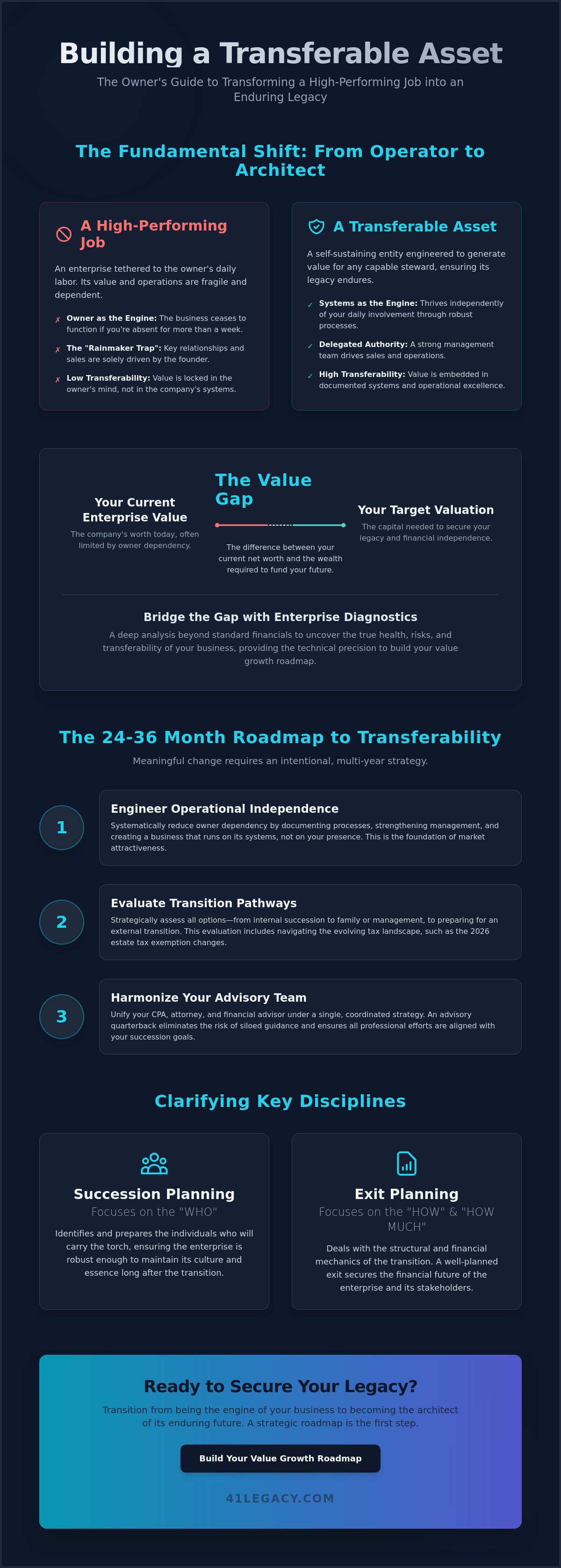
What if the enterprise you've spent decades perfecting is actually a fragile instrument that ceases to play the moment you put down the baton? For many, succession planning for small business owners feels like a distant administrative task, yet it's actually the ultimate act of craftsmanship. You've poured your essence into this work, but if the business cannot function for more than a week without your direct presence, you haven't yet built a transferable asset. You've built a high-performing job that remains tethered to your daily labor.
We understand the quiet weight of this uncertainty. It's difficult to find strategic clarity when your CPA, attorney, and financial advisor aren't coordinated, leaving you unsure of your enterprise's true market value. This guide promises to show you how to bridge that Value Gap, transforming your company into a self-sustaining legacy that thrives independently of your involvement. We'll preview the essential shifts for 2026, including navigating the new 15 million dollar estate tax exemption and engineering your operations for maximum transferability. It's time to transition from being the engine of your business to becoming the architect of its enduring future.
Key Takeaways
- Reframe your role from a daily operator to a steward of a transferable asset, ensuring the business thrives with or without your presence.
- Employ Enterprise Diagnostics to uncover the "Value Gap," providing the technical precision required to understand your enterprise's true market worth.
- Excellence in succession planning for small business owners centers on reducing owner dependency through the intentional engineering of operational systems.
- Evaluate internal and external transition pathways with a focus on preserving your legacy while navigating the evolving tax landscape of 2026.
- Harmonize the efforts of your professional advisors through a unified advisory roadmap to eliminate the risks of siloed and conflicting guidance.
The Philosophy of Succession: Building a Transferable Asset vs. Occupying a Job
Succession is the ultimate test of a founder’s craftsmanship. It is the intentional cultivation of enterprise value and operational independence, transforming a business from a personal extension of the owner into a self-sustaining entity. Succession planning is a process that requires us to view the enterprise not as a source of income, but as a legacy to be preserved. For many, succession planning for small business owners begins with a difficult realization: they don't own an asset; they own a demanding job. This distinction is the foundation of our work at 41 Legacy.
A lifestyle business exists to serve the founder's immediate needs, whereas a transferable asset exists to generate value for any capable steward. We often see owners fall into the "Rainmaker Trap," where they remain the primary driver of sales and relationships. While this might feel like a position of strength, it actually devalues the company in the eyes of a potential successor. If the essential intellectual capital is locked within the owner's mind, the business is too fragile for anyone else to lead. True stewardship means building a company that can thrive for the next generation without your daily involvement, ensuring the essence of the work persists.
Why Succession Planning Starts Years Before an Exit
Market attractiveness is not a cosmetic finish applied in the final months. It is built through years of operational consistency and documented performance. We find that the timeline for meaningful change in owner dependency usually spans 24 to 36 months. This period allows us to identify the "Value Gap," which represents the difference between your current net worth and the wealth required to fund your future aspirations. Closing this gap requires a disciplined roadmap for value growth that cannot be rushed or simulated.
The Distinction Between Exit Planning and Succession
While often used interchangeably, these concepts are distinct disciplines. Succession focuses on the "who," identifying and preparing the individuals who will carry the torch. Exit planning focuses on the "how" and "how much," dealing with the structural and financial mechanics of the transition. Even a perfect successor cannot save a poorly engineered business asset. Effective succession planning for small business owners ensures the enterprise is robust enough to maintain its culture and essence long after the transition is complete. A well-planned succession preserves the soul of the organization while the exit plan secures its financial future.
Quantifying the Value Gap: The Role of Enterprise Diagnostics
While standard financial statements record the history of a business, they often fail to capture the vitality of its future. Enterprise Diagnostics represent a deeper inquiry, moving beyond basic accounting to evaluate the underlying health and structural integrity of the organization. This level of technical precision is necessary to determine if the company is merely a collection of assets or a cohesive, transferable enterprise. It's the difference between looking at a photograph and examining the blueprints of a masterpiece.
Understanding the distinction between asset value and enterprise value is vital for any successful exit strategy for small business owners. Asset value often reflects the tangible equipment and inventory, whereas enterprise value encompasses the intangible systems that allow a business to generate cash flow without the founder's intervention. The "Value Gap" analysis reveals the distance between your current valuation and the capital required to sustain your legacy after the transition. Identifying these discrepancies early allows for a more intentional approach to succession planning for small business owners, ensuring the final result matches your long term vision.
The Diagnostic Process: Assessing Market Attractiveness
Evaluating market attractiveness requires a surgical look at "Red Flags" that might deter a sophisticated successor during due diligence. Customer concentration is a primary risk. If a single client accounts for a significant portion of revenue, the business's essence is vulnerable. A robust diagnostic also assesses the strength of the management team. If leadership cannot execute the vision without the founder's presence, the enterprise value suffers a significant discount. We look for historical growth patterns that suggest future scalability rather than a series of one-time successes.
Strategic Capacity Evaluation
Scalability is the hallmark of a high-value asset. We examine whether the current infrastructure can handle a 2x or 3x growth spurt without requiring the founder to step back into daily operations. Modern valuation also relies heavily on technology and "IS Services" that streamline communication and production. Strategic Capacity is the ceiling of a company’s growth without further owner investment. To begin uncovering these hidden levers of value, you might consider utilizing our Enterprise Diagnostics to gain the clarity needed for a successful transition. This evaluation ensures that the business remains a living entity, capable of expansion long after your tenure concludes.
Evaluating Transition Pathways: Internal Legacies vs. External Market Attractiveness
Transitioning an enterprise requires more than a signature; it's a deliberate selection of the next steward. For those engaged in succession planning for small business owners, the choice between an internal legacy and an external market sale defines the final chapter of their professional narrative. Internal pathways, such as family successions or management buyouts, offer a sense of continuity and the preservation of a specific culture. However, current research on succession planning suggests that these transitions often carry hidden financial risks. If a successor relies entirely on future business cash flows to fund the purchase, the founder’s retirement security remains tethered to the company's ongoing performance.
In 2026, Employee Stock Ownership Plans (ESOPs) have emerged as a sophisticated tool for those seeking tax-efficient internal transitions. They allow owners to defer capital gains tax while rewarding the collective team that helped build the essence of the company. Conversely, external transitions to strategic buyers or private equity firms often command a "Premium Multiple." This elevated valuation reflects the synergies and market share your business brings to a larger entity. It's vital to remember that a higher price doesn't always equal a superior exit. The risk profile of each path must be weighed against your personal and financial legacy goals. Some owners prefer the clean break of an external sale, while others find deeper satisfaction in seeing their name remain on the door through an internal transfer.
The Family Business Succession Challenge
Family transitions are often the most delicate, requiring a balance between fair market value and the preservation of household harmony. You must formalize roles and responsibilities years before the actual transfer to mitigate "Entitlement Risk." Without this technical precision, the next generation may lack the discipline required to maintain the enterprise's health. We've seen that clear, documented expectations prevent the emotional weight of family dynamics from compromising the business's structural integrity.
Preparing for a Strategic External Buyer
To attract a strategic buyer, your business must be positioned as a "Plug-and-Play" asset. These buyers look for unique intellectual property, established market share, and seamless integration capabilities. This is where Transferability Engineering becomes critical. By systematizing your operations, you ensure the company survives the rigorous due diligence process of a sophisticated acquirer. If you're unsure which path aligns with your vision, a Value Growth Roadmap can provide the strategic clarity needed to decide between a quiet internal legacy or a bold external debut.
Engineering Transferability: Reducing Owner Dependency and Strengthening SOPs
Transferability serves as the silent pulse of your enterprise's market worth. It measures how effortlessly the business can be handed to a new steward without disrupting its inner harmony or financial performance. For many, the "Secret Sauce" of their success remains locked within the founder's mind, a collection of instincts and unwritten rules that perish upon their departure. True excellence in succession planning for small business owners requires us to extract this intellectual essence and crystallize it into Standard Operating Procedures (SOPs). This process isn't merely administrative; it's the technical engineering of independence, ensuring the work continues with the same precision and passion you've always demanded.
We often employ the "Vacation Test" as a diagnostic tool for owner dependency. If your business cannot grow, or even function, while you're completely disconnected for thirty days, you've built a fragile system. A high-value asset must possess the strategic capacity to thrive autonomously. This transition from "People-Dependent" to "Process-Dependent" operations is the primary driver of a premium valuation. It signals to a potential successor that the business is a living entity, capable of sustained growth without the founder's daily labor. By reducing your personal involvement, you're actually increasing the company's durability.
The Role of Documented SOPs in Business Value
Documented processes serve as a shield against perceived risk. When a successor examines your business, they're looking for evidence that your results are repeatable and predictable. We focus on the "Critical Few" processes, those specific actions that drive 80% of your enterprise value. By perfecting these core workflows, you ensure that the company's performance is a result of deliberate design, not just the founder's heroic effort. This level of documentation transforms a chaotic lifestyle business into a polished, transferable asset that commands respect in the marketplace.
Talent Development as a Value Multiplier
Talent development acts as a significant value multiplier during the transition process. We aim to empower a second-tier management team capable of making autonomous strategic decisions. This requires building a culture of accountability that survives your eventual departure. Cross-training key employees is essential to eliminate "Single Point of Failure" risks, ensuring that no individual's absence can derail the collective mission. Incentivizing this team to remain through the transition period preserves the company's institutional memory and provides stability for the new owner. If you're ready to begin the work of Transferability Engineering, we can help you build the systems that secure your legacy and maximize your enterprise's future worth.
The Coordinated Exit: Why Your Succession Plan Needs an Advisory Quarterback
The final orchestration of an exit often reveals a hidden friction. While your CPA focuses on tax mitigation and your attorney prioritizes risk insulation, their advice frequently exists in silos. This lack of coordination creates a strategic vacuum where the owner is forced to act as an intermediary between conflicting professional opinions. Effective succession planning for small business owners requires a singular, unifying vision. Without an advisory quarterback to harmonize these disciplines, the enterprise risks transaction fatigue or a structural failure at the moment of transition.
We believe the role of a Certified Exit Planning Advisor (CEPA) is to provide this necessary alignment. By serving as the strategic quarterback, we ensure that tax strategy, legal protection, and personal financial goals are woven into a single, cohesive narrative. At 41 Legacy, we coordinate with your existing trusted advisors to ensure your exit readiness is absolute. We don't replace your specialists; we empower them by providing the technical precision and strategic clarity required to execute a flawless transition. This collective effort ensures that the business’s essence is protected during the most critical phase of its history.
The Value Growth Roadmap: A Structured Implementation Plan
Moving from the theoretical insights of a diagnostic to the tangible reality of an exit requires a disciplined approach. Our Value Growth Roadmap serves as the master blueprint for this journey, shifting the focus from the abstract idea of "selling the business" to the concrete reality of "exit readiness." This process involves monthly implementation and rigorous accountability. It ensures that every operational adjustment serves the ultimate goal of increasing enterprise value and strengthening transferability. A centralized vision prevents the fragmentation of effort that often derails even the most promising successions, allowing the owner to maintain focus on high-level stewardship.
Protecting the Legacy: A Final Word on Stewardship
Succession planning is the ultimate act of leadership for a business owner. It's the final signature on a life's work, ensuring the essence of the company remains intact through its next chapter. You've spent years as the guardian of your enterprise's history. Now, you must become the architect of its future. True stewardship means preparing the business to flourish without you, preserving its soul while securing its value. Your next step is to move beyond uncertainty. By initiating a diagnostic evaluation, you begin the transition from a daily operator to a visionary steward. This is the path to a legacy that persists, a testament to the meticulous care you've poured into every detail of your work.
Architecting Your Enduring Legacy
The transition from founder to visionary steward requires more than a simple exit strategy; it demands a fundamental re-engineering of the enterprise itself. By focusing on owner dependency reduction and the technical precision of documented systems, you transform your business into a high-value asset that persists independently of your daily labor. Effective succession planning for small business owners isn't a single event but a disciplined process of bridging the Value Gap and aligning your advisory team under a unified roadmap.
At 41 Legacy, our approach is led by a Certified Exit Planning Advisor (CEPA) who prioritizes long-term enterprise value growth over mere transactions. We provide structured Monthly Implementation Support to ensure your business achieves maximum transferability and stays resilient through the coming years of change. You've spent decades building a masterpiece; now it's time to ensure its preservation.
Begin your journey toward strategic clarity with an Exit Readiness Assessment from 41 Legacy.
Your commitment to excellence deserves a legacy that thrives for generations to come.
Frequently Asked Questions
What is the difference between succession planning and exit planning?
Succession planning focuses on the cultivation of future leadership and the preservation of the company's essence. Exit planning deals with the structural mechanics and the financial realization of the transition. While succession addresses who'll lead the next chapter, exit planning determines how the owner's wealth is captured and protected through the process.
When should a small business owner start succession planning?
Meaningful succession planning for small business owners should begin at least three to five years before a planned departure. This timeframe provides the space needed for the intentional reduction of owner dependency and the strengthening of enterprise value. Most structural changes required to maximize transferability take between 24 and 36 months to implement with precision.
How much does a formal business succession plan cost?
The investment in a formal plan depends on the complexity of the enterprise and the depth of advisory support required. Rather than a simple expense, it's a strategic allocation toward increasing the eventual sale multiple and reducing transaction risk. Professionals view these costs as an investment in the business's health that typically pays for itself through a higher enterprise valuation.
Can I still use my local CPA for succession planning?
Your local CPA remains a vital part of your advisory team, but they often focus exclusively on historical tax compliance. A comprehensive plan requires a strategist to coordinate the efforts of your CPA, attorney, and financial advisor. This alignment ensures that tax strategies don't inadvertently compromise your legal protections or your long term legacy goals.
What happens if I do not have a chosen successor in my family or company?
If an internal candidate isn't available, the focus shifts toward maximizing external market attractiveness. Engineering your business into a "plug-and-play" asset makes it highly desirable to strategic buyers or private equity firms. You might also explore an Employee Stock Ownership Plan (ESOP) to reward the collective team that helped build your legacy's foundation.
How do Standard Operating Procedures (SOPs) affect my business’s sale price?
Documented procedures directly increase your business's valuation by reducing the perceived risk for a successor. When a buyer sees a process-dependent operation, they're willing to pay a premium for the certainty of future cash flows. It transforms the business from a personal job into a scalable, transferable asset that can thrive without your daily involvement.
What is a "Value Gap" and why does it matter for my retirement?
The Value Gap is the difference between the current value of your business and the capital you need to fund your post-exit life. Understanding this gap is essential for succession planning for small business owners because it dictates the required growth in enterprise value. Without this clarity, you risk a transition that fails to secure your financial future or support your desired lifestyle.
What does a Certified Exit Planning Advisor (CEPA) actually do?
A Certified Exit Planning Advisor (CEPA) acts as the strategic quarterback for your entire transition process. They coordinate your various professional advisors to ensure everyone's working toward a single Value Growth Roadmap. Their primary focus is on increasing the health and transferability of the enterprise long before any transaction occurs, ensuring you're a steward of a high-value asset.
Disclaimer
This article is for educational and informational purposes only and does not provide legal, tax, investment, or business brokerage advice. 41 Legacy does not offer M&A brokerage services, legal document drafting, tax preparation, or investment advisory services. Business owners should consult licensed professionals in those disciplines before making decisions related to business transactions, legal matters, tax strategy, or financial planning. All examples are illustrative and may not apply to your specific situation.