
Avoiding Common Pitfalls When Selling a Business: A Practical Guide
A company can be profitable yet difficult to transfer if key relationships, decisions, or daily operations depend on the owner, or if its records tell an inconsistent story. For owners focused on avoiding common pitfalls when selling a business, preparation means looking beyond headline results to how clearly the company can operate and be understood without its founder.
Which issues could raise questions, and what should you address first? This guide explains how to identify preventable readiness gaps, strengthen transferability, and present a clearer account of the business. It covers owner dependency, documentation, and the risks of delaying preparation, then outlines practical steps to take with your existing advisory team. An Exit Readiness Assessment can clarify where the gaps are, and a Value Growth Roadmap can help prioritize improvements and carry them forward. A stronger sale process begins with an enterprise prepared to stand on its own.
Key Takeaways
- Avoiding common pitfalls when selling a business starts with assessing readiness, not just choosing a sale date.
- Keep historical results clear and distinguish documented performance from forecasts, assumptions, and one-time explanations.
- Document key decisions, relationships, and operating responsibilities so the company can function beyond the owner.
- Turn preparation into a practical sequence: define goals, identify priority gaps, assign responsibility, and review progress.
- An Exit Readiness Assessment can clarify strengths and gaps, helping owners prioritize steps toward a more transferable business.
Avoiding Common Pitfalls When Selling a Business Starts Before the Sale
Owners often focus first on timing: when to begin, when conditions may be favorable, and how long a transition could take. Readiness deserves equal attention. A sale-preparation pitfall is a preventable weakness that makes the company’s performance, continuity, or ability to operate under new leadership harder to understand. It may not indicate a failing business, but it can leave important parts of the company’s story unclear.
Preparation helps make a business easier to understand, assess, and transition. It is an ongoing stewardship practice, not a guarantee of a particular sale outcome or valuation. Improving readiness can make the company’s story clearer, but it does not determine how another party will assess the business. The broader discipline of exit planning also applies to different paths for transitioning ownership, so it can be useful to start thinking ahead even when a sale date is undecided.
Why last-minute preparation can narrow an owner’s options
Rushed preparation leaves less time to clarify information, assign responsibilities, and address questions about how the company runs. Under pressure, owners may need to explain several years of decisions while also managing daily operations. That can make it harder to distinguish a temporary issue from a recurring pattern or to show how results were achieved.
Unresolved operational questions can distract from performance. If a process depends on undocumented judgment or a single person’s approval, attention may shift from what the business accomplishes to whether it can continue consistently. Starting earlier gives owners room to make deliberate choices at a pace that fits their goals. It does not require committing to a sale date.
What a buyer may struggle to understand
A prospective buyer may need to understand whether financial information is reliable, how customer relationships are maintained, and whether essential work can continue through a change in ownership. If records, reports, and conversations offer different explanations, otherwise sound performance may be harder to assess. The issue is not always the underlying result. Sometimes the company simply lacks a clear, consistent account of how that result was produced.
Transferability is the ability of a business to continue creating value when its owner is no longer central to its daily decisions and relationships. Test it by asking whether another capable leader could explain how key work gets done, where important information is kept, and who is accountable for critical responsibilities. Clear answers help show the company as an operating enterprise, not simply an extension of its founder.
Financial and Documentation Pitfalls That Make a Business Harder to Assess
Clear records help others follow the company’s performance and understand its context. The challenge is not limited to missing documents. Management reports may use different figures from accounting records, while an owner’s explanation of results may rely on assumptions that are not clearly separated from what has already happened. When avoiding common pitfalls when selling a business, consistency and traceability matter: each important figure should have a clear source and meaning.
Inconsistent financial information and unsupported explanations
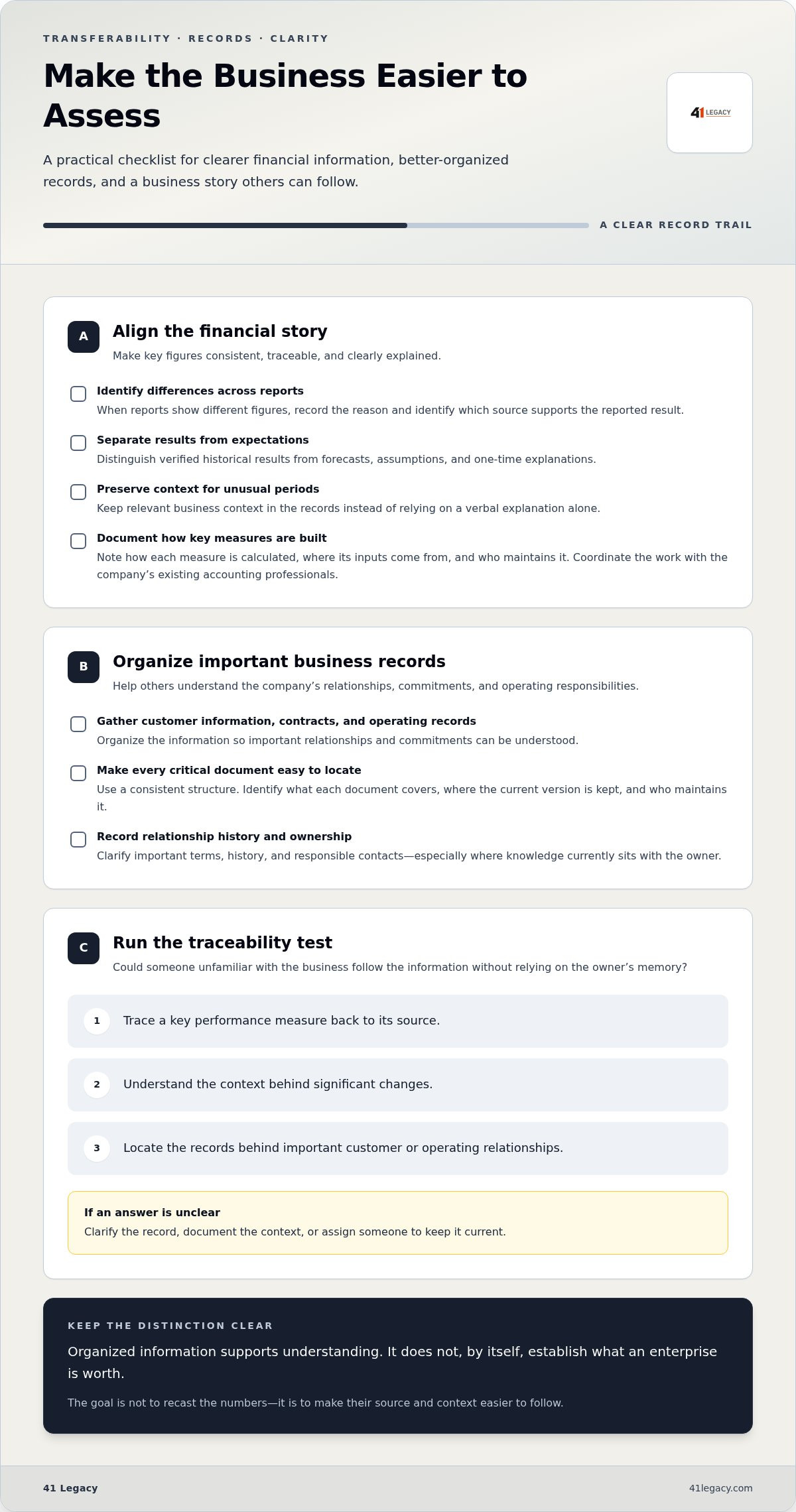
Start by identifying where key reports and explanations differ. If a monthly report shows one revenue figure while another summary shows something else, record the reason and identify which source supports the reported result. Separate verified historical results from forecasts, assumptions, and one-time explanations. If an unusual period affected performance, preserve the relevant business context in the records rather than relying on a verbal explanation alone.
Document how key measures are calculated, where their inputs come from, and who maintains them. Coordinate this work with the company’s existing accounting professionals so the records and business narrative are aligned. The goal is not to recast the numbers. It is to make their source and context easier to follow.
Missing contracts, processes, and business records
Financial reports are only part of the picture. Organize current customer information, contracts, and operating records so the company’s important relationships and commitments can be understood. An informal arrangement may work smoothly day to day, but if its terms, history, or responsible contact are known only to the owner, it can raise questions and make assessment less straightforward.
Use a consistent structure for storing and updating records. For each critical document, make clear what it covers, where the current version is kept, and who is responsible for maintaining it. Keep records distinct from conclusions about value: well-organized information supports understanding, but it does not by itself establish what an enterprise is worth. Owners seeking a broader strategic perspective can explore enterprise value and transferability guidance.
Try a practical readiness test: could someone unfamiliar with the business trace a key performance measure to its source, understand significant changes, and locate the records behind important customer or operating relationships? If not, clarify the record, document the context, or assign someone to keep it current. With a more coherent information base, owners and their existing advisors can discuss the company from a shared, better-supported picture.
Owner Dependency and Weak Operations: Pitfalls That Undermine Transferability
An owner’s expertise can be a major strength. Risk arises when essential knowledge, authority, or relationships exist only with that person. If customers rely on the owner as their sole point of contact, routine decisions wait for the owner’s approval, or key processes live in memory, it may be difficult to see how the company will maintain continuity through a transition.
These patterns can also make the business harder to explain. A prospective new owner may ask who handles a customer issue, how an exception is approved, or what happens when the founder is unavailable. Clear roles and repeatable operations help answer those questions and show how the company functions as an organization, not only through its founder.
When the owner is the company’s central operating system
Look for work that stops or slows when the owner is absent: key customer conversations, pricing or staffing approvals, problem-solving, or knowledge of recurring tasks. Before delegating, map the responsibilities and decision paths. For each, identify who acts now, what information they use, when approval is needed, and who could take responsibility next. This makes delegation deliberate rather than shifting tasks without the authority or context needed to carry them out.
The aim is not to remove the owner’s judgment from the business. Their experience may remain valuable, especially in complex decisions. The goal is to distinguish where that judgment is essential from where clear authority and guidance can let others act confidently.
Why undocumented processes create avoidable uncertainty
Written procedures make recurring work easier to perform consistently and teach to others. They can be simple: steps for handling a customer request, preparing a regular report, or escalating an operational issue. A useful procedure records its purpose, the responsible role, decision points, and where supporting information is kept. It should reflect how work is actually done, not an idealized process employees cannot follow.
As procedures take shape, identify whether key responsibilities have a capable backup and whether accountability is clear. Succession depth does not require naming a single successor for every role. It means understanding how responsibilities can continue if a key person is unavailable or leaves. This practical foundation supports continuity and a clearer account of how the company operates. For more on creating repeatable procedures, read about business SOPs and transferability.
A practical step in avoiding common pitfalls when selling a business is to test whether essential work can continue without the owner stepping in at every turn. Choose a recurring process, document its decision points, and ask the responsible team member to walk through it. Note where they need information, authority, or training, then address those gaps. Owners looking to strengthen this work can explore transferability-focused strategic advisory.
A Practical Sequence for Avoiding Business-Sale Preparation Mistakes
Preparation works best as a managed program, not a one-time cleanup. A clear sequence connects the owner’s goals to the company’s current condition, then turns the most important gaps into accountable work. These steps can be adapted to an internal or external transition without requiring the owner to commit to a sale date.
Start with an honest picture of the company and the owner’s goals
Clarify what the owner wants from a future transition and which conditions matter most, such as the desired role in the business afterward or the kind of continuity the company should preserve. Then review the enterprise as it operates today. Enterprise diagnostics can help identify strengths, vulnerabilities, and the gap between current value and the owner’s financial goals. Rank findings by their likely effect on continuity and transferability, rather than treating every issue as equally urgent.
Turn readiness gaps into accountable work
Once priorities are clear, assign each one a responsible person, a practical measure of progress, and a recurring review point. A documentation priority, for instance, could be tracked by whether a process has been recorded, reviewed, and used by the person responsible for it. This makes progress visible and helps surface delays or changing conditions before they become last-minute concerns.
- 1. Define the goals. Record the owner’s transition objectives and the conditions that would make a future change workable.
- 2. Establish the current state. Use available information and enterprise diagnostics to understand what is working, where the business relies heavily on the owner, and what needs clarification.
- 3. Prioritize the gaps. Focus first on issues that could interrupt operations, obscure performance, or limit the company’s ability to function beyond its founder.
- 4. Assign responsibility and measures. Name who will lead each improvement and how progress will be observed.
- 5. Review and adjust. Set a regular cadence to assess progress, address obstacles, and revise priorities as the business changes.
Keep the work active over time. A measure that was accurate at the start may no longer reflect current operations, and a completed task may need to become a maintained routine. Coordinate with the owner’s existing professional advisors so strategic priorities and their respective areas of work remain aligned. For a broader view of transition preparation, see this guide to exit planning for business owners.
Avoiding common pitfalls when selling a business becomes more practical when readiness has an owner, a measure, and a review rhythm. Explore 41 Legacy’s strategic advisory support to bring structure to the work of strengthening enterprise value and transferability.
How 41 Legacy Helps Owners Prepare a More Transferable Business
Preparing a company for a future transition calls for more than identifying a list of weaknesses. Owners need a clear view of what is working, where risk or owner dependency may limit continuity, and which improvements best support their goals. 41 Legacy provides strategic advisory focused on enterprise value, risk, and transferability, helping owners build a company that can operate beyond its founder.
From enterprise diagnostics to a focused roadmap
An Exit Readiness Assessment gives owners a structured view of current strengths and readiness gaps. Enterprise diagnostics connect the company’s condition with the owner’s goals, including the gap between current value and the owner’s financial objectives. This perspective can bring attention to practical priorities, such as reducing reliance on the founder, strengthening operating accountability, or clarifying how important business relationships are managed.
The findings can inform a Value Growth Roadmap, organizing improvements into a purposeful sequence. The roadmap helps owners direct effort toward areas that matter to enterprise value and transferability. It is a planning tool, not a promise of a particular sale outcome or valuation. 41 Legacy coordinates with the owner’s existing CPAs and attorneys so strategic priorities can be considered alongside their professional work. The owner retains those existing advisory relationships while gaining a clearer framework for moving readiness forward.
Build readiness through consistent implementation
A plan creates direction; consistent follow-through turns it into operating change. Monthly strategic advisory and implementation support help maintain accountability, review progress, and keep priority work moving as the business evolves. For example, if reducing owner dependency is a priority, the work can focus on clarifying decision authority, building leadership capacity, and making responsibilities easier to carry forward. The objective is not to erase the founder’s contribution. It is to help the company preserve its strengths without relying on one person for every essential decision.
For owners avoiding common pitfalls when selling a business, readiness is not a last-minute presentation exercise. It is an ongoing effort to strengthen the enterprise itself. An assessment clarifies where the company stands, diagnostics and a roadmap help make next steps more deliberate, and structured support helps keep those steps connected to the owner’s goals.
Owners ready to bring greater structure to this work can Explore 41 Legacy’s strategic advisory approach.
Build a Business That’s Ready for What Comes Next
A more transferable company is easier to understand when its records tell a clear story, its responsibilities are defined, and essential operations do not depend on the owner alone. That is the practical foundation of avoiding common pitfalls when selling a business. Preparation cannot guarantee a particular outcome, but it can help owners make informed choices and strengthen the enterprise for a future transition.
41 Legacy helps owners bring structure to that work through an Exit Readiness Assessment, enterprise diagnostics, a Value Growth Roadmap, and monthly implementation support. Founded and led by Chris Giammarco, a Certified Exit Planning Advisor, the firm works alongside an owner’s existing advisors to clarify priorities and support progress over time.
Your next step can be a clearer view of where the business stands and what to strengthen first. Explore 41 Legacy’s strategic advisory approach and take a deliberate step toward a business built to thrive beyond its founder.
Frequently Asked Questions
What are the most common pitfalls when selling a business?
Common pitfalls include unclear financial records, unsupported explanations for performance, overreliance on the owner, and undocumented customer relationships or operating processes. These issues can make it harder to understand how the company performs and whether it can continue smoothly through a transition. Avoiding common pitfalls when selling a business starts with identifying gaps early, assigning responsibility for addressing them, and keeping improvements on track rather than treating preparation as a last-minute cleanup.
How far in advance should I prepare my business for sale?
Start preparing well before you intend to begin a sale process. There is no universal timeline, since the work depends on the company’s records, operations, owner goals, and readiness gaps. Early preparation gives you more room to clarify financial information, document responsibilities, strengthen continuity, and coordinate with your existing advisors. You do not need to set a sale date to begin. These improvements can also support a company’s long-term health and other future transition paths.
Can owner dependency affect a business sale?
Yes. If key customers, decisions, approvals, or operating knowledge depend on the owner alone, questions may arise about how the company will function after a transition. Owner expertise can be a strength, but essential work should not rely entirely on one person’s memory or availability. Map key responsibilities and decision paths, identify who could assume each role, and document the knowledge needed to keep important work moving consistently.
What documents should I organize before selling my business?
Organize clear historical financial records, management reports, current contracts, customer information, and records that explain recurring operating processes and responsibilities. Keep forecasts and assumptions distinct from verified historical results, and document the context behind unusual changes in performance. Use a consistent system so the current version of a document and the person responsible for maintaining it are clear. Coordinate financial record clarity with your existing accounting professionals.
Should I improve my business before putting it up for sale?
Consider addressing readiness gaps that could obscure performance, interrupt continuity, or make the business harder to transfer. Not every possible improvement needs equal attention. Begin with your goals and current state, then prioritize changes that strengthen the company’s ability to operate beyond you. Track responsibility and progress over time. Improvements can support a healthier, more transferable enterprise, but they cannot guarantee a particular sale outcome or valuation.
How can I make my business less dependent on me?
Start by identifying where work pauses without your involvement. Map owner-only customer relationships, approvals, recurring decisions, and processes known mainly through experience. Then document how the work is done, clarify who is accountable, and give capable team members the authority and information to handle appropriate decisions. Review how those responsibilities operate in practice and address gaps in training or backup coverage. The aim is to preserve your expertise while making the company less reliant on your daily presence.
What does an exit readiness assessment do?
An Exit Readiness Assessment gives an owner a structured view of the company’s strengths and readiness gaps in relation to a future transition. At 41 Legacy, enterprise diagnostics connect the company’s current position with the owner’s goals and identify areas to prioritize. The assessment supports strategic planning; it is not a promise of a sale outcome or a certified business valuation. Findings can inform a Value Growth Roadmap and ongoing implementation support.

Article by
Mike Laskowski
Mike Laskowski is a Business Value Growth Strategist who helps business owners uncover the truths that drive their performance, risk, and readiness. Blending forensic interviewing from a 26‑year federal career with Strategic Capacity analysis and CEPA methodology, he works upstream to reduce owner dependency, increase transferability, and strengthen enterprise value. Mike guides founders through clarity, operational evolution, and transition readiness so their companies become transferable, owner‑independent assets that endure beyond the founder.
Disclaimer
This article is for educational and informational purposes only and does not provide legal, tax, investment, or business brokerage advice. 41 Legacy does not offer M&A brokerage services, legal document drafting, tax preparation, or investment advisory services. Business owners should consult licensed professionals in those disciplines before making decisions related to business transactions, legal matters, tax strategy, or financial planning. All examples are illustrative and may not apply to your specific situation.

